


21 Jun Automotive Surface Finishing
Automotive surface finishing is a broad discipline that covers the mechanical treatment of metal components at various stages of the production chain, from raw stamped blanks and CNC-machined housings to die-cast brackets and precision-ground shafts. In automotive manufacturing, surface condition directly affects fatigue strength, sealing performance, coating adhesion, and dimensional tolerance stack-up. Finishing processes are therefore not purely cosmetic steps but are integrated quality operations that must be controlled with the same rigor applied to machining or heat treatment.
In This Article
Typical Automotive Parts and Their Finishing Requirements
The range of parts processed in automotive finishing lines is wide. Powertrain components such as transmission housings, pump bodies, valve plates, connecting rods, and camshaft bearings require controlled deburring and edge rounding to prevent burr-related failures in service. Chassis and suspension parts including brackets, control arms, and knuckles require smooth surface profiles to support coating adhesion and corrosion protection. Body-in-white stamped parts and fasteners such as bolts, nuts, and clips are often processed in high-volume batches where throughput and consistency are more critical than individual part precision.
The base material strongly influences process selection. Aluminum die-cast housings are soft and sensitive to aggressive media, while high-strength steel stampings may carry heavier burrs and work-hardened edges that demand more cutting action. Stainless steel components used in exhaust and fluid systems require media and compounds that do not cause iron contamination or surface discoloration. Mixed-metal batches, such as combining aluminum and steel parts in the same finishing run, are generally not recommended because material hardness differences lead to uneven results and cross-contamination risk.
Recommended Process Route for Automotive Components
Most automotive surface finishing applications follow a wet mass finishing route using vibratory equipment. The general sequence involves pre-cleaning to remove cutting oils and chips, vibratory deburring or polishing with appropriate media and compound, part-media separation, and post-process washing or drying. Depending on downstream requirements, additional steps such as phosphating, passivation, or coating may follow.
For components with complex internal channels or blind holes, the pre-cleaning stage is particularly important. Chips and metalworking fluids left inside cavities can contaminate the finishing compound and reduce process efficiency. Pressure washing or ultrasonic cleaning may be used upstream to prepare parts before they enter the finishing stage.
Machine Selection for Automotive Finishing Applications
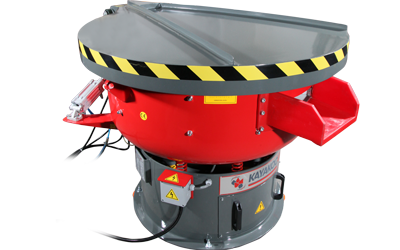
Circular vibratory finishing machines are the most commonly used equipment in automotive mass finishing. These machines use a toroidal, helical media flow pattern generated by a rotating eccentric mass. Parts and media travel together through the bowl in a continuous scrubbing motion that produces consistent edge rounding, burr removal, and surface smoothing across the entire batch. A circular vibratory machine such as the KAYAKOCVIB KVM series is well suited for small to medium automotive components including transmission parts, pump housings, fasteners, stamped brackets, and CNC-machined fittings.
For longer automotive parts such as driveshafts, steering columns, or structural extrusions, trough-type vibratory machines offer a better geometric fit. The elongated working chamber allows long parts to remain oriented without tumbling damage. Machine selection should always consider part length, part weight, the ratio of part size to media size, and the risk of part-on-part impact during processing.
Media and Compound Selection by Material
Media and compound selection is one of the most consequential decisions in automotive surface finishing because it directly controls cutting rate, surface roughness, and part condition after the process.
For aluminum die castings and aluminum CNC-machined parts, plastic media is generally the correct choice. Plastic media cuts gently, avoids excessive material removal, and reduces the risk of edge damage or surface distortion on soft aluminum surfaces. A typical compound pairing for aluminum automotive parts uses a deburring and polishing liquid combined with a degreasing compound to manage oil and chip contamination from machining.
For steel and iron powertrain components, ceramic media is preferred because steel alloys are harder and require stronger mechanical cutting action to remove burrs and break sharp edges effectively. Ceramic media in triangular, cylindrical, or conical shapes is commonly selected based on the part geometry and the access required to internal features. A deburring and polishing compound formulated for ferrous metals is used alongside a degreasing liquid to maintain a clean working bath.
For stainless steel exhaust components or fluid system parts, media selection must account for the risk of iron pickup. Plastic media or high-alumina ceramic media with appropriate stainless-compatible compounds is typically used. Compound selection should avoid chloride-based chemistries that could promote surface attack or crevice corrosion.
| Material | Recommended Media | Typical Compound Type | Key Consideration |
|---|---|---|---|
| Aluminum die casting | Plastic media | Deburring and polishing liquid, degreasing liquid | Avoid aggressive cutting; prevent edge damage |
| Steel and iron parts | Ceramic media | Ferrous deburring liquid, degreasing liquid | Higher cutting action needed for hard burrs |
| Stainless steel | Plastic or high-alumina ceramic | Stainless-compatible compound | Prevent iron contamination and surface discoloration |
| Brass and copper components | Plastic or fine ceramic media | Degreasing liquid suitable for yellow metals | Acid-compatible compound; prevent staining |
Process Parameters and Their Effect on Surface Quality
In vibratory finishing, the key process parameters that control output quality are vibration amplitude and frequency, media-to-part ratio, water flow rate, compound dosing, and cycle time. Each of these variables interacts with the others, and changes to one parameter typically require compensating adjustments elsewhere.
Vibration amplitude controls the intensity of the scrubbing action. Higher amplitude increases cutting rate and is beneficial for heavy deburring of steel parts, but can cause part-on-part contact or edge chipping if parts are too large relative to the machine bowl or if media size is too small to maintain separation. Frequency is typically fixed by the machine motor but can influence the homogeneity of the media flow pattern.
Media-to-part ratio is expressed as the volume of media relative to the volume of parts in the working chamber. For most automotive mass finishing applications, a ratio in the range of 3:1 to 6:1 is typical, though the actual ratio depends on part geometry, part fragility, and the required surface action. Parts with complex geometries or thin-walled sections may require a higher media ratio to ensure coverage and prevent part-on-part contact.
Water flow rate and compound dosing together control the chemistry of the working bath. Insufficient water causes media glazing and reduced cutting efficiency. Excessive compound concentration does not proportionally improve results and increases operating cost. Continuous dosing through a metering pump is preferred over manual addition to maintain bath stability throughout the cycle.
Cycle time must be determined through sample testing rather than estimated from general guidelines. Actual deburring and surface improvement rates depend on the specific part geometry, burr size, material hardness, media cutting rate, and compound activity. Over-processing can cause excessive material removal, dimensional change, or media wear without corresponding surface improvement.
Production Line Integration and Automation
High-volume automotive finishing lines are typically designed as continuous or semi-continuous systems rather than batch-by-batch manual operations. Automated part loading and unloading, timed compound dosing, automatic part-media separation using a separator machine, and inline washing or drying units are commonly integrated into a single finishing line layout.
Separation of parts from media at the end of the cycle is handled by a screen separator. The separator uses vibration and a slotted or perforated screen matched to the media and part geometry to direct parts and media into separate discharge paths. Correct screen aperture selection is important to prevent media loss with parts or part damage during separation.
After wet vibratory finishing, parts carry surface moisture and residual compound. For components that proceed directly to painting, coating, or assembly, controlled drying is required. Circular vibratory dryers or trough dryers with heated air systems can process parts continuously and reduce surface moisture to levels acceptable for downstream operations. For automotive components that require clean, dry, and oil-free surfaces before coating, an intermediate washing stage using pressure or spray washing may be inserted between finishing and drying.
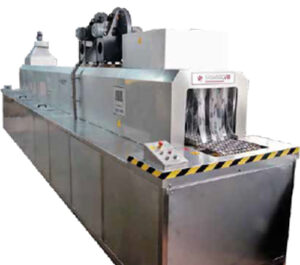
enclosure, integrated conveyor system, and control panel for
automated industrial surface finishing lines.
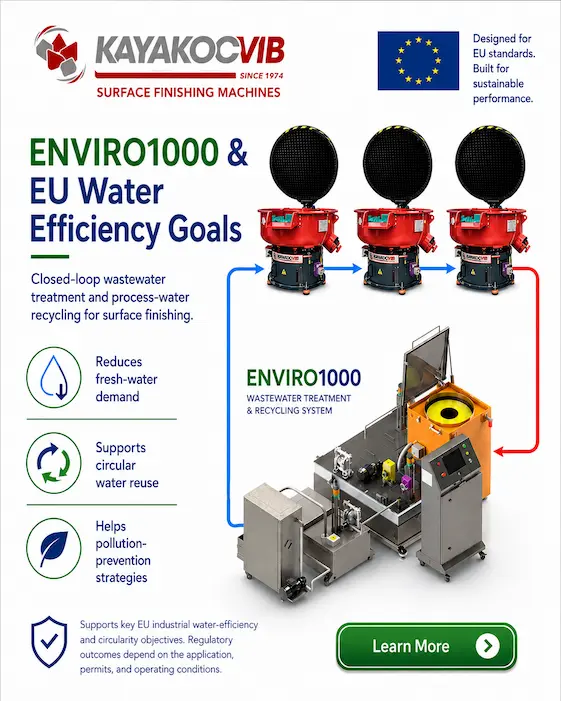
Wastewater from the vibratory finishing process contains finishing compound, metallic fines, and suspended solids. Discharge of untreated finishing effluent is not permissible under most industrial wastewater regulations. Closed-loop wastewater treatment systems that separate solids, neutralize compound chemistry, and recycle treated water back into the finishing process are commonly used in automotive plants to reduce water consumption and manage regulatory compliance.
Quality Control and Inspection Points
Surface quality after automotive surface finishing is evaluated using several methods depending on the part function and downstream process requirements. Edge condition is typically assessed by visual inspection under magnification or by tactile profilometry. Burr height and edge radius are the primary acceptance criteria for machined parts entering assembly or coating operations.
Surface roughness is measured using a contact profilometer and reported as Ra, Rz, or Rq values depending on the specification. Typical automotive finishing processes can improve surface roughness from the as-machined condition to smoother profiles suitable for sealing surfaces or coating adhesion, but actual values depend on starting surface condition, media selection, cycle time, and part geometry. Process validation through sample testing and measurement against part-specific acceptance criteria is required before production release.
For parts with critical dimensional tolerances such as bearing bores or sealing faces, dimensional inspection must confirm that the finishing process has not removed material beyond allowable limits. This is particularly important for aluminum parts processed with aggressive ceramic media or extended cycle times.
Practical Implementation Considerations
Several practical factors affect the success of an automotive finishing installation beyond media and compound selection. Part fixturing or free tumbling suitability must be assessed for each component family. Parts with blind holes smaller than the selected media size create a media lodging risk that can cause line stoppages and part damage during separation. If media lodging is identified during sample testing, a different media geometry, smaller media size, or process modification must be evaluated.
Parts with significant variation in wall thickness, complex undercuts, or thin projections may behave unpredictably during vibratory processing. Sample testing under realistic production conditions, including correct part loading quantity and media-to-part ratio, is the only reliable method to confirm process suitability before committing to production tooling and line integration.
Process documentation including vibration settings, compound dosing rates, water flow, cycle time, and media specification should be maintained as a controlled process record. Changes to any parameter should be validated before implementation in production, because even minor adjustments can shift surface quality outcomes on sensitive automotive components.
Frequently Asked Questions
Can aluminum and steel automotive parts be processed together in the same vibratory batch?
Processing aluminum and steel parts together in the same batch is generally not recommended. The hardness difference between the two materials leads to uneven results, and steel chips or media contamination can embed in softer aluminum surfaces. Separate finishing runs with material-appropriate media and compounds are the standard practice in automotive production.
What media size should be used for automotive parts with narrow slots or blind holes?
Media size must always be larger than the smallest opening on the part to prevent lodging. As a general rule, media should be at least 20 to 30 percent larger than the smallest slot, hole, or recess on the part. Specific media size selection requires confirmation through sample testing with the actual part geometry.
How is cycle time determined for automotive vibratory finishing?
Cycle time is determined through sample testing using the actual part, selected media, compound, and machine settings. There is no universal cycle time that applies across all automotive components. Starting points from media supplier data or machine manufacturer recommendations can be used as initial trials, but final cycle time must be validated against the part-specific acceptance criteria for burr removal, edge radius, and surface roughness.
Is post-finishing washing always required for automotive components?
Whether post-finishing washing is required depends on the downstream process. Parts proceeding directly to painting, powder coating, or assembly with sealing components typically require controlled washing and drying to remove compound residue and surface moisture. Parts entering a phosphating or passivation line may integrate washing into that stage. Process sequence should be designed based on the full production route, not the finishing step in isolation.
Related Machine and Process Resources
Related Video Demonstration
Conclusion
Automotive surface finishing is an engineering-driven process that requires careful alignment between part material, part geometry, finishing objective, media selection, machine type, and process parameters. Vibratory finishing with correctly selected ceramic or plastic media and appropriate compounds addresses the majority of automotive deburring, edge rounding, and surface smoothing requirements for steel, aluminum, stainless, and mixed-metal component families. Production line integration, including separation, washing, drying, and wastewater management, must be planned as part of the finishing system rather than as afterthoughts. Process validation through sample testing before production release is not optional in automotive manufacturing, where surface condition directly affects downstream coating adhesion, assembly fit, and in-service durability. Selecting the right equipment, media, and process route for each specific component family is the foundation of a reliable automotive surface finishing operation.
Sorry, the comment form is closed at this time.