



26 Jun Vibratory Drying in Surface Finishing
Vibratory drying is a mechanical drying method used in industrial surface finishing lines to remove moisture from metal parts after wet vibratory deburring, polishing, or washing operations. Unlike passive drying methods such as air drying or oven drying, vibratory drying uses controlled mechanical motion combined with dry absorbent media and warm air flow to accelerate moisture removal without damaging part surfaces or causing part-on-part contact damage. Choosing the right vibratory drying configuration depends on part geometry, material type, production volume, and how the drying step integrates with the upstream finishing process.
In This Article
When Vibratory Drying Is Required
In most wet mass finishing operations, parts exit the finishing machine together with water, liquid compound residue, and fine media particles. If parts are transferred directly to inspection, packaging, or secondary operations without proper drying, surface staining, water spots, flash rust on steel parts, and contamination risks become serious quality concerns. Passive drying methods are typically too slow for production environments and often leave uneven moisture distribution on complex geometries with recessed features, threads, or blind holes.
Vibratory drying addresses these risks by keeping parts in continuous motion during the drying cycle. Motion prevents parts from stacking or resting on wet surfaces, which is one of the primary causes of localized water marks and contact staining. Warm air circulation simultaneously removes moisture vapor from the machine chamber, while the dry absorbent media draws surface moisture away from the part.
Core Selection Criteria for Vibratory Drying Machines
Selecting the correct drying machine requires evaluating several engineering parameters before specifying equipment. The following criteria should guide the selection process.
Part Geometry and Size
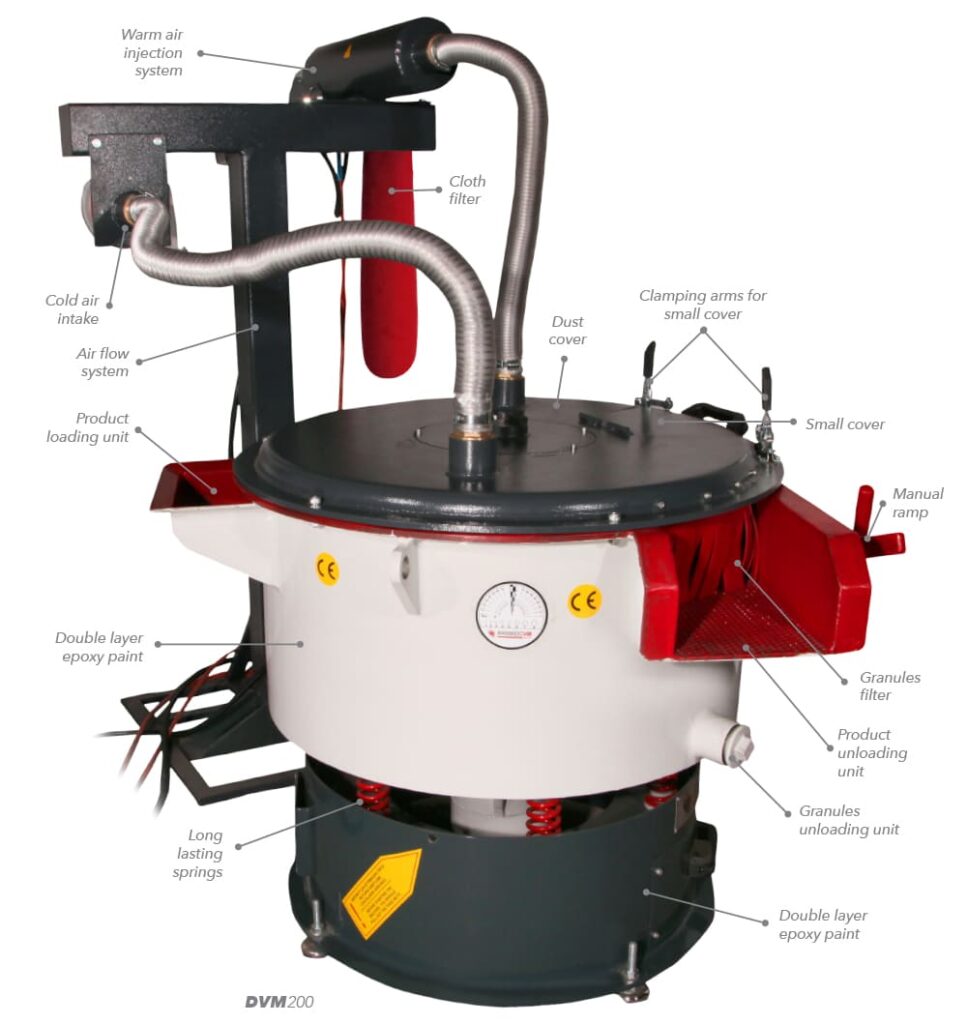
Circular vibratory dryers, such as the KAYAKOCVIB DVM series, are well suited for small to medium parts including fasteners, CNC machined components, stamped parts, and die casting components. The circular bowl geometry creates a continuous helical flow pattern that keeps parts moving without concentrated impact zones. This makes circular dryers appropriate for parts where geometry allows free movement without interlocking or bridging.
For long, slender, or large parts that would be damaged or poorly dried in a circular bowl, trough-type vibratory dryers are more appropriate. The KAYAKOCVIB D-TVM series uses a linear trough configuration that allows longer parts to travel through the drying zone without folding, bending, or damaging sensitive surfaces. Long shafts, rails, elongated housings, and structural automotive components are typical candidates for trough dryer configurations.
Material Sensitivity
Material type directly affects the drying media selection and the acceptable level of mechanical agitation. Aluminum and soft alloy parts require gentler vibratory amplitude and softer drying media to prevent surface scratching during the drying cycle. Steel and stainless steel parts can generally tolerate standard corn cob or walnut shell drying media without surface damage, but part geometry and surface condition still need to be evaluated before finalizing settings.
Parts with very fine polished surfaces require careful drying media selection. Standard corn cob granules are mildly abrasive and may affect high-gloss finishes if media granule size is not matched to the surface condition. For bright or mirror-polished parts, a finer, less abrasive drying media should be selected and drying amplitude kept at the lower end of the operational range.
Production Volume and Cycle Time
In high-volume production environments, drying cycle time directly affects overall line throughput. Vibratory drying machines can be integrated into automated finishing lines where parts flow continuously from the finishing machine through a separator, into the dryer, and then to the unloading station or conveyor. In batch-mode operations, dryer capacity must be matched to the upstream finishing machine batch size to prevent production bottlenecks.
Drying cycle times in vibratory dryers typically range from a few minutes to around twenty minutes depending on part geometry, moisture load, air temperature, and media type. Complex parts with deep recesses or blind holes generally require longer drying cycles than simple flat or convex geometries. Actual cycle time must be validated through testing rather than assumed from general ranges.
Machine Selection Matrix for Vibratory Drying
| Part Type | Recommended Machine Type | Typical Drying Media | Key Consideration |
|---|---|---|---|
| Small fasteners, CNC parts, stamped parts | Circular vibratory dryer (DVM) | Corn cob or walnut shell granules | Check for interlocking parts that may bridge |
| Long shafts, rails, large housings | Trough vibratory dryer (D-TVM) | Corn cob or walnut shell granules | Trough length must suit maximum part length |
| Polished or bright-finished parts | Circular or trough dryer, lower amplitude | Fine corn cob or polishing sawdust | Validate media abrasivity against surface quality |
| Mixed batch with varied geometries | Circular vibratory dryer (DVM) | Corn cob granules | Check that all geometry types drain and dry adequately |
| Aluminum or soft alloy parts | Circular or trough dryer, reduced amplitude | Fine or pre-treated corn cob | Avoid aggressive media or high amplitude settings |
Drying Media and Absorbent Compound Selection
The drying media used in vibratory drying serves two functions. First, it creates a tumbling buffer that prevents part-on-part contact during the drying cycle. Second, it absorbs and carries away surface moisture through capillary action and physical contact with the wet part surface.
Corn cob granules are the most widely used drying media in industrial vibratory drying applications. They are naturally absorbent, available in various granule sizes, and compatible with most metal types. Walnut shell granules offer a slightly harder surface and can provide a mild burnishing or light polishing effect during drying, which can be an advantage when a uniform matte or light sheen finish is acceptable.
In some applications, a small amount of drying compound or anti-rust additive is blended into the drying media. Anti-rust additives are particularly relevant when drying steel or iron parts that may be susceptible to flash rust during or immediately after the drying cycle. The additive deposits a thin protective film on the part surface, providing short-term corrosion protection until parts reach the next processing or packaging stage.
Drying media must be replaced or refreshed periodically as it absorbs moisture over repeated cycles and loses its drying efficiency. Saturated media that is not replaced will increase drying cycle time and may leave parts with residual moisture. Media condition should be monitored as part of routine process maintenance.
Process Variables That Affect Drying Quality
Several controllable process variables determine drying quality in a vibratory drying system. Understanding each variable allows engineers to tune the process for consistent results across production batches.
Vibratory amplitude and frequency control the motion intensity of parts and media inside the dryer. Higher amplitude increases part-to-media contact frequency, which accelerates moisture removal but also increases the mechanical energy applied to the part surface. For sensitive or polished parts, lower amplitude is preferred even if it extends the drying cycle slightly.
Air temperature and air flow volume directly affect the evaporation rate of surface moisture. Most vibratory dryers use warm air delivered through the machine chamber, with air temperatures typically controlled in a range that accelerates evaporation without causing thermal stress or discoloration on sensitive alloys. The air flow must be sufficient to carry moisture vapor out of the machine continuously, preventing humidity buildup inside the drying chamber that would slow the process.
Part-to-media ratio is another variable that affects drying performance. If the machine is loaded with too many parts relative to media volume, each part receives less media contact and drying becomes uneven. If media volume is too high relative to part load, cycle efficiency drops and parts may receive unnecessary mechanical exposure. The correct part-to-media ratio must be established during process setup and maintained consistently during production.
Integration with Automated Finishing Lines
In automated surface finishing lines, vibratory drying is positioned as the final stage before part unloading, inspection, or packaging. A typical automated line for wet vibratory finishing includes a finishing machine, a part-media separator, a washing or rinsing station, and a vibratory dryer in sequence. Parts flow from stage to stage with minimal manual handling, which improves process consistency and reduces labor costs.
When designing an integrated line, the dryer capacity must be matched to the throughput rate of the separator and finishing machine. Any imbalance between stages creates a production bottleneck or idle time. In fully continuous systems, the dryer operates in a steady-state flow mode rather than in discrete batches, which requires the dryer to maintain consistent drying quality across a continuous stream of incoming wet parts.
Automation also allows process parameter monitoring and adjustment. Air temperature, amplitude, and cycle time can be controlled through a programmable logic system, which enables recipe-based operation for different part types processed on the same line. This is particularly useful in job shop environments or facilities producing multiple part families on shared equipment.
Common Selection Mistakes to Avoid
One of the most frequent mistakes in vibratory drying selection is using a dryer that is too small for the actual part batch size. Overloading a dryer reduces media-to-part contact, extends cycle time, and produces inconsistently dried parts. Dryer capacity should be specified with a realistic loading margin, not based on the machine’s maximum rated volume.
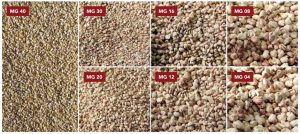
Another common error is selecting corn cob granules with a grain size that is incompatible with the part geometry. Very coarse corn cob may not reach recessed areas on complex parts, leaving moisture trapped in threads, blind holes, or undercuts. Finer granule sizes improve penetration into complex geometries but require more frequent replacement as finer media becomes saturated faster.
Using vibratory drying without an upstream rinsing stage is also a process design error. If parts enter the dryer still carrying compound residue or process chemicals from the finishing operation, the drying media becomes contaminated rapidly and the part surface may develop chemical staining. A clean water rinse or counter-current rinse before the drying stage significantly extends media life and improves surface quality after drying.
Frequently Asked Questions
What is the difference between a circular vibratory dryer and a trough vibratory dryer?
A circular vibratory dryer uses a bowl-shaped chamber that generates helical part flow, making it suitable for small to medium parts. A trough vibratory dryer uses a linear channel configuration that accommodates longer or larger parts that cannot be properly dried in a circular bowl without damage or poor media contact.
Can vibratory drying cause surface damage?
Vibratory drying can cause surface marking if the machine amplitude is too high, the drying media is too coarse for the part material, or part loading is excessive. For polished or soft alloy parts, amplitude should be reduced and a finer drying media selected. Process parameters must be validated through sample testing before production release.
How often should drying media be replaced?
Replacement frequency depends on part moisture load, batch size, and media type. Saturated media loses absorbency and reduces drying efficiency. Media condition should be checked regularly during production, and replacement should be scheduled based on observed drying performance rather than fixed time intervals.
Is vibratory drying suitable for aluminum parts?
Yes, vibratory drying is suitable for aluminum parts when correct media type, granule size, and machine amplitude are selected. Aluminum is softer than steel and requires gentler settings to prevent surface marking during the drying cycle. Process validation with sample parts is necessary before production use.
Related Process Equipment
Related Video Demonstration
Conclusion
Vibratory drying is a process-critical stage in wet mass finishing lines, and selecting the wrong machine type, media, or process parameters directly affects surface quality, cycle time, and production efficiency. The decision between circular and trough configurations depends on part geometry and size. Media selection depends on material sensitivity and surface finish requirements. Process variables including amplitude, air temperature, and part-to-media ratio must be established through testing rather than assumed from general guidelines. When integrated correctly into an automated finishing line, vibratory drying delivers consistent, repeatable results that support downstream quality requirements across a wide range of industrial applications.
Sorry, the comment form is closed at this time.