




12 Jun How to Choose the Right Vibratory Finishing Machine?
The decision to choose vibratory finishing machine type and configuration is one of the most consequential process engineering decisions in a surface finishing line. A mismatched machine produces inconsistent results, longer cycle times, and unnecessary consumable costs. This article explains how to approach the selection process systematically, using part characteristics, process targets, and production requirements as the primary decision inputs.
In This Article
Why Machine Selection Affects the Entire Finishing Process
Vibratory finishing is a mass finishing process in which parts, media, water, and compound are loaded into a vibrating bowl or trough. The vibratory motion drives a toroidal or linear flow that creates continuous contact between media and part surfaces, removing burrs, rounding edges, and improving surface texture over time.
The machine type determines the flow pattern, the contact energy, the part-to-media ratio, and the separation method. Choosing an incorrect machine type can result in part-on-part collisions, inadequate edge rounding, media lodging in blind holes, or insufficient surface improvement even after extended cycle times.
Getting the machine selection right at the start avoids costly process requalification and tooling changes later. It also directly affects media consumption, compound usage, water management, and energy consumption over the life of the line.
Common Problems That Begin With the Wrong Machine Choice
Many finishing defects that appear to be media or compound problems are actually rooted in the wrong machine type or an incorrectly sized machine. Understanding these failure modes helps diagnose existing lines and prevent them in new installations.
Part-on-part collision damage is one of the most frequent consequences of using a circular vibratory machine for parts that are too large or too heavy relative to the bowl volume. When the media-to-part ratio is insufficient, parts contact each other directly and generate dents, scratches, or deformation rather than finishing improvements.
Incomplete deburring on internal features often occurs when machine amplitude or frequency is set incorrectly, or when the media geometry is not matched to the feature dimensions. A machine that is oversized for a small batch will also underperform because the media flow lacks the contact density needed to finish part surfaces consistently.
Media lodging inside holes, slots, or undercuts is a risk that depends partly on media geometry selection but is also influenced by machine motion type. Circular vibratory machines with toroidal flow tend to allow some self-clearing behavior if media size and shape are selected correctly, but this must be verified through sample testing for each part geometry.
Machine Type Selection Logic
The two primary machine types in vibratory finishing are circular vibratory machines and trough vibratory machines. Each has a distinct motion pattern and a different range of suitable applications.
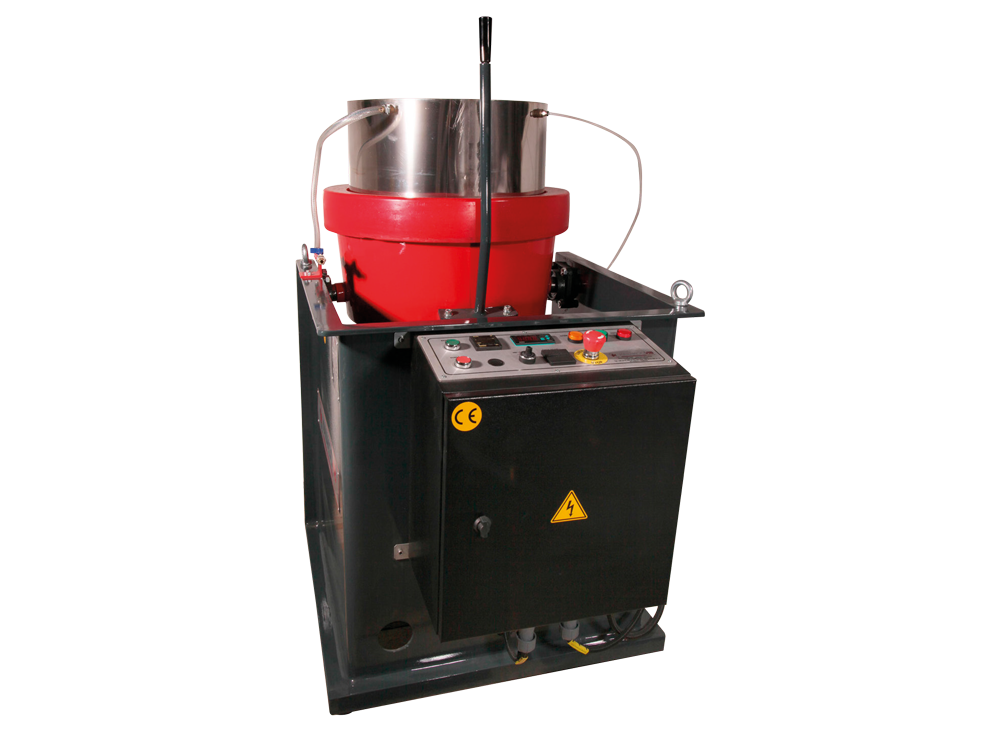
Circular vibratory machines generate a toroidal flow pattern in which the mass of parts and media rotates around the bowl axis while simultaneously flowing upward in the center and downward at the walls. This motion distributes contact energy evenly across the part batch and is well suited for small to medium parts, high-volume production, fasteners, CNC machined components, stamped parts, and die cast parts. The KAYAKOCVIB KVM series is a representative circular vibratory machine used across these applications.
Trough vibratory machines generate a linear or slightly helical flow along the length of the trough. This motion is gentler and more controlled, which makes it suitable for larger parts, longer parts such as shafts or profiles, delicate parts that cannot withstand the rotational energy of a circular bowl, and parts where controlled edge rounding on specific features is required. The KAYAKOCVIB TVM series covers this range of applications.
The selection between circular and trough type is not primarily about part quality. Both machine types can achieve equivalent surface results when configured correctly. The selection is primarily about part geometry, part fragility, batch size, and whether the motion pattern creates a risk of part damage.
Key Variables for Choosing the Right Machine
To choose vibratory finishing machine type and size correctly, engineers must evaluate a defined set of part and process variables before specifying equipment. The following parameters drive the selection decision.
Part size and geometry determine whether a circular or trough machine is appropriate, and what bowl or trough volume is needed. Parts with a longest dimension exceeding roughly 200 to 250 mm are generally better suited to trough-type machines, though this threshold varies with part weight and fragility. Complex geometries with deep internal features require careful media selection to avoid lodging.
Material type influences media hardness selection, compound chemistry, and process intensity. Steel and stainless steel parts typically tolerate higher energy processes and harder ceramic media. Aluminum parts require softer plastic or ceramic media with lower density to avoid surface damage and maintain dimensional tolerances. Mixing aluminum and steel in the same batch is generally not recommended because the finishing energy appropriate for one material differs from the other and cross-contamination of surface chemistry can occur.
Burr size and condition determine the aggressiveness required from the media. Large burrs from milling, casting, or stamping require coarse, high-density ceramic media with a cutting compound. Fine machine tool marks or light deburring after CNC turning require finer media and a less aggressive compound. The media must be capable of reaching and removing the burr without damaging surrounding surfaces.
Required surface quality in terms of surface roughness, edge radius, and cosmetic appearance determines whether the process needs one or multiple stages. A single-stage process with cutting media may deliver adequate deburring but leave a rough surface texture. A two-stage process with a finishing media in the second stage can improve surface texture to a level acceptable for functional coating or assembly. Actual achievable Ra values depend on part material, media type, compound, and cycle time, and must be validated through sample testing.
Production volume and batch frequency determine the machine size and, in high-volume environments, whether a continuous processing line with automatic separation is needed. A small batch of complex parts may be processed in a 50- to 100-liter machine on a manual basis. A production line processing thousands of fasteners per shift may require a 200- to 600-liter machine with integrated separation, washing, and drying.
Machine Sizing and Media-to-Part Ratio
Machine volume selection is closely linked to the required media-to-part ratio. In vibratory finishing, the media-to-part ratio by volume is typically maintained between 3:1 and 10:1 depending on part geometry and required finishing intensity. Delicate or complex parts may need a higher ratio to ensure that parts are fully cushioned and isolated from direct contact with each other.
Undersizing the machine increases the risk of part-on-part contact and reduces finishing uniformity. Oversizing the machine wastes energy and may reduce finishing intensity because the relative contact frequency between media and part surfaces decreases with excessive machine volume relative to the loaded batch.
For new installations without historical batch data, a practical approach is to estimate the part load volume, apply the required media-to-part ratio, and select the nearest standard machine volume above that calculated total. The machine should be loaded to approximately 70 to 85 percent of its working volume under typical production conditions to maintain effective flow.
Separation, Washing, and Drying Requirements
Machine selection cannot be considered in isolation from what happens after the finishing cycle. After vibratory finishing with wet compound, parts must be separated from media, rinsed or washed, and dried before they can be inspected, coated, or assembled.
Part-media separation is handled by a separator screen sized to the part geometry. Parts pass through the screen while media is retained and returned to the machine. For very small parts with complex geometry, separation screen design requires care to prevent parts from passing through openings that are close to the media size. The KAYAKOCVIB SM separator series is designed for integration with both KVM and TVM finishing machines.
If parts require oil or coolant removal in addition to deburring, or if they have inaccessible areas with residual compound, a washing step may be needed after finishing. Pressure washing or ultrasonic cleaning can be integrated into the line downstream of the separator depending on cleanliness requirements.
Drying is required to prevent surface oxidation, water staining, or interference with subsequent coating or inspection steps. The KAYAKOCVIB DVM circular dryer and D-TVM trough dryer are matched to the respective finishing machine types and use heated air and media to remove surface moisture efficiently. Drying cycle time is a production line bottleneck consideration and should be matched to finishing cycle time to avoid idle time in the line.
Process Parameter Checklist for Machine Selection
Before finalizing a vibratory finishing machine specification, the following parameters should be confirmed or estimated through sample testing and process engineering review.
- Part material: determines media hardness, compound chemistry, and process intensity range
- Part dimensions and weight: determines machine type (circular or trough) and minimum volume
- Burr size and location: determines media geometry, size, and required contact energy
- Required surface roughness or edge radius: determines number of finishing stages and final media selection
- Batch weight and volume per cycle: determines machine working volume and media-to-part ratio
- Production volume per shift or day: determines machine size, cycle time target, and automation level
- Separation method: determines screen design and separator specification
- Post-finishing cleanliness: determines whether washing is required and at what standard
- Drying requirement: determines whether a dryer is needed and what dryer type is appropriate
- Wastewater: determines whether a treatment or recycling system is needed for compound-laden rinse water
Machine Selection Table for Common Applications
| Application | Recommended Machine Type | Media Type | Key Consideration |
|---|---|---|---|
| CNC turned parts, small to medium | KVM circular vibratory | Ceramic or plastic, matched to burr size | Media-to-part ratio, media size relative to holes |
| Stamped sheet metal parts | KVM circular vibratory | Ceramic cutting media | Part-on-part contact risk, part orientation in flow |
| Long shafts or profiles | TVM trough vibratory | Ceramic or plastic depending on material | Part length, gentle linear flow prevents bending stress |
| Aluminum die castings | KVM circular vibratory | Plastic or low-density ceramic | Avoid high-energy media that causes surface damage |
| Fasteners, high volume | KVM circular vibratory with auto-separation | Ceramic, size matched to thread geometry | Media lodging in threads, continuous process mode |
| Delicate or thin-wall parts | TVM trough vibratory | Plastic media, low density | Reduced energy, high media-to-part ratio |
Optimization After Initial Machine Selection
Even after the correct machine type is selected, process optimization is an ongoing activity. Vibratory finishing results are sensitive to several variables that interact with each other, and initial process settings are rarely the final optimized settings.
Amplitude and frequency settings on the vibratory machine control the energy input to the process. Higher amplitude increases the relative motion between media and parts, which increases cutting rate but also increases the risk of part-on-part contact damage. These settings should be adjusted based on observed part condition after initial trial runs, not set to maximum values by default.
Compound concentration directly affects both the cutting rate and the surface condition of parts after finishing. Excessive compound concentration can leave residue on parts and change the abrasive behavior of the media. Insufficient compound concentration reduces lubrication and can cause media loading, where worn abrasive particles clog the media surface and reduce cutting efficiency.
Water flow rate in a wet process affects compound concentration, temperature, and the flushing of debris from the machine. A controlled water flow set to maintain a consistent compound concentration is more reliable than intermittent dosing. Water hardness can also affect compound performance and should be considered when setting up dosing systems.
Media wear and media charge management are ongoing maintenance items. As media wears, its cutting geometry changes, and the media mass decreases over time. A consistent media charge level should be maintained by adding new media on a scheduled basis. Mixing very worn media with fresh media in the same charge reduces process consistency.
Frequently Asked Questions
What is the most important factor when choosing between a circular and trough vibratory machine?
Part geometry and part fragility are the primary factors. Circular machines are suited for compact, robust parts in high volumes. Trough machines are preferred for long, large, or delicate parts where the linear flow pattern reduces collision risk and provides a gentler process.
How do I estimate the correct machine volume for my batch?
Estimate the total volume of parts per batch, apply the appropriate media-to-part ratio (typically 3:1 to 8:1 by volume depending on part geometry), and select a machine whose working volume accommodates the combined load at 70 to 85 percent fill. Always validate with sample testing before committing to final machine sizing.
Can the same vibratory machine handle multiple part types?
In many production environments, one machine processes different part batches at different times. However, media selection must be compatible with all planned part types. Parts made from different materials, especially aluminum and steel, should not be processed in the same batch. Recipe changes between part types require adjusting compound dosing, cycle time, and potentially media type.
When is a centrifugal disc machine preferred over a vibratory machine?
Centrifugal disc finishing is preferred when cycle time must be very short, when very high surface quality is required on small precision parts, or when process energy must be concentrated more intensively than a vibratory machine can provide. For general deburring and polishing at standard production volumes, vibratory finishing is typically more cost-effective and easier to scale.
Conclusion
The ability to choose vibratory finishing machine type and configuration correctly requires a structured evaluation of part material, geometry, burr condition, surface quality target, batch volume, and downstream processing requirements. Circular vibratory machines cover the majority of general deburring and polishing applications for compact parts. Trough vibratory machines address longer, larger, or more fragile parts where circular flow would cause damage. Machine volume, media selection, compound control, and post-finishing integration all influence the final process result and must be considered as a system rather than individual decisions. Process validation through sample testing remains the only reliable method to confirm that a selected machine and process configuration will meet the required surface quality and production targets for a specific part and application.
Sorry, the comment form is closed at this time.