



22 Jun Ultrasonic Cleaning Metal Parts
Ultrasonic cleaning metal parts is one of the most effective methods for removing oils, machining chips, grinding residue, polishing compounds, and oxide layers from components with complex internal geometries or tight tolerances. Unlike spray washing or immersion tank degreasing, ultrasonic technology works at the microscopic level through acoustic cavitation, reaching areas that conventional washing systems cannot access. Understanding how the process works and what parameters control the result is essential for selecting the right configuration and achieving consistent surface cleanliness in production.
In This Article
What Ultrasonic Cleaning Is and How It Works
Ultrasonic cleaning is an immersion-based process in which high-frequency sound waves, typically between 20 kHz and 80 kHz, are transmitted through a liquid bath containing the parts being cleaned. These sound waves generate alternating cycles of compression and rarefaction in the liquid, causing microscopic bubbles to form and violently implode in a process called acoustic cavitation. Each cavitation implosion releases a localized burst of energy that dislodges contaminants from the part surface, including from internal bores, threads, blind holes, and undercuts.
The cleaning action is entirely mechanical at the microscopic scale, but it is controlled by the chemical composition of the cleaning solution, the bath temperature, the ultrasonic frequency, and the duration of the cleaning cycle. Higher frequencies produce smaller, more numerous cavitation bubbles, which are better suited to fine or delicate surfaces. Lower frequencies produce larger, more energetic bubbles, which are more effective for heavy contamination on robust metal parts.
The Full Process Sequence
Ultrasonic cleaning metal parts in an industrial setting is not a single-step operation. It is a multi-stage process route that typically includes pre-treatment, the ultrasonic bath, rinsing, optional passivation or corrosion protection, and drying. Each stage has a specific function in the overall cleaning result.
- Pre-cleaning or pre-rinsing: Parts arriving with heavy chip loads, cutting oils, or machining fluids are often pre-rinsed or spray-washed before entering the ultrasonic bath. This prevents rapid saturation of the ultrasonic solution and extends bath service life.
- Ultrasonic bath: Parts are submerged in the heated cleaning solution inside the ultrasonic tank. Transducers bonded to the tank floor or walls convert electrical energy into ultrasonic vibrations that propagate through the solution. Parts may be held in baskets, fixtures, or part-specific carriers depending on geometry and batch size.
- First rinse: After the ultrasonic stage, parts pass through a fresh water or demineralized water rinse to remove cleaning agent residue and loosened contaminants from the surface. A cascade rinse configuration using two or three consecutive rinse tanks is common in high-specification applications.
- Second rinse or neutralization: In some processes, particularly for steel or stainless steel, a second rinse with demineralized water or a mild neutralizing agent is included to prevent flash rust or chemical residue.
- Passivation (where required): For stainless steel parts used in medical, aerospace, or food processing applications, a passivation stage using dilute nitric acid or citric acid solution may follow rinsing. This step is not part of the cleaning process itself but is often integrated into the same line when contamination-free surfaces are a prerequisite for successful passivation.
- Drying: Parts must be thoroughly dried before storage, packaging, or further processing. Hot air drying, vacuum drying, or centrifugal drying may be used depending on part geometry, material, and production volume. Residual moisture on steel or iron parts will cause rapid surface oxidation.
Process Parameters That Control Cleaning Quality
The cleaning result in ultrasonic cleaning metal parts depends on a combination of parameters that must be set correctly for each application. Changing any one parameter changes the cleaning intensity, the contamination removal efficiency, and the surface condition of the part after cleaning.
| Parameter | Typical Range | Effect on Cleaning |
|---|---|---|
| Ultrasonic frequency | 20 to 80 kHz | Lower frequency: higher energy, heavier contamination. Higher frequency: gentler, finer surfaces. |
| Bath temperature | 40 to 75 degrees C | Higher temperature improves chemical activity and cavitation efficiency. Risk of surface oxidation at excessive temperatures. |
| Cleaning cycle time | 2 to 15 minutes | Longer cycles improve heavy contamination removal. Very long cycles risk part damage on delicate surfaces. |
| Solution concentration | 1 to 10 percent by volume | Correct concentration ensures emulsification and removal of oils without leaving residue. |
| Basket or fixture movement | Static or oscillating | Part movement through the bath improves cavitation exposure on complex geometries. |
Actual cycle times and temperatures depend on part material, contamination type, part geometry, and solution chemistry. These parameters should be validated through test batches before committing to production settings. Values listed above represent typical industrial ranges and are not guaranteed outcomes for all applications.
Cleaning Solution Selection for Metal Parts
The chemical composition of the ultrasonic bath is one of the most important variables in the process. The solution must match both the base material and the type of contamination being removed. Using an incompatible solution can result in surface staining, etching, oxidation, or residue that is difficult to remove in subsequent rinse stages.
For steel and stainless steel parts with machining oils, chips, and light oxide layers, alkaline cleaning solutions are most commonly used. These solutions emulsify oils effectively and support strong cavitation activity at moderate temperatures. For aluminum parts, a pH-neutral or mildly alkaline solution is preferred because strongly alkaline solutions can attack the aluminum surface and cause discoloration or surface roughening. For copper, brass, and mixed metal assemblies, a neutral or mildly acidic solution formulated for yellow metals should be selected to avoid galvanic or chemical reaction at contact points.
Degreasing compounds used in ultrasonic systems must be formulated to remain stable under continuous cavitation without breaking down into foam or losing cleaning activity. Conventional shop floor degreasers are not suitable for ultrasonic baths. Process-specific aqueous cleaning compounds designed for ultrasonic use should be sourced from the machine or consumable supplier.
Industrial Applications Across Manufacturing Sectors
Ultrasonic cleaning is used across a broad range of industrial sectors wherever part cleanliness directly affects downstream process performance or product function.
In CNC machining, parts with deep bores, cross-drilled oil passages, or complex internal channels are cleaned ultrasonically to remove chips and cutting fluid residue that spray washing cannot reach. In automotive production, fuel system components, hydraulic valve bodies, and injection system parts require particle-free internal surfaces that cannot be achieved through manual or spray-only cleaning. In aerospace manufacturing, structural components and precision actuator parts may require documented cleanliness levels where ultrasonic cleaning supports validation against contamination particle count standards. In medical device manufacturing, implants, surgical instruments, and device housings require contamination-free surfaces as a prerequisite for subsequent passivation, coating, or sterilization processes.
In all these applications, ultrasonic cleaning metal parts is used not as a cosmetic step but as a functional process that directly enables downstream quality requirements.
Where Ultrasonic Cleaning Fits in a Finishing Line
In integrated surface finishing lines, ultrasonic cleaning typically appears after mechanical finishing operations such as vibratory deburring, centrifugal disc finishing, or drag finishing, and before final inspection, coating, or assembly. Parts that have been processed through wet vibratory finishing with polishing compounds carry compound residue, media fines, and process water chemistry on their surfaces. Ultrasonic cleaning removes these residues more thoroughly than a simple water rinse, particularly from recessed surfaces and threaded features.
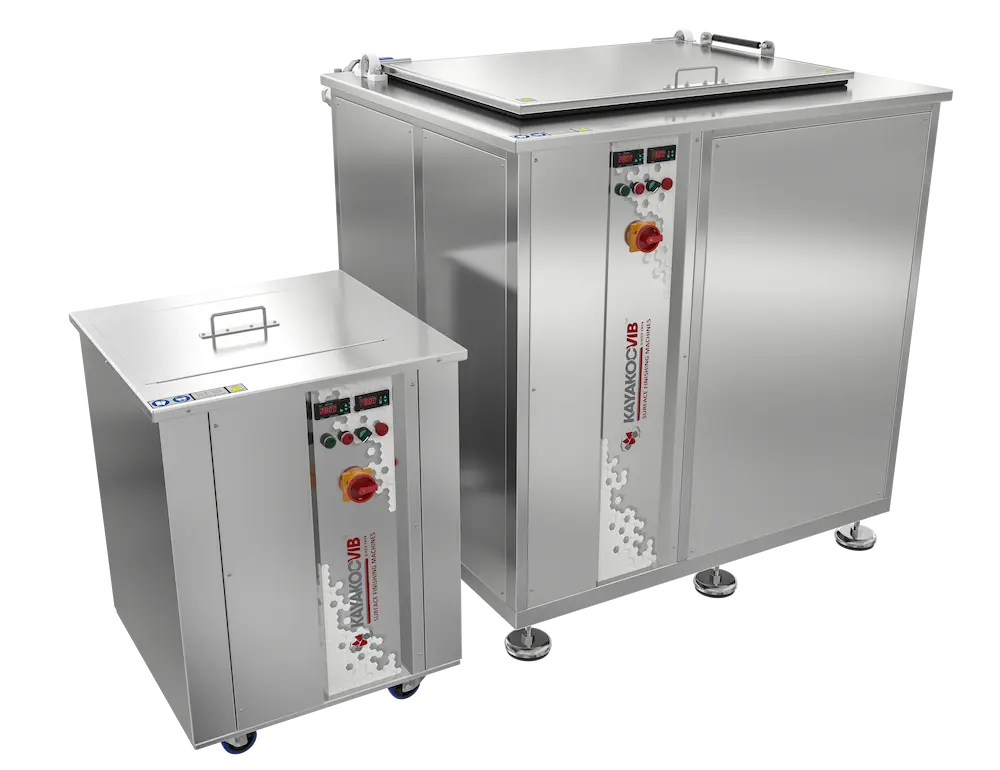
When KAYAKOCVIB USW ultrasonic cleaners are integrated into a finishing line alongside vibratory or centrifugal finishing machines, the sequence typically runs from mechanical finishing through media separation, then ultrasonic cleaning, rinse stages, and hot air or centrifugal drying. This configuration allows fully cleaned and dried parts to move directly into inspection or packaging without manual handling between stages.
Pressure washing with equipment such as the KAYAKOCVIB PRS-W series may be used as a pre-cleaning stage before ultrasonic treatment when parts carry heavy chip loads or bulk oil contamination that would rapidly degrade the ultrasonic bath. Using pressure washing as a pre-stage extends ultrasonic solution service life and reduces the frequency of bath changes.
Filtration and Bath Management
An ultrasonic cleaning system without effective filtration degrades quickly during production. Contaminants removed from parts accumulate in the bath, reducing cavitation intensity and redepositing onto part surfaces if the bath is not maintained. Continuous or periodic filtration through paper bag filters, cartridge filters, or centrifugal separators keeps the bath functional between scheduled solution changes.
Bath concentration should be monitored regularly using conductivity measurement or chemical titration, depending on the cleaning agent type. Temperature stability is maintained by built-in heating elements controlled by a thermostat or PLC. In automated systems, bath management including dosing, temperature control, and filter monitoring can be integrated into the machine control system to maintain consistent process conditions across production shifts.
Wastewater generated from bath changes and rinse stages must be treated before discharge. Depending on the chemistry used and local regulations, this may require oil separation, pH adjustment, or flocculation. For facilities with high washing volumes, closed-loop water recycling systems reduce fresh water consumption and lower wastewater treatment costs.
Ultrasonic Cleaning Compared to Alternative Washing Methods
Ultrasonic cleaning metal parts achieves contamination removal from internal geometries that other washing methods cannot match consistently. Spray washing is effective for external surfaces and open channels but lacks penetration into blind holes, narrow gaps, or complex internal passages. Immersion tank degreasing without ultrasonic energy removes bulk contamination through chemical action alone but leaves fine particle and oil residue in tight features. Manual wiping or brushing is inconsistent and introduces contamination from cloths or brushes themselves.
For parts where cleanliness is validated by particle count, residual oil measurement, or downstream coating adhesion, ultrasonic cleaning provides the most reliable and repeatable process among aqueous cleaning methods. However, for very large parts or parts with extremely heavy contamination, pressure washing or combined pressure and ultrasonic systems may be more practical.
Frequently Asked Questions
What types of contamination can ultrasonic cleaning remove from metal parts?
Ultrasonic cleaning is effective at removing machining oils, cutting fluids, grinding sludge, polishing compound residue, metal chips, light oxide layers, and surface soils from metal parts. The cleaning chemistry must be matched to the contamination type and the base material.
Is ultrasonic cleaning safe for aluminum parts?
Yes, ultrasonic cleaning is suitable for aluminum when a pH-neutral or mildly alkaline cleaning solution is used. Strongly alkaline solutions can chemically attack aluminum surfaces and cause etching or discoloration. Frequency selection and cycle time should be validated for delicate aluminum parts to avoid surface damage.
How often should the ultrasonic bath solution be changed?
Bath change frequency depends on production volume, contamination load, and solution type. Continuous filtration extends bath life, but solution effectiveness decreases as emulsified oils and dissolved contaminants accumulate. Regular concentration and contamination monitoring is required to determine the correct change interval for each production application.
Can ultrasonic cleaning replace passivation for stainless steel?
No. Ultrasonic cleaning removes surface contamination, which is a prerequisite for passivation, but it does not replace the passivation process itself. Passivation uses a controlled acid treatment to restore the passive oxide layer on stainless steel. Clean surfaces are required before passivation to ensure uniform treatment results.
Related Process Equipment
Related Video Demonstration
Conclusion
Ultrasonic cleaning metal parts is a precision cleaning process that relies on acoustic cavitation, controlled solution chemistry, and correctly set process parameters to achieve consistent contamination removal from complex part geometries. The process is most valuable when parts have internal features, tight tolerances, or cleanliness requirements that spray or immersion washing alone cannot satisfy reliably. Effective implementation requires careful matching of frequency, temperature, cycle time, and cleaning solution to the part material and contamination type, followed by structured rinse and drying stages. In integrated finishing lines, ultrasonic cleaning provides a validated and repeatable cleaning step that supports downstream coating, passivation, inspection, and assembly operations.
Sorry, the comment form is closed at this time.