



04 Aug Replace Manual Deburring CNC
The decision to replace manual deburring in CNC workshops is driven by three converging pressures: inconsistent edge quality, rising labor costs, and increasing production volumes that manual methods cannot scale with. When CNC-machined parts move to a repeatable mechanical finishing process, the result is more predictable edge rounding, more consistent surface condition, and reduced dependency on operator skill level. This article guides production engineers and process managers through the selection logic for making that transition effectively.
In This Article
Why Manual Deburring Fails at Production Scale
Manual deburring is technically viable for low-volume prototype work or for parts with simple geometry and accessible burr locations. However, as batch sizes grow, manual deburring introduces several structural problems. Edge rounding is operator-dependent and varies between shifts. Cycle time per part is difficult to reduce without compromising quality. Labor cost per unit remains high and does not decrease with volume. Inspection becomes inconsistent because different operators apply different force, angle, and tool pressure.
For steel, stainless steel, aluminum, and mixed-metal CNC components, these inconsistencies create downstream problems in coating adhesion, dimensional tolerance verification, and assembly fit. Automated vibratory finishing solves these problems by applying uniform mechanical energy to every part in every batch under controlled process parameters.
Defining the Selection Criteria Before Choosing a Machine
Before selecting a machine type, process engineers must assess the specific conditions of the parts leaving the CNC machining center. The key variables that determine which mechanical finishing method is appropriate are part geometry, part size, burr size and location, material, required surface condition after finishing, and production volume per shift.
Parts with external burrs on flat faces and edges are the easiest to process in vibratory finishing. Parts with internal bores, cross-holes, or complex undercuts require careful evaluation because media must be able to contact the burr location and then exit the part without lodging. Very thin-walled parts or delicate profiles may require lower process intensity or plastic media rather than ceramic media to avoid part damage during mass finishing.
Part and Burr Analysis Before Process Selection
Understanding burr origin is useful for selecting the right process. CNC turning operations typically leave light to medium axial burrs at the end of bores or at shoulder transitions. CNC milling leaves exit burrs at pocket edges and through-hole exit faces. Threading operations leave thread-entry burrs. In most of these cases, the burrs are thin and have relatively low adhesion, making them suitable for vibratory finishing without pre-treatment.
Heavy burrs produced by aggressive cutting parameters, worn tooling, or interrupted cuts may require a light pre-trimming step before loading parts into a vibratory machine. Attempting to remove very thick burrs in a vibratory machine alone can significantly increase cycle time and may not achieve acceptable results on all part surfaces equally. Process engineers should evaluate burr thickness before setting expectations for vibratory deburring alone.
Machine Type Selection Logic for CNC Parts
For the majority of CNC-machined parts in the small to medium size range, circular vibratory finishing machines are the most practical replacement for manual deburring. The circular tub geometry creates consistent part-to-media flow that exposes all external surfaces and edges to abrasive contact without requiring part fixturing. Parts move freely through the media mass and receive uniform treatment across the entire batch.
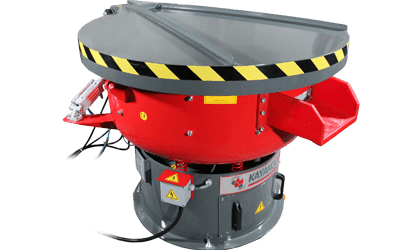
A circular vibratory machine such as the KAYAKOCVIB KVM series is well suited for CNC turned parts, milled components, valve bodies, fittings, brackets, and similar mixed-geometry parts. The adjustable vibration amplitude and frequency allow process engineers to tune the intensity to match the part material and burr size without changing the machine or tub geometry.
For longer CNC components such as shafts, bars, tubes, or extruded profiles that do not fit well in a circular tub without risk of part-to-part impingement, a trough-type vibratory machine is more appropriate. Trough machines guide parts in a helical flow path that keeps longer components oriented more consistently and reduces the chance of part collision damage during the cycle.
Media Selection Based on Part Material
Media selection is one of the most consequential decisions when replacing manual deburring in CNC workshops, because the wrong media choice can damage part surfaces, fail to remove burrs efficiently, or create lodging problems in internal features.
For steel and stainless steel CNC parts, ceramic media is generally preferred. Ceramic media provides the cutting force needed to remove the harder burrs typical of these materials and operates efficiently in wet process conditions with a deburring compound. Common media shapes for general CNC deburring include triangle, cylinder, and star shapes, selected based on the part geometry and the risk of lodging in holes or slots.
For aluminum CNC parts, plastic media is generally preferred because aluminum is a softer material that can be scratched or over-cut by aggressive ceramic media. Plastic media delivers lighter cutting action and is better suited to the softer surface of aluminum alloys. This also reduces the risk of media residue embedding in the aluminum surface during the process.
For workshops processing mixed materials in the same facility, separate media sets and separate machine programs should be maintained for steel and aluminum batches. Mixing ceramic-processed steel parts and aluminum parts in the same batch is not recommended because the differing material hardness creates inconsistent results and can transfer contamination between part families.
Selection Matrix for Common CNC Part Profiles
| Part Type | Material | Recommended Machine | Media Type | Key Risk to Evaluate |
|---|---|---|---|---|
| Turned fittings, small housings | Steel, stainless steel | Circular vibratory (KVM) | Ceramic triangle or cylinder | Cross-hole lodging |
| Milled brackets, plates | Aluminum | Circular vibratory (KVM) | Plastic cylinder or cone | Surface scratch risk |
| Valve bodies, complex bores | Steel | Circular vibratory (KVM) | Ceramic with small media option | Internal bore access |
| Shafts, long profiles | Steel or aluminum | Trough vibratory (TVM) | Ceramic or plastic depending on alloy | Part collision damage |
| Small precision turned parts | Stainless steel, brass | Centrifugal disc (KSM) | Ceramic or plastic depending on alloy | Part-on-part contact |
Compound and Water Selection for Wet Deburring
Vibratory deburring in CNC workshops is typically performed as a wet process. Compound and water are added to the machine during the cycle to provide lubrication, prevent rust formation, remove swarf and metal fines from the tub, and improve surface condition after deburring. Selecting the correct compound depends on the base material and the desired surface condition after finishing.
For steel and stainless steel parts, a deburring and polishing liquid such as a 943-type compound is commonly used. This type of compound supports efficient cutting action while controlling rust formation on steel surfaces during the wet process. A degreasing compound such as 028-S is also typically used to remove cutting oil, coolant residue, and machining contamination from parts entering the finishing process.
For aluminum parts, a compound such as an 085-type deburring and polishing liquid is more appropriate. Aluminum is sensitive to the chemical environment during finishing, and selecting an incorrect compound can cause staining, discoloration, or surface pitting. A degreasing liquid compatible with aluminum should also be used when parts carry significant oil or coolant contamination from the machining center.
Practical Process Parameters for CNC Deburring
Once machine type and media are selected, the process engineer must set and validate the core operating parameters. These parameters control the finishing result and must be defined through sample testing before full production release. Typical process parameters to define include vibration amplitude, vibration frequency, compound concentration, water flow rate, cycle time, and load ratio of parts to media.
In most CNC deburring applications using circular vibratory machines, cycle times range from 20 to 60 minutes depending on burr size, material, and required edge condition. Lighter burrs on aluminum parts with plastic media often finish in shorter cycles. Heavier burrs on steel parts using ceramic media may require longer cycles or higher amplitude settings. These ranges are approximate and depend on the specific application conditions. Actual process parameters must be confirmed through test runs using representative parts and the selected media and compound combination.
The load ratio of parts to media also affects results. Overloading a machine with too many parts reduces media contact per part and slows the process. Underloading can increase part-to-part contact risk. A typical starting ratio is approximately 50 to 60 percent media and 40 to 50 percent parts by volume, but this must be adjusted based on part size, weight, and fragility.
Common Wrong Choices When Transitioning from Manual to Mechanical Deburring
The most common error when workshops attempt to replace manual deburring in CNC production is selecting the wrong media size relative to part geometry. Media that is too large will not access slots, bores, or recesses where burrs are located. Media that is too small may lodge inside holes and create a new manual retrieval problem that is worse than the original manual deburring task.
A second common error is expecting vibratory finishing to remove burrs that require mechanical force beyond what mass finishing can reliably deliver. Very thick burrs, large flash, or gate stubs from casting operations that have been incorrectly classified as CNC burrs will not be removed efficiently in a standard vibratory cycle. These require pre-trimming or a different process route.
A third common error is running steel and aluminum parts together in the same batch to save time. This practice results in inconsistent surface quality for both material groups and risks contaminating aluminum surfaces with iron particles, which can cause surface discoloration or corrosion after finishing.
Validation Checklist Before Production Release
- Confirm media size clears all critical holes, slots, and bores without lodging risk.
- Run sample parts and inspect edge condition, surface roughness, and dimensional impact after finishing.
- Confirm compound concentration and water flow rate are stable and repeatable between batches.
- Verify that part-to-part contact does not cause cosmetic or dimensional damage under production load conditions.
- Confirm that post-finishing washing and drying are adequate for the surface cleanliness requirement.
- Document process parameters as the validated production recipe before full volume release.
Washing and Drying After Wet Vibratory Deburring
After vibratory deburring, CNC parts typically carry residual compound, water, and metal fines on their surfaces. For parts that proceed directly to coating, painting, or precision measurement, thorough washing is necessary before further processing. Pressure washing or immersion washing can remove compound residue from external surfaces. For parts with complex internal geometry, ultrasonic cleaning may be required to reach enclosed areas that pressure washing cannot access effectively.
Drying is also required before storage or coating to prevent rust formation on steel parts and to ensure surface condition is stable for dimensional inspection. Vibratory dryers using corncob or other drying media can be integrated directly after the finishing and washing stage to complete the finishing line without manual handling between steps.
Frequently Asked Questions
Can vibratory finishing fully replace manual deburring for all CNC parts?
For most CNC-machined parts with external burrs and accessible edges, vibratory finishing provides a reliable and repeatable replacement for manual deburring. Parts with very small internal features, blind bores, or heavy casting-type burrs may require process adjustment, pre-trimming, or a different machine type. Validation through sample testing is required before production release.
How do I know if my parts are suitable for circular vibratory finishing?
Parts are generally suitable if they can tumble freely in the media mass without interlocking with each other, if the burr locations are accessible to the selected media size, and if the part material is compatible with wet finishing chemistry. Parts with thin walls, sharp projections, or large aspect ratios may require trough machines, lower intensity settings, or protective media separation.
What is the typical ROI consideration when replacing manual deburring with vibratory finishing?
ROI depends on labor cost per part in the manual process, batch size, machine investment, and media and compound consumption. In most industrial applications, the labor reduction across high-volume production shifts provides the primary cost justification. Actual payback period depends on production volume and application conditions and requires site-specific cost analysis to confirm.
Is a separate washing step always required after vibratory deburring?
In most industrial applications, at minimum a rinse or spray wash is needed to remove compound residue before further processing. For parts proceeding to coating or tight-tolerance measurement, a dedicated washing stage is typically required. The need for ultrasonic cleaning depends on part geometry and cleanliness specification.
Related Process Equipment
Related Video Demonstration
Conclusion
The decision to replace manual deburring in CNC workshops is ultimately a process engineering decision, not a capital equipment decision alone. Selecting the correct machine type, media, and compound for the specific part material and geometry is what determines whether mechanical finishing delivers consistent results at production scale. For most small to medium CNC-machined parts in steel, stainless steel, and aluminum, circular vibratory finishing provides the most practical and scalable solution. Establishing validated process parameters through sample testing before full production release is the essential final step that converts the machine investment into repeatable, measurable output quality.
Sorry, the comment form is closed at this time.