


29 Jul Industrial Parts Washing
Industrial parts washing is the controlled removal of contaminants from metal and manufactured components using mechanical, chemical, thermal, or acoustic energy. In production environments, effective washing is not an optional step but a process prerequisite that directly affects downstream results including coating adhesion, plating quality, surface finish consistency, and dimensional accuracy during inspection. Understanding the engineering principles behind industrial parts washing helps manufacturers select the correct cleaning method, machine type, and process parameters for their specific application.
In This Article
What Industrial Parts Washing Actually Means
In engineering terms, industrial parts washing refers to any controlled aqueous or solvent-based cleaning process applied to manufactured parts to remove machining oils, cutting fluids, grinding residues, polishing compounds, metal chips, oxide layers, fingerprints, or other surface contaminants. The goal is to deliver a defined cleanliness level suitable for the next production step, whether that is surface finishing, inspection, assembly, plating, painting, or packaging.
Parts washing differs from casual rinsing. Industrial washing processes are engineered to achieve repeatable cleanliness results across large production volumes. Process parameters such as temperature, pressure, cleaning agent concentration, exposure time, and mechanical agitation are controlled and monitored. Results are validated against cleanliness standards relevant to the industry and the downstream process.
Contaminant Types and Why They Matter
The selection of a washing process begins with identifying the contamination type present on the part surface. Different contaminants require different removal mechanisms, and using the wrong approach leads to incomplete cleaning, surface damage, or chemical residue problems.
Common contaminant categories in metal manufacturing include water-soluble coolants and cutting fluids, petroleum-based machining oils and greases, metallic chips and fines from machining or grinding, polishing compounds and finishing media residues, oxide layers and scale from heat treatment, and particulate contamination from handling or storage. In many production routes, parts carry a combination of these contaminants, which influences both chemical selection and mechanical cleaning intensity.
Core Cleaning Mechanisms
Industrial parts washing systems use one or more of four fundamental cleaning mechanisms. Understanding these mechanisms is essential for selecting the right system and process settings.
Mechanical action involves physical contact or kinetic energy transfer, such as spray impingement in pressure washing, turbulence from agitation, or cavitation from ultrasonic transducers. Chemical action involves surfactants, alkaline builders, or acidic agents that break down, emulsify, or dissolve contaminants. Thermal energy increases chemical reaction rates and reduces oil viscosity, making contamination easier to remove at elevated temperatures. Time governs how long the cleaning mechanism acts on the surface, and it must be balanced against production cycle requirements.
In most industrial washing systems, these mechanisms work together. Increasing one allows the others to be reduced, which is useful when part geometry or material limits the intensity of any single mechanism.
Pressure Washing Systems
Pressure washing machines deliver heated aqueous cleaning solution at controlled pressure through spray nozzles directed at the part surface. Parts may be stationary on a fixture, rotating on a turntable, or conveyed through a tunnel washer depending on part geometry and production volume.
The cleaning performance of a pressure washing system depends on nozzle design and arrangement, spray pressure, solution temperature, chemical concentration, and dwell time in the cleaning zone. Typical spray pressures in industrial cabinet washers range from low-pressure flood wash configurations up to high-pressure targeted jet systems used for complex geometries or blind holes. Higher pressure improves mechanical contaminant removal but must be controlled to avoid distorting thin or delicate parts.
Pressure washing is effective for removing bulk oil, chips, and loose contamination from medium to large parts. It is less effective for removing tightly bonded compounds from internal passages, threads, or fine surface textures where spray impingement cannot reach. For CNC machined parts, hydraulic components, or precision assemblies, additional cleaning stages may be required.
KAYAKOCVIB PRS-W pressure washing machines are designed for integration into industrial finishing lines, handling parts directly after deburring or surface finishing operations. They deliver heated spray washing, rinsing, and drying within a single enclosed process chamber.
Ultrasonic Cleaning Systems
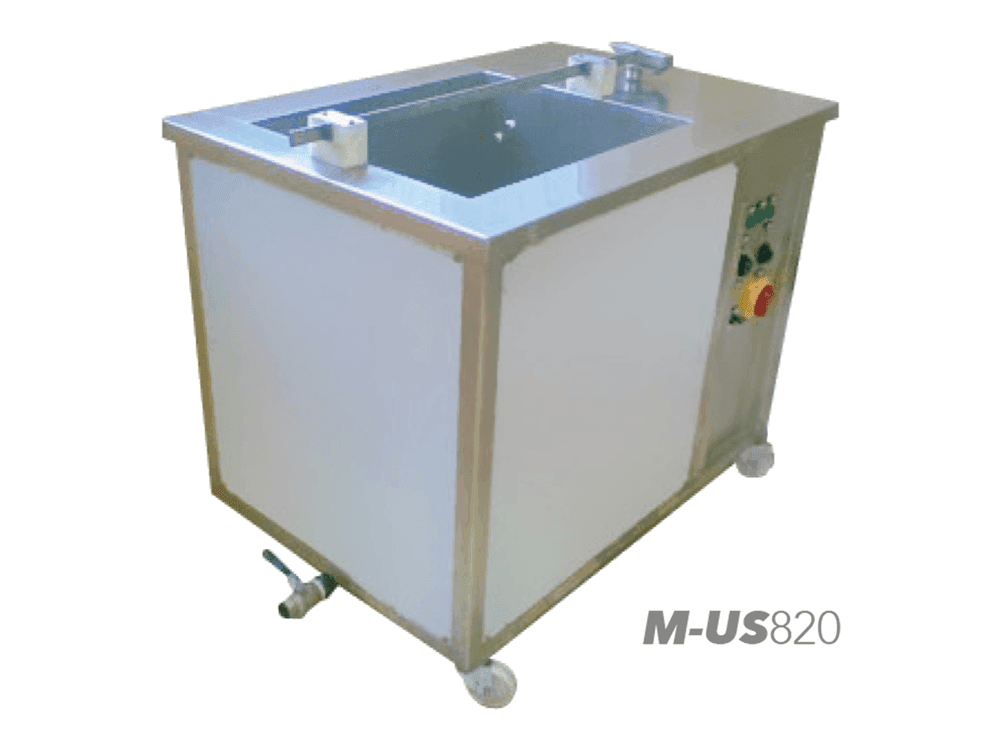
Ultrasonic cleaning uses high-frequency sound waves transmitted through a liquid bath to generate microscopic cavitation bubbles. When these bubbles collapse near a part surface, they produce localized pressure impulses that dislodge contaminants from the surface, including residues inside blind holes, threads, grooves, and complex internal geometries that spray-based systems cannot reach effectively.
The frequency of ultrasonic transducers determines cleaning aggressiveness. Lower frequencies in the range of 25 to 40 kHz produce larger cavitation bubbles with higher impact energy, suitable for heavy contamination and robust parts. Higher frequencies above 80 kHz produce finer cavitation with lower impact energy, suitable for delicate or high-precision components where surface integrity must be preserved. Operating temperature, chemical composition, degassing time, and part basket arrangement all influence ultrasonic cleaning efficiency.
Ultrasonic cleaning is particularly relevant for small, geometrically complex, or precision parts such as medical components, aerospace parts, hydraulic valve bodies, fuel system parts, and fine mechanical assemblies. It is also commonly used after vibratory or centrifugal finishing to remove polishing compound residues from recessed areas. KAYAKOCVIB USW ultrasonic cleaners are designed for industrial production environments where both cleaning consistency and integration with finishing lines are required.
Typical Washing Process Stages
A complete industrial washing process typically involves more than a single cleaning tank or spray stage. In production lines processing parts for demanding downstream applications, the following stages are commonly found in sequence.
- Pre-wash or rough wash stage to remove bulk contamination such as chips, heavy oil, or polishing compound
- Main cleaning stage using heated aqueous chemistry with sufficient agitation or spray pressure to achieve the target cleanliness level
- Rinse stage using clean water to remove cleaning agent residues from part surfaces
- Final rinse or passivation stage, where applicable, to apply corrosion inhibitor, passivation chemistry, or pH neutralization depending on material and downstream requirements
- Drying stage using hot air circulation, centrifugal drying, or vacuum drying to remove surface moisture and prevent staining or corrosion
The number of stages required depends on the contamination level, the cleanliness specification, the part material, and the downstream process. Not every application requires all five stages, but omitting a necessary stage creates quality risks that appear later in the production route.
Cleaning Chemistry Selection
Cleaning chemical selection depends on the contaminant type, the base material, and the downstream requirements. For most metal parts in industrial finishing environments, aqueous alkaline cleaning agents are the standard choice. They are effective against oils, greases, and metallic fines without posing the handling and disposal challenges of solvent-based systems.
For steel and stainless steel parts, moderately alkaline cleaners with corrosion inhibitors are commonly used. For aluminum parts, pH range is a sensitive parameter because strongly alkaline solutions can attack the surface. Aluminum-safe cleaning agents formulated for neutral to mildly alkaline conditions are preferred. For copper and brass alloys, mildly acidic or neutral chemistry with appropriate inhibitors prevents surface discoloration.
Cleaning agent concentration, water hardness, bath temperature, and bath life management are production variables that affect cleanliness consistency over time. In high-volume production environments, bath concentration monitoring and controlled replenishment are necessary to maintain cleaning performance.
Filtration and Water Management
Industrial washing systems accumulate contaminants in the cleaning solution over time. Without filtration and bath management, contamination levels rise until the cleaning efficiency drops and parts begin to fail cleanliness requirements. Effective filtration systems continuously remove metallic fines, oil, and particulate matter from the washing bath.
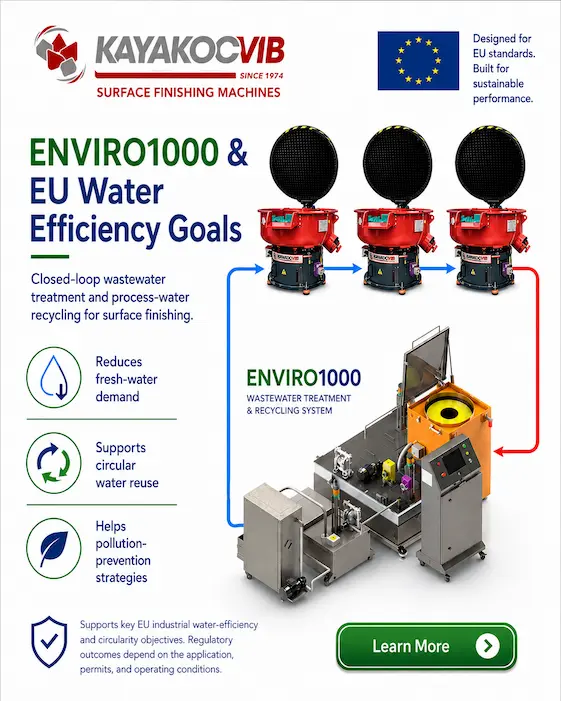
Common filtration approaches include mesh basket filters for coarse particle removal, paper or synthetic cartridge filters for fine particulate, oil skimmers for surface oil removal, and centrifugal or belt filter units for high-volume systems. In automated finishing lines, closed-loop water recycling systems allow washing water to be treated and reused, reducing freshwater consumption and waste disposal costs. Wastewater treatment systems separate oils, heavy metals, and sludge from the water stream before discharge or recirculation.
Washing After Surface Finishing Operations
In many production routes, industrial parts washing is performed directly after vibratory finishing, centrifugal disc finishing, or drag finishing operations. After wet finishing with compound, parts carry residues of finishing compound, fine media dust, and process water. These residues must be removed before inspection, coating, or assembly.
The contamination left after vibratory finishing is different from machining contamination. Finishing compound residues often contain surfactants, brighteners, and organic additives that require dedicated aqueous cleaning to remove completely. Parts with deep recesses, internal threads, or blind holes may require ultrasonic cleaning to achieve full compound removal. Spray washing alone may leave residue in areas where spray impingement is blocked by part geometry.
Drying after washing is also important. Wet parts entering inspection, packaging, or assembly introduce moisture that can cause staining, corrosion, or adhesion failures. Hot air drying integrated directly after the rinse stage is the most common approach in automated lines.
Process Parameters That Control Cleaning Quality
| Parameter | Effect on Cleaning | Typical Range |
|---|---|---|
| Solution temperature | Increases chemical activity and oil viscosity reduction | 40 to 80 degrees C depending on process |
| Spray pressure | Mechanical removal of loose contamination and films | 0.5 to 6 bar depending on part sensitivity |
| Chemical concentration | Determines emulsification and saponification capacity | 1 to 5 percent aqueous solution typical |
| Dwell time | Contact time between cleaning agent and surface | 30 seconds to several minutes per stage |
| Ultrasonic frequency | Controls cavitation intensity and bubble size | 25 kHz to 130 kHz depending on application |
| Rinse water quality | Affects residue and staining after drying | Deionized or softened water for critical parts |
These parameters interact with each other. A system running at higher temperature can often achieve equivalent cleanliness with lower chemical concentration or shorter dwell time. When process conditions change, such as a shift in contamination type from coolant to heavy oil, parameter adjustments are required to maintain the target cleanliness level. Actual cleaning performance depends on the specific application, part geometry, and contamination load, and must be validated through testing before production release.
Integration Into Automated Finishing Lines
In high-volume manufacturing environments, industrial parts washing is integrated directly into the finishing line rather than operated as a separate manual station. Automated lines typically include a deburring or finishing machine, a separator for part-media separation, a washing station, a rinse station, and a drying unit connected by conveyor or part transfer systems. This integration eliminates manual part handling between process stages, reduces labor cost, and maintains process consistency across shifts.
For small to medium parts processed in vibratory or centrifugal finishing systems, conveyor-fed cabinet washers or continuous tunnel washers are commonly used after the separator. For precision parts requiring ultrasonic cleaning, the parts may be transferred into ultrasonic bath stations integrated within the same production cell. The layout depends on part size, production volume, floor space, and the cleanliness level required by the downstream process.
Cleanliness Validation
Cleaning process validation is necessary before releasing a washing process for production. Common validation methods include gravimetric cleanliness testing by filtering and weighing residues collected from a defined washing volume, particle counting by analyzing the particulate content of a rinse volume, water break test for surface wetting uniformity, and white cloth or UV fluorescence tests for oil and compound residues. The appropriate validation method depends on the cleanliness specification required by the downstream process or customer requirement.
For critical applications in aerospace, medical, or hydraulic component manufacturing, cleanliness specifications may reference industry standards that define acceptable particle counts, particle sizes, and contamination mass per component. These specifications drive decisions about washing system design, filtration level, rinse water quality, and drying method. Process engineers should confirm cleanliness requirements with the downstream process owner before designing a washing system for these applications.
Related Process Equipment
Related Video Demonstration
Conclusion
Industrial parts washing is an engineering process governed by a set of interacting variables including cleaning mechanism, chemical selection, temperature, time, filtration, and drying. Selecting the right system requires understanding the contamination type, the part material and geometry, the required cleanliness level, and the downstream process requirements. Pressure washing systems handle bulk contamination efficiently for medium to large parts, while ultrasonic cleaning reaches complex internal geometries and fine surface details that spray systems cannot access. In automated production lines, washing, rinsing, and drying stages are integrated directly into the finishing sequence to maintain process consistency and reduce handling. Proper parameter control, bath management, and cleanliness validation are the engineering foundations that make industrial parts washing a reliable and repeatable production process.
Sorry, the comment form is closed at this time.