


07 Aug Finishing System for Automotive Parts
Selecting the correct finishing system for automotive parts is one of the most consequential process decisions in a production line. Automotive components vary enormously in geometry, material, burr condition, and surface quality requirement, and a mismatch between the part profile and the finishing system leads to poor surface quality, excessive cycle times, or part damage. This guide provides a structured engineering approach to machine selection, media and compound logic, and process integration for automotive surface finishing applications.
In This Article
Why Automotive Parts Demand Structured Finishing System Selection
Automotive production involves a wide range of parts processed at high volume under strict dimensional and surface quality tolerances. Engine components, transmission housings, brake brackets, steering knuckles, fasteners, hydraulic valve bodies, and stamped structural parts all carry different finishing requirements. Some need aggressive deburring after machining or stamping. Others need edge rounding to reduce stress concentration. Many require a defined surface roughness before coating, anodizing, or assembly.
A single finishing system rarely covers the full range of automotive part families. The engineering decision is to match the machine type, media type, compound chemistry, and process intensity to each specific part group. Applying a circular vibratory machine to every part without considering geometry, burr size, or cycle time requirements will result in suboptimal performance across the line.
Primary Selection Criteria for Automotive Finishing Systems
Before selecting any machine or media, engineers should define the following parameters for each part family:
- Part material: steel, stainless steel, aluminum, zamak, cast iron, or mixed metals
- Part geometry: overall dimensions, weight, wall thickness, internal channels, blind holes, and surface profile
- Incoming defect condition: burr size and type, machining marks, oxide layer, scale, or contamination
- Required surface output: Ra target, edge condition, burr removal level, or cosmetic appearance
- Production volume: parts per shift, batch size, and required throughput
- Downstream process: coating, anodizing, painting, assembly, or inspection
- Automation requirement: manual batch operation or inline continuous feed
These parameters collectively determine whether a circular vibratory machine, trough vibratory machine, or centrifugal disc machine is the appropriate platform, and what media shape, size, and compound chemistry should be used.
Part Geometry and Material Analysis
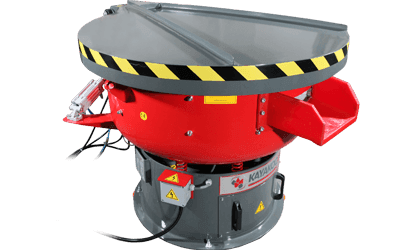
Part geometry is often the most restrictive selection variable. Circular vibratory finishing machines handle the majority of automotive parts well, including small to medium-sized machined components, fasteners, stamped brackets, and die cast housings. These machines generate a consistent toroidal mass flow that moves media and parts together through the working chamber, producing uniform deburring and surface improvement across complex geometries.
Long or elongated components such as shafts, connecting rods, or structural extrusions do not always process well in circular machines because part-to-part contact during tumbling can cause cosmetic damage or uneven coverage. For these geometries, a trough vibratory finishing machine is more suitable. The linear or helical mass flow in a trough machine keeps long parts oriented more predictably and reduces the risk of part collision.
For very small high-precision automotive parts such as fuel injector components, valve spools, or hydraulic fittings requiring short cycle times and controlled surface results, centrifugal disc finishing machines offer significantly higher process intensity. The centrifugal action compresses media and parts against the rotating disc, generating much higher surface contact energy than standard vibratory systems. This allows cycle times that would take 60 to 90 minutes in a vibratory machine to be completed in 10 to 20 minutes under typical conditions, depending on part geometry and target surface quality.
Material also affects machine and media selection directly. Aluminum and zamak parts are softer and more sensitive to aggressive cutting. Plastic media is generally preferred for these materials to avoid excessive material removal or surface scratching. For steel, stainless steel, and cast iron automotive parts, ceramic media provides the harder cutting action needed to remove machining burrs and improve surface condition effectively.
Machine Selection Logic for Common Automotive Part Families
The table below summarizes the recommended finishing system type based on typical automotive part characteristics.
| Part Family | Material | Recommended Machine | Media Type |
|---|---|---|---|
| CNC machined housings, brackets | Aluminum, steel | KVM Circular Vibratory | Plastic (Al), Ceramic (steel) |
| Fasteners, small stamped parts | Steel, stainless steel | KVM Circular Vibratory | Ceramic |
| Die cast engine parts | Aluminum, zamak | KVM Circular Vibratory | Plastic |
| Shafts, connecting rods, extrusions | Steel, aluminum | TVM Trough Vibratory | Ceramic or plastic depending on material |
| Hydraulic valve bodies, injector parts | Steel, stainless steel | KSM Centrifugal Disc | Ceramic or plastic depending on geometry |
| Transmission gears, precision parts | Hardened steel | KSM Centrifugal Disc | Ceramic, fine grade |
This table represents typical engineering starting points. Actual machine and media selection must be confirmed through sample testing with representative parts before production release. Part geometry variations within the same family may require separate process qualification.
Media and Compound Selection for Automotive Applications
Media selection depends on the combination of base material, burr size, and required surface output. For aluminum automotive parts, plastic media in cone, cylinder, or triangular shapes is typically selected. Plastic media cuts more gently and reduces the risk of scratching or embedding media particles into soft aluminum surfaces. For steel and iron automotive components with heavier burrs or machining marks, ceramic media in various cutting grades provides the necessary abrasive action to achieve effective deburring and surface preparation within acceptable cycle times.
Compound chemistry works alongside media to control cutting rate, surface brightness, corrosion inhibition, and cleaning action. For aluminum and zamak parts, 085 deburring and polishing liquid is commonly used in combination with 028-S degreasing liquid to manage surface cleaning and lubrication. For steel and stainless steel automotive parts, 943 deburring and polishing compound is a standard choice, also used with 028-S for effective degreasing during the wet process. When parts carry heavy oxide, scale, or strong surface contamination, 028 acidic degreasing liquid may be appropriate as an initial cleaning stage.
Media size must be matched to part geometry. Media that is too large will not reach recessed areas, internal chamfers, or cross-drilled passages. Media that is too small creates lodging risk in blind holes, slots, or narrow gaps. For automotive parts with complex internal geometry, media size selection is a critical validation step that must be confirmed before production.
Process Parameters That Influence Surface Quality
Once the finishing system is selected, the following process parameters control the final surface output:
- Amplitude and frequency: higher amplitude increases material removal rate but may increase part-to-part collision risk for delicate parts
- Load ratio: the ratio of parts to media in the working chamber affects surface contact pressure and uniformity
- Compound concentration: higher compound concentration accelerates cutting but may cause surface staining if not controlled
- Water flow rate: continuous water flow maintains compound concentration and removes swarf; inadequate flow causes compound build-up and reduced process consistency
- Cycle time: determined by incoming burr size, target surface roughness, media type, and machine intensity
- Separation method: effective part-media separation after finishing is necessary to prevent re-contamination and surface damage
For automotive production, process parameters should be documented and controlled. Any change in incoming part condition, such as a new machining tool or changed cutting parameters, may require process revalidation to maintain consistent surface output.
Common Selection Mistakes in Automotive Finishing
Several recurring errors reduce the effectiveness of a finishing system for automotive parts. Mixing aluminum and steel parts in the same batch is one of the most common and damaging mistakes. The different materials require different media types, compound chemistry, and process intensity. Running them together results in compromised surface quality on both material groups and can cause cross-contamination or galvanic staining.
Selecting media that is too aggressive for thin-walled aluminum die castings leads to excessive dimensional removal and cosmetic surface damage. Applying a low-intensity vibratory machine to heavily burred steel stampings results in insufficient deburring and unacceptably long cycle times. Neglecting to size the media correctly for parts with internal features leads to media lodging, which can cause part rejection or downstream assembly problems.
Another common error is selecting a machine based on lowest capital cost without considering cycle time requirements and throughput targets. A centrifugal disc machine may cost more initially, but for high-precision small automotive parts, the shorter cycle time and consistent surface quality may justify the investment when total production economics are evaluated.
Automation and Line Integration Considerations
High-volume automotive finishing lines commonly integrate multiple process stages. After wet vibratory or centrifugal finishing, parts typically require separation from media, washing to remove compound residue and swarf, and drying before downstream operations such as coating or assembly. Inline automation connects these stages using conveyor systems, rotary separators, washing stations, and industrial dryers, reducing manual handling and maintaining consistent part flow.
A circular vibratory finishing machine such as the KAYAKOCVIB KVM series can be configured with an integrated separator and connected to washing and drying systems to form a continuous finishing line. For trough machine applications handling long parts, D-TVM trough dryers are used to process parts after wet finishing without risking part damage from high-energy tumbling. Automation level should be matched to production volume. Batch operation with manual handling is reasonable for low-volume specialty parts. Continuous feed automation is necessary for high-volume automotive production where manual handling would create a production bottleneck.
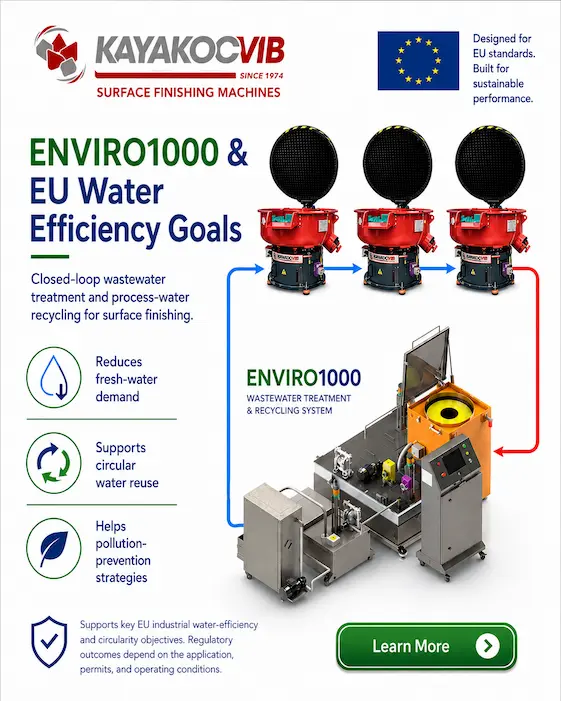
Wastewater management is also an operational requirement in closed-loop automotive finishing lines. Compound and water consumption generates wastewater containing suspended solids, oils, and chemical residues. Wastewater treatment or recycling systems allow process water to be reused, reducing disposal costs and environmental impact. This requirement should be factored into line design from the start, not added retrospectively.
Frequently Asked Questions
What finishing system is most commonly used for small automotive CNC parts?
Circular vibratory finishing machines are the most widely used platform for small to medium CNC machined automotive parts. They handle complex geometries well, are available in a wide range of chamber volumes, and can be integrated with separation and drying stages for continuous production.
When should a centrifugal disc machine be selected over a vibratory machine?
Centrifugal disc finishing machines are preferred when cycle time is a critical constraint, when parts require high surface precision, or when the part size is small enough to be processed safely under high centrifugal force. They are commonly used for hydraulic components, precision gears, and injector parts where surface quality requirements are more demanding than standard vibratory finishing can achieve within acceptable cycle times.
Can aluminum and steel automotive parts be finished in the same machine?
Aluminum and steel parts should not be processed together in the same batch. These materials require different media types, compound chemistry, and process intensity. Mixing them results in suboptimal surface quality for both material groups and increases the risk of cross-contamination or surface staining.
How are process parameters validated before production release?
Process validation begins with sample testing using representative production parts. Engineers define the target surface condition, measure the incoming part condition, run finishing trials with selected media and compound, and measure the output. Parameters are adjusted iteratively until the target surface quality is consistently achieved. The validated parameters are then documented as the production standard.
Related Process Equipment
Related Video Demonstration
Conclusion
Selecting an effective finishing system for automotive parts requires a structured evaluation of part geometry, material, burr condition, surface quality target, production volume, and automation requirements. No single machine type covers all automotive applications. Circular vibratory machines handle the majority of small to medium automotive parts with good process flexibility. Trough machines address long or elongated components. Centrifugal disc machines deliver higher process intensity for precision small parts with demanding surface requirements. Media and compound selection must align with base material to avoid surface damage or inadequate cutting action. Every finishing system selection should be confirmed through sample testing before production release, as actual results depend on application-specific conditions that cannot be fully predicted from general guidelines alone.
Sorry, the comment form is closed at this time.