



01 Aug Finishing Media Wastewater Solids
Finishing media wastewater solids are one of the most persistent and underdiagnosed problems in wet mass finishing operations. As ceramic or plastic finishing media wears down over thousands of processing hours, it releases fine abrasive particles, clay binders, and filler material directly into the process water. These particles accumulate in the recirculating water circuit, overload sedimentation or filtration units, increase chemical oxygen demand, and ultimately cause downstream wastewater treatment failures. Understanding why these solids are generated and how to control them is essential for any facility running continuous or high-volume vibratory finishing lines.
In This Article
Why Finishing Media Releases Solids Into Process Water
All finishing media degrades over time. Ceramic media, which is the standard choice for steel and stainless steel deburring applications, is composed of abrasive grain, clay binder, and various fillers that are fired together at high temperature. As the media cuts burrs and refines surfaces, the binder matrix erodes and releases fine ceramic particles. These particles range in size from coarse silt down to colloidal clay fractions that remain suspended in water for extended periods.
Plastic media, used for softer materials such as aluminum, zinc die castings, and copper alloys, degrades differently. The plastic binder breaks down more slowly, but the embedded abrasive grain is eventually released as fine silica or alumina particles. Both media types contribute to increasing solids concentration in the process water circuit as operating hours accumulate.
The rate of media wear depends on several factors: media type and density, media age, compound concentration, water flow rate, machine loading, and the hardness of the parts being processed. A machine running aggressive ceramic media at high amplitude with undersized compound dosing will generate solids far more rapidly than an equivalent line using softer plastic media with stable compound chemistry.
How Solids Accumulate and Why They Become a Problem
In a typical wet vibratory finishing setup, process water is recirculated from the machine through a drain, into a collection sump, and then passed through some form of treatment before being reused or discharged. When finishing media wastewater solids are present at low concentration, a simple sedimentation stage can usually handle the load. However, as media wear accelerates or as treatment capacity is undersized, solids begin to build up faster than they are removed.
Several specific failure modes result from this accumulation. First, the sedimentation tank or filter becomes overloaded and solids pass through into the recirculated water. When contaminated water is pumped back into the vibratory machine, the suspended solids redeposit on part surfaces, causing staining, smearing, or surface contamination that requires rework. Second, fine colloidal particles increase water turbidity to the point where optical or chemical sensors in the treatment system cannot function accurately. Third, accumulated sludge in collection tanks hardens if left undisturbed, making manual cleaning far more labor-intensive than planned maintenance intervals would suggest.
In facilities processing mixed metals such as aluminum and steel in separate machines sharing the same water treatment circuit, cross-contamination of metallic fines creates additional complications. Aluminum oxide particles and iron fines can react under certain pH and temperature conditions, forming deposits that clog pipework and valves.
Root Cause Categories for Excessive Solids Generation
Diagnosing a finishing media wastewater solids problem requires identifying which root cause category applies. The four main categories are media condition, machine operation, compound chemistry, and treatment system capacity.
Media condition is the most common root cause. Media that has been in service beyond its effective life begins to break down more rapidly than new media. This breakage is distinct from normal gradual wear. A media charge that has crossed into active breakdown phase will generate several times the solids load of media in normal service. Regular media condition checks, including visual inspection of media shape integrity and size distribution, are necessary in any controlled finishing operation.
Machine operation contributes to accelerated wear when amplitude settings are too high for the media and part combination in use. Excessive amplitude increases impact velocity between media pieces, accelerating the mechanical breakdown of the binder matrix. Overloading the machine with parts above the recommended fill ratio can produce the same effect by reducing media-to-media cushioning.
Compound chemistry plays a role because the correct compound both lubricates the process and maintains pH stability in the water. When compound dosing is too low, the water becomes more abrasive and chemically aggressive toward the media surface. When dosing is inconsistent, pH fluctuations accelerate chemical degradation of clay binders in ceramic media formulations.
Treatment system capacity becomes the limiting factor when the sedimentation tank, filter, or centrifugal separator is correctly sized for normal operating conditions but is not able to handle solids spikes during media changeover, batch size changes, or compound reformulation periods.
Solids Separation Methods and Their Practical Limits
The most widely used method for managing finishing media wastewater solids is gravity sedimentation. In a sedimentation tank, contaminated water enters a chamber where flow velocity drops sufficiently for heavier particles to settle to the bottom. Clarified water is drawn from the upper zone and returned to the finishing machine. This approach works well for coarser particles above approximately 50 to 100 microns but is largely ineffective for fine colloidal clay fractions that remain in suspension almost indefinitely without chemical assistance.
Flocculation is used to address the fine fraction. A coagulant or flocculant chemical is dosed into the contaminated water before it enters the sedimentation chamber. The flocculant causes fine particles to aggregate into larger flocs that settle more readily. The selection of flocculant type and dosing rate depends on the specific chemistry of the wastewater, including pH, hardness, suspended solids concentration, and the presence of surfactants from process compounds. In practice, flocculant dosing requires regular monitoring and adjustment because process conditions change as media ages and compound chemistry varies.
Centrifugal separation offers higher separation efficiency for fine solids than gravity sedimentation alone. A centrifuge accelerates particles outward at many times gravitational force, allowing particles down to 5 to 10 microns to be separated from the liquid phase within seconds. This approach is effective for high-throughput lines where sedimentation tank residence times would be impractically long. The limitation is that centrifugal units require more maintenance than passive sedimentation tanks and involve higher capital cost.
Belt press or filter press systems are used downstream of sedimentation or centrifugal stages to dewater the collected sludge before disposal. The dry sludge cake produced by filter pressing is significantly easier and less expensive to dispose of than liquid sludge, and in some jurisdictions is accepted for landfill disposal rather than hazardous liquid waste handling.
Wastewater Treatment System Design for Finishing Lines
A well-designed wastewater treatment system for a vibratory finishing line typically combines several stages. The first stage is mechanical pre-screening to remove large solid fragments before they enter the treatment circuit. The second stage is primary sedimentation for coarse particle removal. The third stage is chemical treatment for fine particle flocculation and pH correction. The fourth stage is secondary sedimentation or filtration to remove flocculated particles. The fifth stage is treated water storage before recirculation or discharge.
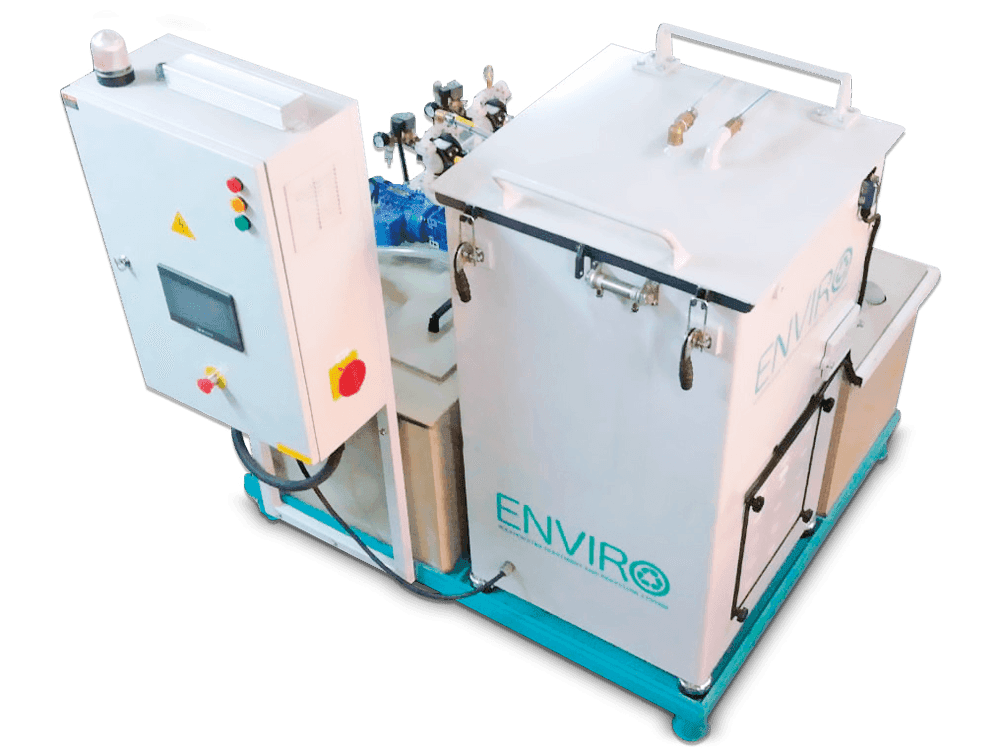
Systems such as the KAYAKOCVIB SDM-T sedimentation tank are designed for integration directly into vibratory finishing water circuits. The SDM-T handles primary clarification and can be configured with chemical dosing capability for flocculation. For operations requiring oil removal alongside solids separation, the KAYAKOCVIB FLOG oil separation unit addresses the mixed oil and solids load that is common when finishing machined steel parts carrying cutting oil residues. For complete closed-loop water reuse, the KAYAKOCVIB ENVIRO1000 wastewater treatment system integrates sedimentation, flocculation, and filtration in a compact unit suitable for mid-size production facilities.
Closed-loop water reuse is the preferred approach for facilities with high finishing throughput, because it eliminates the need for continuous fresh water input and reduces wastewater discharge volumes. However, closed-loop systems require more careful monitoring of water chemistry than open systems, because dissolved salts, surfactants, and metallic ions accumulate in the recirculated water over time and can eventually affect process quality if not managed through periodic water exchange or blowdown.
Corrective Actions for Active Wastewater Problems
When finishing media wastewater solids are causing visible surface contamination on parts, staining, or treatment system failure, the following corrective sequence is typically effective.
- Inspect media condition immediately. If media shows heavy rounding, significant size reduction, or active fragmentation, partial or full media replacement should be evaluated before continuing production.
- Check compound dosing rate and adjust to the recommended level for the current media and part combination. Confirm that the compound supply system is functioning and that no blockages exist in dosing lines.
- Reduce machine amplitude temporarily if media wear rate appears excessive. Verify that machine fill ratio is within the manufacturer’s recommended range.
- Drain and clean the sedimentation tank or treatment unit. Remove accumulated sludge manually if necessary. Inspect for scaling or hardened deposits in pipework.
- Adjust flocculant dosing if fine solids are passing through the treatment stage. A jar test using a small sample of the contaminated water can help determine the correct flocculant type and dosing rate before adjusting the full-scale system.
- Verify that treated water returned to the machine meets acceptable turbidity and pH levels before resuming production.
Prevention Checklist for Ongoing Solids Control
- Record media weight and visual condition at each media addition or replacement event.
- Monitor process water turbidity weekly using a simple turbidity meter or visual comparison standard.
- Maintain compound dosing within the supplier’s recommended range and verify pH stability in the process water at least twice per week.
- Inspect sedimentation tank sludge level monthly and schedule cleaning before sludge reaches the overflow zone.
- Verify machine amplitude settings quarterly and adjust after any change in part geometry, part weight, or media type.
- When switching media type or media supplier, conduct a short trial period with increased solids monitoring frequency to establish a new baseline.
- If processing steel and aluminum parts on the same water treatment circuit, verify that the treatment chemistry is compatible with both metallic fines streams.
Frequently Asked Questions
What causes high turbidity in vibratory finishing process water?
High turbidity is typically caused by colloidal clay particles released from degraded ceramic media binder, or fine abrasive grain from worn plastic media. Inadequate compound dosing accelerates media surface degradation. Flocculation treatment is usually required to remove the fine fraction that gravity sedimentation alone cannot separate.
Can a standard sedimentation tank handle all finishing media wastewater solids?
A sedimentation tank handles coarser particles effectively but is insufficient for fine colloidal fractions. For complete solids management, sedimentation should be combined with flocculation chemistry. High-throughput operations may also require centrifugal separation to achieve acceptable clarification within available residence times.
How often should finishing media be replaced to control wastewater solids?
Media replacement frequency depends on media type, part material, amplitude, and machine loading. There is no universal interval. Media condition should be monitored by tracking weight loss and visual shape integrity rather than by fixed time intervals. Accelerating solids generation in the wastewater circuit is one of the early indicators that media is approaching end-of-life.
Is closed-loop water reuse practical for a facility processing multiple metals?
Closed-loop reuse is technically feasible for multi-metal facilities but requires careful water chemistry management. Dissolved metallic ions from different materials can accumulate and create compatibility issues. Regular monitoring of conductivity, pH, and dissolved metals content, combined with scheduled partial water replacement, is necessary to maintain closed-loop stability.
Related Process Equipment
Conclusion
Finishing media wastewater solids represent a process control problem that spans media selection, machine operation, compound chemistry, and treatment system design simultaneously. Facilities that treat wastewater management as a separate utility function, rather than as an integrated part of the finishing process, are more likely to experience chronic solids overload, surface quality problems, and unplanned maintenance events. Effective control requires regular media condition monitoring, stable compound dosing, correctly sized and maintained treatment equipment, and a clear corrective response protocol when solids concentration begins to rise. Where closed-loop water reuse is the operational goal, treatment system design must account for the full solids and chemical load generated across the entire production cycle, not only steady-state conditions.
Sorry, the comment form is closed at this time.