


23 Jul Finishing Media Selection
Finishing media selection is one of the most consequential decisions in any vibratory finishing process. The wrong media type, geometry, or compound pairing can result in insufficient deburring, excessive material removal, surface damage, media lodging, or unacceptably long cycle times. This guide explains how to approach media selection from an engineering perspective, covering the key variables that determine which media is appropriate for a given part, material, surface condition, and quality target.
In This Article
Why Media Selection Drives Process Results
In vibratory finishing, the media performs the mechanical work. It contacts the part surface continuously, removing burrs, rounding edges, improving surface texture, and generating the desired finish. The machine provides the motion energy, but the media determines how that energy is translated into surface change. Selecting the correct media is therefore not a secondary decision — it defines the cutting rate, cycle time, surface quality, and risk of part damage.
Media selection interacts directly with compound selection, water flow rate, machine amplitude, and loading ratio. These variables cannot be optimized independently. A correctly chosen media type paired with an incompatible compound, or used in a machine with excessive amplitude, will produce inconsistent results. The selection process must consider all these factors together.
Primary Selection Criteria
Before choosing a specific media type, grade, or geometry, engineers should define the following parameters for the part and process:
- Base material and hardness of the workpiece
- Part geometry, including holes, recesses, thin walls, and delicate features
- Burr size, type, and location
- Current surface condition before finishing
- Required surface quality after finishing, including Ra target range if applicable
- Production volume and batch size
- Risk of media lodging in internal features or holes
- Whether the process is wet or dry
These inputs form the foundation of the finishing media selection decision. Skipping any of them increases the risk of selecting an unsuitable media and needing to re-test after production problems emerge.
Media Types and Their Engineering Characteristics
Ceramic Media
Ceramic media is manufactured from abrasive grains bonded in a ceramic or porcelain matrix. It provides strong cutting action and is well-suited for hard metals that require aggressive deburring, edge breaking, or surface refinement. Steel, stainless steel, cast iron, and harder alloys are typical applications for ceramic media. The cutting rate is high relative to plastic media, and ceramic media retains its shape and abrasive properties over a longer service life under normal conditions.
Ceramic media is available in a wide range of geometries and grades, from coarse cutting grades for heavy deburring to fine grades for pre-polishing. Denser ceramic formulations are used when higher impact energy is needed, particularly for harder or thicker burrs.
Plastic Media
Plastic media is manufactured from polyester resin combined with abrasive filler materials at varying concentration levels. It is softer and lighter than ceramic media, producing gentler cutting action with lower risk of surface damage. Plastic media is the standard recommendation for aluminum, zamak, magnesium, brass, copper, and other soft or non-ferrous metals. It is also preferred for thin-walled parts, decorative surfaces, and components where surface integrity must be preserved during finishing.
Because plastic media is less dense than ceramic, the mechanical impact energy per contact is lower. This reduces the risk of denting or deforming soft parts during the vibratory process. For aluminum die castings, CNC-machined aluminum parts, and zinc alloy components, plastic media is generally the appropriate starting point for finishing media selection.
Steel Media
Steel media — including steel balls, pins, and mixed shapes — is used primarily for burnishing operations where the goal is surface compaction, brightening, and smoothing rather than material removal. Steel media does not cut; it polishes by cold-working the surface. It is commonly used for small parts such as fasteners, stampings, and jewelry components. Steel burnishing media requires compatible burnishing compounds and should not be used when material removal or burr elimination is the primary objective.
Media Geometry and Its Effect on the Process
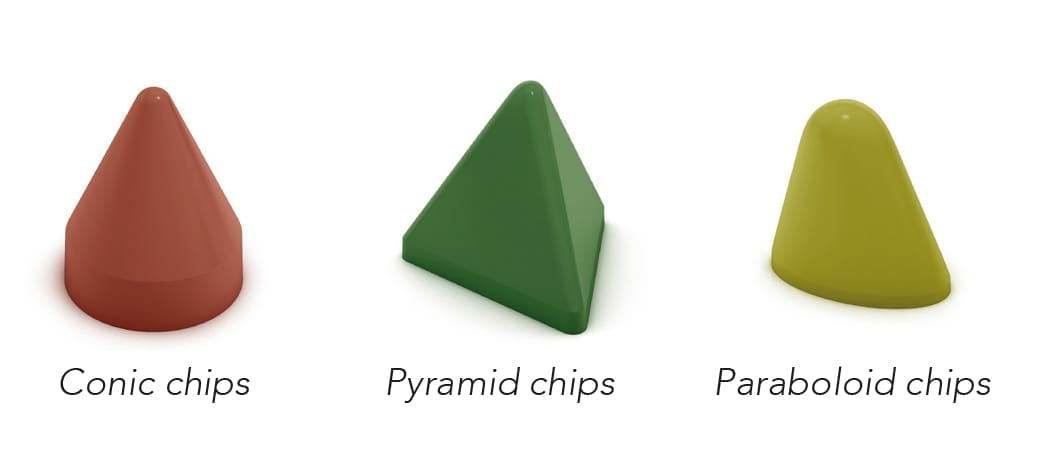
Media geometry determines contact pattern, access to part features, and flow behavior inside the vibratory machine. Common media shapes include triangles, cylinders, cones, wedges, stars, and spheres, each with different contact characteristics.
Angle-cut cylinders and triangles provide good access to flat surfaces and general edges. Cone shapes and wedge shapes improve access to recesses and inside corners. Spherical or ball-shaped media is used when consistent contact on curved or contoured surfaces is needed. Star and cross-shaped media can access complex internal geometries but must be selected carefully to avoid lodging in holes or slots.
The size of the media must always be selected relative to the smallest hole, slot, or recess on the part. As a general engineering rule, media should be large enough that it cannot enter and become trapped in any feature of the part. Media lodging creates quality defects and machine downtime. If parts have very small holes, larger media or plugging the holes before processing may be necessary.
Material-Specific Media and Compound Pairing
The relationship between base material, media type, and process compound is central to finishing media selection. Using the wrong compound with an otherwise correct media type will produce poor results. The following table summarizes recommended starting points for common industrial materials.
| Base Material | Recommended Media Type | Primary Compound | Secondary Compound |
|---|---|---|---|
| Steel, Stainless Steel | Ceramic | 943 deburring and polishing liquid | 028-S degreasing liquid |
| Aluminum, Zamak | Plastic | 085 deburring and polishing liquid | 028-S degreasing liquid |
| Copper, Brass, Yellow Metals | Plastic or fine ceramic | 028 degreasing liquid | — |
| Hardened Steel, Cast Iron | Ceramic (coarse to medium grade) | 943 deburring and polishing liquid | 028-S degreasing liquid |
| Burnishing (all metals) | Steel media (balls or pins) | Burnishing compound | — |
These pairings represent general starting points. Actual compound concentration, water flow rate, and media grade must be confirmed through sample testing and process validation. Mixing aluminum and steel parts in the same finishing batch is not recommended, as galvanic interaction and cross-contamination can affect surface quality on both materials.
Media Grade and Surface Finish Relationship
Within each media type, manufacturers offer a range of grades from coarse cutting to fine finishing. Coarser grades contain higher concentrations of abrasive and produce faster material removal with more aggressive cutting. Fine grades use lower abrasive content or finer abrasive particles, producing slower cutting with better surface texture results.
A typical process route for parts requiring both deburring and surface improvement uses a coarser media in the first stage to remove burrs and heavy surface irregularities, followed by a finer media in the second stage to refine the surface texture. Single-stage processes are possible when the burr size and surface quality target are compatible with a medium-grade media selection.
For parts where surface roughness targets are specified, sample testing is necessary before committing to a production media grade. Achieving a specific Ra value depends not only on media grade but also on initial surface condition, cycle time, compound selection, and machine parameters. These results cannot be guaranteed from media selection alone without process validation.
Common Mistakes in Finishing Media Selection
Several recurring errors occur in industrial practice when finishing media selection is approached without sufficient engineering analysis:
- Selecting ceramic media for aluminum or zamak parts, resulting in aggressive surface damage or excessive material removal
- Selecting media that is too small for the part geometry, causing lodging in holes or recesses
- Using an incompatible compound with a correctly selected media type, reducing cutting effectiveness or causing surface staining
- Using a single coarse media for parts that require both deburring and surface refinement, producing insufficient final surface quality
- Ignoring media wear rate and continuing to use worn or degraded media in production, resulting in inconsistent surface results over time
- Mixing different metal types in one batch without evaluating galvanic or contamination risks
Each of these mistakes can usually be identified and corrected through systematic sample testing before production is committed to a specific media selection.
Media Loading and Machine Parameters
The ratio of media volume to part volume inside the vibratory machine affects both cutting rate and part-to-part contact risk. A higher media-to-part ratio generally reduces part-on-part damage but also reduces process intensity. For fragile, thin-walled, or precision parts, a higher media ratio is preferable. For robust parts requiring fast material removal, a lower ratio can be used, though part-on-part contact must be monitored.
Machine amplitude and frequency also interact with media selection. Higher amplitude increases the impact energy per media contact, which accelerates cutting but also increases the risk of surface damage on softer materials. Fine finishing operations typically use lower amplitude settings to produce smoother surface contact. KAYAKOCVIB KVM series circular vibratory machines allow amplitude adjustment, which should be set in combination with media type and grade to achieve a balanced process.
Validation Before Production Release
No finishing media selection should be transferred directly to production without sample testing. A structured validation sequence typically includes:
- Define the target: burr size to remove, surface condition required, Ra target if applicable
- Select candidate media type based on material compatibility rules
- Select initial media geometry based on part features and lodging risk analysis
- Select media grade based on burr size and surface finish target
- Pair with appropriate compound based on material type
- Run a controlled sample batch with defined machine settings and cycle time
- Inspect parts after finishing: measure Ra if required, check for lodging, check edge condition, check surface integrity
- Adjust media grade, compound concentration, or cycle time based on results
- Confirm final process parameters before production release
This sequence reduces the risk of production defects and avoids committing to an untested media configuration at scale. For complex parts or tight surface quality specifications, multiple test iterations may be necessary.
Frequently Asked Questions
What is the most important factor in finishing media selection?
The base material of the part is the primary factor. It determines whether ceramic or plastic media is appropriate and which compound group is compatible. Secondary factors include part geometry, burr size, and surface quality target.
Can I use ceramic media for aluminum parts?
Ceramic media is generally not recommended for aluminum or zamak because it is too aggressive for soft non-ferrous metals and risks surface damage or excessive material removal. Plastic media is the standard recommendation for aluminum finishing, with process validation confirming the correct grade and geometry.
How do I prevent media lodging in drilled holes?
Select media that is larger than the smallest hole diameter on the part. If hole diameters are very small relative to available media sizes, plug the holes before processing or evaluate whether a different process route is more suitable.
Should I run a single-stage or two-stage media process?
This depends on the burr size and surface quality requirement. If the part has heavy burrs and requires a refined surface finish, a two-stage process using coarser media followed by finer media typically produces better results than a single-stage process. Single-stage processes are appropriate when burr removal requirements and surface quality targets are compatible with one media grade.
Recommended Next Technical Pages
Conclusion
Effective finishing media selection requires systematic analysis of the workpiece material, part geometry, burr condition, surface quality target, and lodging risk before any media type or grade is chosen. Ceramic media for steel and hard metals, plastic media for aluminum and soft non-ferrous metals, and steel media for burnishing represent the foundational logic, but each application requires compound pairing, geometry selection, and machine parameter alignment to produce consistent and validated results. No media selection should be assumed to be correct without controlled sample testing. The decision made at the media selection stage directly determines whether the vibratory finishing process achieves its intended surface quality outcome efficiently and without defect.
Sorry, the comment form is closed at this time.