



08 Aug Edge Rounding Automotive Parts
Edge rounding automotive parts is one of the most process-sensitive operations in automotive surface finishing. Unlike simple deburring, which removes sharp projections, edge rounding requires controlled material removal that produces a defined, consistent radius across all exposed edges of a machined or stamped component. In automotive manufacturing, this distinction matters because edge geometry directly affects coating adhesion, fatigue life, assembly fit, and downstream process compatibility.
In This Article
Why Edge Rounding Matters in Automotive Manufacturing
Automotive metal components are exposed to cyclic loading, vibration, thermal cycling, and in many cases aggressive chemical environments. A sharp edge acts as a stress concentrator. Under repeated load cycles, cracks initiate preferentially at sharp corners, leading to premature fatigue failure. For structural parts such as transmission housings, suspension brackets, and steering knuckles, this is not a cosmetic issue but an engineering one.
Beyond structural integrity, sharp edges cause problems in coating processes. Powder coating, e-coat, and zinc phosphate conversion coatings all show reduced film thickness at sharp corners. A rounded edge allows the coating to flow uniformly and adhere evenly, which directly improves corrosion resistance and coating durability. In automotive production, parts that skip edge rounding often fail salt spray testing or show early coating breakdown at edge zones.
Assembly safety is a secondary but practical concern. Automotive components handled during assembly or maintenance can cause injuries if edges are not adequately radiused. Many automotive OEM specifications define a minimum edge radius as part of the part drawing requirements.
Typical Parts, Materials, and Starting Conditions
The range of automotive parts requiring edge rounding is broad. CNC-machined components such as gearbox housings, valve bodies, cam covers, and bearing housings are common candidates. Stamped parts such as brackets, mounting plates, heat shields, and structural reinforcements are also processed in volume. Sintered parts and die-cast components complete the picture for many powertrain and chassis applications.
Material types vary significantly within a single automotive assembly line. Steel and stainless steel are used for structural and high-temperature components. Aluminum alloys are standard for powertrain housings, wheels, and structural castings where weight reduction is a priority. Mixed-metal batches present additional process challenges because steel and aluminum have different hardness, different cutting response, and different sensitivity to media aggression.
The starting burr condition also varies. CNC-machined parts may have thin, consistent burrs on drilled holes and milled edges. Stamped parts may have rollover burrs on sheared edges. Die-cast parts may have flash along parting lines. Each burr type requires a different process approach in terms of media selection, cycle time, and machine intensity.
Process Route for Automotive Edge Rounding
The standard process route for edge rounding automotive parts in mass finishing follows a wet vibratory finishing sequence. This typically includes a deburring or rounding stage, followed by a separation stage, and in many cases a washing and drying stage before the parts move to coating or assembly.
The wet finishing stage uses a combination of abrasive media and liquid compound circulated continuously through the machine. The media impacts and slides across part surfaces and edges, removing material progressively. The compound controls cutting rate, prevents corrosion, removes chips and fines, and maintains the working surface of the media. Without proper compound management, media glazing occurs and cutting performance drops significantly.
After the rounding cycle, parts and media are separated using a vibratory separator. Parts are then washed to remove compound residue, media dust, and surface contamination. Depending on downstream requirements, a drying stage follows using a vibratory dryer or a centrifugal dryer, particularly when parts must be delivered dry for coating or assembly.
Machine Selection for Automotive Applications
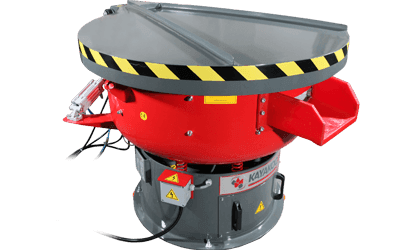
Circular vibratory finishing machines are the standard equipment choice for edge rounding automotive parts in medium to high production volumes. The circular bowl design creates a continuous, uniform mass flow that ensures consistent edge contact across all part surfaces. Parts move through the media mass in a controlled helical path, which distributes the finishing action evenly without creating impact damage on sensitive surfaces.
The KAYAKOCVIB KVM series circular vibratory finishing machines are designed for this type of application. Bowl volume selection depends on part size, batch weight, and required throughput. For small to medium automotive components such as valve bodies, brackets, and machined housings, medium-volume circular bowls provide good process consistency. The vibratory drive amplitude and frequency are adjustable, which allows the process engineer to tune the intensity of the finishing action for the specific part geometry and required edge radius.
For long or asymmetric automotive parts such as connecting rods, axle shafts, or elongated brackets, trough-type vibratory machines may be more appropriate. The trough geometry prevents parts from tumbling end-over-end, which reduces the risk of impact damage and part-on-part contact in longer components.
Media and Compound Selection for Steel and Aluminum Parts
Media selection is the most critical process variable for achieving consistent edge rounding results. The wrong media choice leads to insufficient rounding, surface damage, or unacceptably long cycle times.
For steel and stainless steel automotive parts, ceramic media is the standard choice. Ceramic media provides strong cutting action that matches the hardness of ferrous materials. Common ceramic shapes for edge rounding include triangles, cylinders, and cones. Shape selection depends on part geometry, particularly the accessibility of internal features, holes, and recessed edges. Smaller media penetrates into tighter geometries but may create media lodging risk in blind holes.
For aluminum automotive parts, plastic media is generally preferred. Aluminum is significantly softer than steel, and ceramic media often causes surface scratching, excessive material removal, or surface roughening that is difficult to correct downstream. Plastic media provides a gentler cutting action that produces clean, uniform edge rounding without damaging the aluminum base surface. Plastic cone and triangle shapes are widely used for aluminum housings and die-cast components.
When steel and aluminum parts must be processed together in a mixed-metal batch, process engineers face a genuine challenge. The media hardness required for steel is too aggressive for aluminum, and the media suitable for aluminum provides insufficient cutting for steel. In production environments, separating steel and aluminum parts into dedicated finishing batches is the recommended approach whenever possible.
Compound selection follows the same material logic. For steel parts, a compound such as KAYAKOCVIB 943 deburring and polishing liquid supports cutting performance and corrosion inhibition. For aluminum parts, KAYAKOCVIB 085 deburring and polishing liquid is suitable. In both cases, KAYAKOCVIB 028-S degreasing liquid is used for initial cleaning when parts arrive with cutting oil or stamping lubricant contamination. Compound concentration and flow rate must be validated for each application, as over-dilution reduces cutting efficiency and under-dilution may cause compound buildup or foaming.
Process Parameters That Control Edge Rounding Results
The final edge radius and surface condition after vibratory finishing depend on a combination of adjustable process parameters. Understanding the effect of each parameter allows the process engineer to optimize the cycle without running excessive trials.
| Parameter | Effect on Edge Rounding | Typical Adjustment Range |
|---|---|---|
| Vibration amplitude | Higher amplitude increases media pressure and cutting rate | Low to high depending on machine design |
| Vibration frequency | Higher frequency increases media circulation speed | Fixed or adjustable per machine model |
| Media fill level | Affects part-to-media ratio and mass flow behavior | 60% to 80% of bowl volume typical |
| Part load weight | Heavier loads reduce media circulation and cutting uniformity | Validated per batch and part geometry |
| Cycle time | Longer cycles produce larger edge radius and smoother surfaces | 15 to 90 minutes depending on target |
| Compound flow rate | Controls lubrication, cutting, and chip removal | Application-specific, requires validation |
| Water temperature | Affects compound activity and foam behavior | Room temperature to slightly elevated |
Cycle time is the most direct control variable for edge radius size. Longer cycles produce larger radii, but they also increase surface material removal and may alter part dimensions if not controlled. For tight-tolerance automotive parts, cycle time must be validated against dimensional limits before production release.
Media-to-part ratio is another sensitive variable. Too few parts in the bowl reduces part-on-media contact frequency and extends effective cycle time. Too many parts increases part-on-part contact, which can cause surface damage, uneven rounding, or part nesting where adjacent parts shield each other from media contact.
Surface Quality and Inspection After Edge Rounding
Inspection of edge rounding results in automotive production typically involves a combination of visual inspection, tactile gauging, and in some cases optical profilometry or coordinate measurement for critical surfaces. The relevant quality attributes are edge radius consistency, surface roughness on functional faces, and absence of surface damage or contamination.
Edge radius can be measured using radius gauges for simple geometries or using cross-sectional microscopy for smaller radii. For production parts, a go/no-go approach using visual standards and touch inspection is common at medium volume. For high-volume automotive production where process documentation is required, statistical sampling with dimensional records may be necessary.
Surface roughness on bearing faces, sealing surfaces, and mating faces must be protected during the edge rounding process. If the media is too aggressive or the cycle time is too long, functional surfaces may be affected. This is managed by selecting media geometry that preferentially contacts edges rather than flat faces, and by validating surface roughness on critical surfaces as part of the process approval.
Integration into Automotive Production Lines
In high-volume automotive environments, edge rounding is integrated into automated finishing lines rather than operated as a standalone batch process. A typical automated line includes a loading station, the vibratory finishing machine, a separation unit, a washing system, a drying unit, and a discharge conveyor. Parts flow through the line continuously or in indexed batches, reducing labor requirements and ensuring consistent cycle parameters across every production run.
Automated compound dosing systems control the flow rate and concentration of finishing liquid precisely. This eliminates operator variability in compound mixing and ensures the working compound concentration remains within the validated process window throughout the shift. Wastewater from washing stages is collected and treated using wastewater treatment systems before discharge, which is a regulatory requirement in most automotive manufacturing facilities.
For factories processing multiple part families, a flexible finishing line with adjustable cycle programs allows the same machine to be used for different part types by switching media type, cycle time, and compound parameters. Process programs are stored and recalled by part number, reducing changeover errors and improving production traceability.
Limitations and Validation Requirements
Vibratory finishing for edge rounding automotive parts has practical limitations that process engineers should account for during planning. Very small internal features such as blind holes, narrow slots, or threaded bores may trap media, creating a media lodging risk that requires secondary inspection or media selection changes. Very thin sections or delicate features may be damaged if machine intensity is not reduced to match the part sensitivity.
Heavy casting flash, gate stubs, or large weld seams may exceed what vibratory finishing can practically remove within acceptable cycle times. These features often require pre-processing by grinding, trimming, or machining before vibratory finishing. Expecting a single-stage vibratory process to replace machining operations for heavy material removal leads to unrealistic cycle times and poor process economics.
Final process capability must always be confirmed through sample testing and process validation before production release. Approved process parameters, media type and grade, compound type and concentration, cycle time, and machine settings must be documented and controlled as part of the process specification.
Frequently Asked Questions
What edge radius can vibratory finishing achieve on automotive steel parts?
The achievable edge radius depends on part geometry, media type, cycle time, and machine intensity. In typical industrial applications, vibratory finishing can produce consistent radii ranging from approximately 0.05 mm to over 0.5 mm depending on the process parameters. Actual results require validation through sample testing for each specific part.
Can steel and aluminum automotive parts be processed together?
Processing steel and aluminum parts in the same vibratory finishing batch is generally not recommended. The media hardness suitable for steel is too aggressive for aluminum, and the gentler media suitable for aluminum does not provide sufficient cutting for steel. Dedicated batches per material type produce better results and avoid surface damage.
How is media lodging risk managed for complex automotive geometries?
Media lodging is managed by selecting media shapes and sizes that cannot enter the smallest internal features of the part. Larger media sizes, rounded shapes, and pre-screening of media before use reduce lodging risk. Post-process inspection should confirm that no media remains inside blind holes or recessed features before parts proceed to coating or assembly.
What washing and drying is required after wet vibratory finishing?
After wet vibratory finishing, parts carry residual compound, media fines, and metal chips. A dedicated washing stage using clean water or a dilute cleaning solution removes this contamination. Parts then proceed to drying using a vibratory dryer or centrifugal dryer to reach the surface condition required for coating or assembly. Skipping the washing stage risks coating adhesion failure or corrosion in downstream processes.
Related Process Equipment
Related Video Demonstration
Conclusion
Edge rounding automotive parts through mass vibratory finishing is a technically demanding application that requires careful alignment between part material, burr condition, media type, compound selection, machine settings, and cycle time. Steel parts require ceramic media with appropriate cutting compounds, while aluminum parts require plastic media with gentler chemistry. Machine selection between circular vibratory and trough vibratory configurations depends on part geometry and production volume. Process parameters must be validated through sample testing rather than assumed from general guidelines. In automated automotive production environments, integration of separation, washing, drying, and wastewater treatment stages is standard practice and directly affects both surface quality and regulatory compliance. A well-validated edge rounding process for automotive parts produces consistent edge geometry, improved coating adhesion, and better component fatigue performance across the full production run.
Sorry, the comment form is closed at this time.