


02 Aug Deburring Polishing Drying Line Design
A deburring polishing drying line is an integrated production sequence that takes raw or machined parts through edge conditioning, surface refinement, and controlled drying in a continuous or semi-continuous workflow. Designing such a line requires matching each stage to the part material, geometry, burr condition, and surface quality target. When the line is correctly configured, it delivers repeatable surface results with minimal manual handling between stages.
In This Article
What the Line Must Accomplish
The purpose of the line is not simply to remove burrs. A complete deburring polishing drying line addresses multiple surface conditions in a defined sequence: mechanical burr removal, edge rounding, surface scratch reduction, polishing to a target roughness, wet cleaning, separation of parts from media, and final drying to a moisture-free condition.
Each stage influences the next. If deburring is incomplete, polishing compounds will not perform correctly on the remaining sharp edges. If separation is not clean, media carryover will cause handling problems downstream. If drying is insufficient, parts may oxidize or stain before reaching inspection or packaging. Line design must account for all these dependencies.
Line Architecture and Stage Sequence
A typical deburring polishing drying line follows this process sequence:
- Part loading and feeding into the finishing machine
- Wet deburring and edge rounding with ceramic or plastic media and compound
- Transition to a second stage with finer media for surface smoothing or polishing, if required
- Media and part separation using a separator or vibratory screen
- Washing or rinsing to remove compound residue and process water
- Drying in a vibratory or trough dryer
- Part unloading, inspection, and transfer to downstream packaging or coating
In high-volume automated lines, these stages are linked by conveyors, elevators, or chutes. In lower-volume configurations, parts may be transferred manually between stages, but each stage still follows the same logic.
Machine Selection for Each Stage
Machine selection depends on part size, geometry, material, and the intensity required at each stage.
For small to medium steel, stainless steel, or aluminum parts, circular vibratory finishing machines are widely used for the deburring and polishing stages. These machines provide uniform media contact across the part surface and are well suited to batch processing of mixed part geometries. For long or slender parts that would be at risk of damage in a circular machine, trough-type vibratory machines offer a more controlled rolling motion that reduces part-on-part impact.
When cycle time is a primary constraint and parts are small and precision-critical, centrifugal disc finishing machines provide higher process intensity and shorter processing times compared to vibratory systems. These are common in medical component and aerospace fastener finishing applications.
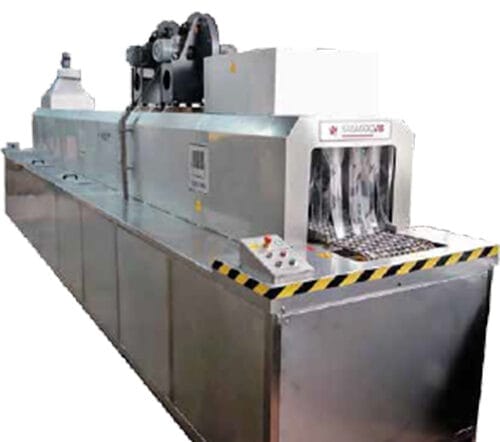
For the drying stage, circular vibratory dryers or trough dryers are the standard industrial solution. These machines use dry granulate media, typically corn cob or walnut shell, to absorb surface moisture while the vibratory motion moves parts continuously through the dryer bed. The drying time depends on part geometry, surface area, and the level of moisture carried over from the finishing stage.
Media and Compound Selection by Material
Media and compound selection must be matched to the base material at each stage of the deburring polishing drying line.
| Material | Deburring Media | Polishing Media | Recommended Compound |
|---|---|---|---|
| Steel and stainless steel | Ceramic media, aggressive cut | Ceramic media, fine cut | 943 deburring and polishing liquid, 028-S degreasing liquid |
| Aluminum and zamak | Plastic media, medium cut | Plastic media, fine cut | 085 deburring and polishing liquid, 028-S degreasing liquid |
| Copper, brass, yellow metals | Ceramic or plastic depending on part hardness | Plastic or porcelain media | 028 degreasing liquid for oxide removal and brightening |
Ceramic media should not be used as the default for aluminum parts. Ceramic media carries higher cutting energy and can cause surface damage or dimensional distortion on soft metals. For aluminum, plastic media in a matching geometric shape provides controlled cutting with lower aggression. Media shape must be selected to match part geometry and avoid lodging in holes, channels, or recessed features.
Process Parameters That Control Surface Quality
Several process variables determine whether the line achieves the required surface result. These must be set and validated before production release.
Amplitude and frequency settings on the vibratory machine control media pressure and circulation speed. Higher amplitude increases cutting rate but may increase part-on-part contact forces, which is a risk for thin-walled or precision-ground parts. Compound concentration in the process water affects both cutting performance and surface brightness. Under-diluted compound can cause staining or foaming. Over-diluted compound reduces cutting efficiency and may allow surface oxidation during wet processing.
Media-to-part ratio affects how consistently each part contacts fresh media surfaces. A ratio that is too low reduces cutting uniformity. A ratio that is too high wastes energy and increases media wear without proportional improvement in surface quality. Typical practice requires process validation with sample parts before committing to production parameters.
Cycle time at each stage must be set based on the starting surface condition and the target finish. Deburring cycles for machined steel parts with medium burrs may typically run from 20 to 60 minutes depending on burr size and media aggressiveness. Polishing cycles with fine media may run shorter or longer depending on the target roughness. Actual values must be confirmed by sample testing because they depend on specific part geometry, media lot condition, and machine configuration.
Washing and Separation Integration
Separation of parts from finishing media is a necessary stage between finishing and drying. Parts carry compound residue and process water from the finishing machine. If this residue is not removed before drying, it can dry onto the part surface and create visible staining or contamination.
A vibratory separator or screening unit is used to segregate parts from media. For applications where parts have complex geometry or where media lodging is a risk, the separation step requires careful attention to screen aperture selection. Media that remains trapped in part features will cause quality failures downstream.
After separation, a rinse stage removes compound residue from the part surface. This may be a simple cascade rinse, a pressure washing stage, or an ultrasonic cleaning stage depending on the cleanliness specification. For parts that will receive coating, painting, or plating after finishing, residue-free surfaces are essential for adhesion quality.
Drying Stage Design Considerations
The drying stage in a deburring polishing drying line must be designed to match the part throughput and moisture load from the upstream wet finishing stages. Vibratory dryers using corn cob or walnut shell granulate are the most common solution in industrial finishing lines.
Corn cob granulate absorbs moisture efficiently and is suitable for most metals. Walnut shell granulate provides a mild burnishing action during drying, which can slightly improve surface appearance on non-ferrous metals. The choice between the two depends on the drying objective and the part material.
Drying temperature, residence time, and the ratio of wet parts to dry granulate volume all affect drying performance. Parts with deep holes, threaded features, or recessed surfaces retain more moisture and require longer drying cycles. If parts are not fully dry before packaging, condensation and surface oxidation are common failure modes, particularly for steel and iron components.
Automation and Line Integration
In automated finishing lines, the deburring, polishing, separation, washing, and drying stages are connected through a material handling system that eliminates manual transfer between machines. This is especially relevant for high-volume production in automotive, fastener, and CNC machining environments where consistent cycle control is required.
KAYAKOCVIB surface finishing automation systems are designed to link circular vibratory finishing machines, separators, washing units, and vibratory dryers into controlled production flows. Each stage can be monitored for cycle time, compound dosing, water temperature, and machine amplitude, allowing production managers to detect process drift before it affects part quality.
Automation reduces operator dependency and improves repeatability, but it also requires that each upstream stage is correctly configured. An automated line cannot compensate for a deburring stage that is running with worn media, an incorrect compound concentration, or an overloaded machine. Line design must include monitoring points and defined maintenance intervals for each stage.
Process Validation Before Production Release
Before a deburring polishing drying line is released for production, the following validation steps are recommended:
- Confirm deburring result on representative sample parts with the full range of expected burr sizes
- Verify edge rounding radius meets the engineering specification
- Measure surface roughness after polishing and confirm it falls within the target range
- Inspect parts after separation for media lodging in all critical features
- Confirm rinse water cleanliness and absence of compound residue on part surfaces
- Verify parts are fully dry after the drying stage with no moisture in recessed areas
- Run a production batch under full process parameters and inspect against quality criteria
Process validation must be repeated if media type, compound, machine, or part geometry changes significantly. A validated line with one media lot may not perform identically when media is replaced with a different grade or supplier batch.
Frequently Asked Questions
Can deburring and polishing be done in the same machine in a single cycle?
In some applications, a single vibratory finishing stage can achieve both deburring and surface smoothing using a medium-cut media and appropriate compound. However, when the part requires aggressive burr removal followed by a fine polished finish, a two-stage approach with different media gives better control over the final surface condition. Single-stage processing is faster but offers less flexibility in surface outcome.
What media shape should be used to avoid lodging in small holes?
Media shape must be selected so that the media cannot enter any hole or recess that it cannot exit freely. If the smallest part feature is a 4 mm hole, media must be sized and shaped to prevent entry. Cylindrical, triangular, and angle-cut ceramic or plastic shapes are common. When lodging risk is high, a larger media size or a different shape family should be tested before committing to production.
How is compound dosing controlled in an automated line?
Compound dosing is typically controlled through a dosing pump connected to the water supply line of the finishing machine. The pump delivers a set volume of compound per unit of water flow. Dosing rate is expressed as a dilution ratio, for example one part compound to fifty parts water, and must be validated against the compound manufacturer specification. Over-dosing and under-dosing both cause process problems and must be monitored during production.
What is the difference between corn cob and walnut shell drying media?
Corn cob granulate has higher moisture absorption capacity and is the general-purpose choice for most metals. Walnut shell granulate is harder and provides a mild burnishing action in addition to drying, which can improve surface brightness slightly on aluminum and non-ferrous metals. Walnut shell is less absorbent than corn cob and may require longer drying time for heavily wetted parts.
Related Process Equipment
Related Video Demonstration
Conclusion
Designing an effective deburring polishing drying line requires integrating each process stage into a coherent sequence where machine selection, media choice, compound type, process parameters, and drying capacity are matched to the specific part and material. The line cannot be optimized by adjusting one stage in isolation. Each variable in deburring, transition to polishing, separation, washing, and drying affects downstream outcomes. Production-ready performance requires validation through sample testing, defined parameter ranges, and regular monitoring of media condition and compound dosing. When all stages are correctly aligned, the line delivers consistent surface quality with controlled cycle times and minimal manual intervention.
Sorry, the comment form is closed at this time.