



09 Aug Deburring Automotive CNC Parts
Deburring automotive CNC parts in batch production is one of the most common and technically demanding surface finishing applications in the automotive supply chain. CNC-machined components such as brackets, housings, valve bodies, connecting rods, and transmission parts consistently carry burrs, sharp edges, and surface contaminants after machining. Removing these defects efficiently and repeatably across high production volumes requires a structured approach to machine selection, media choice, compound chemistry, and process control.
In This Article
Typical Parts, Materials, and Finishing Requirements
Automotive CNC parts span a wide range of geometries and base materials. Steel and stainless steel are used for structural and powertrain components, while aluminum alloys are common in engine blocks, housings, and lightweight structural parts. Batch production may also include mixed-metal loads, though material separation is generally recommended to avoid cross-contamination and incompatible finishing conditions.
The most common finishing requirements after CNC machining include burr removal from drilled holes, milled edges, and turned profiles, controlled edge rounding to prevent stress concentration, surface cleaning to remove cutting oil, chips, and coolant residue, and preparation for downstream processes such as coating, painting, or assembly.
Burr size and location vary significantly by machining operation. Drilling and milling typically produce larger burrs than turning. Internal cross-hole intersections present particular challenges because media contact may be limited by access geometry. Parts with blind holes or tight recesses require careful media selection to prevent lodging.
Recommended Process Route for Batch Deburring
For most automotive CNC part families, circular vibratory finishing is the preferred batch deburring process. The circular vibratory machine creates a consistent toroidal flow of parts and media through the bowl, producing uniform edge rounding and surface finishing without part-to-part contact damage. This process is well suited to medium production volumes, mixed batch geometries, and parts where controlled edge condition is required.
The standard process route for deburring automotive CNC parts includes the following stages. First, parts are loaded into the vibratory machine bowl together with the selected finishing media and a working solution of process compound diluted in water. The machine runs for a defined cycle time, typically ranging from 20 to 90 minutes depending on burr size, material, and required surface condition. After finishing, parts are separated from media using a built-in separator or a dedicated separation unit. Parts then pass through a washing stage to remove compound and media fines, and finally through a drying stage before inspection or downstream processing.
Machine Selection for High-Volume Automotive Applications
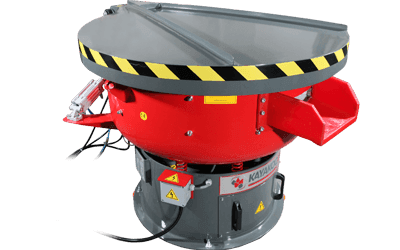
Circular vibratory finishing machines are the standard choice for deburring automotive CNC parts in batch production due to their high capacity, consistent bowl flow, low part damage risk, and straightforward integration with separation, washing, and drying units. A circular vibratory machine such as the KAYAKOCVIB KVM series handles a wide range of part sizes and geometries in a single bowl, with adjustable vibration amplitude and frequency to match process requirements.
Bowl volume selection depends on part size, batch weight, and production volume. As a general guide, the media-to-part volume ratio for CNC parts is typically between 3:1 and 5:1, meaning the media volume significantly exceeds the part volume. This ratio ensures adequate media contact on all part surfaces and prevents part-to-part collisions that could cause impact damage.
For very long CNC-machined shafts, rails, or tubular parts that do not fit well in a circular bowl, a trough vibratory machine would be the more appropriate choice. For small precision CNC parts requiring short cycle times and high surface quality, centrifugal disc finishing machines offer faster cutting action and tighter process control, though their capacity per cycle is generally lower than circular vibratory machines.
Media Selection for Steel and Aluminum CNC Parts
Media selection is one of the most consequential decisions in the deburring process for automotive parts. The base material drives this decision more than any other single factor.
For steel and stainless steel CNC parts, ceramic media is the standard choice. Ceramic media provides the cutting force required to remove machining burrs efficiently from hard metals. Common ceramic media shapes for CNC parts include triangles, cylinders, and cones, with shape selection guided by part geometry and the need to reach internal features. Smaller media shapes improve access to drilled holes and internal radii, while larger shapes are faster for open surface deburring.
For aluminum CNC parts, plastic media is generally preferred because aluminum is a softer material that is more sensitive to aggressive cutting. Plastic media provides gentler deburring action, reduces the risk of surface scratching, and avoids excessive material removal. Using ceramic media on aluminum may produce an acceptable result in some cases, but this must be validated through sample testing because the cutting rate on soft materials can be unpredictable.
When a batch contains mixed steel and aluminum parts, finishing them together in the same load is not recommended. The optimal media type, compound chemistry, and process parameters differ between materials, and mixing can result in under-processing of steel parts or surface damage on aluminum parts. Where production constraints require mixed batches, process validation is essential.
Compound Selection and Water Chemistry
Process compound plays a critical role in deburring automotive CNC parts. The compound controls cutting speed, surface brightness, rust inhibition on ferrous parts, and cleaning performance throughout the cycle.
For steel and iron CNC parts, a deburring and polishing liquid such as KAYAKOCVIB 943 compound is typically used alongside ceramic media. This compound type supports active cutting, provides corrosion protection for steel surfaces during the wet process, and helps maintain media cutting effectiveness over time. A degreasing compound such as 028-S is often combined in the same process to remove cutting oil and coolant contamination carried into the machine on the parts.
For aluminum CNC parts processed with plastic media, a compound such as KAYAKOCVIB 085 deburring and polishing liquid is the standard choice. This compound is formulated to work with softer media and aluminum surfaces, supporting controlled deburring and surface brightening without attacking the base metal. Degreasing with 028-S is also applicable when heavy oil contamination is present.
Compound concentration, water temperature, and flow rate through the machine all influence process consistency. These parameters must be controlled and documented as part of the production process specification.
Process Parameters That Control Edge and Surface Quality
Several process parameters directly influence the quality of deburring and edge rounding on automotive CNC parts. Understanding and controlling these parameters is essential for consistent batch results.
| Parameter | Effect on Process | Typical Range |
|---|---|---|
| Vibration amplitude | Controls media aggressiveness and cutting speed | 1 to 4 mm depending on machine and part |
| Cycle time | Determines degree of burr removal and edge rounding | 20 to 90 minutes, application dependent |
| Media-to-part ratio | Ensures surface coverage and prevents part collision | 3:1 to 5:1 by volume |
| Compound concentration | Controls cutting rate, cleaning, and corrosion inhibition | Per compound supplier specification |
| Water flow rate | Maintains compound concentration and removes swarf | Continuous drip or timed addition |
| Media shape and size | Determines access to internal features and cutting contact | Selected by part geometry |
Vibration amplitude has the most direct effect on cutting aggressiveness. Higher amplitude increases the relative motion between media and parts, accelerating burr removal but also increasing the risk of part damage on thin sections or delicate features. Lower amplitude is used when controlled edge rounding is required without aggressive material removal.
Cycle time is determined through sample testing for each part family. Over-processing increases material removal and may alter dimensional tolerances on precision CNC parts. Under-processing leaves residual burrs that can cause assembly problems, seal damage, or stress concentration in service.
Production Line Integration and Automation
In high-volume automotive production, deburring automotive CNC parts as a standalone manual operation is impractical. Automated finishing lines integrate the vibratory machine with a parts loading system, media separator, washing unit, and drying unit to form a continuous or semi-continuous process flow.
After vibratory finishing, a separator machine divides parts from media. Parts then pass through a pressure washing or spray washing station to remove compound residue, metal fines, and media dust. A vibratory or rotary drying machine using drying chips or warm air completes the sequence before parts enter inspection or packaging.
Wastewater from the washing stage contains compound, metal fines, and cutting oil. In production environments with environmental compliance requirements, a wastewater treatment system is necessary to manage effluent before disposal or recycling. Closed-loop water recycling reduces compound and water consumption and supports sustainability targets in automotive supply chain operations.
Process data logging, machine monitoring, and automated compound dosing systems improve batch-to-batch consistency and reduce operator dependency. These automation elements are increasingly expected in automotive Tier 1 and Tier 2 supplier environments where process documentation and traceability are required.
Quality Control and Inspection After Deburring
Inspection after deburring automotive CNC parts should confirm that all functional edges meet the specified condition, that no media lodging has occurred in holes or recesses, and that the surface is free from contamination. Visual inspection under appropriate lighting, tactile edge checks, and surface roughness measurement are the primary validation methods.
For parts with tight dimensional tolerances, spot-checking critical dimensions after finishing confirms that material removal has remained within acceptable limits. If surface roughness is a downstream requirement for sealing or mating surfaces, Ra measurement on representative samples should be performed and documented as part of process qualification.
Media lodging in blind holes or cross-drilled passages is a risk with certain part geometries. Media selection must account for the smallest accessible hole diameter. A media size that is clearly larger than the hole diameter prevents lodging, though this may limit access to internal burrs. When both internal deburring and lodging prevention are required simultaneously, a combination of media sizes or alternative process methods may be necessary.
Frequently Asked Questions
What media type is recommended for deburring aluminum automotive CNC parts?
Plastic media is generally recommended for aluminum CNC parts because it provides controlled cutting action suited to softer base materials. Ceramic media may be used in specific cases where burr severity requires stronger cutting force, but this must be validated through sample testing to avoid excessive material removal or surface damage.
Can steel and aluminum CNC parts be finished together in the same batch?
Processing steel and aluminum parts in the same batch is not recommended. The optimal media type, compound chemistry, and process parameters differ between these materials. Mixing them typically results in compromised finishing quality for at least one material group and may cause surface damage on aluminum parts from ceramic media intended for steel.
How is cycle time determined for a new CNC part family?
Cycle time is determined through sample testing with representative parts and the selected media and compound combination. Testing at incremental time intervals, such as 20, 40, and 60 minutes, with edge inspection after each interval allows the minimum effective cycle time to be identified. This sample-tested cycle time becomes the production specification and should be revalidated if parts, media, or compound change.
Is washing necessary after vibratory deburring?
Yes, washing is required after wet vibratory deburring to remove compound residue, metal fines, and media dust from part surfaces. Parts that are not washed adequately may carry contamination into downstream processes such as coating, painting, or assembly, which can cause adhesion failures or functional problems.
Related Process Equipment
Related Video Demonstration
Conclusion
Deburring automotive CNC parts in batch production is a process that rewards careful engineering decisions at every stage. Media selection matched to base material, compound chemistry appropriate to both the metal and the contamination present, correctly sized bowl capacity, and controlled process parameters are the factors that determine whether batch finishing delivers consistent and reliable results. For steel CNC parts, ceramic media with an appropriate deburring compound provides the cutting force the process requires. For aluminum parts, plastic media with a compound formulated for softer materials is the standard approach. Circular vibratory machines remain the practical production choice for most automotive CNC part families, with automation of separation, washing, drying, and wastewater treatment completing the line for high-volume environments. All cycle times, media configurations, and quality acceptance criteria should be confirmed through sample testing before production release, as actual results depend on part geometry, burr severity, and specific application conditions.
Sorry, the comment form is closed at this time.