


07 Aug Automotive Finishing Quality Control
Automotive finishing quality control is one of the most demanding process disciplines in mass finishing because automotive parts must meet tight dimensional tolerances, consistent surface roughness targets, and functional performance requirements across very high production volumes. A transmission housing that passes visual inspection but carries unremoved burrs into assembly, or a steel bracket that leaves the finishing line with inconsistent edge rounding, creates downstream risk that is far more costly than the finishing process itself. Engineering finishing quality control from the beginning of the process route is therefore not optional in automotive production.
In This Article
Typical Automotive Parts and Their Finishing Requirements
Automotive production covers a wide range of part families, each with different base materials, geometries, and surface quality targets. The finishing requirements are not uniform, and treating them as such leads to inconsistent results.
Steel and stainless steel parts such as transmission components, brake brackets, suspension parts, and fasteners typically require aggressive deburring after machining or stamping, followed by controlled edge rounding and in some cases a polished or smooth surface finish for functional or sealing reasons. Aluminum die castings and CNC machined aluminum parts, including engine housings, valve bodies, and chassis brackets, require gentler finishing to avoid material smearing, surface damage, or dimensional loss on thin walls and fine features.
Mixed metal batches, such as running aluminum castings together with steel brackets, must be avoided. Harder particles from one material family can damage softer parts, and compounds optimized for one metal may attack another. Separating production batches by material family is a fundamental quality control requirement in any high-volume finishing line.
Process Route Selection Based on Part Type
The correct process route for each automotive part family depends on the base material, the type and size of burrs present, the required surface roughness, and whether functional edge rounding is specified. Selecting the wrong machine type or media is the most common root cause of inconsistent finishing results in production.
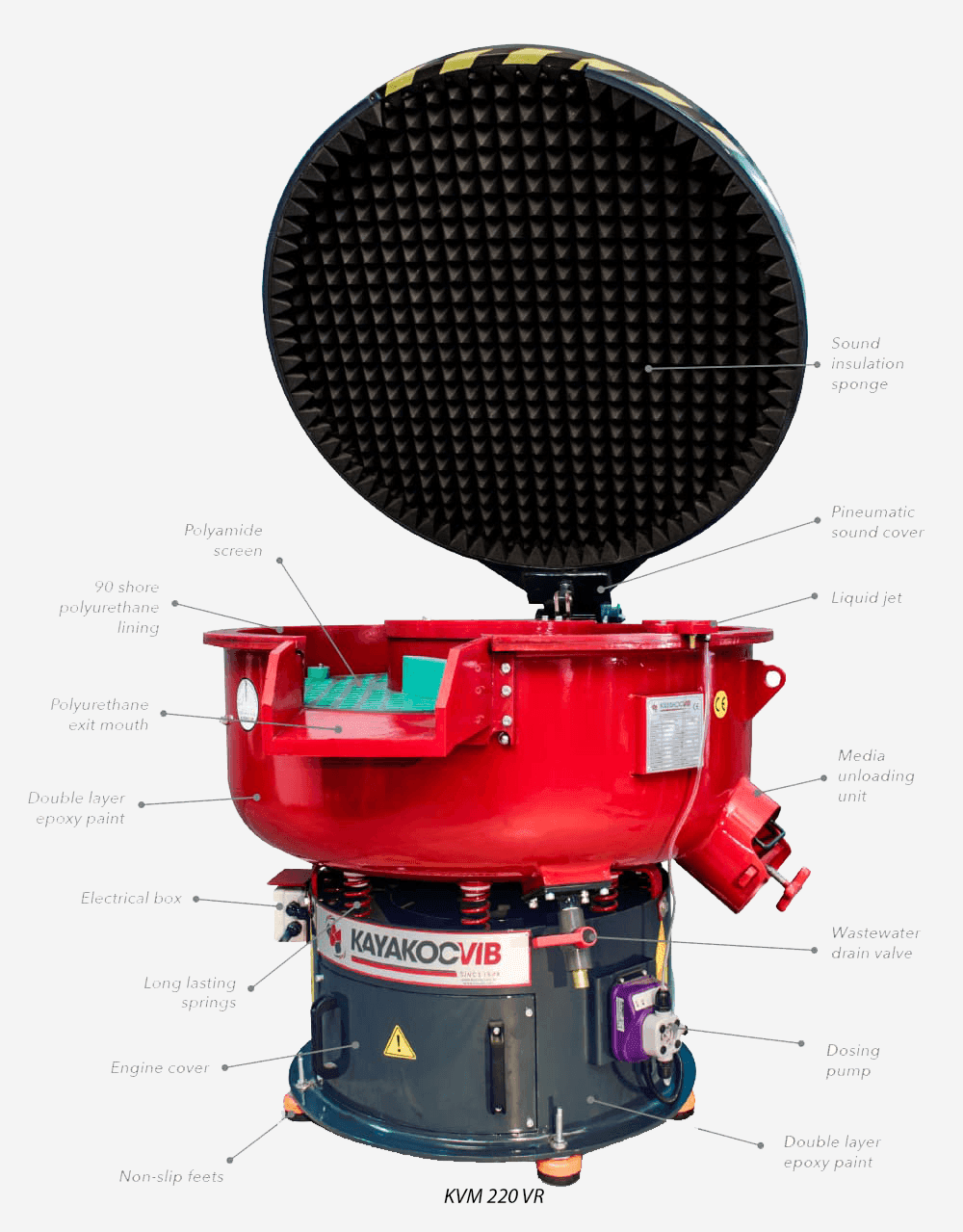
For small to medium steel and aluminum parts, circular vibratory finishing machines are the most common production platform. A machine such as the KAYAKOCVIB KVM series provides continuous part-media contact through three-dimensional vibratory motion, which produces uniform deburring and surface smoothing across complex geometries including bores, pockets, and undercuts that cannot be reached by manual or abrasive belt methods.
For longer automotive parts such as connecting rods, shaft components, or structural brackets that do not tumble well in a circular bowl, trough-type vibratory finishing machines are generally more appropriate. The KAYAKOCVIB TVM series trough machines allow long parts to be processed horizontally without the risk of part-to-part collision or excessive part rotation that can cause edge chipping on precision surfaces.
Media and Compound Selection for Automotive Applications
Media and compound selection directly controls the cutting rate, surface roughness, and edge condition after finishing. These selections must be matched to the part material and the target surface quality, not applied generically.
For steel and iron automotive components, ceramic media is the standard choice. Ceramic provides the cutting hardness required to remove machining burrs, stamping flash, and sharp edges from harder ferrous metals. A deburring and polishing compound such as a 943-type liquid is typically used with ceramic media to control the cutting rate and maintain clean water chemistry during wet processing.
For aluminum die castings and machined aluminum parts, plastic media is preferred. Plastic media is less aggressive than ceramic and reduces the risk of surface smearing, micro-gouging, or material buildup on softer aluminum surfaces. A compound such as an 085-type deburring and polishing liquid is commonly used with plastic media for aluminum parts. A 028-S type degreasing compound is also used in both material families when oil removal and chip cleaning are required before or during the finishing cycle.
Media shape selection affects which surfaces are contacted and how aggressively material is removed. Angle-cut cylinders and cones penetrate into pockets and bores well. Triangular and wedge-shaped media provide flat surface contact. Spherical burnishing media are used in later stages when a bright or smooth surface is the target rather than aggressive cutting. For automotive parts requiring multiple finishing stages, it is common to run a cutting stage first with a fresh or medium-worn ceramic or plastic media, followed by a refinement or burnishing stage with finer or less aggressive media.
Process Parameters That Control Surface Quality
After machine type and media are selected correctly, the process parameters determine whether consistent surface quality is achieved across every production batch. The following parameters must be defined, documented, and controlled as part of automotive finishing quality control.
| Parameter | Typical Range | Quality Impact |
|---|---|---|
| Cycle Time | 20 to 120 minutes depending on part and target | Determines extent of deburring and surface refinement |
| Media-to-Part Fill Ratio | 2:1 to 5:1 by volume | Insufficient media causes part-to-part contact and surface damage |
| Compound Dosing Rate | Application-dependent, typically 0.5 to 2 L per hour | Controls cutting rate, water clarity, and foam level |
| Water Flow Rate | Adjusted to maintain wet finishing conditions | Affects compound concentration and chip removal |
| Vibratory Amplitude | Adjusted per machine and part sensitivity | Higher amplitude increases cutting intensity; lower protects delicate parts |
| Media Condition | Monitored by size reduction over time | Worn media loses cutting efficiency and changes surface result |
All parameter values listed above are application-dependent. Actual settings must be validated through sample testing before production release. Results vary depending on part geometry, material condition, burr type, and machine characteristics.
Inspection and Quality Control Points in the Finishing Line
Automotive finishing quality control requires defined inspection points at multiple stages of the process, not only at final inspection. Waiting until parts reach final assembly to identify a finishing defect creates unnecessary scrap, rework, and production delay.
Incoming part inspection should confirm that parts entering the finishing line are free of excessive casting flash, gate stubs, or machining damage that vibratory finishing alone cannot correct. Heavy casting flash or large gate remnants generally require trimming before vibratory processing. Sending such parts into the finishing machine without pre-treatment reduces process efficiency and can damage media.
In-process inspection at the end of the finishing cycle should check for consistent edge condition across a sample of parts from each batch. Edge rounding uniformity, burr removal completeness, and surface roughness should be measured against defined acceptance criteria. For production lines running the same part continuously, statistical sampling per batch is the standard approach.
Post-finishing inspection must also confirm that no media lodging has occurred. Small media pieces trapped in bores, slots, or threaded holes are a serious quality risk in automotive assembly. Part geometry analysis during process development should identify lodging risk areas, and media size selection should be confirmed to prevent lodging in all critical features.
After wet vibratory finishing, parts must be washed and dried properly before inspection and packaging. Residual compound film, water staining, or rust formation on steel parts between finishing and drying will create surface defects that are difficult to distinguish from process failures. Washing with clean water and controlled drying in a vibratory dryer or forced-air drying system is part of the process, not an optional step.
Automation and Process Repeatability in Automotive Production
In automotive production, part volumes and quality consistency requirements make manual finishing operations difficult to sustain. Operator-dependent finishing processes introduce variability in cycle time, compound dosing, water flow, and part handling that directly affects surface quality consistency.
Automated finishing lines connect the vibratory finishing machine, separator, washing system, and drying unit in a continuous material flow. Parts are loaded by conveyor or robot, processed through the finishing cycle, separated from media automatically, washed, dried, and transferred to the next production stage without manual intervention between steps. This eliminates the principal sources of process variability while also improving throughput and reducing labor cost per part.
For automotive finishing quality control in automated lines, the control system should log cycle time, compound dosing rate, water flow, and machine amplitude for each production batch. This data provides traceability and allows process engineers to detect parameter drift before it causes surface quality failures. Media condition monitoring should also be integrated into the maintenance schedule, as worn media is one of the most common causes of gradual surface quality degradation in continuous production.
Common Quality Failures and Their Root Causes
Understanding the typical failure modes in automotive surface finishing helps production engineers intervene before defects reach downstream inspection or assembly.
- Inconsistent edge rounding across a batch usually indicates uneven part distribution, overloaded machine bowls, incorrect media fill ratio, or worn media that no longer provides uniform contact.
- Residual burrs after finishing typically point to insufficient cycle time, wrong media type or shape for the burr geometry, or media that is too worn to cut effectively.
- Surface smearing or micro-gouging on aluminum parts usually results from using ceramic media instead of plastic, or from running aluminum parts with steel parts in the same batch.
- Water staining or rust spotting on steel parts after finishing is caused by delayed drying, inadequate washing, or compound residue left on the part surface.
- Media lodging in bores or slots indicates that media size was not correctly matched to the part geometry during process development.
- Dimensional loss on thin walls or fine features suggests excessive cycle time, too aggressive a media grade, or too high a vibratory amplitude for delicate part sections.
Frequently Asked Questions
What is the most important factor in automotive finishing quality control?
Media selection matched to the base material is typically the most critical single factor. Using the wrong media type for the material, such as ceramic media on soft aluminum, can cause surface damage regardless of how well all other parameters are set. Machine type, cycle time, and compound selection are each important but depend on getting the media selection correct first.
How should cycle time be set for automotive parts?
Cycle time should be determined through sample testing, not estimated from general tables. The correct cycle time depends on the burr size, base material, media type and condition, machine amplitude, and target surface quality. Over-processing can cause dimensional loss or surface smearing, while under-processing leaves burrs and insufficient edge rounding. Production cycle time must be re-validated whenever media is replaced or machine settings are changed.
Can different automotive part materials be processed together in one batch?
Generally, no. Steel and aluminum parts should not be processed in the same batch. The hardness difference between materials creates a risk that harder particles from one material will damage softer parts. Compound chemistry optimized for one material may also be incompatible with another. Separate process batches by material family to maintain predictable surface quality and avoid cross-contamination.
How is media condition monitored in production?
Media wears gradually through normal use, reducing in size and cutting efficiency over time. Most finishing engineers track media size reduction by periodic weight or volume measurement of a media sample. When media drops below a minimum size threshold, lodging risk in small features increases and cutting efficiency drops. Replacing media before it reaches this threshold prevents gradual surface quality degradation and maintains process consistency.
Related Process Equipment
Related Video Demonstration
Conclusion
Automotive finishing quality control is an engineering discipline that requires correct process route design, matched media and compound selection, defined process parameters, and structured inspection at each stage of the finishing line. The most consistent results come from lines where material separation by batch is enforced, media condition is actively managed, compound dosing and cycle times are documented per part family, and automated material handling eliminates operator-dependent variability. For automotive production environments processing steel, aluminum, or mixed metal part families at high volumes, vibratory finishing with controlled process parameters remains the most scalable and repeatable method for achieving consistent deburring, edge rounding, and surface smoothing results. Process validation through sample testing before production release is always required, as actual surface quality results depend on application-specific conditions that cannot be fully predicted from general parameter tables alone.
Sorry, the comment form is closed at this time.