



01 Aug Automation Repeatability Deburring
Automation repeatability deburring is one of the most technically significant improvements available to manufacturers running high-volume or quality-critical finishing operations. In manual deburring, results vary between operators, shifts, and fatigue levels. In automated systems, every part follows the same controlled sequence with fixed machine settings, timed cycles, consistent media conditions, and repeatable compound dosing. The result is a statistically stable surface output that manual methods cannot match at scale.
In This Article
Why Repeatability Fails in Manual Deburring
Manual deburring introduces variability at multiple points. Operator technique differs between individuals. Pressure applied to a hand tool, angle of contact, and time spent on each part are all inconsistent. Shift changes and fatigue reduce consistency further. For parts with complex geometries, internal channels, or tight dimensional tolerances, manual deburring also creates risk of dimensional deviation or surface damage from uncontrolled contact.
In industries such as aerospace, medical device manufacturing, and precision CNC machining, these inconsistencies are not acceptable. A deburring process that produces different edge conditions on the same part number across production runs creates inspection failures, rework loops, and assembly problems downstream.
The Automation Repeatability Deburring Process Sequence
An automated deburring line eliminates operator dependency by locking in every process variable. The sequence below describes a typical workflow for a vibratory finishing-based automated system processing steel or aluminum CNC-machined parts.
- Parts arrive from the machining cell via conveyor or robotic transfer and are loaded into the vibratory finishing machine without manual handling.
- The machine control system activates the programmed cycle. Amplitude, vibration frequency, cycle time, and compound dosing rate are all set in the recipe stored in the PLC or HMI.
- Finishing media and compound work together inside the machine bowl or trough. Media type, size, and shape are selected based on part geometry, material, and burr characteristics. Water flow and compound concentration are controlled by a dosing pump on a fixed timer.
- At the end of the programmed cycle, the discharge gate opens automatically. Parts and media separate through an integrated separator unit. Parts are conveyed out while media returns to the machine bowl.
- If wet finishing was used, parts proceed through an integrated washing stage to remove compound residue, metal fines, and surface contamination before drying.
- Parts enter the drying stage. Corncob granules or drying chips absorb residual moisture. The dryer runs on a fixed temperature and time setting.
- Finished parts exit the drying unit and move to inspection or the next production stage via conveyor. No manual transfer occurs in a fully automated line.
Each step in this sequence is controlled by fixed parameters stored in the system recipe. When a new production batch starts, the operator selects the recipe and the system reproduces the same conditions as every previous run for that part number.
Machine Control Points That Drive Consistency
The repeatability of automated deburring depends on the precision of machine control at each stage. The following control points are technically significant.
Vibration amplitude and frequency determine how aggressively media contacts parts. In circular vibratory machines, amplitude is adjusted by changing eccentric weight settings. In production automation, these settings are locked in and should not be changed between batches unless a process change is approved and validated. Uncontrolled amplitude variation is a primary cause of inconsistent edge rounding results.
Cycle time is the most direct parameter controlling the degree of deburring and edge rounding. Automated systems run fixed timers. Manual processes rely on operator judgment. Even a 10 to 15 percent variation in cycle time can produce measurable differences in edge radius, surface roughness, and material removal depth on precision parts.
Compound dosing rate affects cutting action, surface brightness, and part cleanliness at discharge. Automated dosing pumps deliver a consistent compound-to-water ratio throughout the cycle. Manual compound addition is inconsistent and difficult to reproduce between operators or shifts.
Media load volume affects the part-to-media ratio inside the machine. Automated loading systems can maintain a controlled fill level. If media degrades over time, automated systems can track media consumption and trigger replenishment alerts to maintain consistent process conditions.
Media and Compound Selection for Automated Lines
Media and compound selection must match the base material and part geometry. In automated lines, these selections are fixed at process development and should not change without revalidation.
For steel and stainless steel parts, ceramic media is typically used because it provides the cutting force needed to remove machining burrs efficiently. Triangular, cylindrical, or satellite-shaped ceramic media are commonly selected depending on part geometry and the risk of media lodging in holes or recesses. A deburring and polishing liquid such as a compound formulated for ferrous metals is dosed continuously during the wet cycle.
For aluminum parts, plastic media is generally preferred. Aluminum is softer and more sensitive to surface marking from aggressive ceramic cutting. Plastic media provides controlled cutting with lower risk of surface damage. A compound suitable for non-ferrous metals is dosed at the appropriate concentration. Mixing aluminum and steel parts in the same finishing batch is not recommended because their different densities and surface sensitivities produce inconsistent results and potential contamination.
In fully automated lines, compound is stored in a bulk container connected to a metering pump. The pump activates on a timed schedule during the cycle. This eliminates manual addition errors and ensures every batch receives the same chemical concentration.
Process Parameters and Their Effect on Surface Output
| Parameter | Controlled By | Effect on Output | Risk if Uncontrolled |
|---|---|---|---|
| Vibration amplitude | Eccentric weight setting | Cutting intensity and media pressure on part surface | Inconsistent edge radius, surface marking |
| Cycle time | PLC timer or recipe | Degree of deburring and edge rounding | Under- or over-processing, batch variation |
| Compound dosing rate | Metering pump | Surface brightness, cutting efficiency, cleanliness | Staining, insufficient deburring, contamination |
| Media type and size | Process specification | Cutting action, edge geometry, surface finish | Media lodging, surface damage, poor deburring |
| Media-to-part ratio | Fill level control | Contact frequency and process uniformity | Underfill causes part-on-part collision damage |
| Water flow rate | Flow control valve | Compound dilution and sludge removal | Sludge buildup reduces process efficiency |
Actual surface output values depend on material, burr size, part geometry, media condition, and machine settings. All parameter ranges must be validated through sample testing before production release. The table above identifies where each parameter is controlled and what happens when it is left uncontrolled.
Washing and Drying in the Automated Sequence
After wet vibratory finishing, parts carry compound residue, metal fines, and fine media particles on their surface. In manual operations, washing is often inconsistent. In automated lines, parts pass through a washing station immediately after separation. Pressure washing or immersion washing removes residue reliably when water pressure, temperature, and dwell time are fixed.
Drying follows washing. Corncob or synthetic drying media in a vibratory or trough dryer removes surface moisture. The dryer operates at a set temperature with a fixed cycle time. In automated lines, drying output is consistent because the machine conditions do not change between batches. Inconsistent drying in manual operations often results in surface staining, oxidation on steel parts, or water marks on aluminum.
For facilities managing water consumption, wastewater treatment units can be integrated after the washing stage to recycle process water and manage compound-loaded effluent. This supports environmental compliance and reduces operating cost in high-volume automated finishing lines.
Production Validation Before Release
Automation improves repeatability, but the process must be validated before production release. Validation confirms that the locked-in parameters consistently produce parts within the required edge condition, surface roughness, and cleanliness specification.
The recommended validation approach includes running a defined sample batch using the production recipe, inspecting parts at the start, middle, and end of the batch, and comparing results against acceptance criteria. Edge radius can be measured with optical profilers or contact measurement tools. Surface roughness can be measured with a profilometer. Cleanliness can be assessed by visual inspection, gravimetric analysis, or cleanliness test methods depending on the application.
If the validation batch is within specification, the recipe is approved and locked. Any future change to media type, compound, machine settings, or cycle time requires a revalidation cycle. This discipline is what makes automation repeatability deburring technically sustainable over long production periods.
Integration into CNC and Assembly Production Lines
Automated deburring lines can be positioned immediately after a CNC machining cell, reducing inter-process handling and queue time. Part transfer can be managed by conveyors, robots, or vibratory feed systems depending on part size and geometry. In high-volume production of fasteners, turned parts, or stamped components, continuous feed systems allow parts to enter and exit the finishing machine without batch interruption.
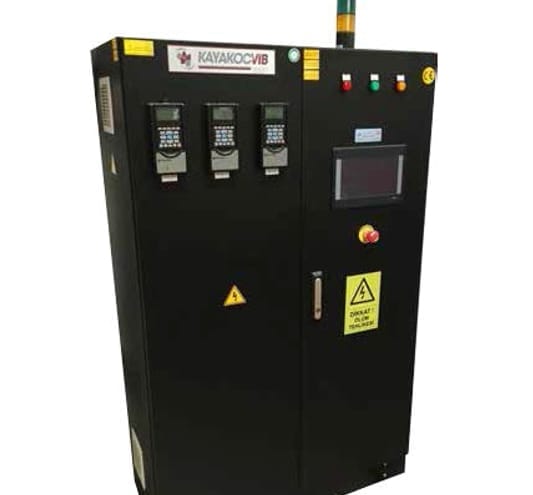
For mid-volume precision CNC parts, batch processing with robotic loading is more common. The robot loads a defined quantity of parts into the vibratory machine, the machine runs the recipe, and the robot or conveyor removes finished parts for inspection. KAYAKOCVIB automation systems support both continuous and batch configurations, integrating machine control, separation, washing, and drying into a single line managed from a central control panel.
In automotive and aerospace supply chains, automated deburring lines also support traceability requirements. Batch records, cycle parameters, and timing data can be logged automatically, creating a production record that confirms each batch was processed within validated conditions. This data is increasingly required by quality management systems in safety-critical industries.
Frequently Asked Questions
What is the main advantage of automation in deburring over manual methods?
The main advantage is process repeatability. Automated systems apply fixed parameters across every batch and every part, eliminating the variation introduced by operator technique, shift changes, and fatigue. This produces statistically stable edge and surface conditions that manual deburring cannot achieve at production scale.
Which machine types are used in automated deburring lines?
Circular vibratory finishing machines are the most common choice for small to medium parts in high-volume production. Trough vibratory machines are used for longer or more delicate parts. Centrifugal disc finishing machines are used when short cycle times and high surface quality are required for precision components. Machine selection depends on part geometry, material, production volume, and required surface specification.
How does compound dosing affect repeatability?
Compound dosing directly affects cutting efficiency, surface brightness, and cleanliness. Manual compound addition is inconsistent between operators and batches. Automated metering pumps deliver a controlled concentration throughout the cycle, ensuring every batch receives the same chemical conditions. Inconsistent dosing is a common cause of surface staining, reduced deburring efficiency, and batch-to-batch variation.
Can automated deburring lines handle mixed part families?
Yes, but each part family requires its own validated recipe. Automated systems store multiple recipes in the PLC. The operator selects the recipe for the current part number. Mixing different materials such as aluminum and steel in the same batch is not recommended because their finishing requirements differ significantly.
Related Process Equipment
Related Video Demonstration
Conclusion
Automation repeatability deburring solves the core problem of manual finishing: uncontrolled variation between operators, batches, and shifts. By fixing every process variable inside a machine recipe, from vibration amplitude and cycle time to compound dosing and drying conditions, automated lines produce consistent edge quality and surface condition across thousands of parts. The process walkthrough described here applies to CNC machined parts, fasteners, stamped components, and precision parts across automotive, aerospace, medical, and general manufacturing. Validation remains essential before production release, and any parameter change requires revalidation. When properly implemented and maintained, automated deburring delivers a level of process consistency that supports quality systems, reduces rework, and enables reliable production scaling.
Sorry, the comment form is closed at this time.