



28 Jul Industrial Ultrasonic Cleaners
Industrial ultrasonic cleaners are widely used in precision manufacturing environments where mechanical washing, manual cleaning, or spray rinsing cannot reliably remove contaminants from complex part geometries. Ultrasonic cleaning relies on acoustic cavitation to penetrate blind holes, fine threads, internal passages, and tight tolerances that conventional washing systems cannot reach effectively. For industries such as automotive, aerospace, medical device manufacturing, and CNC machining, ultrasonic cleaning is often the preferred cleaning method when surface cleanliness directly affects downstream processes such as coating, passivation, assembly, or inspection.
In This Article
Where Ultrasonic Cleaning Fits in Precision Component Manufacturing
Precision components typically carry several types of surface contamination after machining or finishing operations. These include cutting oils, emulsion-based coolants, grinding paste, fine metal chips, burr fragments, polishing compound residue, oxide films, and handling soils. The cleaning requirement varies depending on the downstream process. Parts destined for electroplating, PVD coating, or passivation must meet a higher cleanliness standard than parts going directly to assembly.
Ultrasonic cleaning is most valuable when part geometry creates access challenges for spray or immersion washing. Internal channels in hydraulic components, fine threads in fuel injection parts, micro-holes in medical implants, and recessed features in aerospace precision parts all present cleaning challenges that benefit from the penetrating action of cavitation energy. For parts with open geometries and moderate contamination, pressure washing systems may be sufficient and faster. The decision between ultrasonic and pressure-based cleaning depends on contamination type, part geometry, required cleanliness level, and process throughput.
How Industrial Ultrasonic Cleaners Work
Ultrasonic cleaning operates by converting electrical energy into high-frequency mechanical vibration through piezoelectric transducers bonded to the tank wall or immersed in the cleaning bath. These transducers typically operate at frequencies between 25 kHz and 130 kHz. The vibration generates alternating pressure waves in the liquid, creating millions of microscopic cavitation bubbles that form and collapse rapidly. The collapse of these bubbles releases localized energy that mechanically dislodges contamination from part surfaces, including interior features that liquid flow alone cannot reach.
Lower frequencies, typically in the 25 kHz to 40 kHz range, generate larger and more energetic cavitation bubbles. This produces stronger mechanical scrubbing action suitable for robust parts with heavy contamination or tightly adhered soils. Higher frequencies, in the 80 kHz to 130 kHz range, produce finer and more uniform cavitation that is gentler on part surfaces. This is preferred for soft materials, highly polished surfaces, or delicate precision parts where surface integrity must be preserved.
Frequency selection is therefore not arbitrary. For hardened steel CNC components with coolant and chip contamination, a lower frequency around 25 to 40 kHz is generally effective. For aluminum optical components, polished stainless steel medical parts, or thin-walled aerospace structures, a higher frequency in the 80 kHz range reduces the risk of surface damage or erosion.
Typical Cleaning Sequence for Precision Parts
A complete industrial ultrasonic cleaning line for precision components typically includes several sequential stages rather than a single cleaning tank. Each stage has a defined function, and omitting stages often results in incomplete cleaning or recontamination.
- Pre-wash or pre-rinse: Removes bulk contamination such as chips, loose oils, and gross soils before the ultrasonic stage. This prevents rapid bath contamination and extends cleaning solution life.
- Ultrasonic cleaning bath: The main cleaning stage where cavitation removes adhered oils, machining residues, and fine particles. Temperature, chemistry, frequency, and immersion time are the key variables at this stage.
- Ultrasonic rinse or cascade rinse: One or more rinse stages remove cleaning chemistry and loosened contamination from part surfaces. Ultrasonic agitation during rinsing improves penetration into internal features.
- Passivation bath (where required): For stainless steel components, a dilute nitric or citric acid passivation stage may follow rinsing. This removes free iron and promotes a stable chromium oxide passive layer. Passivation is commonly required in medical and aerospace applications.
- Final deionized water rinse: Prevents mineral deposits and water stains on precision surfaces. Deionized water quality is typically monitored by conductivity to ensure consistent results.
- Drying: Hot air drying, vacuum drying, or infrared drying removes residual moisture to prevent oxidation and prepare parts for the next process step.
The number of stages and chemistry at each stage must be matched to the part material, contamination profile, and downstream process requirements. A cleaning sequence suitable for steel hydraulic components is not necessarily suitable for aluminum aerospace parts or medical implants.
Cleaning Chemistry and Compound Selection
Ultrasonic cleaning performance depends heavily on chemistry selection. The cleaning solution must emulsify or saponify the target contamination, remain chemically compatible with the part material, and not leave residues that interfere with downstream operations.
Alkaline cleaning compounds are most commonly used for steel, stainless steel, and hardened tool steel parts. These compounds effectively emulsify cutting oils, coolants, and grinding pastes at elevated temperatures typically between 50 and 70 degrees Celsius. For aluminum and light alloy components, neutral or mildly alkaline chemistry is preferred because strongly alkaline solutions can attack aluminum surfaces and cause etching or discoloration.
Aqueous cleaning compounds based on surfactant and builder combinations are the standard for most industrial ultrasonic applications. Solvent-based ultrasonic cleaning, typically using modified alcohols or hydrofluoroethers, is used in specialized applications such as electronic components or precision optics where aqueous residues are unacceptable. Solvent-based systems require additional safety and environmental controls.
For mixed metal batches involving both steel and aluminum parts, selecting a chemistry that is safe for the most sensitive material is generally the conservative approach, though cleaning effectiveness for harder soils may require adjustment through temperature, time, or concentration.
Process Parameters That Control Cleaning Quality
Understanding which parameters control cleaning quality allows process engineers to optimize cleaning lines systematically rather than through trial and error.
| Parameter | Typical Range | Effect on Cleaning |
|---|---|---|
| Ultrasonic frequency | 25 to 130 kHz | Lower frequency increases cavitation intensity; higher frequency is gentler on surfaces |
| Bath temperature | 40 to 75°C | Higher temperature improves chemical activity and oil emulsification |
| Cleaning compound concentration | 1 to 5% by volume (application dependent) | Too low reduces cleaning action; too high increases rinsing burden and cost |
| Immersion time | 3 to 20 minutes per stage | Longer time improves cleaning of complex geometries; excessive time risks surface attack on sensitive materials |
| Basket loading density | Part-dependent | Overloading creates shielding between parts and reduces cavitation energy distribution |
| Rinse water quality | Deionized, conductivity typically below 20 µS/cm | Poor rinse water quality causes mineral deposits and staining on precision surfaces |
These ranges are indicative for typical industrial applications. Actual parameters must be validated through sample testing for each specific part, material, contamination type, and cleanliness requirement. Cleaning performance should be confirmed through cleanliness testing methods appropriate to the application, such as gravimetric particle counting, water break tests, or white light inspection.
Industrial Applications by Sector
The application profile of industrial ultrasonic cleaners spans several manufacturing sectors, each with distinct cleanliness requirements and part geometry challenges.
In automotive manufacturing, ultrasonic cleaning is frequently used for fuel injector components, hydraulic valve bodies, turbocharger housings, and transmission precision parts. These components carry tight tolerances and internal passage geometries that require complete removal of machining chips, coolant residues, and metallic particles before assembly. Residual particles in hydraulic or fuel systems can cause premature wear or functional failure.
Aerospace applications typically involve aluminum structural components, titanium precision parts, and high-strength steel fasteners. The cleanliness standards for aerospace parts are stringent, and ultrasonic cleaning is often followed by passivation, conversion coating, or anodizing processes that require clean, oxide-free surfaces. Frequency selection and chemistry compatibility must be carefully validated for aerospace-grade alloys.
Medical device manufacturing represents one of the most demanding applications for ultrasonic cleaning systems. Implants, surgical instruments, and precision components must be cleaned to levels that support biocompatibility validation and sterilization processes. Stainless steel and titanium implants commonly require ultrasonic cleaning followed by passivation and deionized water rinsing as part of a validated cleaning protocol. In this sector, cleaning process documentation and validation are as important as the cleaning result itself.
CNC machining operations across general metal processing generate parts with consistent contamination profiles, primarily cutting oil, emulsion coolant, and fine metallic chips. Industrial ultrasonic cleaners integrated into CNC production lines allow consistent pre-inspection or pre-coating cleaning without manual handling steps.
Comparing Ultrasonic Cleaning with Pressure Washing
Industrial ultrasonic cleaners and pressure washing machines both serve degreasing and cleaning functions but operate through different mechanisms and are suited to different part profiles.
| Criterion | Ultrasonic Cleaning | Pressure Washing |
|---|---|---|
| Cleaning mechanism | Acoustic cavitation in liquid bath | High-pressure spray and impingement |
| Internal feature access | Excellent for blind holes, fine threads, internal passages | Limited for internal features; spray access required |
| Cycle time | Typically longer per batch | Typically faster for open-geometry parts |
| Part geometry suitability | Complex, precision, internal passages | Open, accessible surfaces |
| Chemistry requirement | Aqueous or solvent chemistry matched to material | Aqueous alkaline or neutral chemistry |
| Capital investment | Higher for multi-stage systems | Moderate |
| Automation integration | Possible with conveyor or robot loading | Well-suited to conveyor or rotary drum systems |
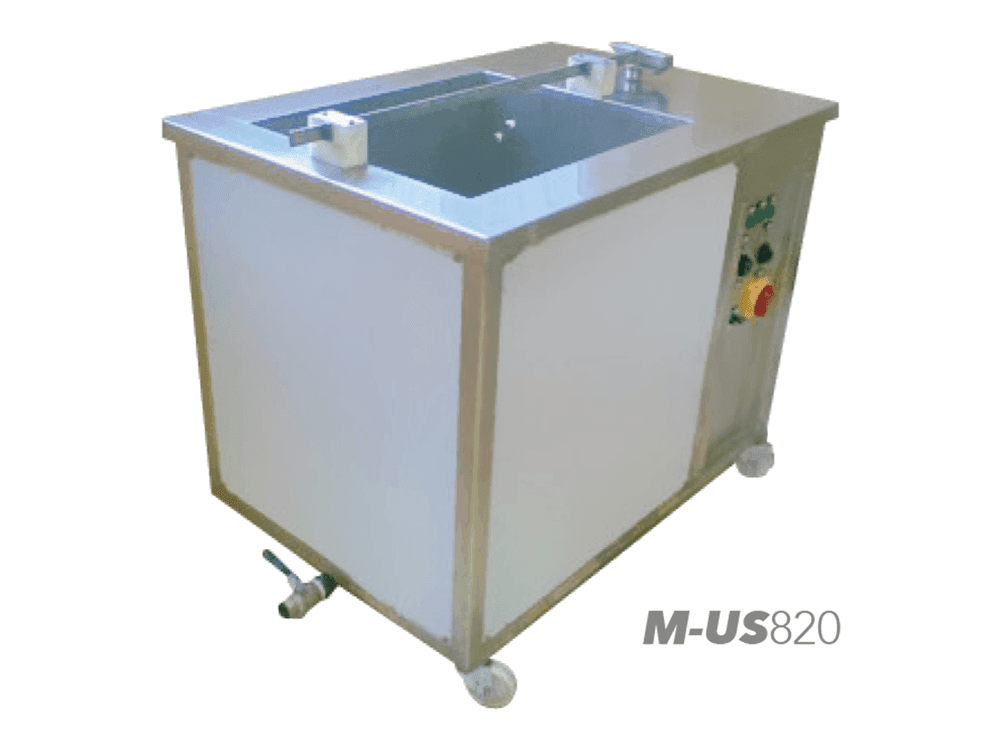
In many industrial finishing lines, both technologies are used in combination. Pressure washing may handle bulk degreasing and chip removal in a first stage, with ultrasonic cleaning reserved for final precision cleaning of parts with critical cleanliness requirements. The KAYAKOCVIB USW ultrasonic cleaner and PRS-W pressure washing systems are examples of equipment used in such multi-stage configurations, where each machine is positioned according to its process strength.
Filtration and Bath Maintenance
Maintaining cleaning bath quality is essential for consistent cleaning performance. Ultrasonic cleaning baths accumulate oil, metallic particles, and decomposed chemistry over time. Without effective filtration, bath contamination eventually redeposits on parts or reduces cavitation efficiency.
Most industrial ultrasonic systems use continuous or intermittent filtration through paper, bag, or cartridge filters positioned in the bath recirculation circuit. Oil skimmers or coalescing separators are used to remove free-floating oil from the bath surface. Regular monitoring of bath conductivity, pH, and visual contamination level helps determine when bath chemistry must be refreshed or replaced.
Wastewater from ultrasonic cleaning and rinsing stages must be managed according to applicable environmental regulations. Emulsified oils, surfactants, and metallic particles in spent bath and rinse water typically require treatment before discharge. Wastewater treatment and recycling systems help reduce water consumption, lower disposal costs, and support sustainability targets in production facilities.
Automation and Line Integration
Industrial ultrasonic cleaning systems can be integrated into automated production lines at varying levels of complexity. In high-volume manufacturing, parts are transported through sequential cleaning stages using conveyors, robotic loading systems, or indexed tank carriers. Fully automated lines eliminate manual handling between stages, reduce cross-contamination risk, and support consistent process control.
For CNC machining cells, robotic or conveyor-based loading of ultrasonic cleaning tanks directly after machining operations enables continuous production flow without manual intervention. Parts enter the cleaning sequence, pass through ultrasonic wash, rinse, optional passivation, and drying stages, and exit ready for inspection, coating, or assembly. This integration reduces part handling time and supports traceability requirements in regulated industries.
Automation readiness depends on part geometry, basket or fixture design, throughput requirements, and the number of cleaning stages in the sequence. Process engineers should evaluate loading density, basket shielding effects, part fixture design, and drainage efficiency as part of line commissioning.
Frequently Asked Questions
What frequency should be used for industrial ultrasonic cleaners on aluminum parts?
For aluminum components, higher frequencies in the 60 to 80 kHz range are generally preferred. Higher frequencies produce smaller, less aggressive cavitation bubbles that clean effectively without risking surface erosion or pitting on softer aluminum alloys. Frequency selection should be validated with sample testing before production release.
Can industrial ultrasonic cleaners replace passivation for stainless steel?
No. Ultrasonic cleaning removes surface contamination, oils, and particles but does not perform passivation. For stainless steel components requiring a stable passive oxide layer, a dedicated passivation stage using dilute nitric or citric acid must follow ultrasonic cleaning and rinsing. The two processes have different functions and are typically used in sequence.
How often should ultrasonic cleaning bath chemistry be changed?
Bath life depends on part load, contamination type, filtration efficiency, and bath volume. Regular monitoring of pH, conductivity, and visual bath condition provides the most reliable indicator. In high-production environments, bath analysis at defined intervals is recommended. There is no universal replacement schedule that applies across all applications.
Are industrial ultrasonic cleaners suitable for mixed metal batches?
Mixed metal batches present chemistry compatibility challenges. Steel and aluminum parts require different chemistry profiles, and a single cleaning solution must be validated as safe and effective for all materials present. In most precision cleaning applications, separating steel and aluminum parts into dedicated cleaning batches produces more consistent results and reduces the risk of material damage.
Related Process Equipment
Related Video Demonstration
Conclusion
Industrial ultrasonic cleaners deliver cleaning performance that is not achievable through spray washing or immersion cleaning alone, particularly for precision components with complex internal geometries, tight tolerances, or high cleanliness requirements. The engineering logic for selecting and optimizing an ultrasonic cleaning system involves matching frequency to part material and sensitivity, selecting chemistry compatible with contamination type and downstream process, designing the full cleaning sequence including rinsing, passivation, and drying stages, and integrating filtration and wastewater management. For manufacturers in automotive, aerospace, medical, and general CNC machining sectors, a properly configured ultrasonic cleaning system provides a reliable, repeatable foundation for surface cleanliness at the precision level these industries require. Process validation through sample testing remains essential before committing to production parameters, as actual cleaning performance depends on the specific combination of part geometry, material, contamination profile, and required cleanliness standard.
Sorry, the comment form is closed at this time.