


25 Jun When to Buy Finishing Machine
Deciding when to buy a finishing machine is one of the more consequential production decisions a manufacturer can make. The question is not simply whether a finishing process is needed, but whether the current manual or outsourced approach is costing more in time, labor, quality risk, and capacity than a dedicated machine would. This article provides an engineering-based framework for evaluating that decision, covering the production signals that justify investment, the machine selection logic that follows, and the financial reasoning that supports a clear answer.
In This Article
The Core Decision Problem
Most manufacturers begin surface finishing manually. Operators use files, bench grinders, flap wheels, or sandpaper to deburr and refine parts. For low volumes, this is often acceptable. The problem arises when production volume increases, when part complexity rises, or when quality requirements become more stringent than manual work can consistently satisfy.
Manual finishing is inherently variable. Two operators working on the same part will produce different results. Cycle time per part is difficult to control, and it scales poorly with volume. As part counts grow, labor hours accumulate, scrap rates from inconsistent finishing can increase, and delivery schedules begin to depend on finishing capacity rather than machining capacity.
The decision to invest in a finishing machine is justified when manual or outsourced finishing becomes the rate-limiting step in the production line, or when the quality gap between manual results and product requirements can no longer be closed by labor alone.
Production Signals That Indicate a Machine Is Needed
There is no single threshold that triggers the need for a finishing machine. However, a set of recurring production signals, when present together, strongly indicate that the investment is economically and technically justified.
- Finishing labor hours consistently exceed 10 to 15 percent of total part production time
- Quality complaints or part rejections trace back to surface condition rather than dimensional error
- Outsourced finishing costs are rising or lead times are extending
- Production capacity is being held back by the finishing stage
- Part drawings specify Ra values, edge condition requirements, or surface cleanliness that manual work cannot reliably achieve
- New product contracts require consistent, documented surface finishing as part of delivery requirements
- Part mix has expanded to include materials or geometries that manual methods handle poorly
When three or more of these signals are present simultaneously, the case for investment becomes strong. When all of them are present, continuing without a machine typically generates more cost than the machine itself would require.
When to Buy a Finishing Machine Based on Part and Process Analysis
Beyond production signals, the decision requires a technical analysis of the parts being processed. The part geometry, material, burr condition, and required surface outcome each influence both the decision to invest and the type of machine required.
Part Geometry and Size
Small to medium parts with complex geometry, internal features, holes, or slots are typically well suited for mass finishing in vibratory or centrifugal machines. These machines process large batches simultaneously, with the media reaching surfaces that manual tools cannot access. For long or slender parts, circular vibratory machines may cause tangling or collision damage, and a trough-type machine is more appropriate.
Material and Burr Condition
Steel and stainless steel parts with heavy burrs from stamping, milling, or turning require high-cutting ceramic media and sufficient machine energy to achieve consistent deburring. Aluminum, zinc alloy, and softer metal parts generally require plastic media to avoid over-cutting and surface damage. Mixed-material batches should generally be avoided because the process parameters optimized for one material may damage another.
Required Surface Quality
If the downstream process includes coating, plating, anodizing, or adhesive bonding, surface preparation quality directly affects the adhesion and performance of the next process. In these cases, the finishing machine is not optional. It is a functional process requirement, not a quality enhancement.
Machine Selection Logic After the Decision Is Made
Once the decision to invest is confirmed, the selection of machine type follows from the part and process analysis. The four primary machine categories relevant to most manufacturers are circular vibratory machines, trough vibratory machines, centrifugal disc machines, and dryers.
| Machine Type | Best Suited For | Typical Batch Size | Cycle Time |
|---|---|---|---|
| Circular Vibratory (KVM) | Small to medium parts, general deburring, polishing, fasteners, CNC parts | Medium to large | 30 to 120 minutes typically |
| Trough Vibratory (TVM) | Long parts, large castings, delicate parts prone to collision damage | Small to medium | 30 to 180 minutes typically |
| Centrifugal Disc (KSM) | Small high-precision parts, medical components, short cycle requirements | Small to medium | 5 to 30 minutes typically |
| Vibratory Dryer (DVM) | Drying wet parts after vibratory finishing, corrosion prevention | Matched to upstream machine | 10 to 30 minutes typically |
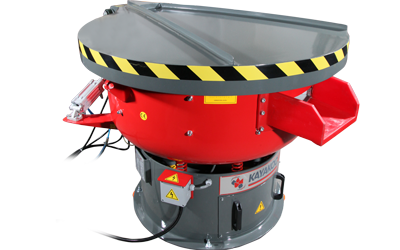
Circular vibratory machines such as the KAYAKOCVIB KVM series are the most common starting point for manufacturers entering automated finishing. They handle a wide range of part types, accept both ceramic and plastic media, and can be integrated with separators and dryers as volume grows. For parts that are too long or too fragile for circular machines, trough vibratory machines such as the KAYAKOCVIB TVM series provide a gentler process with controlled part movement.
For manufacturers with high-precision requirements and short cycle time needs, centrifugal disc finishing machines such as the KAYAKOCVIB KSM series operate at significantly higher intensity than vibratory machines and can achieve comparable surface results in a fraction of the time. This makes them appropriate for medical components, precision aerospace parts, and high-value CNC parts where throughput and surface quality are both priorities.
ROI Calculation Framework
Understanding when to buy a finishing machine requires translating production signals into financial terms. A straightforward ROI calculation helps justify or defer the investment based on actual production data.
The primary cost categories to measure are direct labor cost for manual finishing, outsourcing cost if applicable, scrap and rework cost attributable to finishing quality failures, and any production delays caused by finishing being the bottleneck. These costs represent the ongoing operational loss that a machine would reduce or eliminate.
On the investment side, the machine purchase price, installation cost, media and compound cost, and any infrastructure modifications represent the total investment. In most industrial cases, the payback period for a mass finishing machine can range from six months to two years depending on production volume, labor cost structure, and the degree to which the machine replaces outsourced work. Actual payback depends on application conditions and must be validated against real production data.
A simple first-pass calculation compares annual finishing cost before machine investment against the projected annual cost after machine investment. When the difference exceeds the machine cost within a two-year window, the investment is typically justified from a purely financial perspective.
Common Mistakes in the Investment Decision
Several recurring mistakes delay or complicate the decision to invest in a finishing machine. Understanding these helps manufacturers avoid them.
The most common mistake is underestimating manual finishing cost. Labor cost per part is often calculated only as direct wages, excluding supervision time, rework time, inspection time, and the cost of inconsistent quality. When all finishing-related labor is included, the true cost per part is typically higher than initial estimates suggest.
Another common mistake is selecting a machine based on purchase price rather than process fit. A smaller or lower-cost machine that cannot handle the required batch size, part geometry, or surface quality will not solve the production problem. Machine selection must be driven by part requirements first, then validated against production volume and budget.
A third mistake is purchasing a machine without validating the process with sample testing. Surface finishing results depend on the interaction between the machine, media type and size, compound chemistry, water flow rate, load volume, and cycle time. These parameters must be established through controlled sample runs before committing to a production configuration.
Automation Readiness and Line Integration
For manufacturers with higher production volumes or multiple part families, the question of when to buy a finishing machine also involves deciding how much automation to integrate from the start. A standalone machine handles the finishing operation, but an integrated line adds part loading, media separation, washing, drying, and part unloading without manual intervention between steps.
Integration decisions should be based on the ratio between labor cost and throughput requirement. When batch sizes are large enough that manual handling between machines adds measurable labor time per batch, automation of the transfer steps becomes financially viable. Separator machines, vibratory dryers, and washing systems can be added as modules to an existing machine line as volume grows, allowing manufacturers to start with a core machine and expand incrementally.
Validation Checklist Before Purchase
Before finalizing the decision to buy a finishing machine, the following technical and operational questions should be answered.
- Has the current finishing cost per part been measured accurately, including all labor, rework, and outsourcing costs?
- Has sample testing confirmed that the selected machine type and media combination can achieve the required surface result on the actual production part?
- Is the machine capacity matched to the current and projected production volume?
- Has the facility been evaluated for floor space, electrical supply, water supply, and drainage requirements?
- Is there a plan for media management, compound supply, and wastewater disposal or recycling?
- Has the operator training requirement been assessed?
- Is the downstream process requirement, such as coating, plating, or inspection, clearly defined so the finishing target is measurable?
If all seven points have been addressed, the purchase decision rests on a solid technical and operational foundation. If several remain unresolved, addressing them before purchase will reduce the risk of selecting the wrong machine or configuration.
Frequently Asked Questions
At What Production Volume Does a Finishing Machine Become Justified?
There is no universal volume threshold. The justification depends on labor cost per part, outsourcing cost, quality requirement, and machine investment. In many cases, manufacturers find that finishing machine investment becomes financially justified when monthly part volumes exceed several thousand pieces requiring consistent finishing, but actual breakeven depends on part value and finishing complexity.
Can One Machine Handle Multiple Part Families?
Yes, with process parameter adjustments. However, parts with significantly different materials, sizes, or burr conditions may require separate media loads or separate batch runs to avoid process conflicts. Mixing aluminum and steel in the same batch is generally not recommended because the media aggressiveness optimized for one material will produce incorrect results on the other.
What Is the Difference Between Vibratory and Centrifugal Disc Finishing for Machine Selection?
Vibratory finishing uses lower-intensity media movement and is suitable for a wide range of part types and sizes. Centrifugal disc finishing operates at much higher intensity, producing faster cycle times and higher surface quality on small precision parts. The selection depends on part sensitivity, required cycle time, and surface quality target. Delicate or large parts are generally not suitable for centrifugal disc machines.
Does the Machine Replace All Manual Finishing?
In most cases, a finishing machine handles the primary deburring, edge rounding, or surface refinement operation. Some parts may still require targeted manual finishing for specific features such as deep bores, sharp internal corners, or surfaces requiring visual inspection. The machine reduces labor significantly but may not eliminate all manual steps depending on part geometry and quality specification.
Related Machine and Process Resources
Conclusion
The decision of when to buy a finishing machine is an engineering and financial judgment based on production signals, part requirements, and process capability. When manual or outsourced finishing is limiting production capacity, generating quality failures, or accumulating labor costs that exceed the machine investment over a two-year horizon, the case for purchase is strong. Machine selection must follow part analysis, not budget alone, and process parameters must be validated through sample testing before production commitment. For manufacturers evaluating this step, the most reliable approach is to measure actual finishing cost accurately, define the surface quality requirement precisely, and validate the selected machine type against real production parts before finalizing the investment.
Sorry, the comment form is closed at this time.