


31 Jul Wastewater Recycling Vibratory Finishing
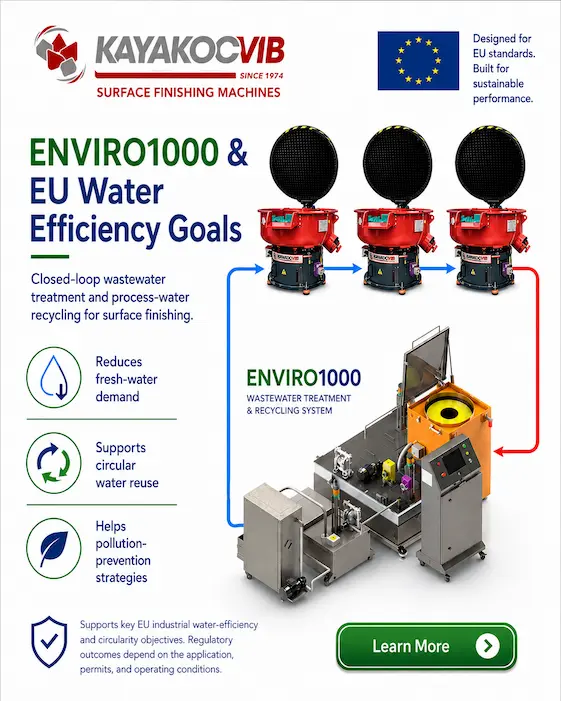
Wastewater recycling vibratory finishing is a water management approach that captures, treats, and recirculates process water generated during wet vibratory finishing operations. In industrial mass finishing, vibratory machines use a continuous flow of water mixed with finishing compounds to transport media, remove swarf, cool parts, and carry away surface contamination. Without a treatment system, this water must be discharged as industrial effluent or hauled off-site at significant cost and environmental impact. A closed-loop recycling system changes the economics and compliance profile of the entire finishing operation by recovering usable water from treated effluent and returning it to the finishing machine.
In This Article
Why Wastewater Management Matters in Vibratory Finishing
Wet vibratory finishing produces a continuous stream of contaminated water. This effluent contains fine abrasive particles worn from ceramic or plastic media, metallic swarf removed from part surfaces, residual finishing compound, oil and emulsion transferred from incoming parts, and dissolved or suspended oxides depending on the base material being processed. For facilities running steel, stainless steel, aluminum, or mixed metal components, the composition of this effluent changes with each material type, making generic discharge solutions unreliable without treatment.
Regulatory pressure on industrial wastewater discharge has increased across most manufacturing regions. Limits on suspended solids, pH, oil content, and heavy metals require that finishing operations either treat their effluent to acceptable levels or pay for external disposal. For high-volume finishing departments processing automotive components, CNC machined parts, or stamped metal parts, daily water consumption can be substantial. Wastewater recycling vibratory finishing directly reduces both raw water consumption and disposal volume, which affects operational cost in two directions simultaneously.
How the Closed-Loop Recycling Process Works
A closed-loop wastewater recycling system for vibratory finishing collects process water from the separator or machine discharge, passes it through a sequence of treatment stages, and returns clarified water to the machine inlet. The treatment sequence depends on the contamination profile of the effluent, but a complete industrial system typically addresses four categories: suspended solids, free and emulsified oils, pH adjustment, and residual compound chemistry.
In the first stage, gross solids are removed by screening or settling. Fine metallic particles and media fines that pass through the separator screen are allowed to settle in a holding tank or are captured by a drum filter or belt filter unit. This stage reduces the suspended solids load before chemical treatment and prevents accumulation of abrasive particles in downstream pumps and pipework.
In the second stage, oil separation is performed. Incoming parts often carry cutting oil, stamping lubricant, or coolant residue that transfers into the process water during finishing. Free oils can be skimmed mechanically. Emulsified oils require demulsification using specific chemical agents before separation becomes effective. Leaving oil in recycled water degrades compound performance, causes foam, and can leave surface staining on finished parts.
In the third stage, flocculation or coagulation is applied to aggregate fine suspended particles into larger settleable or filterable flocs. A flocculant chemical is dosed into the treated stream under controlled mixing, causing fine metallic and abrasive particles to cluster and settle to the sludge zone. The clarified overflow water then moves to a holding tank ready for recirculation. Sludge collected from the flocculation stage is dewatered using a filter press or centrifuge before disposal or material recovery.
In the fourth stage, pH adjustment is applied if needed. Most finishing compounds operate best within a specific pH range, and recycled water must be conditioned to avoid disrupting compound chemistry. Acid or alkali dosing is used to bring the recycled stream to the correct operating pH before it re-enters the finishing machine.
Machine and System Integration for Recycled Water
Integrating a wastewater recycling system into a vibratory finishing line requires attention to flow rates, tank sizing, and chemical dosing control. The treatment system must be sized to match the water consumption rate of the vibratory machines it serves. For a single large circular vibratory machine, a compact treatment unit may be sufficient. For a production line with multiple machines operating simultaneously, a centralized treatment station with buffer capacity is more practical.
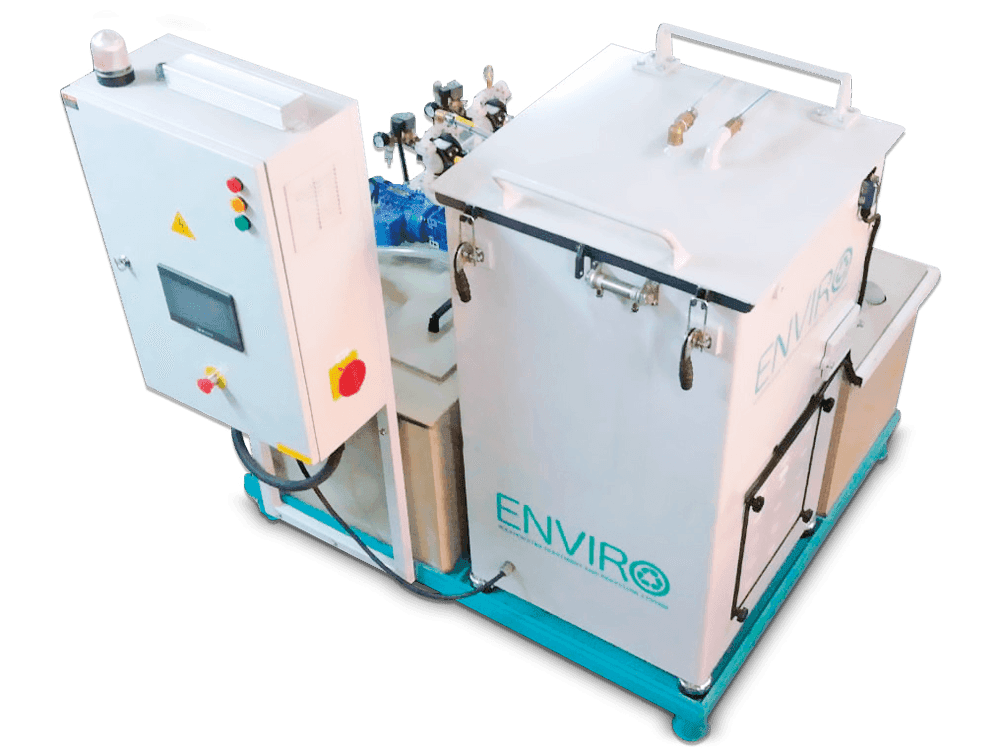
KAYAKOCVIB offers the ENVIRO1000 wastewater treatment system, the FLOG flocculation unit, and the SDM-T sludge dewatering module as components for building closed-loop water management configurations tailored to specific finishing line requirements. These systems are designed to work alongside KAYAKOCVIB KVM circular vibratory machines and TVM trough vibratory machines in production environments where continuous water reuse is a process requirement rather than an option.
The separator machine plays an important role in the recycling loop. After the finishing cycle, parts and media are discharged onto a separator screen where process water drains and is directed to the treatment circuit. The separator controls how much swarf, media fines, and compound-laden water enters the treatment stream per cycle. A well-adjusted separator reduces the load on the downstream treatment system and improves overall recycling efficiency.
Typical Applications and Part Families
Wastewater recycling vibratory finishing is most relevant in high-volume or continuous production environments where finishing machines operate for extended shifts. Automotive component manufacturers deburring and edge-rounding transmission parts, engine brackets, and stamped body components generate large volumes of process water daily. CNC machined parts in steel and stainless steel are also common candidates, particularly when oil contamination from machining is a factor in the incoming part condition.
Aluminum parts processed in vibratory finishing produce alkaline wastewater because aluminum oxide dissolves in alkaline compound chemistry. Steel parts produce water with higher suspended metal content and potential iron compound precipitation. Mixed-metal production, where steel and aluminum parts are processed in separate batches but share a central water treatment system, requires careful chemical management to avoid cross-contamination effects in the recycled water stream.
General manufacturing operations running finishing as a support process rather than a primary production step also benefit from recycling systems, particularly where local regulations restrict direct discharge and transport of liquid industrial waste adds measurable cost per month.
Process Parameters That Affect Recycling Performance
| Parameter | Effect on Recycling System | Typical Control Method |
|---|---|---|
| Suspended solids in feed water | Increases filter load and flocculant demand | Pre-screening, drum filter, sedimentation |
| Oil content | Causes foam, staining, and compound interference | Oil skimmer, demulsifier dosing |
| pH of process water | Affects compound performance and metal precipitation | Acid or alkali dosing with pH controller |
| Compound concentration in recycle | Alters deburring and surface quality if overdiluted or concentrated | Makeup dosing based on conductivity or titration |
| Sludge accumulation rate | Determines filter press or centrifuge cycle frequency | Timed dewatering cycles or level-based control |
| Water temperature | Affects settling rate and chemical reaction speed | Ambient control or heat exchanger if needed |
These parameters interact with each other. High oil content combined with high suspended solids creates a more complex treatment challenge than either condition alone. Process engineers designing a recycling system for vibratory finishing must characterize the effluent from their specific application before selecting treatment chemistry and equipment sizing. Assumptions based on general finishing data can lead to undersized treatment capacity or incorrect chemical selection, both of which reduce recycling efficiency and may cause surface quality problems on finished parts.
Compound and Chemistry Management in Closed-Loop Systems
Finishing compounds do not simply disappear during recycling. A portion of the compound recirculates with the treated water and continues to contribute to the finishing process. This is one of the advantages of closed-loop wastewater recycling vibratory finishing: compound efficiency improves because less fresh compound is consumed per cycle. However, compound chemistry must be monitored to prevent imbalance. If recycled water carries excessive compound concentration, foaming can increase and surface staining may occur on sensitive materials such as aluminum or polished stainless steel.
Makeup dosing of fresh compound must be calibrated against actual recycled concentration rather than set to a fixed rate. Conductivity measurement is a practical inline method for tracking compound strength in the recycled water and adjusting dosing pumps automatically. For aluminum finishing, 085 deburring and polishing liquid is a common process chemical that works within the pH range compatible with aluminum oxide management. For steel and stainless steel parts, 943 deburring and polishing liquid combined with 028-S degreasing liquid is appropriate, with the degreaser helping to control oil accumulation in the recycle stream.
Sludge Handling and Solid Waste Management
The sludge produced by flocculation and settling contains metallic fines, media abrasive particles, and bound chemical residue. Its handling classification depends on the base metals processed. Steel finishing sludge typically contains iron oxide compounds and may be classified as non-hazardous industrial waste in many jurisdictions, subject to local regulation. Sludge from mixed-metal operations containing aluminum, brass, or stainless steel requires more careful classification and may carry different disposal requirements.
Dewatering the sludge before disposal is important for reducing transport volume and disposal cost. A filter press reduces sludge moisture content significantly and produces a semi-dry cake that is easier and cheaper to handle than wet slurry. The SDM-T sludge dewatering module from KAYAKOCVIB is designed for integration with the ENVIRO1000 system in finishing line configurations where automated sludge handling is required. Dewatered sludge from steel finishing may in some cases be accepted by metal recyclers, depending on purity and local market conditions, though this requires confirmation with the recycler based on actual sludge analysis.
Frequently Asked Questions
What contaminants must be removed before water can be recycled in vibratory finishing?
The main contaminants requiring removal are suspended abrasive and metallic particles, free and emulsified oils, residual compound, and pH imbalance. Effective treatment typically involves pre-screening, oil separation, flocculation, sedimentation, and pH adjustment before water is returned to the finishing machine.
Does recycled water affect surface quality on finished parts?
If the recycling system is properly managed, recycled water performs comparably to fresh water in most finishing applications. Problems such as staining, foam, or uneven surface finish typically indicate imbalanced compound concentration, insufficient oil removal, or inadequate pH control in the recycled stream rather than an inherent limitation of water recycling.
How much water can a closed-loop system save compared to open discharge?
Water savings in closed-loop wastewater recycling vibratory finishing depend on the specific finishing operation, machine size, and discharge losses. In many industrial applications, closed-loop systems can recycle the majority of process water with makeup water added only to compensate for evaporation and drag-out losses. Actual figures require measurement under real operating conditions and cannot be guaranteed without application-specific data.
Can one recycling system serve multiple vibratory finishing machines?
Yes. A centralized treatment station can serve multiple vibratory machines when the system is sized appropriately for the combined water flow rate and effluent load. Central systems are common in larger finishing departments where several machines operate in parallel on different part families or shift schedules.
Related Process Equipment
Conclusion
Wastewater recycling vibratory finishing is not a single technology but a structured treatment sequence that addresses the specific contamination profile of mass finishing effluent. Effective closed-loop operation requires correct sizing of treatment capacity, chemical selection matched to the base material and compound chemistry, reliable sludge dewatering, and ongoing monitoring of recycled water parameters. When these elements are correctly integrated, the system reduces raw water consumption, lowers disposal cost, supports regulatory compliance, and maintains finishing process consistency. The engineering decisions required to configure a viable recycling system are application-specific and should be based on effluent characterization, production volume analysis, and validation through pilot testing before full-scale implementation.
Sorry, the comment form is closed at this time.