



12 Jul Vibratory Finishing Process Steps
The vibratory finishing process is a mass finishing method used across CNC machining, automotive, aerospace, fastener, and medical manufacturing to deburr, smooth, radius, and polish metal parts at production scale. Understanding the process sequence from loading through separation and drying is essential for engineers who need consistent, repeatable surface quality results. This article walks through the complete vibratory finishing process step by step, covering machine working principles, media and compound selection, parameter adjustment logic, washing and drying stages, and practical validation points.
In This Article
How a Vibratory Finishing Machine Works
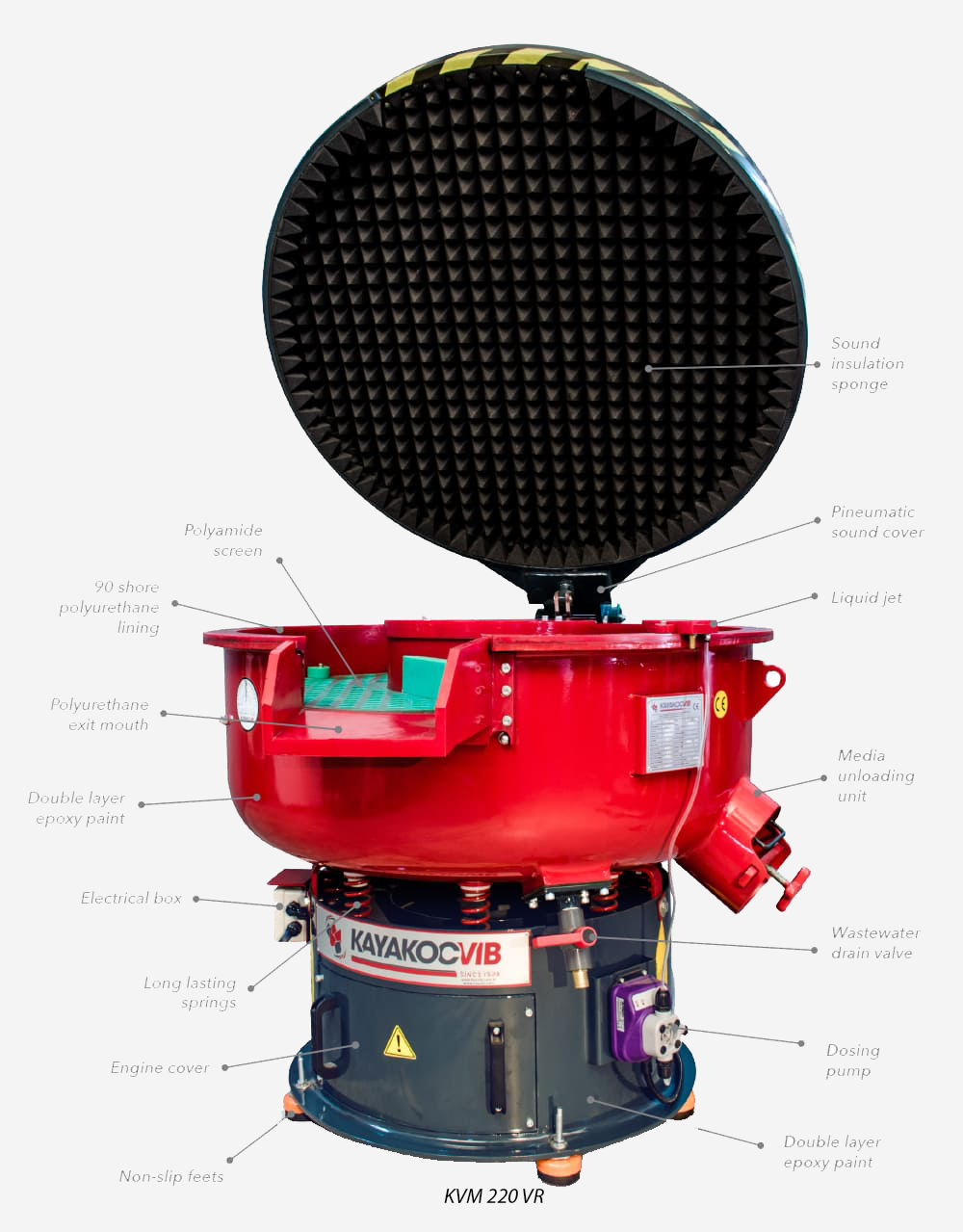
A vibratory finishing machine uses a motor-driven eccentric weight system to generate controlled vibration in a bowl or trough-shaped processing chamber. This vibration causes the media and parts to move in a continuous toroidal or helical flow pattern. Parts and media rub against each other repeatedly as they circulate through the chamber. This relative motion between parts and media is what removes burrs, rounds edges, smooths surface peaks, and improves surface finish over time.
In circular vibratory machines, the bowl geometry drives parts and media in a circular spiral path. In trough-type vibratory machines, the elongated chamber drives a helical flow that is better suited to longer or larger parts. The intensity of the finishing action is controlled by adjusting the vibration amplitude and frequency, which are set by changing the eccentric weight position and motor speed.
Step-by-Step Vibratory Finishing Process Sequence
The following steps represent a standard wet vibratory finishing process route as used in industrial production environments. Dry finishing follows a similar logic but without water and compound.
- Part Inspection and Pre-Cleaning: Before loading, parts should be inspected for excessive flash, gate stubs, or weld spatter that may exceed the cutting capacity of the media. Heavy protrusions should be removed by trimming or grinding before vibratory finishing. Parts with residual cutting oil, coolant, or heavy contamination benefit from pre-washing to avoid overloading the process chemistry.
- Media and Compound Selection: Select media type, shape, and size based on part material, geometry, burr size, and required surface condition. For steel and stainless steel parts, ceramic media is generally preferred because it provides sufficient cutting force for hard metals. For aluminum, zinc alloy, or softer metals, plastic media is typically more appropriate to avoid aggressive material removal and surface damage. Compound selection follows a similar logic: for steel parts, a deburring and polishing liquid such as 943 is commonly used alongside 028-S degreaser; for aluminum and zamak parts, 085 compound paired with 028-S is a typical starting point. Media size and shape must be matched to part geometry to prevent lodging in holes, slots, or internal features.
- Machine Loading: Parts and media are loaded into the vibratory machine in a defined ratio. A typical media-to-part volume ratio ranges from approximately 2:1 to 4:1, depending on part size, weight, and geometry. Overloading the machine reduces the relative motion between parts and media, which decreases finishing efficiency and can cause part-on-part contact damage. Underloading wastes media capacity. The correct loading level should fill the working chamber to approximately 80 to 90 percent of its usable volume.
- Water and Compound Dosing: In wet finishing, water and compound are introduced into the machine through a metered dosing system. Compound concentration, water flow rate, and dosing interval all affect the cutting rate, surface brightness, and foam control. Insufficient compound concentration slows cutting action and may result in re-deposition of removed material onto part surfaces. Excessive compound creates foam management problems and can leave residue. A continuous low-flow dosing method is generally more consistent than batch dosing.
- Process Run and Monitoring: The machine runs for a defined cycle time, which may range from under thirty minutes for lightly deburred parts in centrifugal disc machines to several hours for vibratory finishing with heavy burrs or aggressive surface smoothing targets. During the run, the operator should monitor foam level, water drain condition, and media wear. If the process uses a closed drain, the liquid should be checked periodically to ensure it is not heavily loaded with swarf, which can re-contaminate parts.
- Mid-Cycle Parameter Adjustment: In some processes, the compound type or dosing rate is changed partway through the cycle. A common approach is to run a cutting compound in the first phase to remove burrs and then switch to a burnishing or polishing compound in the second phase to improve surface brightness. This two-stage approach within a single machine run is used in applications where both deburring efficiency and surface quality are required.
- Part-Media Separation: At the end of the cycle, parts must be separated from media. On vibratory machines equipped with an integrated separation screen, the machine can be switched to discharge mode, causing parts and media to flow over a screen that retains media and passes parts through for collection or conveyance. Automated separation units, such as the KAYAKOCVIB SM series separators, handle this stage in continuous or high-volume production lines without manual intervention.
- Rinsing and Washing: After separation, parts typically carry compound residue, swarf particles, and process water. A rinsing or washing stage removes these residues before drying or downstream processing. Depending on part cleanliness requirements, this may involve a simple water rinse, a pressure washing stage, or ultrasonic cleaning for parts with blind holes, threads, or complex internal geometries where residue can be trapped.
- Drying: Wet finished parts must be dried to prevent corrosion, water spotting, or contamination of downstream processes such as coating, plating, or assembly. Vibratory drying machines use dry wood chip media or corn cob media circulating with the parts to absorb surface moisture through mechanical contact and friction heat. For steel and stainless steel parts, drying should begin promptly after rinsing to minimize flash rust risk. Circular vibratory dryers are typically used for small to medium parts; trough dryers are used for larger or longer parts.
- Final Inspection and Quality Verification: After drying, parts are inspected for burr removal completeness, edge condition, surface roughness, and any process-induced defects such as media lodging, part-on-part marks, or staining. Surface roughness measurement provides objective data on process performance. Inspection results are compared against defined acceptance criteria before parts are released for downstream operations.
Process Parameters That Control Surface Quality
The surface quality achieved by vibratory finishing depends on a combination of interacting parameters. No single variable controls the outcome in isolation. The table below summarizes the primary process parameters and their typical effect on finishing results.
| Parameter | Effect on Finishing Result | Adjustment Range |
|---|---|---|
| Vibration amplitude | Controls cutting intensity and part movement speed | Low to high via eccentric weight position |
| Media type and hardness | Determines cutting force and surface condition | Ceramic, plastic, steel, or specialty media |
| Media size and shape | Affects contact area, edge access, and lodging risk | Matched to part geometry and feature size |
| Compound concentration | Controls cutting rate, brightness, and foam | Typically 0.5 to 3 percent dilution by volume |
| Water flow rate | Affects compound distribution and swarf removal | Continuous low-flow dosing preferred |
| Cycle time | Determines total material removal and surface smoothing | Minutes to several hours depending on target |
| Load ratio (media to parts) | Controls relative motion and part-on-part contact risk | Typically 2:1 to 4:1 by volume |
Actual surface roughness values and cycle times depend on part material, initial surface condition, media specification, machine settings, and compound selection. Process validation through sample testing is required before committing to production parameters.
Machine Selection for the Vibratory Finishing Process
Selecting the correct machine type is a prerequisite for effective vibratory finishing. Circular vibratory machines, such as the KAYAKOCVIB KVM series, are suitable for small to medium parts across a wide range of materials including steel, stainless steel, aluminum, and mixed metal fasteners. The circular bowl geometry provides uniform part movement and good media circulation, making it a practical choice for general deburring, edge rounding, and surface smoothing applications.
Trough vibratory machines are preferred when parts are long, have unfavorable aspect ratios, or would risk damage from tumbling in a circular bowl. The trough geometry allows long shafts, extrusions, or connecting rods to travel through the machine in a more controlled helical path, reducing the risk of part-on-part collision or edge damage.
For applications requiring very short cycle times, high surface quality, or small precision parts such as medical components or cutting tools, centrifugal disc finishing machines provide significantly higher process intensity than standard vibratory machines. However, centrifugal disc machines have lower capacity per batch and require more careful process control to avoid part damage.
Washing, Separation, and Drying Integration
The vibratory finishing process does not end at the machine discharge. Washing, separation, and drying stages are functional parts of the finishing line and directly affect final part quality, downstream process compatibility, and production throughput. In automated production lines, these stages are connected by conveyors, elevators, or robot handling systems so that parts move continuously from finishing through separation, rinsing, drying, and final inspection without manual handling between stages.
Wastewater from the finishing process carries compound residues, swarf, and metal particles. In high-volume or environmentally regulated production environments, wastewater treatment and recycling systems allow process water to be filtered, treated, and reused, reducing both water consumption and chemical discharge. This is an important operational and regulatory consideration for production facilities running multiple finishing machines continuously.
Common Process Risks and How to Manage Them
Several recurring process risks affect vibratory finishing quality and should be addressed in process design and setup. Media lodging occurs when media becomes trapped in holes, slots, or recesses on the part. This risk increases when media size is too small relative to the minimum feature opening. The standard engineering response is to select media with a minimum dimension larger than the smallest hole or slot on the part, and to verify during sample testing that no lodging occurs under production loading conditions.
Part-on-part contact marks occur when the load ratio is too high, part density is high, or parts are delicate. Reducing the load ratio or switching to a softer media type typically reduces this risk. Aluminum parts are particularly sensitive to part-on-part marks because the material is soft and easily scratched.
Staining or discoloration after finishing may result from insufficient rinsing, wrong compound selection, incompatible metals being processed together, or delayed drying. Aluminum and steel parts should not be mixed in the same batch, as galvanic reactions and cross-contamination can cause surface staining on both materials.
Validation Before Production Release
Before releasing a vibratory finishing process to serial production, process engineers should confirm the following through sample testing:
- Burrs are fully removed across all part features, including internal edges and blind holes where applicable.
- Edge radius meets drawing specification or engineering requirement.
- Surface roughness is within the required Ra range for the part application.
- No media lodging is present in any holes, slots, or recesses.
- No part-on-part contact marks are present on finished surfaces.
- Parts are dry, clean, and free from compound residue after the drying stage.
- Cycle time and compound consumption are within acceptable production cost parameters.
These validation points should be documented and repeated when any input variable changes, including a different batch of raw parts, a new media lot, a compound reformulation, or a machine maintenance event.
Frequently Asked Questions
What is the typical cycle time for vibratory finishing?
Cycle time varies widely depending on part material, burr size, media type, machine intensity, and required surface condition. Light deburring of steel fasteners may be completed in thirty to sixty minutes, while aggressive surface smoothing of aluminum castings may require two to four hours or more. Actual cycle time must be determined through process testing.
Can different materials be finished together in the same batch?
Generally, mixing dissimilar metals in the same batch is not recommended. Aluminum and steel parts processed together can cause galvanic staining and cross-contamination of the media. Parts should be grouped by material type for consistent and predictable results.
How is media replaced or replenished?
Media wears down gradually through the finishing process. As media size decreases below a minimum usable dimension, cutting efficiency drops and lodging risk increases. Regular media inspection and controlled top-up or full replacement schedules are necessary to maintain consistent process performance. The replacement interval depends on media type, part material, and production volume.
What happens if compound concentration is too low?
Insufficient compound concentration reduces the lubrication and chemical activation of the media surface, which slows cutting rate and can cause swarf and metal particles to re-deposit onto part surfaces. This typically results in a dull, smeared surface condition rather than a clean, uniform finish. Compound dosing should be calibrated and verified regularly.
Related Process Equipment
Related Video Demonstration
Conclusion
The vibratory finishing process is a controlled, multi-stage production operation that requires careful coordination of machine setup, media selection, compound dosing, cycle parameters, separation, washing, and drying to deliver consistent surface quality across industrial production volumes. Each step in the sequence affects the next, and the final result depends on how well all variables are matched to the part material, geometry, and surface requirement. Process validation through sample testing remains the reliable method for confirming that a defined parameter set will deliver the required output before full production begins. For manufacturers seeking to standardize or optimize their vibratory finishing operations, the starting point is always a clear understanding of the part requirements followed by systematic testing of each process stage.
Sorry, the comment form is closed at this time.