



13 Jul Vibratory Finishing for Metal Parts
Vibratory finishing for metal parts is one of the most widely used mass finishing processes in industrial manufacturing, applied across CNC machining, automotive, aerospace, fastener production, and general metalworking. The process uses controlled mechanical vibration to drive finishing media against part surfaces, producing consistent deburring, edge rounding, and surface smoothing results without the part-by-part handling required by manual or robotic polishing methods. Understanding where vibratory finishing performs reliably, how to configure the process for specific materials, and where its limits begin is essential for production engineers selecting a finishing route.
In This Article
Typical Parts, Materials, and Surface Defects
Vibratory finishing is applied to a wide range of metal components. Common part families include CNC-turned and milled parts, stamped and pressed components, fasteners, castings, forgings, laser cut profiles, and sheet metal parts. Materials processed include carbon steel, alloy steel, stainless steel, aluminum alloys, and mixed metal batches in some general manufacturing environments.
The surface defects most commonly addressed by vibratory finishing are machining burrs, sharp edges from cutting or stamping, tool marks and feed lines, oxide discoloration, light scale, and surface roughness from grinding or turning operations. In some applications, vibratory finishing is also used for pre-treatment before coating or plating, where a uniform, clean, and slightly matte surface is required for adhesion.
The geometry of the part determines whether vibratory finishing is practical. Parts with accessible external surfaces, through-holes larger than the media dimensions, and reasonable aspect ratios are well suited to the process. Parts with deep internal cavities, blind holes smaller than the media size, or very thin wall sections require careful process design and media selection to avoid media lodging or part deformation.
Recommended Process Route for Common Metal Parts
A standard vibratory finishing process route for metal parts follows a defined sequence from loading through separation and drying. The general sequence is as follows.
- Pre-clean parts if heavy oil, coolant, chips, or contamination are present. Dry parts or allow coolant to drain before loading.
- Load parts and media into the vibratory machine bowl or trough. Media-to-part volume ratio is typically in the range of 3:1 to 10:1 depending on part size, geometry, and required finishing intensity.
- Start the machine and introduce process compound and water. Compound type and concentration depend on material and finishing objective.
- Run the finishing cycle. Cycle time depends on burr size, required edge radius, starting surface condition, material, and media selection. Typical industrial cycle times range from 20 minutes to several hours depending on the application.
- Separate parts from media using an integrated separator or a separate separation machine.
- Rinse parts with clean water to remove compound and media residue.
- Dry parts using a vibratory dryer or other drying method appropriate for part geometry and material.
- Inspect parts for burr removal completeness, edge condition, and surface quality before release to the next production stage.
This sequence applies to wet vibratory finishing, which is the standard configuration for most metal deburring and polishing applications. Dry vibratory finishing using dry media and no compound is used in specific cases such as final polishing, burnishing, or surface brightening, but is less common for heavy deburring.
Machine Selection for Metal Part Applications
Two vibratory machine types are widely used for metal parts: circular vibratory finishing machines and trough vibratory finishing machines. The selection depends on part size, part geometry, production volume, and required process intensity.
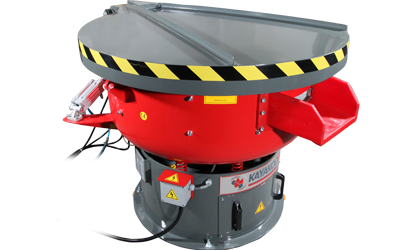
Circular vibratory finishing machines, such as the KAYAKOCVIB KVM series, are suitable for small to medium parts including fasteners, CNC turned parts, stamped components, and die cast parts. The circular bowl geometry creates a toroidal mass flow that provides consistent media-to-part contact across the entire batch. This makes circular machines well suited for high-volume production of similar parts where uniformity and repeatability are important.
Trough vibratory finishing machines, such as the KAYAKOCVIB TVM series, are preferred for longer components, profiles, shafts, or parts that would tangle, nest, or collide destructively in a circular bowl. The linear mass flow in a trough machine allows elongated parts to travel end-to-end without excessive part-on-part contact. Trough machines are also commonly used when processing parts in a single layer to minimize contact damage on delicate or precision surfaces.
| Parameter | Circular Vibratory Machine | Trough Vibratory Machine |
|---|---|---|
| Typical part size | Small to medium | Medium to large or elongated |
| Part geometry | Compact, symmetrical | Long, profiled, or delicate |
| Mass flow pattern | Toroidal circular flow | Linear end-to-end flow |
| Batch capacity | High volume batches | Lower volume, selective batches |
| Part-on-part contact risk | Moderate for larger parts | Lower for elongated parts |
| Automation integration | Standard for high volume lines | Used for specific part families |
Media and Compound Selection by Material
Media selection is one of the most influential variables in vibratory finishing for metal parts. Choosing the wrong media type or shape for a given material can result in excessive material removal, surface damage, media lodging, or insufficient deburring.
For steel and stainless steel parts, ceramic media is the standard choice. Ceramic media provides the cutting hardness needed to remove machining burrs, break sharp edges, and reduce surface roughness on harder metals. Ceramic media is available in a wide range of shapes including triangles, cylinders, stars, cones, and spheres. Shape selection depends on part geometry, accessibility of surfaces, and the risk of media lodging in holes or slots.
For aluminum alloys and softer metals such as zinc die castings, plastic media is generally preferred. Plastic media is less aggressive than ceramic, which reduces the risk of surface damage, denting, or excessive material removal on softer materials. Plastic media also tends to produce a smoother surface finish on aluminum parts when used with appropriate compounds.
Compound selection follows a similar logic. For steel and stainless steel parts, 943-type deburring and polishing compounds combined with 028-S degreasing compounds are commonly used. For aluminum and softer metals, 085-type compounds designed for non-ferrous applications are preferred, again combined with 028-S for degreasing. For yellow metals such as brass or copper, 028-type compounds with a more acidic profile are suitable for removing oxides and surface contamination.
Water flow rate and compound concentration must be calibrated for the machine size and batch volume. Insufficient compound concentration leads to poor surface quality and media glazing. Excessive compound concentration can cause foam buildup, inadequate rinsing, or compound residue on finished parts.
Process Parameters That Control Surface Quality
Several process parameters directly determine the surface quality achievable through vibratory finishing for metal parts. These parameters must be configured based on the specific application and validated through sample testing before production release.
Vibration amplitude controls the energy input to the media-part mass. Higher amplitude increases cutting rate and is suitable for heavy deburring. Lower amplitude reduces surface aggressiveness and is appropriate for final polishing or delicate parts. Frequency and eccentric weight settings on the vibratory motor determine amplitude and must be adjusted for each application.
Cycle time determines the extent of material removal, edge rounding, and surface smoothing. Short cycle times may leave residual burrs. Excessively long cycle times may cause over-processing, rounding of functional edges, or dimensional change on tight-tolerance features. Cycle time must be validated through progressive inspection at defined intervals.
Media-to-part ratio affects both finishing uniformity and part-on-part contact. Insufficient media volume increases the risk of part damage from direct part-to-part collision. Excessive media volume may reduce process efficiency for certain part geometries.
Water flow rate controls lubrication, compound distribution, and swarf removal from the machine bowl. Insufficient water flow causes media loading with metal fines, which reduces cutting performance and can discolor parts. Consistent water flow at the correct rate maintains stable process conditions throughout the cycle.
Limitations of Vibratory Finishing for Metal Parts
Vibratory finishing is effective for a broad range of applications, but it has defined limitations that engineers must account for during process design.
Heavy casting flash, large gate stubs, or structural burrs from forging typically require mechanical trimming before vibratory finishing. The process is not designed to remove large volumes of metal quickly, and attempting to do so results in very long cycle times, excessive media wear, and poor dimensional control.
Media lodging is a consistent risk for parts with small holes, narrow slots, or complex internal channels. If media dimensions are not selected with part geometry in mind, media pieces can become trapped inside parts, causing secondary damage or requiring manual removal. A media lodging analysis should be completed before processing any part with critical internal features.
Very thin-walled or delicate parts may deform under the mechanical pressure of the media mass. For such parts, process intensity must be reduced, softer media must be selected, or alternative finishing processes such as drag finishing or centrifugal disc finishing should be evaluated.
Mixing aluminum and steel parts in the same finishing batch is generally not recommended. Steel particles from steel parts can embed into aluminum surfaces, causing galvanic corrosion or visual contamination. Separate processing runs or dedicated machines for each material group are standard practice in quality-controlled environments.
Vibratory finishing cannot produce mirror-bright polished surfaces in a single process stage. Achieving very low Ra surface roughness values requires multi-stage finishing using progressively finer media, often followed by centrifugal disc finishing or drag finishing for the final polishing stage. Actual achievable Ra values depend on starting surface condition, material, media selection, and cycle parameters, and must be confirmed through sample testing.
Production Line Integration and Automation
In high-volume manufacturing environments, vibratory finishing for metal parts is typically integrated into automated production lines. Automation reduces manual handling, ensures consistent loading, and enables continuous production without operator intervention between cycles.
A typical automated finishing line for metal parts includes a loading station or conveyor feed, the vibratory finishing machine, an integrated or separate part-media separator, a rinsing station, and a drying unit. In wet finishing lines, a wastewater treatment and recycling system is an important downstream component, allowing process water to be cleaned and reused rather than discharged, which reduces water consumption and meets environmental discharge requirements.
Circular vibratory machines with integrated separation and conveyorized part flow are common configurations for fastener production, CNC part finishing, and automotive component processing. For larger or more complex parts, semi-automated configurations with manual loading and automated separation are also used.
Quality Control and Inspection Points
Process validation for vibratory finishing should include defined inspection points to confirm that finishing objectives are consistently met. Key inspection criteria for metal parts include complete burr removal from all required surfaces, edge radius within specification, surface roughness within the required Ra range, absence of media lodging in holes or slots, and absence of surface damage or part-on-part contact marks.
Visual inspection under consistent lighting conditions is standard practice. For precision parts, surface profilometry measurements and edge radius measurement using optical comparators or microscopy may be required. First-article inspection after process setup and periodic in-process checks during production runs are both recommended for quality-controlled applications.
Frequently Asked Questions
Can vibratory finishing remove all types of machining burrs from metal parts?
Vibratory finishing effectively removes fine to medium machining burrs from accessible surfaces. Heavy structural burrs, large flash, or burrs in deep inaccessible areas may require pre-treatment such as mechanical trimming or a different finishing process. The process capability for a specific burr type should be confirmed through sample testing before production release.
How long does a typical vibratory finishing cycle take for steel parts?
Cycle times vary widely depending on burr size, part geometry, required surface quality, media type, and machine settings. Typical industrial cycle times range from approximately 20 to 90 minutes for standard deburring applications. Multi-stage processes for surface polishing may require longer total processing time across successive cycles.
Is it possible to process aluminum and steel parts together in the same vibratory machine?
Processing aluminum and steel parts in the same batch is not recommended. Steel particles can embed into aluminum surfaces, causing surface contamination and galvanic corrosion risk. Separate batches and separate media sets for ferrous and non-ferrous materials are standard practice in controlled manufacturing environments.
What causes media lodging in vibratory finishing, and how can it be prevented?
Media lodging occurs when media pieces enter holes, slots, or cavities in parts and cannot exit due to geometry or size mismatch. Prevention requires selecting media shapes and dimensions that cannot fit into critical part features. A media selection review against part drawings is an important step in process design for any part with internal features.
Related Process Equipment
Related Video Demonstration
Conclusion
Vibratory finishing for metal parts provides a reliable, scalable, and cost-effective route for deburring, edge rounding, and surface smoothing across a wide range of industrial materials and part geometries. Process performance depends on correct machine selection between circular and trough configurations, appropriate media and compound pairing for the base material, and careful calibration of amplitude, cycle time, media-to-part ratio, and water flow. The process has defined limitations for heavy burrs, very fine internal features, and high-gloss surface requirements, all of which must be addressed through process design and sample validation before production release. For manufacturers evaluating vibratory finishing as a production process, initial sample testing across representative part types remains the most reliable method for confirming process capability and establishing production parameters.
Sorry, the comment form is closed at this time.