



21 Jun Surface Roughness Ra Finishing
Surface roughness Ra finishing is a measurable, controllable outcome of mass finishing, vibratory finishing, and precision polishing processes. Ra, the arithmetic mean deviation of a surface profile, serves as the primary industrial metric for quantifying surface texture before and after finishing operations. Understanding how Ra changes at each process stage allows engineers to select the correct machine, media, compound, and cycle parameters rather than relying on trial-and-error.
In This Article
What Ra Measures and Why It Matters in Finishing
Ra is defined as the arithmetic average of absolute deviations of the surface profile from a mean line, measured in micrometers (µm) or microinches (µin). It is the most widely reported surface texture parameter in manufacturing because it is easy to measure with contact profilometers and correlates reliably with functional surface behavior such as friction, wear resistance, fatigue life, coating adhesion, and sealing performance.
A CNC-machined steel part may leave the machine with a typical Ra in the range of 1.6 to 6.3 µm depending on cutting conditions, tool geometry, and feed rate. Die-cast aluminum components often present Ra values of 3.2 to 12.5 µm due to die wear, ejection marks, and parting line flash. Stamped or laser-cut parts may carry burrs and edge irregularities that produce locally high Ra values. Each of these starting conditions requires a different finishing approach to reach the target Ra.
How Ra Changes Across Finishing Stages
Surface roughness Ra finishing does not happen in a single stage for most industrial parts. The reduction in Ra follows a predictable pattern depending on the abrasive mechanism applied at each stage.
In the first stage, coarse deburring removes mechanical burrs, flash, and sharp edges. At this stage, abrasive cutting media removes material from peaks in the surface profile. Ra may initially appear to increase slightly on smooth machined surfaces because aggressive cutting media introduces fine scratches while removing larger defects. This is normal and expected behavior when starting with high-cutting ceramic media on finely machined parts.
In the intermediate stage, medium-cut media or transitional plastic media refines the surface texture established in the deburring stage. Abrasive particle size in the media decreases, which reduces the depth and width of cutting marks. Ra progressively decreases as surface peaks are reduced and valleys begin to fill with finer scratch patterns.
In the final polishing stage, low-abrasive or non-abrasive burnishing media combined with polishing compounds produces a smooth, reflective surface. Burnishing media such as stainless steel balls or high-density ceramic smooth peaks without removing significant bulk material. At this stage, Ra values in many industrial applications can reach below 0.4 µm on steel and stainless steel parts, depending on the starting condition, media selection, and process duration. Actual results depend on part geometry, material, and require process validation.
Ra Reference Values by Process and Material
The following table shows typical Ra ranges associated with common pre-finishing and post-finishing conditions. These values are approximate industrial references and will vary depending on machine type, media, compound, cycle time, and part geometry. They should not be interpreted as guaranteed process outcomes.
| Condition | Material | Typical Ra Range (µm) |
|---|---|---|
| CNC turning (medium feed) | Steel | 1.6 – 6.3 |
| CNC milling (medium feed) | Aluminum | 1.6 – 3.2 |
| Die casting (standard die) | Aluminum / Zamak | 3.2 – 12.5 |
| After vibratory deburring | Steel | 0.8 – 2.4 |
| After vibratory polishing | Steel / Stainless | 0.2 – 0.8 |
| After centrifugal disc finishing | Steel / Aluminum | 0.1 – 0.5 |
| After drag finishing (high precision) | Steel / Carbide | 0.02 – 0.1 |
Process Variables That Control Ra Change
Several independent variables directly influence the rate and final value of surface roughness Ra during finishing operations. Engineers must control these variables as a system, not individually.
Media Abrasivity and Grain Size
The abrasive grain embedded in finishing media is the primary cutting tool. Higher grain count and harder abrasive types remove material faster and reduce Ra more aggressively in early stages. Ceramic media with bonite or aluminum oxide grain is standard for steel and stainless steel deburring. Plastic media with finer abrasive grades is preferred for aluminum, zamak, and softer non-ferrous metals because the lower cutting force reduces the risk of surface damage and media grain embedding.
Media Shape and Contact Geometry
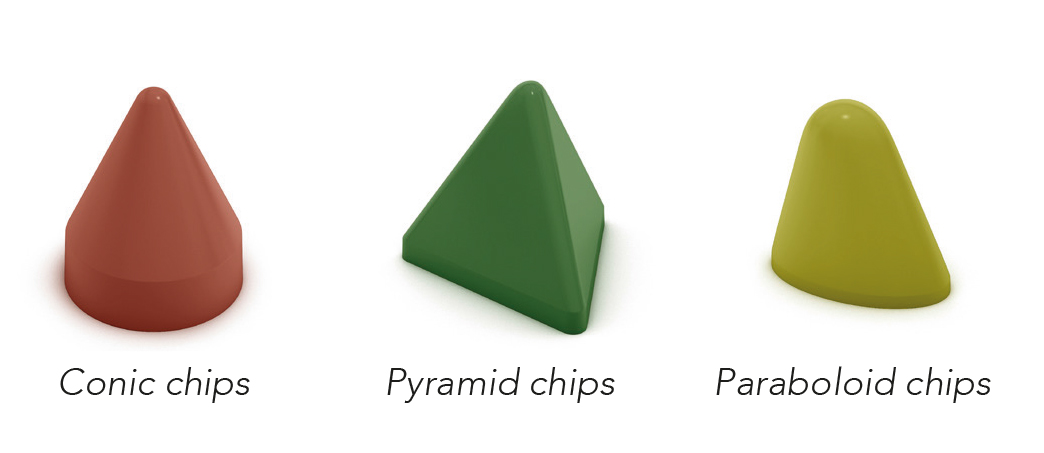
Media shape determines how cutting contact is distributed across the part surface. Conical, triangular, and cylindrical media shapes reach flat surfaces and external radii well. Satellite or tetrahedron shapes provide better access to recesses and complex geometry. Spherical or rounded media produces burnishing action rather than abrasive cutting, which is the mechanism responsible for the final low-Ra polish stage.
Compound Type and Concentration
Finishing compounds control the chemical environment of the process. For steel and iron parts, a deburring and polishing liquid such as a 943-type compound provides lubrication, corrosion inhibition, and suspension of swarf. For aluminum and zamak parts, an 085-type compound provides similar lubrication with chemistry suited to softer metals. A 028-S degreasing liquid is commonly used for cleaning stages. Compound concentration affects cutting rate, foam behavior, surface brightness, and post-process cleanliness. Insufficient compound causes dry cutting, poor swarf suspension, and re-contamination of the surface.
Machine Energy and Motion
Vibratory finishing machines control Ra change through vibration frequency and amplitude. Higher amplitude increases media-to-part contact pressure, accelerating material removal and Ra reduction in early stages. In circular vibratory machines such as the KAYAKOCVIB KVM series, amplitude and frequency can be adjusted to control cutting intensity. For long or large parts, trough vibratory machines such as the TVM series distribute motion more evenly along the part length, which helps achieve consistent Ra across the full surface. For high-precision applications or very short cycle time requirements, centrifugal disc finishing machines such as the KSM series apply significantly higher centrifugal force, producing faster Ra reduction and better surface uniformity.
Cycle Time
Ra reduction during finishing follows a diminishing returns curve. In the early phase of a cycle, Ra drops quickly as macro-scale peaks and burrs are removed. As the surface becomes smoother, the rate of Ra change slows. Extending cycle time beyond the point where Ra plateau is reached increases machine wear and energy consumption without producing measurable surface improvement. Cycle time must be validated for each part, media, and target Ra combination rather than assumed from generic tables.
Multi-Stage Finishing and Ra Control
When a large gap exists between the incoming Ra and the target Ra, a multi-stage process is typically required. Running a single stage with very aggressive media to achieve a low Ra in one pass usually produces surface waviness and an inconsistent texture, even if the average Ra value appears acceptable on a profilometer reading.
A typical multi-stage sequence for a steel CNC part targeting Ra below 0.4 µm might involve a first stage with high-cut ceramic media for deburring and edge rounding, a second stage with medium-cut plastic or ceramic media for surface refinement, and a final stage with non-abrasive burnishing media and polishing compound. Each stage must be defined with its own media, compound, cycle time, and water flow settings.
For aluminum die-cast parts, plastic media is used throughout because ceramic media risks embedding abrasive grain into the soft aluminum surface, which permanently degrades the surface and may cause finishing failures in subsequent coating or anodizing operations.
Ra Measurement and Validation in Industrial Finishing
Surface roughness Ra finishing results must be validated through measurement, not assumed from visual inspection alone. Contact profilometers measure Ra by dragging a stylus across a defined evaluation length and calculating the mean deviation. Non-contact optical profilometers are used for very smooth surfaces or delicate parts where stylus contact may disturb the measured surface.
Measurement location matters in finishing validation. Ra measured on a flat surface may differ significantly from Ra measured in a recessed area, on a radius, or near an edge. This is especially true for complex geometry parts where media contact is uneven. Engineers should define standard measurement points at the start of process development and use the same points for ongoing production verification.
Incoming Ra should always be measured before finishing to establish a baseline. Without a consistent baseline, it is impossible to confirm whether Ra improvement is due to the finishing process or simply variation in the incoming parts. This is a common source of process instability in production environments.
Application Examples by Industry
In CNC machining, finishing processes are used to reduce Ra on turned and milled steel and aluminum parts to meet dimensional or functional tolerances. Typical targets range from 0.8 µm for mechanical components to below 0.4 µm for hydraulic or sealing surfaces.
In automotive manufacturing, stamped brackets, transmission components, and fasteners are finished to remove burrs and improve surface consistency before assembly or coating. Ra targets depend on the functional requirement, not only cosmetic appearance.
In medical device manufacturing, stainless steel and titanium components often require Ra values below 0.8 µm for cleanability and corrosion resistance. Drag finishing systems such as the KAYAKOCVIB DRG series are used for high-precision implant components where controlled surface finishing and very low Ra values are required. Process validation must be performed to meet component-specific requirements.
In aerospace, aluminum and titanium structural parts require consistent edge condition and surface texture to meet fatigue life requirements. The finishing process must be documented and repeatable, which drives the use of controlled automated systems rather than manual or batch processes.
Common Misunderstandings About Ra in Finishing
A frequent misunderstanding is that a lower Ra always means better performance. For some applications, a controlled surface texture with moderate Ra improves paint adhesion, lubricant film retention, or bonding strength more than an ultra-smooth surface. Engineers should define target Ra based on the functional requirement of the part, not an assumption that smoother is always superior.
Another common mistake is measuring Ra on only one surface location and using that value to accept or reject the entire part. Complex geometry parts may have significantly different Ra values across different surfaces. A single measurement point provides an incomplete picture of the finishing result.
Ra also describes only amplitude variation in the profile. It does not capture surface directionality, profile shape, or the presence of specific defects such as pits, scratches, or embedded particles. For applications where these factors matter, additional parameters such as Rz, Rq, or Rsm should be considered alongside Ra.
Frequently Asked Questions
What is a typical Ra value after vibratory finishing?
Ra values after vibratory finishing depend on the starting condition, media type, compound, and cycle time. In many industrial applications, steel parts move from an incoming Ra of 1.6 to 6.3 µm down to 0.4 to 1.6 µm after a standard deburring and polishing cycle. Achieving Ra below 0.4 µm typically requires a dedicated polishing stage with low-abrasive or burnishing media. Actual results require process validation with sample parts.
Why does Ra sometimes increase after the first finishing stage?
Ra can increase slightly at the beginning of a deburring cycle if the incoming surface has a smooth machined finish and the selected media is too aggressive. Coarse abrasive media introduces fine cutting marks across the surface while removing burrs and sharp edges. This is expected behavior in a multi-stage process where the first stage prepares the surface for a subsequent polishing step. Using a medium-cut media from the start on a fine-machined surface can avoid unnecessary Ra increase in the first stage.
Can surface roughness Ra finishing be automated in production?
Yes. Automated finishing lines integrate loading, machine operation, separation, washing, and drying into a continuous production flow. Automation improves Ra consistency by removing human variation in loading density, cycle time, and compound dosing. Automated systems are practical for high-volume production of consistent part families. Each process parameter must still be validated through sample testing before production release.
Does media shape affect the final Ra value?
Yes. Media shape directly affects how uniformly the abrasive surface contacts the part. Flat or angular media shapes produce faster cutting but may create directional scratch patterns. Round or spherical burnishing media produces uniform contact and progressive smoothing, which is the mechanism used to achieve the lowest Ra values in polishing stages. Media shape selection must match the target Ra and the part geometry.
Related Process Equipment
Conclusion
Surface roughness Ra finishing is an engineering-controlled process where measurable Ra reduction follows predictable physical mechanisms. The rate and final value of Ra depend on the combination of media abrasivity, media shape, compound chemistry, machine energy, and cycle time. No single parameter can be optimized in isolation. Engineers designing or validating a finishing process must define the incoming Ra baseline, select media and machine type appropriate for the part material and geometry, and validate the target Ra through measurement at defined surface locations. Multi-stage processes are typically required when large Ra reductions are needed or when both deburring and polishing objectives must be met in the same production sequence. Actual process capability must always be confirmed through sample testing under production conditions.
Sorry, the comment form is closed at this time.