



08 Jul Surface Roughness After CNC Machining
Surface roughness after CNC machining is one of the most common quality concerns in precision manufacturing. CNC turning, milling, and grinding operations leave characteristic tool marks, micro-burrs, and surface irregularities that may not meet functional or aesthetic requirements without a dedicated post-machining finishing operation. Understanding how to reduce Ra values systematically, which finishing process to select, and what variables control the final surface quality is essential for production engineers working across automotive, aerospace, medical, and general manufacturing sectors.
In This Article
Why CNC Machining Leaves Residual Surface Roughness
Every CNC cutting operation produces a surface topography that is directly related to tool geometry, cutting speed, feed rate, depth of cut, and material properties. Feed marks from milling cutters and turning tools create periodic surface patterns that appear as measurable Ra values, typically ranging from Ra 0.8 to Ra 6.3 micrometers depending on the operation and cutting parameters. Grinding operations produce finer surfaces but still leave directional lay patterns and subsurface stress that can affect fatigue performance and sealing function.
Beyond tool marks, CNC machining generates micro-burrs at edges and cross-holes, surface contamination from cutting fluids and chips, and occasionally work-hardened surface zones on stainless steel or titanium. These combined effects mean that machined parts frequently require a post-machining finishing stage before they can be inspected to final specification or sent to downstream processes such as coating, hardening, or assembly.
Engineering Principle Behind Post-Machining Surface Improvement
Mass finishing processes improve surface roughness after CNC machining through controlled abrasive or burnishing contact between the part surface and finishing media. The media acts as a distributed cutting and smoothing tool, removing material from surface peaks while leaving valleys relatively intact. Over successive contact cycles, the surface profile flattens, Ra values decrease, and edge geometry transitions from sharp or ragged to controlled and consistent.
The driving mechanism is relative velocity between parts and media, combined with media pressure against the part surface. Higher relative velocity and harder, more abrasive media remove material faster but may cause dimensional change or surface damage on delicate features. Lower process intensity with finer or less aggressive media produces smoother results with minimal material removal, which is critical for tight-tolerance CNC parts.
Two fundamentally different contact modes exist in industrial mass finishing: loose media finishing in vibratory or centrifugal machines, where parts and media move together in a mixed mass, and controlled single-part finishing in drag finishing machines, where each part is individually driven through a stationary or rotating media bed at a defined speed and angle.
Vibratory Finishing for General CNC Part Batches
Circular vibratory finishing machines are the most widely used platform for improving surface roughness after CNC machining in batch production environments. The machine bowl generates a toroidal motion pattern that causes the mixed part-media mass to flow continuously. Every part surface is contacted repeatedly by media throughout the cycle, producing progressive and relatively uniform roughness reduction across all accessible surfaces.
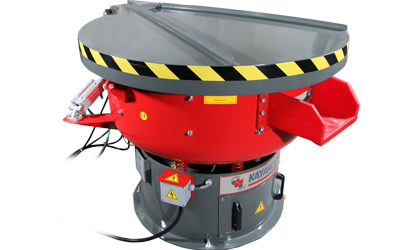
The KAYAKOCVIB KVM series circular vibratory finishing machines are used in many CNC machining operations for deburring, edge rounding, and surface smoothing of steel, stainless steel, and aluminum parts. The circular bowl geometry is well suited to compact to medium-sized parts, and the process can handle batch quantities efficiently without manual intervention during the cycle.
For steel and stainless steel CNC parts, ceramic media with 943 deburring and polishing compound is a common starting configuration. Ceramic media provides the cutting action needed to remove tool marks and micro-burrs from harder materials. For aluminum CNC parts, plastic media combined with 085 deburring and polishing compound is generally preferred because plastic media is less aggressive and reduces the risk of part damage or surface smearing on softer alloys. Media shape selection also matters: triangular and cylindrical shapes reach flat surfaces efficiently, while conical and satellite shapes improve access to internal radii and complex geometries.
Process Parameters That Control Surface Quality
The final Ra value achievable through vibratory finishing depends on several interacting process variables. Understanding these variables allows engineers to tune the process systematically rather than through trial and error.
| Process Variable | Effect on Surface Roughness | Typical Range |
|---|---|---|
| Media abrasiveness | Higher abrasiveness accelerates roughness reduction but increases material removal | Coarse, medium, fine, or polishing grade |
| Media size | Smaller media contacts finer surface features; larger media provides more mass and cutting force | 5 mm to 50 mm depending on part geometry |
| Compound concentration | Higher concentration improves lubrication and chip flushing; too high reduces cutting | 1% to 5% dilution in water typically |
| Water flow rate | Controls temperature, chip removal, and surface cleaning during the process | Continuous flow or timed dosing |
| Cycle time | Longer cycles produce smoother surfaces up to the limit of the media grade | 20 minutes to several hours depending on target Ra |
| Machine amplitude | Higher amplitude increases media pressure and relative velocity, accelerating the process | Adjustable on most industrial machines |
For CNC machined parts, a multi-stage process sequence often produces the best results. An initial cut-down stage with coarser ceramic or plastic media removes primary tool marks and burrs. A subsequent smoothing stage with finer media refines the surface. A final polishing or burnishing stage with non-abrasive media and polishing compound can bring Ra values to very fine levels if required by the application. Each stage requires a rinse step between transitions to avoid contaminating finer media with coarser abrasive residue.
Drag Finishing for High-Precision CNC Components
For CNC parts with stringent surface quality requirements, complex geometries, or high unit value, drag finishing offers a more controlled alternative to batch vibratory processing. In drag finishing, individual parts are mounted on spindles and dragged through a stationary or slowly rotating media bed at a defined speed, depth, and angle. The controlled contact conditions produce very uniform surface roughness reduction across all exposed surfaces, with high repeatability between parts.
The KAYAKOCVIB DRG drag finishing machine is used in applications where batch vibratory finishing cannot achieve the required surface quality consistency, or where the risk of part-to-part contact damage is unacceptable. Typical DRG applications include precision turned components, high-tolerance hydraulic valve bodies, aerospace structural parts, and medical implants where dimensional integrity and surface finish must be maintained within tight limits.
Drag finishing cycle times per part are shorter than equivalent vibratory finishing cycles because the controlled media contact is more intense and directional. This makes drag finishing suitable for low to medium batch sizes of high-value parts, while vibratory finishing remains the preferred solution for high-volume batches of standard CNC parts.
Material-Specific Considerations for CNC Part Finishing
Material selection determines which finishing approach, media type, and compound formulation will be effective. Steel and stainless steel CNC parts generally require ceramic media and higher process intensity to achieve meaningful roughness reduction. Hardened steel parts may require longer cycle times or more abrasive media grades because the surface resists material removal. Stainless steel has a tendency to smear or work-harden if compound concentration is too low or media is too aggressive without adequate lubrication.
Aluminum CNC parts are softer and more sensitive. Plastic media with appropriate polishing compound produces smooth, bright surfaces without the risk of mechanical damage or surface imprinting that ceramic media may cause on softer alloys. Aluminum also requires careful attention to compound pH because alkaline compounds can cause staining or etching on uncoated aluminum surfaces.
Mixed material batches should be avoided in the same finishing run where possible. Different materials respond at different rates to the same media and compound, leading to inconsistent results across the batch. If mixed material finishing is unavoidable, process parameters must be validated for the most sensitive material in the batch.
Surface Quality Validation After Finishing
Achieving consistent surface roughness improvement after CNC machining requires a structured validation approach rather than relying on visual inspection alone. Contact profilometry using a calibrated stylus instrument provides Ra, Rz, and Rq measurements that can be compared directly against engineering specifications. Non-contact optical profilometry offers higher-resolution data for complex surfaces or very fine Ra values.
Edge geometry should be checked under magnification to confirm that burrs have been removed completely and that edge radii are within the specified range. For functional surfaces such as bearing seats, sealing faces, or hydraulic valve lands, surface texture direction and Rz plateau values may be more critical than Ra alone. These parameters should be clearly defined in the engineering specification before process development begins.
Process validation should be performed on representative sample parts before full production release. Cycle time, media type, compound concentration, and water flow should be documented as fixed process parameters. Any future change to media type, compound supplier, or machine amplitude setting should trigger a re-validation of surface roughness output to confirm that the process is still within specification.
Automation and Integration in CNC Finishing Lines
In high-volume CNC machining environments, the finishing operation can be integrated into the production flow using automated part loading, unloading, and transport systems. Automatic compound dosing systems maintain consistent compound concentration throughout the process cycle, reducing operator dependency and improving batch-to-batch repeatability.
After wet vibratory finishing, parts require separation from media, rinsing, and drying before they can proceed to inspection or downstream operations. SM series separators handle part-media separation efficiently. Industrial washing or pressure rinsing removes compound and chip residue from part surfaces. Drying using DVM circular vibratory dryers or hot-air drying ensures parts are surface-dry before coating, packaging, or assembly.
Wastewater generated by continuous compound dosing and water flow must be treated before discharge. Closed-loop wastewater treatment systems allow process water and compound to be recycled, reducing chemical consumption and wastewater disposal costs. This is increasingly important for CNC finishing operations subject to environmental regulations or sustainability targets.
Frequently Asked Questions
What Ra values can typically be achieved after vibratory finishing of CNC machined parts?
Achievable Ra values depend on the starting surface condition, material, media grade, and cycle configuration. In many industrial applications, vibratory finishing can reduce Ra from typical machining levels of Ra 1.6 to Ra 6.3 down to Ra 0.4 to Ra 0.8 or finer with multi-stage processes. Actual results require validation through sample testing and cannot be guaranteed without process development.
Can vibratory finishing damage tight tolerances on CNC parts?
Vibratory finishing removes a small amount of material from part surfaces. For most CNC parts, this removal is minimal and within acceptable tolerance. However, for very tight dimensional tolerances or thin-walled features, media selection, process intensity, and cycle time must be controlled carefully. Pre- and post-process dimensional measurement is recommended during process development.
Should aluminum and steel CNC parts be finished in the same batch?
No. Aluminum and steel parts should not be processed in the same finishing batch. Different materials require different media types and process intensities, and cross-contamination of media can cause staining or surface defects on aluminum parts. Separate finishing runs with material-specific media and compound should be used.
How is finishing media selected for stainless steel CNC parts?
Stainless steel CNC parts generally require ceramic media because of the material hardness and work-hardening tendency. A 943-type deburring and polishing compound with adequate water flow is typically used to maintain lubrication and prevent surface smearing. The specific media shape, size, and abrasiveness grade should be selected based on part geometry and target Ra, and confirmed through sample testing.
Related Process Equipment
Related Video Demonstration
Conclusion
Improving surface roughness after CNC machining is an engineering process that requires systematic selection of the finishing method, media type, compound formulation, and process parameters based on the specific part material, geometry, and surface quality target. Batch vibratory finishing with circular or trough machines is the practical solution for most CNC part families, while drag finishing addresses high-precision or high-value components where individual part control is required. Regardless of the process selected, consistent results depend on documented process parameters, material-matched media and compound selection, and systematic surface quality validation before production release. Process development through sample testing remains the only reliable path to confirming that a finishing operation will meet engineering specifications across production volumes.
Sorry, the comment form is closed at this time.