


29 Jul Parts Washing Before Coating
Parts washing before coating is one of the most technically consequential preparation steps in any industrial finishing line. Regardless of the coating type applied downstream, whether powder coating, liquid paint, electroplating, phosphating, or PVD, the adhesion quality and long-term durability of that coating depends directly on the cleanliness and surface condition of the part entering the coating process. Contamination remaining on the surface at this stage, including machining oils, cutting fluids, metal fines, oxide layers, buffing compounds, or fingerprints, will cause adhesion failure, blistering, delamination, or corrosion under the coating film.
In This Article
Why Surface Contamination Affects Coating Performance
Coatings form a chemical and mechanical bond with the substrate surface. Any contamination layer acting between the coating and the substrate interrupts this bond. Oil contamination is particularly problematic because it creates a hydrophobic film that prevents aqueous conversion coating chemicals, phosphate layers, and primer systems from bonding uniformly. Even thin residual oil films invisible to the naked eye can cause adhesion inconsistency across a batch.
Metal fines and abrasive particles left from prior deburring, grinding, or mass finishing operations create surface roughness irregularities that trap contamination and generate localized coating defects. Oxide layers on aluminum and stainless steel, if not addressed, can reduce corrosion protection by preventing the conversion coating from reacting uniformly with the base metal. The washing sequence before coating must therefore address the full contamination profile of the part, not only visible soiling.
Typical Parts, Materials, and Contamination Profiles
In automotive manufacturing, parts entering the coating line commonly carry stamping oils, drawing lubricants, rust preventive compounds, metal fines, and handling contamination. Steel stampings, aluminum die castings, and machined components each present a different contamination chemistry requiring matched washing chemistry.
In CNC machining and general metal processing, parts typically carry water-soluble or oil-based cutting fluids, coolant residues, metal chips, and in many cases, polishing compounds or compound residues from a prior vibratory or centrifugal finishing stage. Aerospace and medical components may additionally carry precision machining oils, lapping compounds, and passivation residues that require careful removal without surface damage.
Mixed-metal production lines handling steel, stainless steel, and aluminum in the same shift must account for the fact that washing chemistry optimized for one material may not be suitable for another. Alkaline degreasing at high concentration, effective on steel, can cause surface etching or staining on aluminum if concentration and exposure time are not controlled. Process parameters must be validated per material group, not assumed to be universal.
Process Route for Washing Before Coating
An effective parts washing before coating sequence typically follows a defined stage structure. The exact stages depend on the contamination level, part geometry, material, and downstream coating requirements. A common industrial route for metal parts entering a liquid or powder coating line includes the following stages.
- Pre-degreasing or spray wash to remove bulk oil and gross contamination before the main wash stage. This extends the service life of the main wash bath chemistry.
- Main alkaline degreasing wash, applied by spray, immersion, or ultrasonic agitation, depending on part geometry and contamination type. This stage removes oil films, cutting fluids, and light oxide.
- Rinse stage to remove detergent and chemical residues. A cascade rinse system using two or three rinse stages reduces water consumption and prevents carry-over contamination of downstream chemistry.
- Conversion coating or phosphating stage where required by the coating specification. Iron phosphate is commonly applied to steel parts before powder coating. Zinc phosphate provides heavier corrosion protection. Chromate-free conversion coatings are used for aluminum in many industries.
- Final rinse with deionized or demineralized water to prevent mineral deposits forming on the surface during drying. This is particularly relevant for visible or precision surfaces.
- Drying stage to remove all moisture before the part enters the coating booth or oven. Residual moisture trapped under a powder coating film will cause blistering during curing.
Not every application requires all six stages. Light contamination on aluminum parts entering a clear anodizing line may require only degreasing, rinse, and drying. Heavy oil and chip contamination on steel machined parts heading into a corrosion protection coating system will typically require the full sequence plus conversion coating.
Machine Selection for Parts Washing Before Coating
Machine selection for parts washing before coating depends on part geometry, contamination type, production volume, and the accessibility of internal cavities or complex features. The two primary machine types relevant to pre-coating washing in industrial metalworking are pressure washing machines and ultrasonic cleaning machines.
Pressure washing machines use high-pressure spray nozzles to apply heated detergent solution to the part surface. Parts may be stationary on a fixture, rotated on a turntable, or conveyed through a tunnel washer depending on the configuration. Tunnel washers are well suited to high-volume production lines where parts move continuously on a conveyor and each washing, rinsing, and drying stage is a separate zone within the machine. Cabinet-type pressure washers with rotating baskets or turntables are used for batch washing of smaller parts. The KAYAKOCVIB PRS-W pressure washing machine provides this type of industrial spray washing capability for metalworking applications.
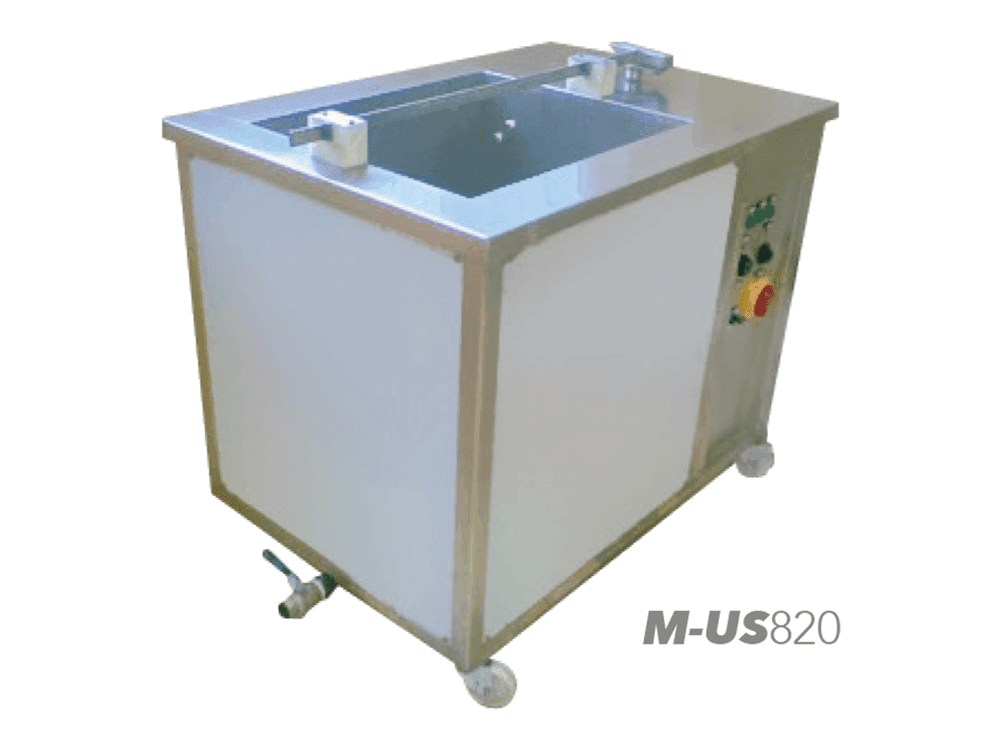
Ultrasonic cleaning machines use transducer-generated ultrasonic energy at frequencies typically between 25 kHz and 80 kHz to produce cavitation in the liquid bath. Cavitation is the rapid formation and collapse of microscopic bubbles at the part surface, which delivers localized mechanical energy that dislodges contamination from surfaces including blind holes, thread roots, and internal channels that spray washing cannot easily reach. Ultrasonic cleaning is particularly effective for precision parts with complex geometry, medical components, small CNC machined parts, and parts with tight tolerances where abrasive or mechanical cleaning is not acceptable. The KAYAKOCVIB USW ultrasonic cleaner series is designed for this application within industrial surface finishing lines.
| Washing Method | Best Suited For | Limitation |
|---|---|---|
| Pressure Washing | Open geometry, high volume, bulk batch or conveyor parts | Limited access to deep internal features, blind holes |
| Ultrasonic Cleaning | Complex geometry, precision parts, blind holes, medical and aerospace parts | Lower throughput than tunnel washers, tank volume constraints |
| Immersion Wash | General degreasing, pre-soak for heavily contaminated parts | No active agitation without ultrasonic or pump recirculation |
Washing Chemistry and Parameter Control
The choice of washing chemistry must match the base metal, the contamination type, and the downstream coating process. Alkaline cleaners with pH typically between 9 and 13 are the standard for steel and iron parts. They saponify oil contamination and suspend particles for removal. Concentration, bath temperature, and contact time must be controlled within the ranges specified for the chemistry to avoid under-cleaning or surface attack.
For aluminum parts, mildly alkaline or pH-neutral cleaners are generally preferred because strongly alkaline solutions can etch the aluminum surface and generate hydrogen gas, which poses both a surface quality and safety concern. The actual pH and concentration tolerance varies between aluminum alloys and must be confirmed by process validation for each alloy type.
Water temperature in the wash stage typically falls between 50 degrees Celsius and 75 degrees Celsius in most industrial applications, with higher temperatures improving oil emulsification and detergency. Actual temperature requirements depend on the chemistry formulation. Rinse water quality, particularly conductivity, affects the cleanliness of the final rinsed surface. Deionized or reverse osmosis water in the final rinse stage reduces mineral spotting, which is important for visible surfaces and for conversion coating performance.
Filtration of the wash bath extends chemistry service life by removing suspended particles and oil. Skimmers remove floating oil from the bath surface. Paper band filtration or cartridge filters remove fine particles. Regular bath monitoring for pH, concentration, and contamination level is standard practice in controlled production environments.
Drying After Washing Before Coating
Complete drying before coating application is not optional. Moisture remaining on the part surface after the final rinse will interfere with powder coating adhesion, cause blistering during cure, promote flash rust on steel surfaces between washing and coating, and may prevent liquid paint adhesion. Drying is achieved by convection air drying, forced hot air drying, or infrared drying depending on part mass, geometry, and throughput requirements.
Parts with deep cavities, recesses, or blind holes present a drainage and drying challenge because wash water can pool inside these features and drain slowly. In these cases, parts may be fixtured at an angle to assist drainage, blow-off stages may be added to the washing machine exit, or compressed air lances may be used to remove water from cavities before the drying stage. Trapped moisture that reaches the coating booth is a known cause of coating defects that can be difficult to trace back to the washing step without systematic process review.
Integration with the Upstream Finishing Line
In many manufacturing environments, parts washing before coating follows directly after a mass finishing or surface preparation stage. Vibratory deburring and polishing processes typically use water-based compounds that leave residue on the part surface. Centrifugal disc finishing processes similarly leave compound residue, polishing film, and media fines on the part. These residues must be removed by washing before any coating is applied.
When the finishing line is automated, the washing system can be positioned immediately after the mass finishing machine and separator, so parts move from deburring to washing to coating without manual handling. Reducing manual handling between washing and coating reduces the risk of recontamination from handling oils and fingerprints. In high-volume lines, inline conveyor washing systems integrated with the finishing and coating equipment provide the most consistent cleanliness level prior to coating.
Quality Control Points Before Coating
Surface cleanliness before coating can be assessed by several practical methods used in industrial environments. The water break test, in which deionized water is applied to the part surface, indicates whether oil contamination remains. A clean surface shows a continuous water sheet. A contaminated surface shows water beading or breaking into droplets. This test is simple, fast, and suitable for in-process monitoring.
Surface conductivity measurement on the final rinse water indicates whether mineral contamination is being introduced at the rinse stage. Parts exhibiting residual chemical staining or discoloration after washing indicate either incorrect chemistry, excessive contact time, incorrect concentration, or a material compatibility issue that requires process adjustment before production continues. Visual inspection under proper lighting catches gross contamination, while cleanliness standards for critical surfaces may specify test panel cleanliness grades such as those used in corrosion protection standards.
Frequently Asked Questions
What contamination types must be removed before coating?
Oil, cutting fluids, rust preventives, metal fines, polishing compound residues, oxide films, and any handling contamination must be removed. The specific contamination profile depends on the prior manufacturing operations performed on the part.
Can ultrasonic cleaning replace pressure washing before coating?
Ultrasonic cleaning and pressure washing address different contamination scenarios and part geometries. Ultrasonic cleaning is more effective for complex geometry and internal features. Pressure washing is better suited to high-volume throughput and open surface geometry. In some applications, both methods are used in sequence.
Is drying always required after washing before coating?
Yes. Residual moisture on the part surface at the time of coating application causes adhesion failure, blistering during powder coat curing, and flash rust on unprotected steel surfaces. Drying must be confirmed before parts enter the coating process.
Does washing chemistry need to change between steel and aluminum parts?
Yes. Strongly alkaline chemistry suitable for steel degreasing can cause surface etching on aluminum. Chemistry concentration, pH, temperature, and contact time must be validated separately for each base material to prevent surface damage and ensure adequate cleaning.
Related Process Equipment
Related Video Demonstration
Conclusion
Parts washing before coating is not a secondary or optional step in the production sequence. It is an engineering-controlled process stage that directly determines coating adhesion performance, corrosion protection durability, and final surface quality. The required washing route depends on the base material, contamination type, part geometry, and downstream coating specification. Machine selection between pressure washing and ultrasonic cleaning follows from part geometry complexity and required throughput. Chemistry selection must account for material compatibility, particularly when aluminum or mixed-metal batches are processed. Drying must be complete before coating, and quality control checkpoints at the exit of the washing stage prevent contamination-related coating defects from reaching final inspection. Consistent results require process validation per material and contamination type, not a generic washing approach applied uniformly across all parts.
Sorry, the comment form is closed at this time.