


30 Jul Flocculation Wastewater Treatment
Flocculation wastewater treatment is a chemical and mechanical process used in surface finishing facilities to separate suspended solids, emulsified oils, and dissolved finishing compounds from process water before discharge or reuse. In vibratory finishing, deburring, and polishing operations, process water accumulates significant concentrations of fine metal particles, abrasive debris, compound residues, and oils. Without controlled treatment, this effluent cannot be discharged legally and cannot be recycled effectively into the finishing process. Understanding how flocculation works within the wastewater treatment sequence allows process engineers to design efficient closed-loop water systems that reduce operating costs and meet environmental discharge requirements.
In This Article
What Flocculation Does in a Finishing Wastewater Stream
In surface finishing operations, spent process water is a complex mixture. It contains fine metallic particles worn from workpieces, abraded media fines, residual finishing compounds, emulsified or free-floating oils, and colloidal particles too small to settle by gravity alone. These colloidal particles carry surface electrical charges that keep them suspended and prevent natural sedimentation, even over extended holding periods.
Flocculation works by neutralizing these surface charges and binding small particles into larger aggregates called flocs. Once formed, flocs are heavy enough to settle under gravity or to be captured by mechanical separation equipment. The result is a clarified water phase that can be recycled back into the finishing machine and a concentrated solids sludge that can be dewatered and disposed of separately.
This process is typically preceded by coagulation, where a chemical coagulant destabilizes colloidal particles, and followed by sedimentation or filtration to physically remove the formed flocs from the water stream. In industrial practice, the terms coagulation and flocculation are often used together because both steps are needed for effective solids removal.
The Flocculation Wastewater Treatment Sequence
A properly engineered wastewater treatment line in a surface finishing facility follows a defined sequence of stages. Each stage builds on the previous one, and skipping or underperforming any stage compromises the overall system efficiency.
- Collection and equalization: Spent process water from vibratory or centrifugal finishing machines is collected in an equalization tank. This step homogenizes the incoming effluent, smoothing out variation in flow rate and contamination concentration before chemical treatment begins.
- pH adjustment: The water pH is measured and corrected to the range optimal for coagulant and flocculant performance, typically between 6.5 and 8.5 for most inorganic coagulants, though exact ranges depend on the chemistry used. Acid or alkali dosing pumps handle this adjustment automatically in automated systems.
- Coagulation: A coagulant chemical, commonly aluminum sulfate, ferric chloride, or a polyaluminum chloride, is dosed into the water and mixed rapidly. The coagulant neutralizes the surface charges on colloidal particles, causing them to destabilize and begin forming micro-aggregates.
- Flocculation: A polymer flocculant, typically a polyacrylamide-based product, is added under slow, controlled agitation. The polymer chains bridge between the destabilized particles, binding them into larger, visible floc structures. Agitation speed is important: too fast breaks apart forming flocs, while too slow prevents adequate particle contact.
- Sedimentation or flotation: The flocculated water is transferred to a settling tank or dissolved air flotation unit where flocs either sink to the bottom as sludge or are floated to the surface for collection. Residence time in this stage directly affects clarification efficiency.
- Filtration: Clarified water passes through a sand filter, cartridge filter, or membrane filter to remove residual fine particles before storage or reuse. This step is particularly important when the clarified water is intended for direct recycling into finishing machines.
- Sludge dewatering: Collected sludge from the settling stage is processed through a filter press, belt press, or centrifugal decanter to reduce water content. Dewatered sludge cake is then removed for waste disposal in compliance with local regulations.
- Water recycling or discharge: Treated water is either recirculated into the finishing process or discharged to a municipal sewer system after confirming compliance with effluent quality limits for suspended solids, pH, heavy metals, and oil content.
Process Parameters That Control Flocculation Efficiency
Several variables control how effectively flocculation wastewater treatment removes contaminants. Getting these parameters right requires initial testing on the actual effluent, because finishing facility wastewater composition varies considerably depending on base material, media type, and compound chemistry.
| Parameter | Typical Range | Effect on Process |
|---|---|---|
| pH during coagulation | 6.5 to 8.5 | Controls coagulant solubility and charge neutralization efficiency |
| Coagulant dose | 50 to 300 mg/L depending on contamination load | Under-dosing leaves colloidal particles destabilized; over-dosing restabilizes particles |
| Flocculant dose | 1 to 10 mg/L typical for polyacrylamide | Controls floc size and settling speed; excess polymer can cause restabilization |
| Slow mix time for flocculation | 10 to 30 minutes | Longer contact allows larger floc formation; agitation speed must remain gentle |
| Settling time | 30 to 120 minutes depending on floc density | Determines sludge compaction and clarified water quality |
| Temperature | 15 to 35 degrees Celsius | Cold water slows floc formation; very hot water can reduce polymer effectiveness |
Actual parameter values depend on the specific contamination profile of the effluent, the coagulant and flocculant chemistry selected, and the target water quality for reuse or discharge. Process optimization requires jar testing on representative effluent samples before committing to final chemical dosing rates in production.
Oil Separation as a Pre-Treatment Step
In many surface finishing facilities, process water contains both suspended solids and emulsified or free oils from machining fluids, lubricants, or rust inhibitors that carry over with incoming parts. Oils can interfere with coagulation and flocculation chemistry, reducing treatment efficiency and increasing chemical consumption.
Oil removal should be performed as a pre-treatment step before chemical dosing. This typically involves an oil skimmer to remove free-floating oil, a coalescing plate separator for dispersed oil droplets, or dissolved air flotation where fine air bubbles lift oil droplets to the surface. In operations processing steel or aluminum parts with significant oil contamination, bypassing this pre-treatment stage leads to increased coagulant and flocculant demand and poorer final water clarity.
Closed-Loop Water Reuse in Surface Finishing
One of the primary engineering drivers for implementing flocculation wastewater treatment in surface finishing plants is the ability to close the water loop and minimize fresh water consumption. In a vibratory finishing process, water is consumed continuously as part of the compound mixing, lubrication, and media cooling function. Without a recycling system, this water must be replaced with fresh supply and the spent water must be managed as industrial effluent.
A properly designed closed-loop system treats spent process water, removes solids and oils, adjusts chemistry, and returns clarified water to the compound dilution and machine feed system. This approach typically reduces fresh water consumption significantly in continuous production environments, though exact savings depend on machine type, process intensity, and the quality of treatment achieved.
Closed-loop operation also reduces the volume of effluent requiring external disposal, which can lower environmental compliance costs in facilities subject to volume-based discharge fees or strict effluent quality permits.
Machine Systems for Industrial Flocculation Treatment
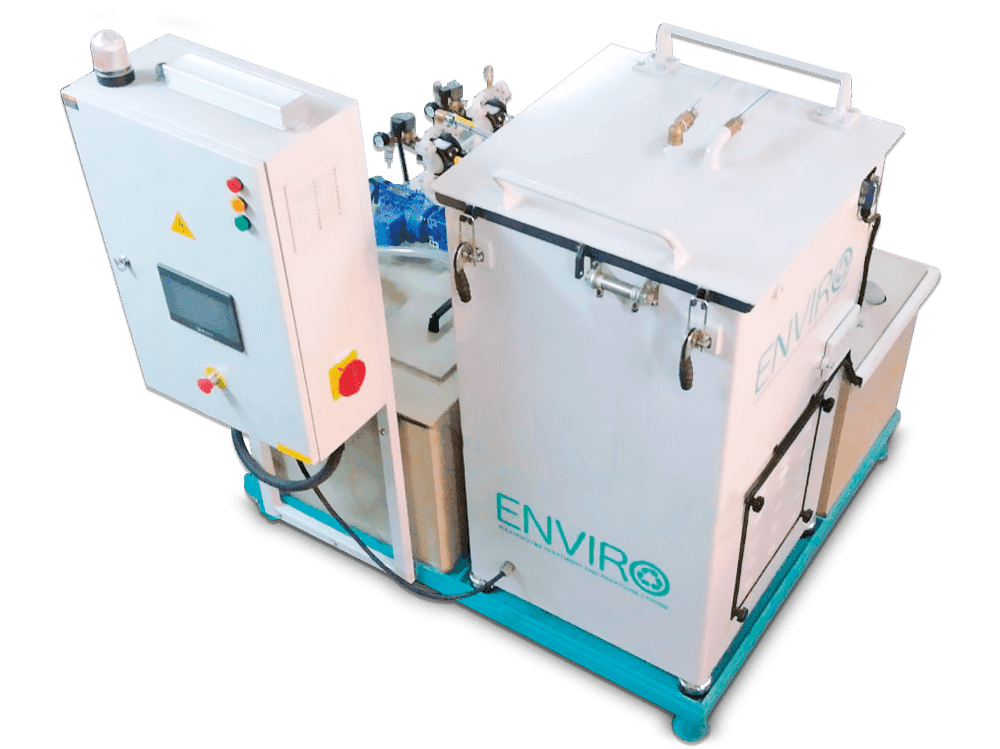
Industrial-scale flocculation wastewater treatment in surface finishing facilities is handled by dedicated treatment systems that automate chemical dosing, mixing, settling, filtration, and sludge handling. These systems integrate pH sensors, dosing pumps, level controls, and programmable logic controllers to maintain consistent treatment quality without requiring constant operator intervention.
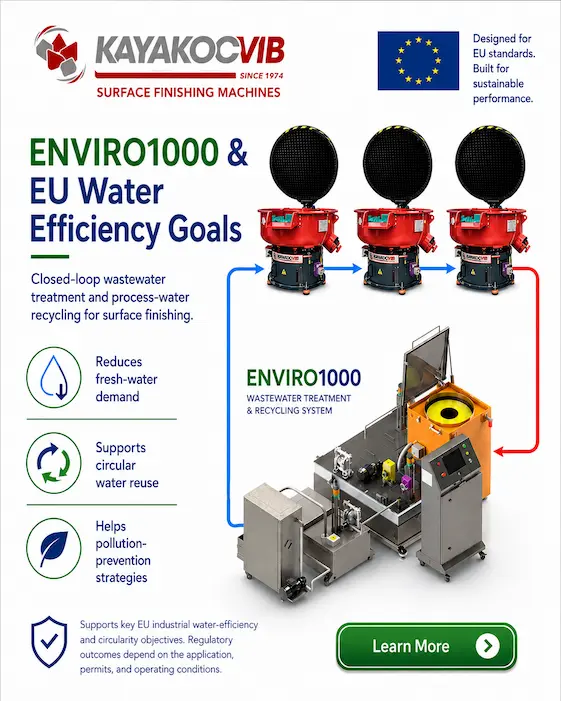
KAYAKOCVIB offers wastewater treatment systems including the ENVIRO1000 and FLOG systems, designed specifically for the wastewater generated by vibratory finishing and mass finishing operations. These systems handle the typical contamination profile of finishing effluent, including fine metal fines, media abrasive particles, compound residues, and emulsified oils. The SDM-T system handles sludge dewatering to reduce disposal volume from the treatment process. These systems are sized based on the daily water volume produced by the finishing line, and can be integrated into automated finishing cells.
Selecting the right system capacity is important. An undersized treatment system creates bottlenecks that force holding tank overflow or discharge of partially treated water. An oversized system may have insufficient residence time at low flow rates. System sizing should be based on peak daily water volume from the finishing machines, accounting for cleaning cycles and periodic high-flow events.
Solids Handling and Sludge Disposal
The sludge produced by flocculation wastewater treatment contains concentrated metal fines, abrasive media particles, and finishing compound residues in a water matrix. Depending on the base materials processed, this sludge may contain heavy metals such as chromium, nickel, zinc, or copper at concentrations that classify it as hazardous industrial waste under local regulations.
Sludge dewatering reduces the volume of material requiring disposal. A filter press can reduce sludge water content from 95 percent to below 60 percent in many applications, converting a fluid waste stream into a manageable solid cake. Dewatered sludge must still be characterized chemically before disposal to confirm the correct waste classification and disposal route.
Facilities processing stainless steel or chrome-plated components should be particularly careful about chromium content in sludge and should verify disposal compliance with current hazardous waste regulations in their jurisdiction.
Practical Validation Before Full Operation
Before committing to a final flocculation chemistry and dosing program, engineering teams should perform bench-scale jar testing using representative samples of actual process effluent. Jar testing involves adding measured doses of coagulant and flocculant to small effluent samples under controlled mixing conditions, observing floc formation and settling behavior, and measuring residual turbidity and other quality parameters in the clarified fraction.
Jar testing results provide the starting point for chemical selection and dosing rates, but full-scale system behavior may differ from bench scale due to mixing dynamics, temperature variation, and fluctuating effluent composition. An initial commissioning period with daily monitoring and parameter adjustment is normal before a new treatment system reaches stable operation.
Key quality checks during commissioning include clarified water turbidity, pH of treated water, residual oil concentration, and suspended solids content. If the treated water is intended for reuse in finishing machines, compound carryover and its effect on the finishing process chemistry must also be evaluated.
Frequently Asked Questions
What is the difference between coagulation and flocculation in wastewater treatment?
Coagulation uses a chemical agent to neutralize the electrical charges that keep colloidal particles suspended, causing initial particle destabilization. Flocculation follows coagulation and uses a polymer to bridge these destabilized particles into larger, settleable aggregates called flocs. Both steps are required for effective solids removal from finishing wastewater.
Can flocculation remove oils from surface finishing wastewater?
Flocculation is primarily effective for suspended solids and colloidal particles. Free-floating oils should be removed by skimming or coalescing separators before flocculation. Emulsified oils may be partially removed during flocculation if the emulsion is destabilized by the coagulant, but dedicated oil separation pre-treatment is generally needed for reliable oil removal in finishing effluent.
How often should chemical dosing be adjusted in a flocculation system?
Chemical dosing should be reviewed whenever the composition of incoming process water changes significantly. Changes in base material, finishing compound, media type, or production volume can all alter the effluent chemistry. In practice, dosing rates may need adjustment seasonally due to temperature effects on floc formation, or when new part types or compounds are introduced into the finishing line.
Is flocculation-treated water safe to reuse directly in vibratory finishing machines?
Treated water can typically be reused for compound dilution and machine operation, but the suitability depends on the quality of treatment achieved. Residual suspended solids or chemical carryover in recycled water can affect finishing compound performance and surface quality on parts. The water quality after treatment should be validated against the requirements of the specific finishing process before full closed-loop operation begins.
Related Process Equipment
Conclusion
Flocculation wastewater treatment is an essential process engineering component for surface finishing facilities that operate wet deburring, polishing, or vibratory finishing processes at production scale. By combining coagulation, flocculation, sedimentation, and filtration in a properly sequenced treatment line, facilities can achieve the clarified water quality needed for either safe discharge or direct recycling back into the finishing process. Correct chemical selection, dosing optimization through jar testing, and appropriate sludge handling are the key engineering decisions that determine system performance. Automated treatment systems from manufacturers such as KAYAKOCVIB, including the ENVIRO1000 and FLOG platforms, provide integrated solutions that reduce operator workload while maintaining consistent treatment quality. The long-term value of a well-designed system lies in reduced water consumption, lower disposal costs, and reliable compliance with effluent regulations, all of which depend on correctly matching the treatment chemistry and system capacity to the actual effluent load of the finishing operation.
Sorry, the comment form is closed at this time.