



10 Aug Finishing Aluminum Aerospace Parts
Finishing aluminum aerospace parts presents engineering challenges that do not exist in general industrial deburring or polishing work. Aerospace aluminum components — including structural brackets, hydraulic manifolds, actuator housings, and precision machined frames — carry tight dimensional tolerances, complex internal geometries, and surface condition requirements that are driven by function, fatigue resistance, and downstream processes such as anodizing, chemical conversion coating, or adhesive bonding. A poorly controlled finishing process can remove material beyond tolerance, introduce micro-scratches, create surface stress, or leave compound residue that compromises coating adhesion. This article explains the engineering requirements, process route selection, machine and media logic, and quality control considerations for aerospace aluminum finishing in production environments.
In This Article
Typical Aerospace Aluminum Parts and Their Finishing Requirements
Aerospace aluminum finishing covers a broad range of part families. CNC-machined structural components typically arrive from machining with sharp edges, burrs at intersecting bores, and a machined surface texture that may be acceptable dimensionally but unsuitable for anodizing or painting without further treatment. Sheet metal brackets and formed parts may carry sheared edges, punch burrs, or weld spatter. Precision housings for avionic assemblies may require edge rounding to a controlled radius without surface scratching.
The dominant aluminum alloys used in aerospace applications — 2024, 6061, 7050, and 7075 — differ in hardness and surface sensitivity. 7075 is harder than 6061 and tolerates slightly more aggressive media contact, but both remain softer than steel and are susceptible to surface damage from ceramic media or excessive process intensity. Titanium parts occasionally appear in the same production environment, but aluminum and titanium should not be mixed in the same finishing batch due to galvanic contamination risk and different media requirements.
Typical finishing objectives for aerospace aluminum components include burr removal at machined edges, controlled edge rounding within specified radius limits, surface smoothing to support anodizing or coating adhesion, and surface cleanliness free from machining oil, chips, and compound residue.
Why Standard Deburring Approaches Are Often Unsuitable
Manual deburring with files or abrasive tools is common in low-volume aerospace shops but introduces inconsistency. Individual operators produce different edge geometries, and hand pressure can leave directional scratches on sealing faces or precision bores. Manual deburring is also slow for complex parts with multiple intersecting bores or internal features that are difficult to access.
Electrochemical deburring offers precision for internal features but requires part-specific tooling, electrolyte management, and material conductivity considerations. It does not address surface texture or cleaning simultaneously. Abrasive blasting can remove burrs but may introduce compressive stress that is not always predictable and can leave embedded abrasive particles in soft aluminum surfaces.
Mass finishing processes — particularly centrifugal disc finishing — address many of these limitations by providing controlled, repeatable, low-impact abrasive action across all part surfaces simultaneously. The process is particularly suitable for batches of small to medium aerospace aluminum parts where consistency and cycle repeatability are required.
Centrifugal Disc Finishing for Aerospace Aluminum
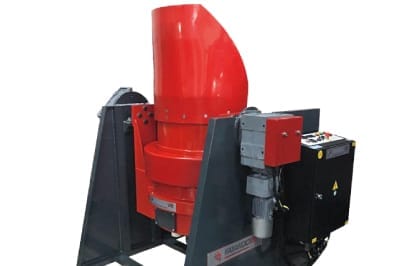
Centrifugal disc finishing is the process of choice for many aerospace aluminum part families because it delivers high cutting or polishing action in short cycle times while maintaining controllable process intensity. The machine consists of a stationary cylindrical bowl and a rotating disc at the base. The disc imparts centrifugal force to the media and parts, generating a toroidal flow pattern. Parts and media circulate continuously, with abrasive contact occurring across all exposed surfaces.
Compared to standard vibratory finishing, centrifugal disc machines generate significantly higher process intensity, reducing cycle times from hours to minutes for equivalent material removal. This is important for aerospace production environments where throughput and batch consistency both matter. The KAYAKOCVIB KSM series centrifugal disc finishing machines are designed for this application range, offering adjustable disc speed, bowl geometry, and process parameter control suited to sensitive materials such as aerospace aluminum.
Process intensity in centrifugal disc finishing is primarily controlled through disc rotational speed. For aerospace aluminum parts, lower to moderate disc speeds are typically used to avoid part-to-part impact damage and excessive material removal. The actual speed setting depends on part geometry, part weight, media type, and the required surface outcome, and must be established through sample testing before production runs.
Media Selection for Aerospace Aluminum Finishing
Media selection is one of the most consequential decisions in finishing aluminum aerospace parts. Ceramic media, which is standard for steel and iron deburring, is too aggressive for most aerospace aluminum applications. Ceramic media can cause surface scratching, micro-chipping at part edges, and dimensional deviation on thin-wall sections or precision features.
Plastic bonded abrasive media is the standard choice for aerospace aluminum finishing. Plastic media is softer, generates less aggressive cutting action, and produces a smoother surface finish on aluminum without the risk of surface damage associated with ceramic media. The abrasive grain type and concentration within the plastic matrix determine the cutting rate. For deburring followed by surface smoothing, a two-stage process using cut-grade plastic media followed by finish-grade plastic media is commonly used. For edge rounding to a controlled radius, the cut-grade stage duration controls the rounding amount and must be monitored against dimensional acceptance criteria.
Media geometry selection depends on part geometry. For parts with recessed features, narrow slots, or internal channels, media must be sized and shaped to avoid lodging inside the part. Cone, triangle, and cylinder shapes in varying sizes are selected based on the smallest critical feature dimension. Media lodging inside an aerospace component is a serious production defect and must be prevented through media size analysis before process release.
Process Chemicals for Aluminum Finishing
Liquid compounds used during wet centrifugal disc finishing serve multiple functions simultaneously: lubrication to reduce part-to-part impact, surface brightening or cleaning, pH buffering to prevent surface oxidation, and rinsing action that removes swarf and used abrasive from the process zone. For aluminum and other non-ferrous materials, alkaline or near-neutral compounds are preferred. Strongly acidic compounds can cause surface etching or staining on aerospace aluminum, which may affect anodizing adhesion or visual acceptance.
An 085-type deburring and polishing liquid is generally appropriate for aluminum mass finishing applications. It supports brightening and light oxide removal without attacking the base metal. A 028-S degreasing liquid is suitable for the cleaning stage to remove machining oils, coolant residue, and process compound before inspection or downstream surface treatment. Compound concentration, flow rate, and water quality all affect the final surface condition and must be validated as part of the process setup.
Process Route for Aerospace Aluminum Parts
A typical production process route for finishing aluminum aerospace parts using centrifugal disc finishing follows a defined sequence. The exact parameters for each stage require validation through sample testing with production-representative parts.
- Pre-inspection: Confirm incoming parts meet dimensional acceptance before finishing. Identify any features at risk of media lodging or dimensional sensitivity.
- Media and machine setup: Select appropriate plastic media geometry and size based on part geometry analysis. Load the KSM machine with media at the correct media-to-part ratio for the part weight and batch size.
- Deburring stage: Run at the validated disc speed with 085 compound at the correct dilution and flow rate. Cycle time depends on burr size and required edge condition.
- Surface smoothing stage (if required): Replace cut-grade media with finish-grade plastic media or run a separate lighter stage at reduced intensity for surface refinement.
- Separation: Separate parts from media using a vibratory separator or screen. Inspect for media lodging on complex geometry parts.
- Washing: Wash parts using clean water or 028-S compound solution to remove finishing residue, swarf, and compound film. Pressure washing or ultrasonic cleaning may be used for parts with blind holes or internal passages.
- Drying: Dry parts using a vibratory dryer to prevent water staining on aluminum surfaces before inspection or coating.
- Post-process inspection: Verify edge condition, surface texture, and dimensional conformance before release to downstream operations.
Surface Quality Control and Inspection Points
Surface quality control for aerospace aluminum parts after finishing must address several specific characteristics. Edge radius conformance is typically verified using optical comparator or profilometer measurement on reference edges. Surface roughness in Ra terms may be specified for sealing surfaces, bearing contact areas, or anodizing preparation surfaces, and should be measured on representative surfaces after each process stage during validation.
Visual inspection under controlled lighting conditions identifies surface scratches, pitting, staining, or remaining burr remnants. For anodizing preparation, the surface must be free of smeared aluminum, embedded media particles, and compound residue, as these defects become visible after anodizing and may cause adhesion failure.
Dimensional checks on critical features — bore diameters, sealing groove widths, threaded hole conditions — must confirm that the finishing process has not removed material beyond drawing tolerance. Because centrifugal disc finishing generates higher process energy than vibratory finishing, thin walls, precision bores, and sharp-corner features require particular attention during process validation.
Process Parameters That Affect Finishing Outcome
| Parameter | Effect on Aluminum Parts | Typical Control Range |
|---|---|---|
| Disc speed | Controls process intensity and material removal rate | Lower to moderate settings for aerospace aluminum; validated per part |
| Media type | Determines cutting aggressiveness and surface finish | Plastic bonded abrasive preferred over ceramic |
| Media size and shape | Affects feature access and media lodging risk | Selected based on smallest critical feature dimension |
| Compound type and concentration | Controls lubrication, brightening, and oxide prevention | 085 for deburring/polishing; 028-S for degreasing stage |
| Cycle time | Determines edge rounding amount and surface refinement level | Validated through sample testing; not generalized |
| Media-to-part ratio | Controls part-to-part contact frequency and surface coverage | Higher ratios reduce part-to-part impact on delicate parts |
| Water flow rate | Affects swarf removal and compound dilution during process | Controlled to maintain consistent compound concentration |
Integration Into Aerospace Production Lines
In higher-volume aerospace machining operations, finishing aluminum aerospace parts can be integrated into a semi-automated or automated production cell. Parts are loaded into the centrifugal disc machine after machining, processed through a defined cycle, separated automatically using a vibratory separator, transferred to a washing station, and dried before moving to inspection or coating.
Automated part handling reduces operator contact with freshly machined surfaces, minimizing contamination risk. Consistent machine loading — same batch size, media fill level, compound concentration, and disc speed — is essential for process repeatability across production shifts. Any variation in these parameters can produce surface finish or edge condition differences that affect downstream process performance.
Wastewater from the finishing and washing stages contains aluminum swarf, spent compound, and suspended solids. In aerospace facilities subject to environmental compliance requirements, wastewater treatment and recycling systems are typically required before discharge. These systems can recover water for reuse in the finishing process, reducing compound and water consumption over time.
Limitations and Validation Requirements
Centrifugal disc finishing is highly effective for most small to medium aerospace aluminum parts, but it is not suitable for all geometries. Very large structural components that exceed machine capacity require alternative approaches such as trough vibratory finishing or manual deburring for localized features. Parts with extremely tight tolerances on all surfaces — where even light plastic media contact would risk dimensional deviation — may require selective masking or alternative edge treatment methods.
Heavy burrs from milling or drilling operations may require pre-deburring using a brush deburring or manual station before mass finishing, since centrifugal disc finishing is optimized for light to medium burr removal rather than heavy flash or thick gate removal. Internal passages that are not accessible to media flow will not be deburred by the process; those features require separate tooling or electrochemical treatment.
Every process parameter set used for aerospace aluminum parts must be validated through a documented sample testing protocol before production release. Validation should include dimensional measurement, surface roughness measurement, edge radius assessment, and visual surface inspection under aerospace inspection criteria.
Frequently Asked Questions
Can ceramic media be used for finishing aerospace aluminum parts?
Ceramic media is generally not recommended for aerospace aluminum. It is more aggressive than plastic bonded abrasive media and can cause surface scratching, micro-chipping at edges, and dimensional deviation on precision features. Plastic media is the standard choice for aluminum and other soft non-ferrous aerospace materials.
How is media lodging prevented during aerospace aluminum finishing?
Media lodging is prevented by selecting media shapes and sizes larger than the smallest critical feature opening on the part. Before process release, a media size analysis must be performed against the part drawing to confirm that no media geometry can enter and become trapped in blind holes, slots, or internal passages.
What surface roughness values can centrifugal disc finishing achieve on aluminum?
Achievable surface roughness depends on media type, abrasive grade, compound selection, disc speed, and cycle time. Actual Ra values must be determined through process validation with production-representative parts. It is not appropriate to state guaranteed Ra values without application-specific testing, as results vary by part geometry and initial surface condition.
Is a washing stage required after centrifugal disc finishing of aerospace aluminum?
Yes. Washing is required to remove compound residue, aluminum swarf, and media particles from part surfaces before inspection or downstream coating processes. For parts with blind holes or internal channels, pressure washing or ultrasonic cleaning may be needed to ensure complete residue removal.
Related Process Equipment
Related Video Demonstration
Conclusion
Finishing aluminum aerospace parts requires a carefully engineered process route that balances effective burr removal and surface refinement against the dimensional sensitivity and surface integrity requirements of aerospace-grade aluminum. Centrifugal disc finishing, using plastic bonded abrasive media and appropriate deburring compounds, provides the combination of process consistency, surface quality, and cycle time control that aerospace production demands. Machine parameters including disc speed, media selection, compound type, and cycle time must be validated through documented sample testing for each part family before production release. Process integration with washing, drying, and wastewater management completes the finishing line and supports downstream anodizing, chemical conversion coating, or painting operations. The engineering decisions made during process setup directly determine whether the finished component meets the surface and dimensional requirements that aerospace quality standards require.
Sorry, the comment form is closed at this time.