


01 Jul Fastener Deburring Case Study
This fastener deburring case study examines how a mid-volume fastener manufacturer transitioned from manual brushing operations to automated vibratory finishing, and what process decisions drove that change. Fasteners including hex bolts, machine screws, socket head cap screws, and self-tapping screws present a well-defined but technically demanding finishing challenge: high volume, tight surface quality requirements, mixed material grades, and burrs generated at thread rolling, heading, and trimming operations. Manual brushing addressed these problems one piece at a time. Vibratory finishing addresses them at batch scale, with repeatable and documentable process control.
In This Article
The Production Problem: What Manual Brushing Could Not Solve
In the original production line, operators used rotating wire brushes, hand files, and buffing wheels to remove burrs and sharp edges from finished fasteners before inspection and packaging. For low-volume specialty fasteners, this approach was acceptable. When order volumes increased and the product mix expanded to include stainless steel hex bolts and aluminum machine screws alongside carbon steel fasteners, the limitations became clear.
Manual brushing produced inconsistent results across operators and shifts. Stainless steel fasteners required significantly more effort than carbon steel, and aluminum parts were often over-finished or scratched when brushes calibrated for harder metals were used. Cycle time per batch was difficult to control, and documentation for surface quality acceptance was informal. Rework rates on thread areas were higher than the quality department accepted.
The engineering team identified three root issues: inconsistent deburring force, inability to process mixed geometries in the same batch without part-specific adjustments, and no repeatable process record. These were structural problems with manual operations, not operator skill problems.
Defining the Finishing Requirements Before Machine Selection
Before selecting a machine type, the team documented the finishing requirements precisely. This step is often skipped in practice, which leads to machine selection based on price rather than process fit.
The requirements for this application were:
- Burr removal at thread runout and head-to-shank transitions
- Edge rounding on hex drive features without radius overrun
- Surface smoothing on shank and head bearing surfaces
- No media lodging in threaded holes or socket head recesses
- Compatibility with carbon steel, stainless steel, and aluminum fasteners processed in separate batches
- Dry output with no water contamination prior to packaging
- Process documentation capability for quality records
The volume requirement was between 80 and 120 kg per batch, with two to three batch cycles per shift. This ruled out small laboratory-scale machines and confirmed the need for a production-grade circular vibratory unit.
Machine Selection: Circular Vibratory Finishing for Fastener Geometry
Circular vibratory finishing machines were selected over centrifugal disc finishing machines for this application. Both machine types are capable of deburring and surface smoothing on small metal parts, but the selection logic differed based on part geometry and batch composition.
Centrifugal disc machines deliver higher process intensity and shorter cycle times, which is useful for precision parts requiring rapid surface refinement. However, for threaded fasteners with socket head recesses, the high-energy impact in centrifugal disc machines increases the risk of media lodging in cavities and can cause uncontrolled edge rounding on drive features. Circular vibratory machines produce a gentler, more uniform tumbling motion that reduces this risk while still achieving effective deburring over a typical cycle of 20 to 60 minutes depending on material and burr condition.
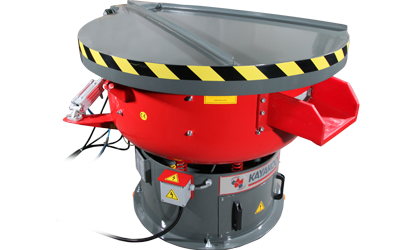
A circular vibratory finishing machine such as the KAYAKOCVIB KVM series provides a toroidal flow pattern in which the entire batch of parts and media rotates and tumbles continuously. This motion distributes media contact evenly across all surfaces, including thread roots, shank surfaces, and head bearing faces. The amplitude and frequency of vibration can be adjusted to control process intensity, which is important when switching between carbon steel, stainless steel, and aluminum batches.
Media and Compound Selection for Mixed Fastener Materials
Media selection was one of the most technically important decisions in this transition. Because the production line processed three different base materials in separate batches, the team needed media and compound recommendations for each material family rather than a single universal setup.
For carbon steel fasteners, ceramic cutting media in a triangular or cylindrical geometry was selected. Ceramic media provides the cutting action needed to remove burrs and scale from heat-treated steel without glazing or loading. The process liquid used was a 943-series deburring and polishing compound combined with 028-S degreasing liquid to control foam, maintain pH, and prevent flash rusting between the vibratory step and drying.
For stainless steel fasteners, ceramic media was also used, but with a finer cut grade to avoid over-cutting the surface. Stainless steel is harder than mild carbon steel but more sensitive to surface scratching, and the compound selection was adjusted to support passivation-compatible conditions. The 943-series compound remained suitable, with attention to compound concentration to avoid staining.
For aluminum machine screws, the approach changed significantly. Plastic media was selected because aluminum is a soft metal that scratches and deforms under ceramic cutting action unless the application specifically requires aggressive material removal. Plastic media provides controlled surface smoothing and light deburring without gouging the base material. The compound used was an 085-series deburring and polishing liquid with 028-S degreasing liquid.
Mixing aluminum and steel parts in the same batch was not considered. Galvanic contamination from steel particles embedding into aluminum surfaces creates corrosion risk, and the media and compound requirements for the two materials are incompatible in a single process cycle.
Process Parameters and Cycle Structure
The vibratory finishing process for this fastener application was structured as a wet finishing cycle followed by separation and drying. The key process parameters established during trial runs are shown below as approximate industrial reference values. Actual parameters must be validated through sample testing for each specific application.
| Material | Media Type | Cycle Time (Typical) | Compound | Amplitude Setting |
|---|---|---|---|---|
| Carbon steel fasteners | Ceramic, triangular or cylindrical | 25 to 40 minutes | 943 + 028-S | Medium to high |
| Stainless steel fasteners | Ceramic, fine cut grade | 30 to 50 minutes | 943 + 028-S | Medium |
| Aluminum fasteners | Plastic, medium cut grade | 20 to 35 minutes | 085 + 028-S | Low to medium |
After the vibratory finishing cycle, parts and media were discharged through the machine’s integrated separation screen. The screen aperture was selected to pass parts through while retaining media, eliminating the need for manual separation. Wet parts were then transferred to a DVM circular vibratory dryer loaded with dry hardwood or corn cob drying media. The drying cycle required approximately 10 to 20 minutes depending on fastener size and surface water retention.
Surface Quality Outcomes and Inspection Points
After process validation through multiple trial batches, the vibratory finishing process consistently produced burr-free thread runout transitions, smooth shank surfaces, and uniform edge conditions on hex drive features. Surface roughness values on shank surfaces were reduced compared to post-machining condition, with typical Ra improvements depending on initial surface condition, media grade, and cycle time. Exact Ra values require application-specific measurement and cannot be guaranteed as universal outcomes.
The inspection protocol after finishing included:
- Visual and tactile check for residual burrs at thread runout and head transitions
- Go/no-go gauge check on external threads to confirm media contact did not alter thread form dimensions
- Dimensional check on socket head recesses to confirm drive geometry was preserved
- Surface appearance check for staining, discoloration, or media residue
- Spot Ra measurement on shank surfaces for process audit records
Thread form dimension was a specific concern during validation. Vibratory finishing at medium amplitude on a correctly loaded machine did not measurably alter external thread form on M6 through M16 fasteners in this application. However, fine-pitch threads or very small fasteners may require additional care in media size selection to prevent excessive thread contact. This must be validated on a case-by-case basis.
Production Line Integration and Throughput Comparison
The transition from manual brushing to vibratory finishing changed both throughput and labor allocation. Manual brushing required one operator per part family with cycle times that scaled linearly with batch size. Vibratory finishing processes a full machine load simultaneously, with the operator performing loading, parameter setup, and unloading rather than active part-by-part work.
For this production setup, a single KVM-series circular vibratory machine with 200-liter bowl capacity allowed the team to process batches that previously required three operator-hours in under 45 minutes of unattended process time. Operator involvement was limited to loading, setup, separation check, and transfer to the dryer. This freed operator capacity for other inspection and handling tasks.
Labor reduction figures depend on production volume, shift structure, and batch composition. They should not be treated as guaranteed outcomes without analysis of the specific production environment. The quality improvement, however, was consistent: process-driven finishing removed the operator-to-operator variation that manual brushing produced and created a documented, repeatable process record for each batch.
Limitations and Conditions That Require Additional Consideration
Vibratory finishing is effective for the fastener deburring case study described here, but it is not without limitations. Several conditions require attention before assuming the process transfers directly to a different fastener type or production setup.
Very small fasteners below M4 in diameter may require finer media to avoid media bridging or uncontrolled edge rounding. Fasteners with blind threaded holes may trap media during the cycle, requiring specific media geometry selection or a post-process air blow-off step. Parts with very heavy burrs from cold heading or trimming operations may benefit from a rough-cut ceramic pre-processing step before moving to the main finishing cycle.
Stainless steel fasteners are also more sensitive to compound selection than carbon steel. Using an incorrect compound concentration or alkaline compound that is incompatible with stainless alloys can cause surface staining that requires rework. Compound selection and concentration must be validated with stainless grades before full production release.
Finally, parts that have been heat treated to high hardness values may require longer cycle times or higher-cut ceramic media to achieve equivalent burr removal compared to softer grades. Process parameters should always be established through trial runs before production commitment.
Frequently Asked Questions
Can vibratory finishing replace manual brushing for all fastener types?
Vibratory finishing is suitable for most standard fastener geometries including hex bolts, machine screws, socket head cap screws, and self-tapping screws. Very small or complex geometries may require media size adjustments or alternative machine types. Process validation through sample testing is required before production release.
How is media lodging in threaded holes prevented?
Media lodging risk is controlled through media geometry and size selection. The media must be large enough that it cannot enter threaded holes or socket head recesses. Triangular and cylindrical ceramic media with an appropriate size relative to the fastener recess geometry reduces lodging risk. Centrifugal disc machines are generally avoided for fasteners with deep recesses due to higher impact energy.
Should aluminum and steel fasteners be finished in the same batch?
No. Aluminum and steel fasteners must be processed in separate batches. Steel particles can embed into aluminum surfaces during vibratory finishing, causing galvanic corrosion risk and surface contamination. Media and compound requirements also differ between the two materials.
What is a typical cycle time for fastener vibratory finishing?
Typical cycle times range from approximately 20 to 50 minutes depending on material, burr size, media type, and machine amplitude setting. These are industrial reference values and actual cycle times must be established through trial runs for each specific fastener type and finishing requirement.
Related Process Equipment
Related Video Demonstration
Conclusion
This fastener deburring case study demonstrates that the transition from manual brushing to vibratory finishing is technically justified when production volume, surface quality consistency, and process documentation requirements exceed what manual operations can reliably deliver. The key engineering decisions in this transition were not machine cost or brand selection, but rather accurate definition of finishing requirements, correct media and compound selection for each material family, process parameter validation through sample testing, and proper integration of separation and drying steps. A circular vibratory finishing machine matched to batch size and part geometry, combined with a validated media and compound system, produces repeatable deburring and surface smoothing results that manual brushing cannot match at production scale. The process must be validated for each fastener type and material grade before production commitment, and no universal parameter set should be assumed to transfer without testing.
Sorry, the comment form is closed at this time.