


31 Jul Environmental Benefits Wastewater Recycling
The environmental benefits of wastewater recycling in metal finishing extend beyond regulatory compliance. In high-volume deburring, polishing, and surface finishing operations, process water carries suspended solids, fine metal particles, oil contamination, and spent finishing compound. Discharging this water without treatment creates environmental liability and wastes a recoverable resource. Recycling wastewater through a correctly configured treatment system reduces freshwater consumption, lowers chemical discharge loads, and enables continuous production without the operational risk of effluent violations.
In This Article
Why Wastewater Management Fails in Metal Finishing Facilities
Many finishing operations experience wastewater problems not because treatment is impossible, but because the root causes of contamination are not addressed at the source. Water exiting a vibratory finishing machine contains a mixture of abrasive fines, metal swarf, emulsified oil, finishing compound residue, and in some cases chelating agents that make separation difficult. If the treatment system is sized or configured incorrectly for the actual contamination load, downstream problems accumulate.
Common failure patterns include overloaded sedimentation tanks that cannot settle fine particles within the available residence time, inadequate oil separation before sedimentation, and incorrect flocculant dosing that leaves colloidal particles in suspension. These failures result in recycled water that carries residual contamination back into the finishing machine, causing staining on aluminum and stainless steel parts, inconsistent compound performance, and accelerated media degradation.
Identifying which failure mode is active in a given system is the first step toward optimization. The contamination profile of the wastewater depends heavily on the part material, the media type, the compound chemistry, and the production volume. Steel parts processed with ceramic media and acidic compounds produce a different effluent than aluminum parts processed with plastic media and neutral or mildly alkaline compounds.
Root Cause Categories for Wastewater Treatment Underperformance
Treatment system problems in metal finishing generally fall into four categories: hydraulic overload, chemical imbalance, insufficient solids removal, and inadequate oil separation. Each requires a different corrective action.
Hydraulic overload occurs when the volumetric flow rate entering the treatment system exceeds the design capacity of the sedimentation tank or filtration stage. In facilities that have expanded production without upgrading their treatment infrastructure, this is a frequent cause of poor effluent quality. The solution is either to increase tank volume, reduce peak flow by staggering machine drain cycles, or add a buffer collection tank before the treatment stage.
Chemical imbalance in the process water affects both part surface quality and treatment efficiency. Finishing compounds accumulate in recirculated water over multiple cycles. As compound concentration rises, the water chemistry drifts from the intended operating range, affecting the deburring action, the surface brightness of finished parts, and the effectiveness of flocculants used in the treatment stage. Regular monitoring of pH, conductivity, and compound concentration is necessary to maintain stable water chemistry.
Insufficient solids removal is common when fine metal particles below 10 microns remain suspended after primary sedimentation. These particles are too light to settle by gravity alone within a practical tank residence time. Flocculation using appropriate coagulant chemistry causes fine particles to aggregate into larger flocs that settle more rapidly. Without flocculation, fine solids accumulate in the recirculated water and deposit on part surfaces during finishing.
Oil contamination from machined parts entering the finishing machine is a persistent challenge. Cutting oils and coolant residues emulsified in the process water interfere with both part cleanliness and treatment efficiency. Mechanical oil skimmers, coalescing plate separators, or dissolved air flotation units can be used upstream of the sedimentation stage depending on the oil concentration and emulsification level present in the incoming water.
Closed-Loop Water Reuse: How the System Should Work
A correctly functioning closed-loop water reuse system in a metal finishing facility captures all process water from the finishing machines, separates solids and oil, adjusts chemistry where necessary, and returns clean water to the process. The environmental benefits of wastewater recycling are only fully realized when the closed loop is genuinely closed, meaning no continuous freshwater addition is required except to compensate for evaporation and drag-out losses.
In practice, achieving a fully closed loop requires a treatment system matched to the specific contamination load of the finishing operation. For a facility running wet vibratory finishing on mixed steel and aluminum parts, the treatment sequence typically includes a primary collection sump, mechanical screening or a sedimentation tank for coarse solids removal, an oil separation stage, a flocculation and secondary sedimentation stage, pH adjustment, and a recirculation pump returning treated water to the machine supply line.
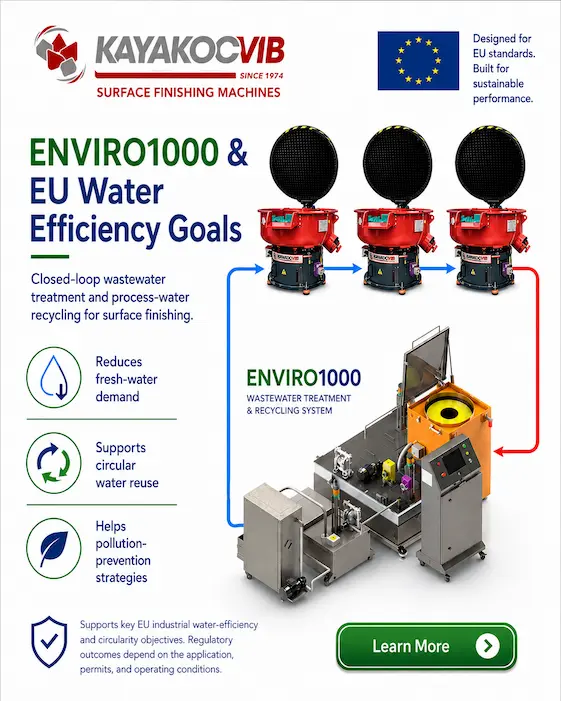
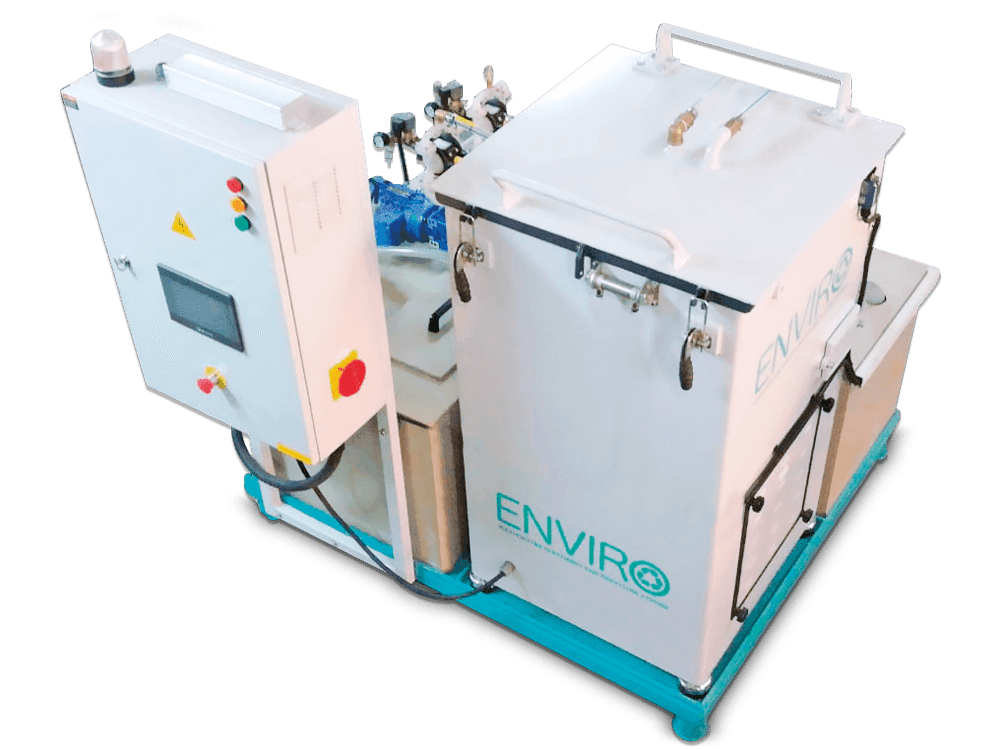
The KAYAKOCVIB ENVIRO1000 wastewater treatment system is designed for this type of integrated closed-loop application, incorporating sedimentation, flocculation, and water recirculation into a compact unit suitable for connection to vibratory finishing lines. For larger production volumes or more complex contamination profiles, the FLOG system provides enhanced treatment capacity with additional separation stages. The SDM-T sedimentation tank is used as a standalone or supplementary sedimentation unit where the primary requirement is gravity-based solids settling before secondary treatment.
Corrective Actions for Specific Wastewater Problems
When staining appears on aluminum or stainless steel parts after wet finishing, the most common cause is contaminated recirculated water carrying suspended metallic fines or excessive compound residue. The corrective action sequence should follow a structured diagnostic approach rather than immediately adding more compound or changing media.
First, check the clarity of the water being returned to the machine. Visually turbid water indicates inadequate solids removal. Second, test the pH of the process water. For aluminum parts processed with plastic media, the operating pH range of the water should remain within the compound manufacturer’s recommended range, typically mildly alkaline. For steel parts processed with ceramic media, slightly different pH ranges apply depending on the compound chemistry. Third, check whether an oil film is visible on the water surface in the sedimentation tank. If oil is present in significant quantity, the oil separation stage is not performing adequately.
The table below summarizes common wastewater treatment problems in metal finishing, their likely root causes, and corrective actions.
| Symptom | Likely Root Cause | Corrective Action |
|---|---|---|
| Part staining after wet finishing | Suspended fines in recirculated water | Optimize flocculation dosing, increase sedimentation residence time |
| Turbid effluent from sedimentation tank | Hydraulic overload or insufficient flocculant | Reduce peak inflow, adjust flocculant type and dosage |
| Oil film on water surface | Inadequate oil separation upstream | Add oil skimmer or coalescing separator before sedimentation |
| pH drift in process water | Compound accumulation over multiple cycles | Monitor and adjust compound dosing, perform partial water exchange |
| Media degradation faster than expected | Chemically imbalanced process water attacking media binder | Check water pH and compound concentration, adjust chemistry |
| Sludge accumulation blocking tank outlet | Infrequent sludge removal schedule | Increase sludge removal frequency, consider sludge dewatering bag or press |
Parameter Tuning and Validation for Water Recycling Systems
Optimizing a wastewater recycling system for environmental performance requires consistent monitoring of several process parameters. These parameters cannot be set once and left unattended. Production volume changes, new part materials, and seasonal temperature variations all affect the behavior of the treatment system.
Flocculant dosing must be calibrated for the actual suspended solids concentration in the incoming water. Over-dosing flocculant adds unnecessary chemical cost and can leave residual flocculant in the treated water, which may then deposit on parts during finishing. Under-dosing leaves fine particles unsettled. Jar testing, a simple bench-scale method, is a practical way to determine the optimal flocculant type and dose for a given water sample before adjusting the production system.
Water exchange rate is another critical variable. In fully closed-loop operation, the concentration of dissolved solids, compound residue, and ionic contamination increases over time. A controlled partial water exchange, where a fraction of the recirculated water is replaced with fresh water on a scheduled basis, prevents uncontrolled chemistry drift. The exchange volume and frequency depend on the specific process, part material, and production throughput.
For facilities processing both aluminum and steel parts, the contamination profiles are quite different and ideally should not be mixed in the same water circuit. Aluminum finishing produces fine aluminum hydroxide particles that behave differently in sedimentation than iron-based fines from steel finishing. Where production scheduling allows, separating the water circuits for different material groups improves both part quality and treatment efficiency.
Environmental Benefits of Wastewater Recycling at the Facility Level
When a closed-loop water reuse system operates correctly, the environmental benefits of wastewater recycling are measurable across several dimensions. Freshwater consumption is reduced significantly because the same treated water is reused through multiple machine cycles. In many industrial finishing applications, water consumption can be reduced to a fraction of a once-through discharge system, though actual savings depend on machine type, production volume, and the effectiveness of the treatment system in maintaining water quality suitable for reuse.
Chemical discharge to the municipal sewer network is reduced because finishing compound, metal ions, and abrasive fines are captured within the closed loop rather than being continuously discharged. This reduces the chemical oxygen demand and suspended solids load in the facility’s effluent, typically making it easier to comply with industrial discharge permits. Sludge generated by the treatment system must still be disposed of according to local regulations, but concentrated sludge handling is generally more manageable than continuous liquid effluent management.
Energy consumption associated with heating incoming freshwater is also reduced in operations where process water is maintained at a controlled temperature for compound activation or rinsing. Reusing water that is already at process temperature avoids repeated heating cycles, contributing to overall energy efficiency at the facility level.
Prevention Checklist for Sustainable Wastewater Recycling
- Match the treatment system capacity to the peak volumetric flow from all connected finishing machines, not only average flow.
- Install an oil separation stage upstream of primary sedimentation when machined parts with cutting oil or coolant residue are processed.
- Calibrate flocculant dosing using jar testing before startup and after any significant change in part material or production volume.
- Monitor process water pH, conductivity, and visual clarity on a defined schedule appropriate to production intensity.
- Establish a controlled partial water exchange schedule to prevent dissolved solids accumulation in the closed loop.
- Segregate water circuits for aluminum and steel finishing where possible to simplify treatment chemistry and improve part surface quality.
- Schedule sludge removal from sedimentation tanks before accumulation reaches the inlet or outlet level, disrupting flow patterns.
- Document baseline water quality parameters after commissioning to use as a reference when troubleshooting future problems.
- Review compound dosing in the finishing machine when water chemistry drifts, since compound is the primary chemical input to the water circuit.
- Validate treated water quality against part surface quality outcomes after any significant system change.
Frequently Asked Questions
What is the main environmental benefit of wastewater recycling in metal finishing?
The primary environmental benefit is the reduction of freshwater consumption and the prevention of untreated chemical and particulate discharge into municipal sewer systems or natural water bodies. A closed-loop system captures metal fines, finishing compound residue, and oil contamination within the treatment circuit rather than continuously discharging them.
Can one wastewater treatment system handle both aluminum and steel finishing lines?
It is technically possible but not always optimal. Aluminum and steel produce different types of particulate contamination and may require different pH ranges for effective flocculation. Where production volumes are significant, separate water circuits for each material group typically improve both treatment efficiency and finished part surface quality.
How often should sludge be removed from a sedimentation tank in a metal finishing facility?
Sludge removal frequency depends on the production volume and the rate of solids generation. In high-volume finishing operations, weekly removal may be required. In lower-volume facilities, monthly removal may be sufficient. The key indicator is monitoring sludge depth relative to the tank inlet and outlet levels. Sludge accumulation that disrupts the flow path reduces sedimentation efficiency regardless of the scheduled removal interval.
What causes pH drift in closed-loop process water and how is it corrected?
pH drift is most commonly caused by compound accumulation over multiple reuse cycles, dissolution of metal ions from processed parts, and evaporation concentrating dissolved species. Correction involves a combination of adjusting compound dosing rates, performing a controlled partial water exchange, and in some cases adding a pH adjustment dosing stage to the treatment system.
Related Process Equipment
Conclusion
Achieving the full environmental benefits of wastewater recycling in metal finishing requires more than installing a treatment unit. The system must be correctly sized, the treatment chemistry must be matched to the actual contamination profile, and the key parameters must be monitored and adjusted as production conditions change. Common problems such as part staining, turbid effluent, and oil contamination each have specific root causes that can be addressed systematically. For facilities operating vibratory finishing lines on steel, aluminum, stainless steel, or mixed-metal parts, a well-configured closed-loop water reuse system reduces freshwater consumption, minimizes chemical discharge, and supports stable, repeatable finishing quality across production batches. Process validation through water quality monitoring and part surface inspection remains essential after any significant change to the treatment system or the finishing process.
Sorry, the comment form is closed at this time.