



08 Jul Edge Rounding vs Deburring
Edge rounding vs deburring is one of the most frequently misunderstood distinctions in industrial surface finishing. Both operations are performed on machined, stamped, or laser-cut metal parts, and both are commonly achieved using the same vibratory finishing equipment. However, the engineering objectives, process parameters, media selection, and quality acceptance criteria differ significantly between the two. Understanding these differences is essential for selecting the correct process route, avoiding rework, and achieving repeatable surface quality in production.
In This Article
Defining the Two Operations
Deburring refers to the removal of burrs, which are unwanted projections of material left at part edges after machining, stamping, punching, or laser cutting. Burrs are typically sharp, irregular, and mechanically attached to the base geometry. The engineering objective of deburring is to remove these projections without altering the intended geometry of the part.
Edge rounding, by contrast, is a controlled geometric modification. The objective is to produce a defined radius or chamfer on a part edge, replacing the sharp intersection of two surfaces with a smooth, consistent transition. Edge rounding is not just about removing a defect. It changes the part geometry in a measurable and intentional way, and the result is typically specified with a radius value or a visual and tactile acceptance standard.
In practice, a deburring process may produce a small degree of edge rounding as a secondary effect. However, a process optimized only for burr removal will not reliably deliver consistent edge radii. The two operations require different thinking when it comes to media selection, cycle time, and process control.
Why the Distinction Matters in Engineering
Treating edge rounding and deburring as interchangeable leads to process failures in precision manufacturing. A CNC machined aerospace component may require a defined edge radius to reduce stress concentration and prevent fatigue cracking. Simply deburring such a part removes the hazard but does not deliver the engineered geometry. Conversely, applying a heavy edge rounding process to a part that only requires burr removal may alter thread dimensions, affect fit tolerances, or create cosmetic issues on functional surfaces.
For quality managers and process engineers, this distinction affects inspection criteria. Deburring is typically verified by tactile or visual inspection to confirm burr absence. Edge rounding requires dimensional verification, often using optical comparators, edge radius gauges, or profilometers, depending on the specification tightness.
Edge Rounding vs Deburring: Process Variables That Control the Result
The key process variables in vibratory finishing respond differently depending on whether the target is burr removal or controlled edge rounding. Understanding how each variable influences the result allows engineers to tune the process correctly for either objective.
| Process Variable | Effect on Deburring | Effect on Edge Rounding |
|---|---|---|
| Media geometry | Aggressive shapes reach into recesses and shear burrs | Rounded or mixed media profiles produce more uniform edge contact |
| Media hardness | Harder ceramic media removes burrs faster on steel | Softer or plastic media may produce gentler, more consistent radii on aluminum |
| Cycle time | Short to medium cycles often sufficient | Longer cycles generally required for measurable and consistent edge radii |
| Compound chemistry | Cutting compounds maintain aggressive material removal | Finishing compounds may be introduced in later stages to refine the rounded edge |
| Machine amplitude and frequency | Higher amplitude improves burr shear action | Controlled amplitude produces more predictable and uniform edge rounding |
| Part-to-media ratio | Higher media volume generally improves burr reach | Correct ratio is critical to avoid over-rounding or part damage |
Machine Working Principle and Selection Logic
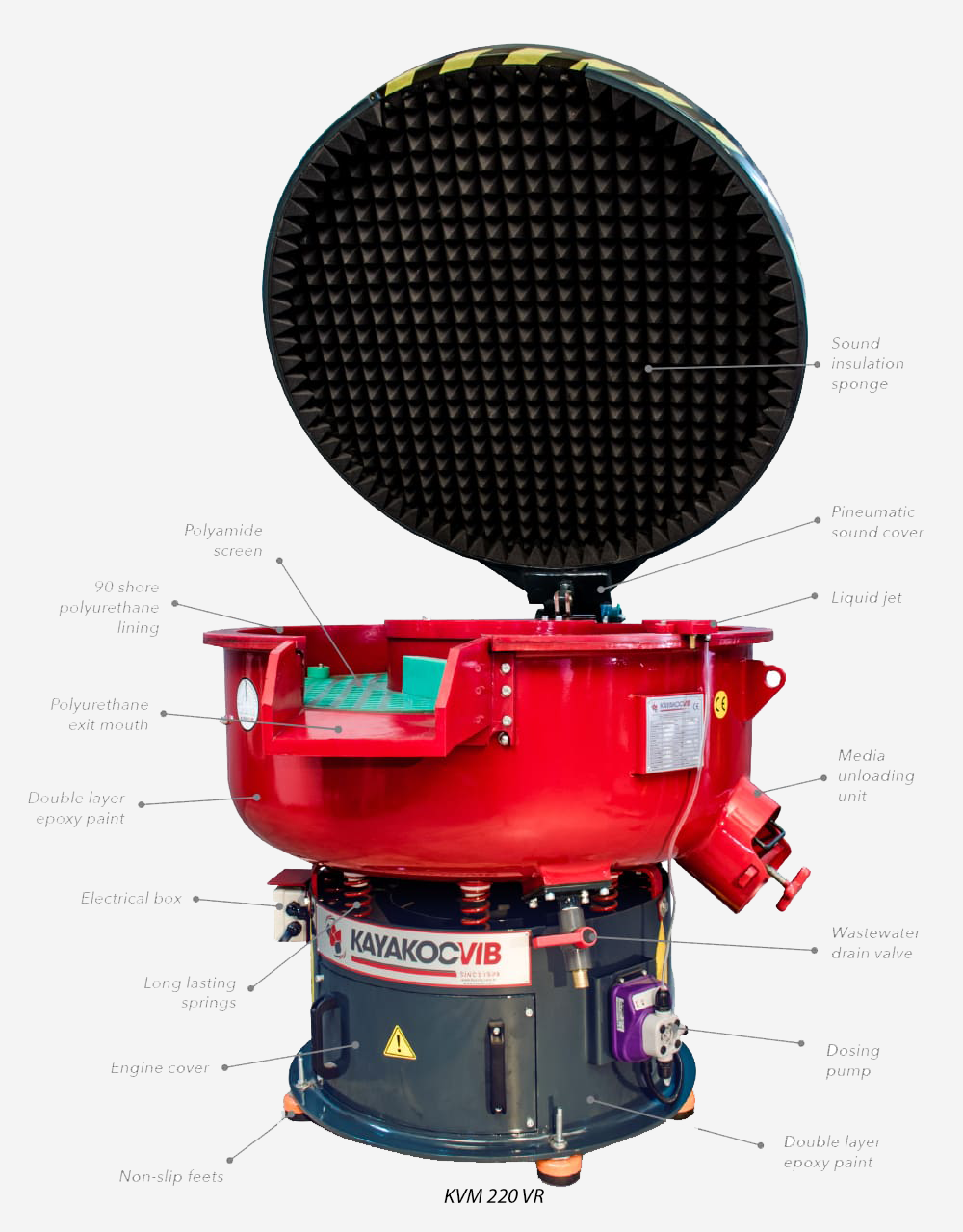
Both deburring and edge rounding in mass finishing rely on the relative motion between parts and finishing media inside a machine bowl or trough. In circular vibratory finishing machines, a vibrating motor generates a helical toroidal flow of the media-part mixture. Parts and media continuously circulate, and the abrasive contact between media and part edges progressively removes material or rounds the edge profile.
A circular vibratory finishing machine such as the KAYAKOCVIB KVM series is well suited to both deburring and edge rounding for small to medium CNC machined parts, stamped components, fasteners, and general metalwork. The adjustable amplitude and frequency settings allow process engineers to shift between an aggressive deburring cycle and a more controlled edge rounding regime without changing the machine platform.
For long or large components where the part geometry does not allow free circulation inside a circular bowl, trough vibratory finishing machines such as the KAYAKOCVIB TVM series provide a linear flow path that accommodates elongated parts while maintaining consistent media contact across the full part length. This is particularly relevant when edge rounding must be uniform along a long edge on structural components or automotive profiles.
Media and Compound Selection for Each Operation
Media selection is one of the most influential factors determining whether a vibratory finishing process delivers burr removal, edge rounding, or both.
For deburring steel and stainless steel parts, ceramic media is the standard choice. Ceramic media provides the cutting hardness needed to shear burrs from harder base materials. Triangular, cylindrical, or satellite-shaped ceramic media are commonly used because their geometry reaches into internal corners and recesses where burrs are most likely to be present. A deburring compound such as a 943-series cutting and polishing liquid supports the cutting action and prevents corrosion during wet processing.
For edge rounding on aluminum or softer alloys, plastic media is generally preferred. Plastic media delivers a gentler cutting action that rounds edges without over-cutting or damaging part surfaces. An 085-series deburring and polishing liquid is a typical compound choice for aluminum edge rounding applications. The lower cutting intensity of plastic media also means longer cycle times are typically required to achieve a measurable edge radius compared to ceramic media on steel.
When a process requires both burr removal and a defined edge radius, a two-stage approach is common. The first stage uses more aggressive media to remove burrs, and a second stage switches to finer or softer media with a finishing compound to refine the edge profile and improve surface finish. This staged approach allows the engineer to control both objectives independently rather than trying to satisfy both with a single media type and cycle time.
Industrial Applications by Operation Type
The target operation type varies significantly by industry and part function. Understanding where each process is primarily required helps production managers assign the correct finishing route at the engineering stage rather than discovering the gap at inspection.
In CNC machining for general manufacturing, deburring is the dominant requirement. Milled, turned, and drilled parts carry burrs at tool exit points, cross-holes, and edge intersections. Burr removal is a functional and safety requirement before assembly or inspection.
In aerospace and medical manufacturing, edge rounding becomes a critical engineering specification. Fatigue life of machined components is directly affected by edge condition. Sharp edges act as stress risers under cyclic loading, and a defined edge radius reduces this effect. For implants, sharp edges also present biological and handling risks. Aerospace structural parts may carry explicit edge radius specifications that must be verified and documented.
In the automotive sector, both operations are commonly required at different stages. Stamped body parts need deburring after blanking and forming. Powertrain components may require defined edge rounding on critical surfaces to control oil film behavior or reduce fretting wear at mating interfaces.
Fastener manufacturing is typically focused on deburring and light edge conditioning to improve coating adhesion and assembly fit, rather than on achieving a geometrically defined edge radius.
Process Control and Quality Validation
One of the practical engineering challenges in distinguishing edge rounding from deburring is the difference in inspection and validation methods. Deburring validation is typically pass-fail and can be performed visually or by feel. The part either has a remaining burr or it does not. This lends itself to fast inline inspection using trained operators or vision systems.
Edge rounding validation is more demanding. A consistent edge radius must be measured and confirmed across multiple part features and production batches. Optical profilometers, edge radius measurement tools, or cross-section analysis may be required depending on the tolerance. Process repeatability is therefore more important in edge rounding than in deburring, because small changes in media wear, compound concentration, cycle time, or machine load can shift the resulting edge radius outside specification.
For production environments where edge rounding is a specified requirement, process engineers should establish and document baseline parameters including media type and age, compound concentration, water flow rate, machine amplitude, and cycle time. Regular media top-up and compound concentration monitoring are part of maintaining edge rounding consistency across production runs.
Frequently Asked Questions
Can deburring and edge rounding be done in the same machine cycle?
In some cases, yes. A vibratory finishing cycle can remove burrs and produce a light edge break simultaneously. However, if a defined edge radius is specified, a single-stage process optimized primarily for burr removal may not reliably deliver a consistent measurable radius. A two-stage process, or a longer controlled cycle with appropriate media, is typically required when edge rounding is a documented engineering requirement.
Which media type is correct for edge rounding aluminum parts?
Plastic media is generally preferred for edge rounding aluminum and other soft non-ferrous alloys. Ceramic media is typically too aggressive for aluminum and may cause surface damage or uncontrolled material removal. Plastic media produces a gentler, more uniform edge contact that allows the radius to develop progressively under controlled conditions.
How is edge rounding radius verified in production?
Verification methods depend on the tolerance specified. For loose specifications, trained tactile and visual inspection may be acceptable. For tighter specifications, optical profilometers, edge radius gauges, or sample cross-section analysis under a microscope may be required. The verification method should be agreed between engineering and quality before the process is released to production.
Does cycle time alone control the edge radius achieved?
Cycle time is one factor, but not the only one. The resulting edge radius depends on the combination of media type, media geometry, compound chemistry, machine amplitude, part-to-media ratio, and part material. Extending cycle time with the wrong media or wrong amplitude will not necessarily deliver the target radius and may cause surface damage or dimensional deviation on other part features.
Related Process Equipment
Related Video Demonstration
Conclusion
The distinction between edge rounding vs deburring is not simply a matter of terminology. The two operations have different engineering objectives, require different process parameters, and are validated by different inspection methods. Deburring targets defect removal and is largely a pass-fail quality check. Edge rounding targets a defined geometric outcome and requires controlled process conditions and measurable validation. Selecting the correct approach at the process planning stage, choosing the appropriate media, compound, machine type, and cycle structure, determines whether the finished part meets its functional specification. For manufacturers working across CNC machining, aerospace, automotive, or medical applications, understanding this distinction prevents costly rework and ensures that finishing adds the intended engineering value to the part rather than simply satisfying a generic surface conditioning step.
Sorry, the comment form is closed at this time.