



27 Jul Drying Media Granules
Drying media granules are a consumable used in vibratory and rotary drying systems to remove residual moisture from metal parts after wet finishing, washing, or compound-based mass finishing operations. The choice of drying media directly affects drying efficiency, surface quality, cycle time, and media service life. Understanding the differences between corn cob, walnut shell, and synthetic granule types allows process engineers to match the drying consumable to the specific part material, geometry, surface condition, and production requirement.
In This Article
Why Drying Media Selection Matters in Surface Finishing
After wet vibratory finishing or industrial washing, parts carry residual moisture on their surfaces and in blind holes, recesses, and threaded features. If parts are left to air dry without media assistance, water spots, flash rust on steel, and white staining on aluminum are common outcomes. Drying media granules absorb and wick moisture away from the part surface through direct contact and tumbling motion, while also applying a light surface conditioning or buffing effect that contributes to final part appearance.
The wrong drying media choice can cause incomplete drying in complex geometries, surface scratching on soft materials, excessive media dust in the drying chamber, or media lodging in holes and recesses. These outcomes affect downstream quality inspection, corrosion protection, and coating adhesion. Selecting the correct drying media granules requires evaluation of part material, surface condition after finishing, geometry complexity, and the production environment.
Types of Drying Media Granules
Corn Cob Granules
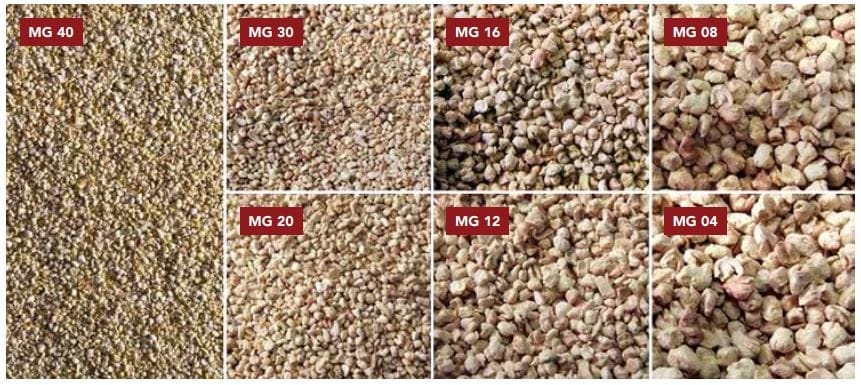
Corn cob media is the most widely used drying granule in industrial surface finishing. It is produced from the ground inner core of dried corn, yielding a lightweight, highly absorbent granule with a slightly abrasive surface texture. Corn cob granules are available in several mesh sizes, typically ranging from coarse grades suitable for large parts with open geometries to fine grades suited for smaller, more complex parts.
The absorbency of corn cob media makes it effective at drawing moisture from flat surfaces, threads, and shallow recesses. Its natural porosity allows it to hold absorbed water until the granules are exhausted or replaced. Corn cob media also imparts a mild burnishing and light polish effect during tumbling contact, which is beneficial for steel, stainless steel, and hard metal parts where a slight surface brightening is acceptable or desirable.
Corn cob media is compatible with most ferrous and non-ferrous metals. For aluminum and zinc alloy parts, the slightly abrasive character of coarser corn cob grades should be evaluated, as aggressive contact can leave fine scratch marks on soft surfaces. Fine-grade corn cob or a reduced loading density may be appropriate for softer materials.
Walnut Shell Granules
Walnut shell media is produced from ground walnut hulls. It is harder and denser than corn cob, with a less porous structure. Walnut granules offer moderate absorbency combined with a stronger mechanical scrubbing action during tumbling. This makes walnut shell media effective for parts with oil residue, polishing compound films, or light surface contamination that corn cob alone may not fully remove.
Walnut shell granules are commonly used when parts exit a finishing or washing process carrying polishing paste residue, drawing lubricants, or light oils that increase the drying challenge. The mechanical contact of walnut media helps lift these residues while simultaneously drying the surface. Walnut shell is also used in dry polishing applications where a light burnishing of brass, copper, and yellow metal parts is required without introducing additional cutting action.
Because walnut shell is harder than corn cob, it carries a higher risk of minor surface marking on very soft materials or precision-machined features. Process testing is recommended when introducing walnut media to parts with ground or lapped surfaces where surface texture consistency is critical.
Synthetic Drying Granules
Synthetic drying granules are manufactured from polymer or ceramic-based materials blended with absorbent compounds. They are engineered to provide consistent density, moisture absorption rate, and mechanical properties that natural media cannot always guarantee due to natural variability in raw material sources.
Synthetic granules are particularly useful in controlled environments such as medical device finishing, aerospace component processing, and precision instrument manufacturing where batch-to-batch consistency in the drying stage is required. They can be engineered with defined hardness levels to suit specific part materials, and many synthetic grades are available with antistatic or low-dust formulations that reduce airborne contamination in the drying chamber.
Synthetic granules typically have a longer service life than natural media because they resist biological degradation and moisture saturation at a slower rate. However, their higher unit cost compared to corn cob and walnut media means that selection should be based on process requirements rather than used as a universal replacement.
Drying Media Selection Criteria
Selecting the correct drying media granules requires systematic evaluation across several engineering parameters. The table below summarizes the primary selection logic based on part material and finishing condition.
| Part Material | Surface Condition After Finishing | Recommended Media Type | Notes |
|---|---|---|---|
| Steel, Stainless Steel | Wet, clean, no oil residue | Corn cob, medium grade | Effective moisture removal with light burnishing |
| Steel, Stainless Steel | Wet, with oil or compound residue | Walnut shell or corn cob with drying additive | Walnut provides stronger residue removal |
| Aluminum, Zinc Alloy | Wet, clean | Fine corn cob or synthetic granule | Avoid coarse grades that may mark soft surfaces |
| Brass, Copper | Wet or lightly oiled | Walnut shell or fine corn cob | Walnut adds light burnishing for yellow metals |
| Medical or Precision Parts | Clean, post-wash | Synthetic drying granule | Consistent properties, low dust, long service life |
| Mixed Metal Batch | Wet, no oil | Fine corn cob | Neutral media reduces risk of cross-material marking |
Drying Media Granule Size and Loading Parameters
Granule mesh size affects both drying efficiency and the risk of media lodging in part features. Coarser granules move more freely in the drying chamber and transfer more tumbling energy, but they may not penetrate small holes, slots, or threaded features effectively. Fine granules offer better penetration into recesses but carry a higher risk of lodging in blind holes or undercuts if part geometry is complex.
As a general process guideline, granule size should be selected so that individual granules cannot enter and become trapped in the smallest hole or recess present on the part. A practical test is to verify that all granules can freely exit any feature they can enter during normal tumbling motion. This validation step is essential before committing to a specific granule size in production.
Media loading volume in the drying machine affects drying cycle time and part-to-media contact intensity. Insufficient media volume reduces contact frequency, extending drying time and potentially leaving moisture in recesses. Excessive media volume can reduce tumbling action and increase the risk of part-on-part contact, particularly for delicate parts. Typical loading practice follows the machine manufacturer’s guidance, with media filling the drying chamber to a level that allows free tumbling while maintaining full part coverage throughout the cycle.
Drying Additives and Finishing Aids
In many industrial drying processes, a small quantity of drying additive or finishing oil is introduced with the drying media granules. These additives serve several functions: they assist moisture displacement from the part surface through a hydrophobic barrier effect, provide a light surface protection against flash rust in the period between drying and packaging or coating, and enhance the visual appearance of the dried part surface by leaving a thin uniform film.
Drying additives are typically applied by spraying a metered quantity onto the drying media load before or during the drying cycle. The additive concentration must be controlled carefully. Excessive additive quantity can leave visible oil residue on part surfaces, interfering with subsequent coating, bonding, or inspection operations. Insufficient additive may leave ferrous parts vulnerable to flash rust during storage or transport if the drying environment is humid.
For parts destined for direct powder coating, painting, or adhesive bonding, drying additives that leave surface residues should be avoided or validated against the subsequent process requirement. In such cases, clean drying with fresh corn cob or synthetic media at elevated temperature in the drying machine may be sufficient without chemical assistance.
Machine Compatibility and Process Integration
Drying media granules are used in purpose-built vibratory drying machines that separate parts from process media and introduce the dry media load in a single integrated operation. Circular vibratory dryers, such as the KAYAKOCVIB DVM series, process small to medium parts and operate on the same vibratory motion principle as vibratory finishing machines, using frequency and amplitude settings to control tumbling intensity and residence time. For longer or larger parts, trough-type dryers such as the KAYAKOCVIB D-TVM series provide the linear geometry necessary to handle parts that would not tumble freely in a circular bowl.
In automated finishing lines, the drying stage follows wet finishing and washing, with parts transferred from the separator or washing unit directly into the dryer without manual handling. The drying media granules are pre-loaded in the dryer, and parts are introduced for a defined drying cycle time before being discharged to the output conveyor. This integration reduces handling time and eliminates moisture-related quality issues caused by delays between washing and drying.
The vibratory frequency and amplitude settings in the dryer control the tumbling energy applied to parts and media. Higher amplitude increases drying speed but also increases mechanical contact intensity. For delicate or precision parts, lower amplitude with extended cycle time is typically preferred to achieve effective drying without surface damage.
Media Maintenance and Replacement
Drying media granules absorb moisture with each processing cycle, and their absorbency decreases as the granule pores become saturated or the granule structure breaks down through repeated mechanical contact. Regular media inspection is necessary to maintain drying performance. Signs of spent drying media include elevated surface moisture on parts after the standard cycle time, increased dust generation in the drying chamber, and visible darkening or clumping of granules indicating moisture saturation.
Corn cob and walnut media can be partially regenerated by spreading them in a heated environment to drive off absorbed moisture, but this is generally practical only in small operations. In industrial production, a regular replacement schedule based on total processing volume or elapsed cycle count is more reliable than visual inspection alone. Synthetic granules typically provide a longer service interval before replacement is required, which can offset their higher purchase cost in high-volume operations.
Media particle breakdown over time generates fine dust that accumulates in the drying chamber and on part surfaces. Excessive fines can deposit in blind holes and surface features, creating cleaning problems downstream. Installing a fine particle screening step before reusing regenerated media, or implementing a scheduled partial media replenishment protocol, manages this effectively in most industrial settings.
Frequently Asked Questions
Can corn cob and walnut shell drying media be mixed?
Mixing corn cob and walnut shell media in the same drying batch is possible but generally not recommended without process testing. The different densities and hardness levels of the two media types create uneven contact intensity on part surfaces and reduce the predictability of the drying result. In most industrial applications, selecting a single media type matched to the part material and surface condition produces more consistent outcomes.
What granule size should be used for parts with threaded holes?
For parts with threaded holes or blind bores, granule size must be larger than the thread pitch or hole diameter to prevent lodging. A practical validation test before production release involves loading sample parts through a complete drying cycle and inspecting all threaded and recessed features for retained granules. If lodging occurs, a coarser granule size or reduced media loading density should be tested.
How often should drying media granules be replaced in production?
Replacement frequency depends on part material, part cleanliness at the drying stage, loading volume per cycle, and operating hours. In high-volume continuous production, a partial replenishment or full replacement schedule based on processing volume is more reliable than a time-based interval. A baseline replacement frequency should be established during process validation and adjusted based on observed drying quality in production.
Do drying media granules affect surface roughness?
In typical drying applications, drying media granules do not significantly change the Ra surface roughness established in the preceding finishing stage. However, coarse corn cob or walnut shell media used at high tumbling amplitude can introduce minor surface texture changes on soft materials such as aluminum or brass. If surface texture consistency is a quality requirement, media grade, loading level, and machine settings should all be validated against finished surface quality specifications before production release.
Related Process Equipment
Related Video Demonstration
Conclusion
Selecting the right drying media granules is a technically specific decision that depends on part material, post-finishing surface condition, geometry complexity, and production volume. Corn cob media covers the majority of general industrial applications with effective moisture absorption and mild burnishing action. Walnut shell granules provide stronger scrubbing and residue removal for parts carrying oil or compound films. Synthetic granules offer controlled consistency for precision, medical, and aerospace applications where natural media variability is a concern. Process parameters including granule size, loading volume, machine amplitude, and cycle time all interact with media type to determine drying efficiency and final surface quality. Validation through sample testing before production release remains the most reliable approach to confirming that the selected drying media granules deliver the required result for a specific part and finishing line configuration.
Sorry, the comment form is closed at this time.