



24 Jun Drag Finishing vs Vibratory Finishing
Drag finishing vs vibratory finishing is one of the most relevant process comparisons in industrial surface finishing, particularly for manufacturers working with precision cutting tools, carbide inserts, mold components, medical implants, and aerospace parts. Both technologies use finishing media and compound to improve surface condition, but they differ fundamentally in how parts move through the media, what surface results they can achieve, and which industrial applications they serve best. Understanding these differences from an engineering perspective is essential for selecting the right process route and avoiding costly mismatches between machine capability and part requirement.
In This Article
Defining the Two Processes
Vibratory finishing is a mass finishing process in which parts and media are loaded together into a bowl or trough, and the machine generates vibratory motion that causes the media-part mixture to flow in a continuous toroidal or helical pattern. Parts move freely within the media mass and are acted upon by the abrasive or polishing surfaces of the media as both components rub against each other. The process is suitable for processing large batches of parts simultaneously and is widely used for deburring, edge breaking, surface smoothing, and pre-treatment before coating or hardening.
Drag finishing is a controlled finishing process in which individual parts are clamped to rotating spindles and physically dragged through a stationary or slow-rotating media bed at a defined speed, depth, and trajectory. Unlike vibratory finishing, the part-to-media contact in drag finishing is precisely controlled by machine kinematics rather than by the random collective motion of the media mass. This fundamental difference makes drag finishing suitable for high-precision applications where consistent, repeatable surface treatment of individual parts is required.
Machine Working Principles Compared
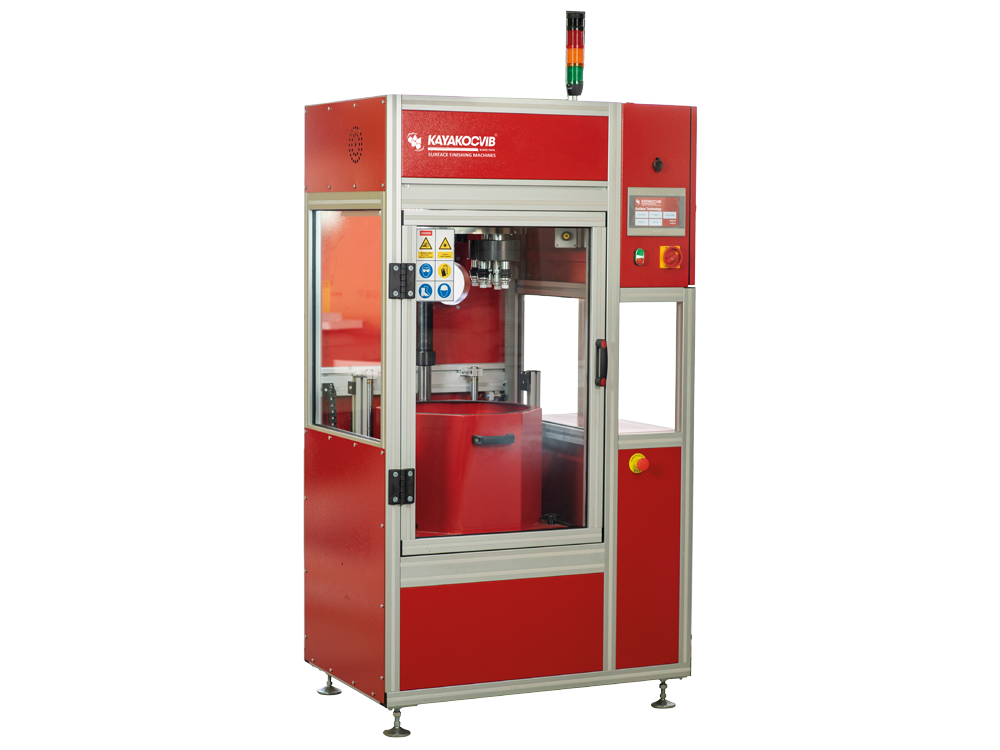
In a circular vibratory finishing machine such as the KAYAKOCVIB KVM series, an eccentric weight motor mounted below or around the bowl generates three-dimensional vibratory motion. This motion causes the media and parts to circulate continuously inside the bowl. The intensity, frequency, and amplitude of the vibration can be adjusted to control the aggressiveness of the process. The process acts on all surfaces of the part simultaneously, including internal features, recesses, and complex geometries, as long as media can access those surfaces.
In a drag finishing machine such as the KAYAKOCVIB DRG series, parts are individually mounted on spindle holders arranged on a rotating carousel. The carousel rotates the spindle arms over the media bowl, and each spindle may also rotate independently around its own axis. The result is a highly controlled relative motion between the part surface and the media. The drag speed, spindle rotation speed, immersion depth, and process time can all be set and stored as recipes through a Siemens PLC control system, enabling consistent repeatability across production batches.
Stream finishing, a variant of drag finishing also available in the KAYAKOCVIB DRG line, uses a rotating media bowl combined with spindle-mounted parts. The counter-rotation between the media bowl and the spindle carousel creates a high relative velocity between media and part surface, significantly increasing process intensity compared to standard drag finishing. Stream finishing is particularly effective for achieving very low surface roughness values and precise edge rounding on cutting tools and precision components within shorter cycle times.
Process Variables That Control Surface Results
In vibratory finishing, the primary controllable variables are vibratory amplitude and frequency, media type, media size and shape, compound type and dosing rate, water flow rate, and process time. Because parts move freely in the media mass, there is a statistical distribution of contact intensity across the part surface and across the batch. This is acceptable for most general deburring and surface improvement applications, but it creates variability that is difficult to eliminate for tight-tolerance precision parts.
In drag finishing, the controllable variables include carousel rotation speed, spindle rotation speed and direction, media immersion depth, process time per cycle, media type, and compound type and concentration. Because each part follows a defined mechanical path through the media, the process acts on each part in a consistent and repeatable manner. This level of control makes it possible to produce highly uniform surface results across production batches, which is a requirement in medical device manufacturing, aerospace component finishing, and precision cutting tool edge preparation.
Drag Finishing vs Vibratory Finishing: Core Technical Differences
The following table summarizes the key technical differences between drag finishing and vibratory finishing for engineering reference.
| Parameter | Vibratory Finishing | Drag Finishing |
|---|---|---|
| Part motion | Free movement within media mass | Clamped, controlled trajectory through media |
| Process control | Batch-level settings | Individual part-level settings via PLC recipe |
| Surface result consistency | Statistical, batch-dependent | High repeatability per part |
| Typical surface roughness achievable | Moderate improvement, application-dependent | High precision, low Ra achievable depending on media and parameters |
| Edge rounding control | Limited, geometry-dependent | Precise, programmable |
| Part complexity handling | Good for internal features and recesses | Best for external surfaces and defined geometry |
| Batch size | High volume per cycle | Lower volume, individual part focus |
| Typical applications | Deburring, general polishing, stamped parts, castings, fasteners | Cutting tools, implants, molds, precision aerospace parts |
| Machine investment | Lower per unit | Higher, justified by precision requirement |
Media and Compound Selection for Each Process
In vibratory finishing of steel and hardened steel components, ceramic media is typically preferred because it provides sufficient cutting action for deburring and surface conditioning on harder materials. Media shape selection depends on part geometry, with triangular or cylindrical shapes used for general access and star or satellite shapes used for more complex geometry. Compound dosing is controlled continuously via a metering pump, with deburring and polishing compounds such as KAYAKOCVIB 943 liquid used for steel applications, and 028-S degreasing liquid used when oil or chip contamination is present on incoming parts.
For drag finishing of carbide cutting tools, precision hardened steel molds, and similar high-value components, media selection is more critical because the controlled process intensity concentrates the abrasive action on specific surfaces. Plastic media or mixed ceramic-plastic media combinations are often used for polishing and edge honing stages to achieve smooth, consistent surface finishes without excessive material removal. Abrasive paste compounds or fine polishing compounds may be applied at controlled dosing rates to achieve targeted Ra values. Actual achievable surface roughness depends on the starting condition of the part, media grit, compound type, drag speed, and cycle time, and must be validated through process testing.
Industrial Applications and Appropriate Process Selection
Vibratory finishing is appropriate for the majority of industrial deburring, edge breaking, and surface smoothing applications where part geometry is not highly sensitive, production volumes are large, and individual part traceability is not required. Typical industries include automotive stamped parts, hardware and fasteners, die casting post-processing, hydraulic component deburring, and general CNC machined parts. The KVM circular vibratory machines are practical for this range of applications, offering variable amplitude control and easy media and compound adjustment.
Drag finishing is the preferred process when the application requires controlled edge rounding with a defined radius, consistent surface roughness reduction to low Ra values, individual part process traceability, or high-value part protection during processing. Cutting tool manufacturers use drag finishing for edge preparation of carbide end mills, drills, and inserts, where the edge hone geometry directly influences tool performance and cutting life. Medical device manufacturers use drag finishing for implant components where surface finish consistency is a regulatory and functional requirement. Mold manufacturers use drag finishing for cavity surface polishing where manual polishing time and variability are unacceptable.
Additive manufacturing post-processing is an increasingly relevant application for drag finishing and stream finishing, particularly for metal parts with complex external geometry that require surface roughness reduction from the as-built condition to a lower Ra target. The controlled drag motion allows the process to act uniformly on external surfaces without the geometric unpredictability of free-mass vibratory finishing.
Automation and Recipe Control
Vibratory finishing machines can be integrated into automated finishing lines with conveyor feeding, automatic media separation using SM separator machines, and part drying using DVM circular dryers or D-TVM trough dryers. For high-volume production, automatic compound dosing, water level control, and media top-up systems reduce operator dependency and improve process consistency. PLC control is available on modern vibratory machines for amplitude, timing, and dosing management.
Drag finishing machines are inherently more automation-capable at the part level because every part follows a programmed process recipe. KAYAKOCVIB DRG machines with Siemens PLC control allow engineers to store multiple recipes for different part types, each with defined carousel speed, spindle speed, immersion depth, process time, and compound parameters. This makes drag finishing well-suited for regulated production environments where process documentation and repeatability validation are required. Part handling before and after drag finishing can be integrated with robotic loading and unloading systems for high-value components where manual handling risk must be minimized.
Limitations of Each Technology
Vibratory finishing has well-known limitations for precision applications. Part-to-part contact within the media mass can cause minor cosmetic damage on soft or delicate surfaces. Internal bores and deep recesses may receive less media contact than external surfaces, creating uneven finishing across complex geometry. Very thin sections or fragile features may require reduced amplitude or protective fixturing. Media lodging in small holes or blind bores is a risk that must be managed through media size selection.
Drag finishing has different limitations. Throughput per hour is lower than vibratory finishing because parts are processed individually or in small groups rather than in large batches. The initial machine investment and fixturing cost are higher, which makes drag finishing economically justified only when the precision requirement, part value, or regulatory requirement cannot be met by conventional vibratory methods. Parts must be reliably clamped to spindles, which requires appropriate fixtures for each part geometry. Internal features, deep bores, and complex internal channels are generally not accessible through drag finishing and may require a secondary operation.
Frequently Asked Questions
When should drag finishing be chosen over vibratory finishing?
Drag finishing is appropriate when the application requires precise edge rounding control, consistent low Ra surface roughness, individual part process traceability, or processing of high-value parts where batch-mode contact damage is unacceptable. Vibratory finishing is sufficient for general deburring, edge breaking, and surface smoothing at high production volumes.
Can the same media be used in both drag finishing and vibratory finishing?
Standard ceramic and plastic media shapes used in vibratory finishing can often be used in drag finishing machines. However, media selection for drag finishing is more specific because the controlled contact mechanics change how media interacts with the part surface. Fine abrasive or polishing media with specific shapes and grit levels are commonly selected for drag finishing to achieve precision surface results. Media suitability must be confirmed through process testing for each application.
What surface roughness levels can drag finishing achieve compared to vibratory finishing?
Drag finishing and stream finishing can achieve lower Ra values than standard vibratory finishing in many applications, particularly for external surfaces of precision components. Typical vibratory finishing improves surface condition but operates within a wider result range due to batch variability. Actual Ra values achievable by either process depend on starting surface condition, material, media grit, compound type, and process parameters, and must be confirmed through sample testing rather than assumed from general reference data.
Is drag finishing used in medical device manufacturing?
Yes. Drag finishing is used for polishing and surface conditioning of implant components, surgical instrument parts, and other precision medical components where surface roughness consistency, part protection during processing, and individual process documentation are required. Process validation through sample testing is mandatory before production release in regulated environments.
Related Process Equipment
Related Video Demonstration
Conclusion
The comparison between drag finishing vs vibratory finishing is ultimately a decision about precision requirements, production volume, part value, and process control depth. Vibratory finishing remains the practical and cost-effective choice for high-volume general deburring, edge breaking, and surface improvement applications where batch processing is acceptable. Drag finishing, and stream finishing as its high-intensity variant, is the correct choice when process repeatability at the individual part level, controlled edge geometry, and low surface roughness are non-negotiable requirements. Engineers selecting between these two process technologies should evaluate part geometry, target surface condition, production volume, and regulatory context together rather than based on machine cost alone. Process capability for both methods must be confirmed through representative sample testing before committing to a production configuration.
Sorry, the comment form is closed at this time.