


24 Jul Corrosion Protection Wet Finishing
Corrosion protection wet finishing is a critical process consideration in mass finishing operations where water-based compounds are used alongside media to deburr, polish, or clean metal parts. When parts exit a wet finishing cycle, their surface is clean, chemically active, and temporarily more vulnerable to oxidation than before processing. Without correct compound selection, adequate rinsing, and rapid drying, flash rust or surface staining can develop within minutes on ferrous parts and within hours on reactive aluminum alloys. Understanding the full process sequence from compound introduction through final drying is essential for maintaining part quality in production environments.
In This Article
Why Wet Finishing Creates Corrosion Risk
In dry finishing processes, parts are not exposed to water or water-soluble chemicals. In wet finishing, water acts as a carrier medium for the compound, assists in flushing away swarf and debris, and controls the surface temperature during the finishing cycle. However, water also removes protective oxide layers and natural passivation films from metal surfaces during mechanical finishing action.
Freshly finished steel surfaces are highly reactive. The mechanical deburring and polishing action exposes clean base metal with no protective layer. If parts are left wet, or if the compound residue is acidic or insufficient in corrosion inhibitor content, flash rust forms rapidly. On stainless steel, incorrect compounds can introduce chloride contamination that promotes pitting corrosion. On aluminum, alkaline compounds at excessive concentrations can etch the surface and create staining that resembles corrosion damage.
The corrosion risk in wet finishing is not a single-point problem. It is a sequence risk that must be managed across the compound selection, the finishing cycle, the separation stage, the rinsing stage, and the drying stage.
The Wet Finishing Process Sequence and Corrosion Control Points
Managing corrosion protection through a wet finishing line requires attention at each stage. The following sequence describes a typical wet finishing workflow with the relevant corrosion control actions at each step.
-
Compound Selection and Dosing: The finishing compound must contain a corrosion inhibitor appropriate for the base material. For steel and iron parts, compounds with alkaline pH and active rust inhibitors are standard. For aluminum and zinc alloys, neutral to mildly alkaline compounds are preferred to avoid surface etching. Compound concentration directly affects inhibitor effectiveness. Under-dosing reduces corrosion protection. Over-dosing can cause foaming, residue buildup, or compound film on part surfaces.
-
Active Finishing Cycle: During the finishing cycle, compound dosing should be continuous or timed at regular intervals to maintain consistent concentration in the working bowl. Parts should remain fully wetted throughout the cycle. Allowing the machine to run dry removes compound coverage and exposes parts to direct metal-on-metal contact and temporary moisture without inhibitor protection.
-
Part and Media Separation: After the finishing cycle ends, parts and media are separated using a separator or vibratory separator deck. At this stage, parts are wet with compound solution. Separation should be completed quickly to minimize the time parts remain in contact with swarf-laden water, which can carry abrasive debris and create localized surface contamination.
-
Rinsing: Rinsing removes compound residue, swarf, and fine media dust from part surfaces. Clean water rinsing is standard, but for ferrous parts, a corrosion-inhibiting rinse is recommended as the final rinse stage. Corrosion inhibiting rinse additives create a thin temporary protective film on the part surface that slows oxidation during drying and storage. Without this film, rinse water itself can initiate flash rust on steel within the drying cycle.
-
Drying: Drying is the final and often underestimated step in corrosion protection. Parts must be dried rapidly and completely. Residual moisture in recesses, blind holes, or internal threads creates localized wet zones that become corrosion initiation sites. Thermal drying using a vibratory dryer with corn cob or walnut shell drying media is the standard method for small to medium parts. Drying temperature, airflow, and dwell time must be calibrated to the part geometry and material to ensure complete moisture removal.
Compound Selection for Corrosion Protection
The compound is the primary corrosion protection tool in any wet finishing process. Compound selection must be aligned with the base metal, the finishing objective, and the downstream handling conditions. Using a generic compound without corrosion inhibitor content is one of the most common causes of flash rust complaints in production finishing operations.
| Base Material | Recommended Compound Type | Key Property | Typical Compound |
|---|---|---|---|
| Steel, Iron | Alkaline with corrosion inhibitor | Rust inhibition, swarf suspension | 943 deburring and polishing liquid |
| Aluminum, Zamak | Neutral to mildly alkaline | Surface protection, no etching | 085 deburring and polishing liquid |
| Copper, Brass | Mildly acidic or neutral | Brightening, oxide removal | 028 degreasing liquid |
| Stainless Steel | Neutral, chloride-free | Passivation support, no pitting risk | Neutral inhibited compound |
| Mixed Metals | Neutral balanced inhibitor | Compatible with multiple surfaces | Application-specific selection required |
For steel and iron parts requiring heavy deburring, compounds such as the KAYAKOCVIB 943 series provide alkaline pH with built-in rust inhibitor that protects parts during the finishing cycle and through the separation and drying stages. For aluminum and zamak alloys processed with plastic media, compounds such as the KAYAKOCVIB 085 series are formulated to avoid surface etching while maintaining part brightness and cleanliness.
Mixed-metal batches require careful compound selection. Running steel and aluminum parts together in the same finishing batch is generally not recommended. Galvanic interaction between dissimilar metals in a wet electrolytic-like environment can cause accelerated surface discoloration on aluminum and localized corrosion on steel contact points. When mixed-metal batches cannot be avoided, a neutral inhibited compound and reduced cycle time are recommended, with validation testing before production release.
Media Selection and Its Role in Corrosion Outcomes
Media type influences corrosion outcomes indirectly through the finishing intensity and the residue it generates. Ceramic media is the standard choice for steel and iron parts requiring active material removal. Ceramic media cuts efficiently, generates fine metallic swarf in the compound slurry, and requires that the compound effectively suspend and flush this swarf to prevent it from redepositing on part surfaces.
Plastic media is generally preferred for aluminum, zamak, and soft alloy parts. Plastic media is less aggressive and generates less metallic contamination in the slurry. The gentler cutting action also reduces surface temperature and avoids the micro-roughening that ceramic media can produce on soft metals, which would create additional corrosion initiation points.
Regardless of media type, media condition affects corrosion protection indirectly. Worn or broken media has higher fines content, which contaminates the compound slurry and increases the risk of debris embedding in part surfaces. Embedded abrasive particles in soft metals such as aluminum can become corrosion initiation sites in service conditions. Media should be inspected regularly and replaced when fines content becomes excessive.
Rinsing and Drying Process Parameters
The rinsing stage is where many production operations lose corrosion control. Parts that are rinsed with plain water and then transferred to a drying system with any delay begin oxidizing before drying is complete. The following parameters are relevant to effective rinsing and drying for corrosion protection.
Rinse water quality affects compound removal efficiency. Hard water with high mineral content can leave water spots and mineral deposits on finished surfaces, particularly on polished aluminum or bright steel. Softened or deionized water is preferred for high-quality finishing applications. The final rinse should include a corrosion-inhibiting additive at the correct dilution to leave a protective film on the part surface.
Drying temperature for vibratory drying systems typically ranges between 60 and 90 degrees Celsius depending on part material and geometry. Higher temperatures accelerate drying but must be validated for temperature-sensitive materials or thin-wall parts. Corn cob drying media absorbs surface moisture effectively and is commonly used for small to medium steel and aluminum parts. Dwell time in the dryer must be sufficient to achieve complete moisture removal from all part surfaces including recesses and internal features.
Parts that exit the dryer still warm should be allowed to reach ambient temperature before packaging or storage in sealed containers. Packaging warm parts traps residual moisture vapour inside the packaging and can cause condensation corrosion on the part surface during storage or transport.
Process Parameters That Affect Corrosion Protection Quality
| Process Stage | Parameter | Corrosion Impact |
|---|---|---|
| Finishing Cycle | Compound concentration | Under-dosing reduces inhibitor film |
| Finishing Cycle | Cycle time | Extended cycles increase metal swarf load in slurry |
| Separation | Transfer time to rinse | Delay increases flash rust risk on ferrous parts |
| Rinsing | Water quality and rinse additive | Hard water spotting, insufficient inhibitor film |
| Drying | Temperature and dwell time | Incomplete drying leaves moisture in recesses |
| Post-Drying | Part temperature at packaging | Warm packaging traps condensation moisture |
Automation and Line Integration for Consistent Corrosion Control
Manual finishing operations introduce variability at every stage. Inconsistent compound dosing, variable rinse duration, and irregular drying times are the most common sources of batch-to-batch corrosion variation in manual lines. Automating the wet finishing sequence eliminates these variables and allows corrosion protection parameters to be controlled precisely and repeatably.
In automated finishing lines, compound dosing is controlled by a metering pump that delivers a preset compound volume per unit of water or per machine cycle. This eliminates operator-dependent variation in compound concentration. Rinse stages are timed and sequenced automatically. Separation, rinsing, and transfer to drying are integrated without manual handling delays that expose wet parts to ambient air.
KAYAKOCVIB finishing lines can integrate vibratory finishing machines, separator units, rinsing stages, drying machines, and wastewater treatment systems into a single controlled production line. For high-volume steel fastener production or CNC machined aluminum component lines, this integration ensures that corrosion protection wet finishing parameters remain consistent across production shifts without relying on manual process discipline.
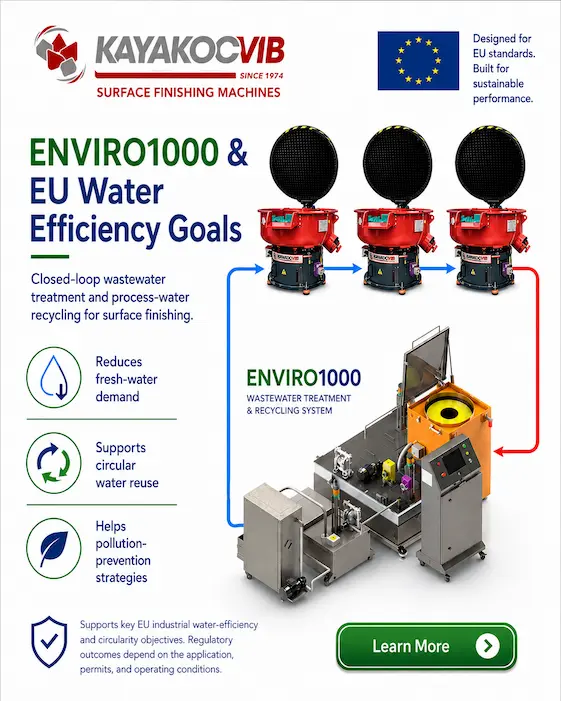
Wastewater from wet finishing operations contains compound residues, metallic swarf, and inhibitor chemicals that require treatment before discharge. A closed-loop water recycling system reduces compound consumption, maintains consistent water chemistry in the finishing bowl, and minimizes the environmental load of the finishing operation. Consistent water chemistry also contributes to corrosion protection by avoiding the dilution of corrosion inhibitor concentration that occurs when large volumes of fresh water are introduced without compound compensation.
Frequently Asked Questions
Why do steel parts develop flash rust after wet vibratory finishing?
Flash rust occurs when freshly finished steel surfaces are exposed to moisture without adequate corrosion inhibitor coverage. The most common causes are insufficient compound concentration during the finishing cycle, plain water rinsing without a corrosion inhibitor additive, delayed transfer from the separator to the dryer, or incomplete drying that leaves moisture in part recesses.
Can the same compound be used for steel and aluminum parts?
Generally no. Steel parts require alkaline compounds with active rust inhibitors. Aluminum and zamak parts require neutral to mildly alkaline compounds to avoid surface etching. Using a strongly alkaline steel compound on aluminum can cause visible surface darkening or etching. Running steel and aluminum parts in the same batch is not recommended because of compound compatibility and galvanic interaction risks.
How does drying media affect corrosion protection?
Corn cob drying media absorbs surface moisture rapidly and generates gentle friction that helps remove residual compound film from part surfaces. Walnut shell media provides similar drying action with slightly more surface polishing effect. Both are effective for corrosion protection wet finishing applications when dryer temperature, airflow, and dwell time are correctly set. Damp or saturated drying media loses absorption capacity and should be replaced or refreshed regularly.
Is a corrosion inhibitor rinse additive always necessary?
For ferrous parts such as steel and iron, a corrosion-inhibiting final rinse additive is strongly recommended in most production environments. Without it, the transition from rinsing to drying leaves the part surface unprotected during the drying cycle. For stainless steel, high-grade aluminum alloys, or parts that receive an immediate post-finishing coating or plating, the requirement depends on downstream process timing and should be validated through sample testing.
Related Process Equipment
Conclusion
Corrosion protection wet finishing is not a single action at the end of the process. It is a sequence of controlled decisions starting from compound selection and dosing, through separation, rinsing, and drying, and ending with correct part packaging and storage. Each stage introduces a potential failure point where moisture, contamination, or inadequate inhibitor coverage can initiate oxidation on freshly finished metal surfaces. Selecting the correct compound for the base material, using a corrosion-inhibiting rinse additive, ensuring rapid and complete drying, and validating the full sequence through sample testing before production release are the engineering fundamentals that determine whether a wet finishing process protects or damages part surface quality. For high-volume or quality-critical applications, line automation with integrated compound dosing, separation, rinsing, and drying stages provides the most consistent and repeatable corrosion protection outcome.
Sorry, the comment form is closed at this time.