




16 Jul Consistent Surface Finish in Batch Production
Achieving a consistent surface finish across batch production is one of the most demanding requirements in industrial mass finishing. When surface quality must meet the same standard across hundreds or thousands of parts per shift, every variable in the process chain becomes a potential source of variation. This article explains how to control those variables systematically, from machine loading through media selection, compound dosing, process timing, and post-process handling, so that part-to-part and batch-to-batch surface quality remains within specification.
In This Article
What Consistent Surface Finish Means in a Production Context
A consistent surface finish means that all parts leaving a finishing process share the same measurable surface condition within an acceptable tolerance band. This includes surface roughness, edge condition, burr removal completeness, and visual appearance. In batch production, consistency must be maintained not only within a single batch but also across consecutive batches processed hours or shifts apart.
In vibratory finishing, mass finishing, and related surface treatment processes, surface finish is not an inherent property of the machine alone. It is the combined result of machine type, bowl geometry, process intensity, media type and size, compound chemistry, water flow rate, batch weight, cycle time, and part geometry. If any of these variables drifts between batches, the output surface quality will drift with it.
Where Batch Inconsistency Originates
Before building a repeatable process, it is necessary to understand where batch-to-batch variation actually begins. In most industrial finishing operations, the root causes fall into a small number of categories.
Media wear is one of the most common sources of long-term drift. Ceramic and plastic finishing media wear down progressively during use. As media volume decreases and individual media pieces become smaller and rounder, their cutting and burnishing action changes. A process validated with new media may produce noticeably different results after several hundred hours of use if media volume is not maintained.
Compound concentration variation is another frequent cause. Liquid finishing compounds are typically dosed through a metering pump. If the pump flow rate drifts, the compound-to-water ratio changes, which directly affects cutting rate, surface brightness, and corrosion inhibition. Overdosing can cause excessive foam, reduced cutting, or surface staining. Underdosing can reduce deburring efficiency and leave parts more prone to flash rust in wet processes.
Loading weight variation also introduces inconsistency. If the ratio of parts to media in the machine bowl changes between batches, the mechanical interaction intensity changes. Overloading reduces part mobility and produces uneven surface contact. Underloading increases impact energy per part and may cause part-on-part damage in sensitive materials.
Part condition variation entering the process is sometimes overlooked. Parts arriving from upstream machining or stamping with inconsistent burr size, different coolant contamination levels, or varying surface oxidation will respond differently to the same finishing cycle. Upstream process stability directly affects finishing output.
Process Walkthrough for Batch Surface Finishing
A well-controlled batch finishing process follows a defined sequence. Each step has specific control points that must be managed to maintain output quality.
- Pre-process inspection: Check incoming part condition for burr size, surface contamination, oil loading, and any geometric features that may affect media contact or create lodging risk. Define the acceptable incoming part range before process setup.
- Machine and media preparation: Verify that media volume in the machine is within the defined operational range. Check media size distribution. Replace or top up media if volume has dropped below the validated threshold. For ceramic media used on steel or stainless steel parts, confirm that the media type and cut grade match the application requirements.
- Batch loading: Load parts and media at the validated weight ratio. For circular vibratory finishing machines, a typical working load fills the bowl to approximately 70 to 90 percent of its working volume, but the exact ratio must be validated for each application. Do not rely on visual estimation alone; use weight measurement for repeatable loading.
- Compound and water setup: Set the compound metering pump to the validated flow rate. Confirm water supply pressure and temperature. Water temperature can affect compound performance, particularly in cold workshop environments. Verify that the compound in use matches the specified type for the current part material.
- Process cycle: Run the machine for the validated cycle time. Do not shorten cycle time to meet throughput targets without re-validating surface quality. If cycle time adjustment is needed, perform sample testing and document the new validated parameters before changing production settings.
- Separation: After the finishing cycle, separate parts from media using a separation screen or separator machine. Incomplete separation allows media to carry over into downstream processes or packaging, which creates handling problems and potential surface damage.
- Post-process washing or rinsing: Wet vibratory finishing leaves compound residue on parts. Rinsing with clean water or a dedicated washing step removes this residue. For parts with tight tolerances or threaded features, a pressure washing step or ultrasonic cleaning may be needed to remove compound from inaccessible areas.
- Drying: Parts must be dried promptly after wet finishing to prevent flash rust on steel parts or water spotting on aluminum or polished surfaces. Heated vibratory dryers using corncob or walnut shell media are commonly used for this purpose.
- Post-process inspection: Measure and record surface condition against the defined specification. If surface quality is outside the accepted range, do not release the batch. Identify the variable that caused the deviation before reprocessing.
Process Parameters That Control Surface Quality
Controlling the following parameters with documented, validated settings is the engineering foundation of a consistent surface finish program in batch production.
| Parameter | Typical Control Method | Effect on Surface Finish |
|---|---|---|
| Media type and size | Defined media specification, volume check before each batch | Controls cutting rate, edge rounding, and surface texture |
| Parts-to-media ratio | Weight measurement at loading | Controls mechanical intensity and part mobility |
| Compound flow rate | Calibrated metering pump | Controls cutting chemistry, foam level, and surface brightness |
| Water flow rate | Flow meter or fixed valve setting | Controls compound dilution and slurry consistency |
| Cycle time | Timer with validated setting | Controls total surface material removal and finish level |
| Machine amplitude | Fixed eccentric weight setting | Controls process intensity and part-media contact pressure |
Each of these parameters must be documented in a process specification sheet for each part family. Changes to any parameter must be validated through sample testing before being applied to production batches.
Media and Compound Selection for Mixed Metal Batches
Media and compound selection has a direct effect on whether consistent surface finish is achievable across a given part population. For steel and stainless steel parts, ceramic media is the standard choice because it delivers the cutting action needed to remove machining marks, burrs, and scale efficiently. Common finishing compounds for steel include deburring and polishing liquids formulated with corrosion inhibitors to protect the part surface during wet processing.
For aluminum parts, plastic media is generally preferred because aluminum is softer and more sensitive to surface damage from aggressive ceramic media. Using ceramic media on aluminum without careful process control can result in embedded media particles or surface discoloration, which creates appearance defects rather than correcting them.
Mixing aluminum and steel parts in the same batch is not recommended. The different hardness levels and different optimal media types mean that a single process setting cannot reliably produce consistent surface finish on both materials simultaneously. Mixed-metal batches require careful process testing and validation before implementation, and in many cases, separate finishing lines for each material group are the more reliable solution.
Compound selection must also account for the post-process requirements. If parts require painting, coating, or adhesive bonding after finishing, compound residue compatibility with the downstream process must be verified. Some compounds leave a surface film that interferes with coating adhesion if not fully removed during washing.
Machine Selection and Its Role in Batch Repeatability
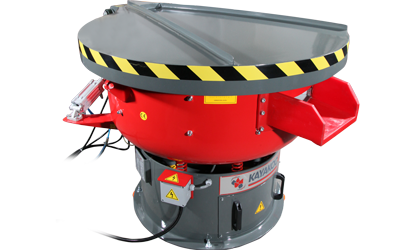
Machine type has a significant influence on how repeatable the finishing process is across batches. Circular vibratory finishing machines, such as the KAYAKOCVIB KVM series, are widely used for batch production of small to medium parts including CNC machined components, stamped parts, fasteners, and cast parts. The circular bowl geometry creates a continuous toroidal part flow, which distributes media contact across all part surfaces and supports uniform finish across the batch.
The amplitude of the vibratory motion is controlled by the eccentric weight setting on the machine. Higher amplitude increases process intensity and cutting rate. Lower amplitude reduces cutting action and is used for finishing or polishing stages. Once validated, the amplitude setting must be held constant across batches. Unauthorized adjustments to the eccentric weight are a common cause of batch-to-batch variation in facilities without strict process discipline.
For long or delicate parts that cannot be tumbled in a circular bowl without risk of part-on-part damage, trough-type vibratory machines provide a gentler, more linear part movement. The selection between circular and trough machine types depends on part geometry, fragility, and the required finishing action rather than on throughput alone.
Automation and Process Control for High-Volume Production
In high-volume production environments, manual process setup introduces variability at every shift change. Automating the compound dosing system, loading weight measurement, cycle time control, and separation sequence reduces human-induced variation and supports a more consistent surface finish from batch to batch.
Automated finishing lines can integrate the vibratory finishing machine with a parts loading station, compound dosing unit, separation screen, washing system, dryer, and unloading conveyor into a single controlled production sequence. When the process parameters are programmed into the machine control system and interlocked with the dosing and timing systems, the operator role becomes monitoring and exception management rather than manual setup at each batch.
Wastewater from wet vibratory finishing contains compound chemistry, fine media particles, and machining residues. In automated or semi-automated lines, wastewater treatment and recycling systems allow process water to be reused, which helps maintain consistent compound concentration over time and reduces wastewater disposal costs. Stable process water chemistry contributes to stable surface finish output.
Validation and Quality Control Points
Process validation is the step that converts a tested finishing recipe into a controlled production process. Before releasing a new finishing process for production, the following validation points should be confirmed and documented.
- Surface roughness measurement on sample parts from at least three consecutive test batches
- Edge condition inspection confirming burr removal completeness across the part geometry
- Visual surface inspection for staining, discoloration, pitting, or media lodging
- Dimensional check confirming that material removal from critical dimensions is within engineering tolerance
- Compound residue check confirming that washing removes residue to the level required by downstream processes
- Media volume measurement confirming that validated media quantity is present at the start of the test batches
After validation, process parameters must be frozen and documented in a controlled process specification. Any deviation from this specification during production should trigger a hold and investigation before the batch is released.
Frequently Asked Questions
What causes surface finish to vary between batches in vibratory finishing?
The most common causes are media wear reducing the available media volume, compound flow rate drift from metering pumps, inconsistent parts-to-media loading ratio, and variation in incoming part condition. Systematic control of these variables is the primary method for achieving batch-to-batch consistency.
How often should finishing media be replaced or topped up?
Media top-up frequency depends on media type, process intensity, and part material. In most production environments, media volume should be checked at defined intervals and topped up to the validated level before volume loss exceeds 10 to 15 percent of the original charge. Media that has worn below minimum size should be screened out and replaced. Exact intervals require process monitoring and documentation specific to each application.
Can the same finishing process handle both steel and aluminum parts?
In most cases, separate finishing processes are recommended for steel and aluminum because the optimal media type and process intensity differ between the two materials. Running them in the same batch increases the risk of surface damage to the softer aluminum parts and makes it difficult to maintain a consistent surface finish standard for either material.
How does automation improve surface finish consistency?
Automation removes manual variability from compound dosing, loading weight measurement, cycle timing, and separation. When these variables are controlled by programmed machine settings rather than manual adjustment, batch-to-batch process conditions remain more stable and the resulting surface quality is more repeatable across shifts and operators.
Related Machine and Process Resources
Conclusion
Maintaining a consistent surface finish in batch production is an engineering discipline, not an equipment guarantee. The process must be designed with defined, measurable control points at every stage from incoming part condition and media preparation through compound dosing, cycle execution, separation, washing, and drying. Each parameter that influences surface quality must be documented, validated through sample testing, and controlled within defined limits during production. When media wear, compound drift, or loading variation occurs, the impact on surface quality is predictable and correctable only if the baseline process is well documented. Machine selection, whether circular vibratory, trough vibratory, or centrifugal disc, supports consistency by providing repeatable mechanical conditions, but the process parameters applied within that machine determine the actual surface finish output. A structured approach to process validation and parameter control is the most reliable path to repeatable surface finishing results across high-volume batch production.
Sorry, the comment form is closed at this time.