


31 Jul Closed-Loop Water Systems for Surface Finishing
Closed-loop water systems for surface finishing lines are engineered water management circuits that treat, recycle, and reuse process water within the finishing facility rather than discharging it to drain after each use. In vibratory deburring, mass finishing, and wet polishing operations, water carries a continuous load of fine metal particles, abrasive fines, spent compound, and oil contamination. Without a structured closed-loop system, this contaminated water must either be discharged to the sewer network through a treatment step or handled as industrial waste, both of which carry regulatory, financial, and environmental costs. A properly engineered closed-loop circuit addresses all of these challenges by treating the water continuously and returning it to the finishing machine at a controlled quality level.
In This Article
Why Surface Finishing Lines Generate Contaminated Water
Wet vibratory finishing, centrifugal disc finishing, and drag finishing processes all require a continuous flow of water mixed with finishing compound. The water serves multiple functions simultaneously: it acts as a carrier for compound actives, it cools the process zone, it flushes cut material and abrasive debris out of the working chamber, and it controls the pH environment that determines whether the process is cutting, brightening, or protecting the part surface.
As the process runs, the water accumulates metal fines ground from the parts and media, abrasive particles worn from ceramic or plastic media, residual oils and coolants carried in on incoming parts, and spent chemical compound. This mixture, commonly called process slurry or finishing effluent, cannot be returned directly to the machine without treatment. Contaminated water reduces compound effectiveness, causes surface staining, promotes media glazing, and in some cases introduces corrosion risk on finished parts. Effective water management is therefore not only an environmental compliance concern but also a direct process quality factor.
Core Components of a Closed-Loop Water Circuit
A functional closed-loop water system for surface finishing is not a single machine but a sequence of treatment stages, each targeting a specific contamination type. The typical circuit includes a primary solids separation stage, an oil separation stage, a chemical treatment or flocculation stage, and a clean water storage tank that feeds the finishing machine.
The sedimentation tank is usually the first stage. Heavy metal particles, ceramic media fines, and coarse abrasive debris settle by gravity in a tank designed with sufficient residence time and minimal turbulence. KAYAKOCVIB SDM-T sedimentation tanks are designed specifically for this application, providing structured sedimentation zones that allow solids to accumulate at the base while clarified water overflows to the next treatment stage. Settled sludge is periodically removed, dewatered if necessary, and disposed of according to local regulations for metal-bearing waste.
After sedimentation, the water still contains suspended fine particles, emulsified oils, and dissolved chemical residues. An oil skimmer or coalescing separator removes floating oils and lubricant residues that rise to the surface. This step is particularly important when machined parts arrive at the finishing line with residual cutting oil or coolant on the surface, which is common in CNC machining and metal stamping operations.
Flocculation or chemical coagulation treatment follows when fine suspended particles cannot be removed by gravity alone. A flocculant chemical is dosed into the water to agglomerate fine particles into larger settleable flocs. The flocculated water then passes through a secondary sedimentation or filter press stage to remove the aggregated solids. The KAYAKOCVIB FLOG flocculation system is designed for this step, providing controlled chemical dosing and mixing to achieve reliable clarification of finishing effluent even when fine metallic or abrasive particles are present in significant concentrations.
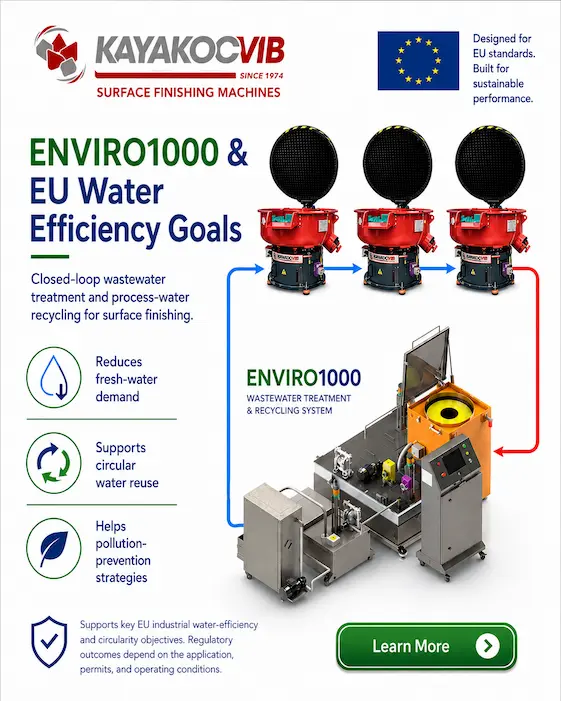
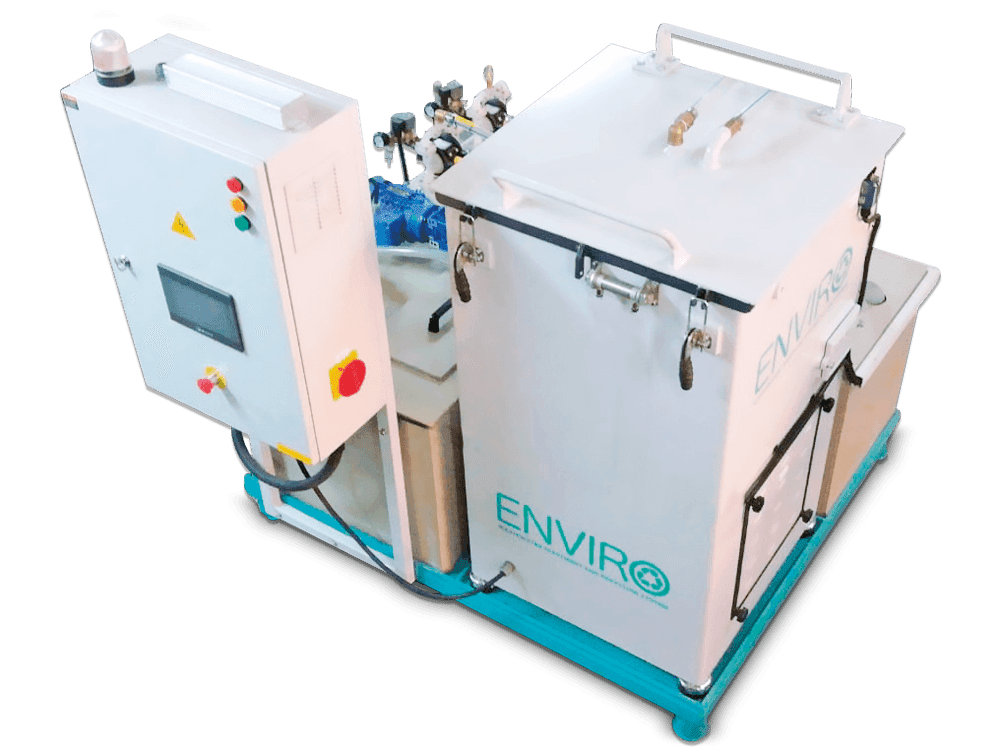
The treated water then flows to a clean water storage tank, from which it is pumped back to the vibratory finishing machine at a controlled flow rate and compound concentration. The KAYAKOCVIB ENVIRO1000 wastewater treatment system integrates these stages into a compact unit suitable for industrial finishing lines, combining sedimentation, oil removal, and chemical treatment in a single engineered system.
Closed-Loop Water Systems in Practice: Application Context
Closed-loop water systems for surface finishing are most commonly implemented in automotive component finishing, CNC machined part deburring, precision stamped part polishing, and high-volume metal processing operations. In these environments, the finishing line runs continuously or in multiple daily shifts, generating large volumes of process water that cannot realistically be discharged as raw effluent without treatment.
In automotive brake component finishing, for example, cast iron fines accumulate rapidly in the process water. Without a closed-loop circuit, the water quickly turns into a dense iron-laden slurry that stains parts, clogs compound dispensing systems, and causes uneven surface quality across the batch. A sedimentation and flocculation system removes these iron fines continuously, allowing the water to be reused across multiple shifts without compromising part quality or compound performance.
In aluminum CNC machining part finishing, the water typically carries aluminum fines, cutting oil residues, and alkaline compound chemicals. Aluminum fines can form abrasive deposits in recirculation lines and nozzles if not removed. A combination of sedimentation and oil removal is usually sufficient for aluminum finishing effluent, whereas steel or cast iron finishing may require additional flocculation due to finer particle sizes that resist gravity settling.
For stainless steel finishing using burnishing or wet polishing processes, water quality control is particularly relevant because stainless steel surfaces are sensitive to iron contamination carried over in recycled water. Cross-contamination from iron particles in recycled water can cause surface staining or premature corrosion on stainless steel parts, so the closed-loop system must be designed to maintain very low suspended solids and iron content in the recirculated water.
Process Parameters That Determine Water System Performance
The performance of a closed-loop water system depends on several interdependent parameters that must be monitored and controlled consistently during production.
| Parameter | Relevance | Typical Control Method |
|---|---|---|
| Suspended solids concentration | Directly affects surface quality and compound effectiveness | Sedimentation tank, filter press, flocculation dosing |
| pH level | Controls compound activity and part corrosion risk | Compound dosing adjustment, pH monitoring probe |
| Oil and grease content | Affects compound emulsification and surface staining | Oil skimmer, coalescing separator |
| Compound concentration | Controls deburring, polishing, or brightening rate | Compound dosing pump with flow control |
| Water flow rate to machine | Determines flushing efficiency and media moisture level | Flow meter, pump speed control |
| Sludge accumulation rate | Determines sedimentation tank cleanout frequency | Scheduled maintenance based on material and volume |
Water pH is one of the most operationally sensitive parameters. Most finishing compounds are formulated for specific pH ranges, and recycled water that accumulates acidic or alkaline residues from the process can shift the working pH away from the compound’s effective range. Regular pH monitoring and compound dosing adjustment are standard practice in well-managed closed-loop systems.
The suspended solids concentration in the recirculated water should be kept below a threshold that varies with the part material and the required surface quality. For bright polishing or burnishing applications, a lower suspended solids limit is necessary compared to general deburring operations. Process engineers typically determine this threshold during initial line commissioning and establish a monitoring routine to maintain compliance.
Integration with Automated Finishing Lines
Closed-loop water systems are most effective when integrated directly into an automated finishing line rather than operated as a standalone unit. In a fully integrated line, the finishing machine, separator, drying system, and wastewater treatment circuit all operate in a controlled sequence. Water flow to the finishing machine is regulated by a pump and flow control system that responds to machine status signals, preventing water waste during idle periods and maintaining correct water flow during active finishing cycles.
Automated compound dosing is typically included in the same control cabinet as the water recirculation system. The dosing pump delivers compound at a rate proportional to the water flow, maintaining a consistent compound-to-water ratio regardless of fluctuations in water consumption during the shift. This approach stabilizes process chemistry across the full working day and reduces the operator intervention required to maintain compound concentration.
In high-volume automotive or CNC machining finishing lines, the closed-loop water circuit may include continuous sludge removal using a screw conveyor or filter press that operates in parallel with the finishing process, eliminating the need for manual tank cleaning during production shifts. These systems allow the finishing line to run continuously without water quality degradation accumulating over time.
Limitations and Practical Considerations
Closed-loop water systems for surface finishing do not eliminate all water discharge. In practice, water is lost through evaporation, parts carry-out, sludge moisture content, and periodic system purging to prevent excessive accumulation of dissolved solids that cannot be removed by physical separation or flocculation. A makeup water supply is therefore always required to replace losses, though the total freshwater consumption is significantly lower than in an open discharge system.
The selection of flocculant chemistry must be compatible with the finishing compound in use. Incompatible combinations can cause foaming, incomplete flocculation, or compound degradation that impairs the finishing process. Compound and chemical suppliers should be consulted during system commissioning to validate chemical compatibility.
Mixed metal finishing lines, where both aluminum and steel parts are processed in the same facility, require careful management of the closed-loop water system to prevent cross-contamination. Aluminum and steel finishing effluent should ideally be treated in separate circuits, or the system must be designed with sufficient purging and flushing capacity between material changeovers to maintain acceptable water quality for each material type.
Sludge disposal remains a regulated activity in most jurisdictions. Metal-bearing sludge from surface finishing operations typically requires characterization testing and disposal through a licensed industrial waste contractor. Dewatering the sludge with a filter press or centrifuge before disposal reduces transport and disposal costs by reducing sludge volume and weight significantly.
Frequently Asked Questions
What is a closed-loop water system in surface finishing?
A closed-loop water system for surface finishing is an engineered circuit that collects process water from the finishing machine, removes metal fines, oils, and spent compound through sedimentation, oil separation, and flocculation, then returns the treated water to the machine for reuse rather than discharging it to drain.
What level of water savings can a closed-loop system achieve?
Water savings depend heavily on the type of finishing process, production volume, and the efficiency of the treatment stages. In many industrial applications, closed-loop systems reduce freshwater consumption significantly compared to open discharge systems, but actual savings require validation based on the specific line configuration, part material, and production schedule.
Does the recycled water affect part surface quality?
If the closed-loop system is correctly designed and maintained, recycled water should not degrade surface quality. However, if suspended solids or pH drift beyond acceptable limits due to insufficient treatment capacity or inadequate maintenance, surface staining, uneven finishing, or compound inefficiency can result. Regular monitoring of water quality parameters is essential.
Is a closed-loop water system required by regulations?
Regulatory requirements vary by country, region, and industry. Many jurisdictions impose discharge limits on metal-bearing effluent from surface finishing operations, effectively requiring either treatment before discharge or a closed-loop system to eliminate direct effluent discharge. Environmental compliance requirements should be verified with local regulatory authorities.
Related Process Equipment
Conclusion
Closed-loop water systems for surface finishing lines represent a convergence of process quality control, environmental responsibility, and operational efficiency. The decision to implement a closed-loop circuit should be driven by a combination of regulatory requirements, water consumption costs, effluent disposal costs, and surface quality demands. Properly engineered systems that integrate sedimentation, oil removal, and flocculation treatment allow finishing lines to maintain consistent water chemistry across extended production runs, reducing both process variability and environmental impact. For manufacturers running continuous or high-volume finishing operations on steel, aluminum, or mixed metal components, a structured closed-loop water management system is a technically justified investment that supports both process reliability and long-term operational cost control.
Sorry, the comment form is closed at this time.