



06 Jul Cleaning After Vibratory Finishing
Cleaning after vibratory finishing is a process stage that directly determines whether the surface quality achieved during deburring or polishing is preserved through to final inspection, coating, or assembly. Vibratory finishing — whether wet or dry — leaves residues on part surfaces including compound film, media fragments, metal fines, oils, and abrasive particles. If these residues are not removed systematically, they compromise downstream operations such as electroplating, anodizing, painting, passivation, and precision assembly. Understanding why this stage matters, which cleaning method applies to a given situation, and how to control the key process variables is essential for any production engineer managing a finishing line.
In This Article
Why Residues Remain After Vibratory Finishing
Wet vibratory finishing uses liquid compounds that serve multiple functions during the process: they act as lubricants, carry away swarf, inhibit corrosion, and assist surface brightening. At the end of the cycle, the compound and the fine metallic particles suspended in it deposit as a thin film on part surfaces. The nature and thickness of this film depend on compound concentration, cycle duration, media type, and water hardness.
Even in dry vibratory processes using dry organic media or corn cob, fine abrasive dust and media breakdown particles accumulate on surfaces and in recessed geometries. Complex part geometries — threaded holes, blind bores, undercuts, and internal channels — trap residues that simple rinsing cannot dislodge without mechanical energy or pressure assistance.
For most industrial applications, this residue removal step is not optional. Compound film left on steel surfaces before heat treatment or coating causes adhesion failures. Metal fines trapped in medical device bores are a contamination risk. Compound residue on aluminum parts before anodizing results in uneven oxide layer formation. The cleaning stage after vibratory finishing is therefore a process-critical step in any quality-controlled production route.
Cleaning Method Selection Logic
The correct cleaning method depends on part geometry, base material, production volume, downstream surface requirements, and the nature of the residue. There is no single universal answer. The two primary industrial methods used after vibratory finishing are pressure washing and ultrasonic cleaning, each suited to different conditions.
Pressure washing uses high-velocity water jets — sometimes combined with a detergent solution — to physically dislodge surface residues through hydraulic shear force. Ultrasonic cleaning uses high-frequency acoustic cavitation energy transmitted through a liquid medium to penetrate micro-geometries and remove tenacious contamination that mechanical water pressure cannot reach.
| Cleaning Method | Working Principle | Best Suited For | Limitations |
|---|---|---|---|
| Pressure Washing | High-velocity water jet impact | General-purpose parts, open geometries, high throughput | Limited penetration into blind holes or fine internal channels |
| Ultrasonic Cleaning | Acoustic cavitation in liquid | Precision parts, complex geometry, threaded holes, medical and aerospace parts | Higher capital cost, smaller batch size per cycle |
| Rinse-Only Tumble | Water flow during rotation | Simple open-geometry parts, low contamination levels | Insufficient for compound film removal without agitation |
Pressure Washing After Vibratory Finishing
Pressure washing is the most widely used post-finishing cleaning method in high-volume industrial environments. A rotary spray cabinet or conveyor-type pressure washer directs water jets at controlled pressure and temperature onto parts as they rotate or travel through the wash zone. The hydraulic energy breaks the adhesion between compound film and part surface, and the liquid carries the loosened residue into a filtration and drainage system.
Key process variables in pressure washing include water temperature, jet pressure, nozzle configuration, wash time, and detergent concentration. For compound residue removal from steel and stainless steel parts, hot water in the range of 50 to 70 degrees Celsius combined with an alkaline detergent is typically more effective than cold water alone. For aluminum, the detergent pH must be carefully selected to avoid surface attack — neutral or mildly alkaline products are generally preferred.
KAYAKOCVIB PRS-W pressure washing machines are designed for integration into finishing lines, allowing part flow directly from the vibratory machine through the wash station without manual transfer. This reduces contamination risk and supports consistent cycle-to-cycle cleaning performance. Filtration units within the wash circuit extend solution life and prevent redeposition of removed contaminants onto part surfaces.
Ultrasonic Cleaning for Complex Part Geometries
When part geometry includes internal channels, blind threaded holes, fine surface features, or recessed areas that pressure washing cannot reach effectively, ultrasonic cleaning provides superior contamination removal. The ultrasonic transducers generate high-frequency pressure waves — typically in the 25 to 40 kHz range for industrial parts cleaning — that create and collapse microscopic cavitation bubbles throughout the cleaning liquid. The implosion energy of these bubbles acts on all wetted surfaces simultaneously, regardless of geometry complexity.
This makes ultrasonic cleaning particularly relevant for medical components, aerospace precision parts, hydraulic valve bodies, fuel system components, and any part where residual particles in fine features represent a functional or regulatory risk. The cleaning liquid in ultrasonic systems is typically a mild aqueous detergent solution. After the ultrasonic cleaning stage, parts are rinsed with clean water and dried.
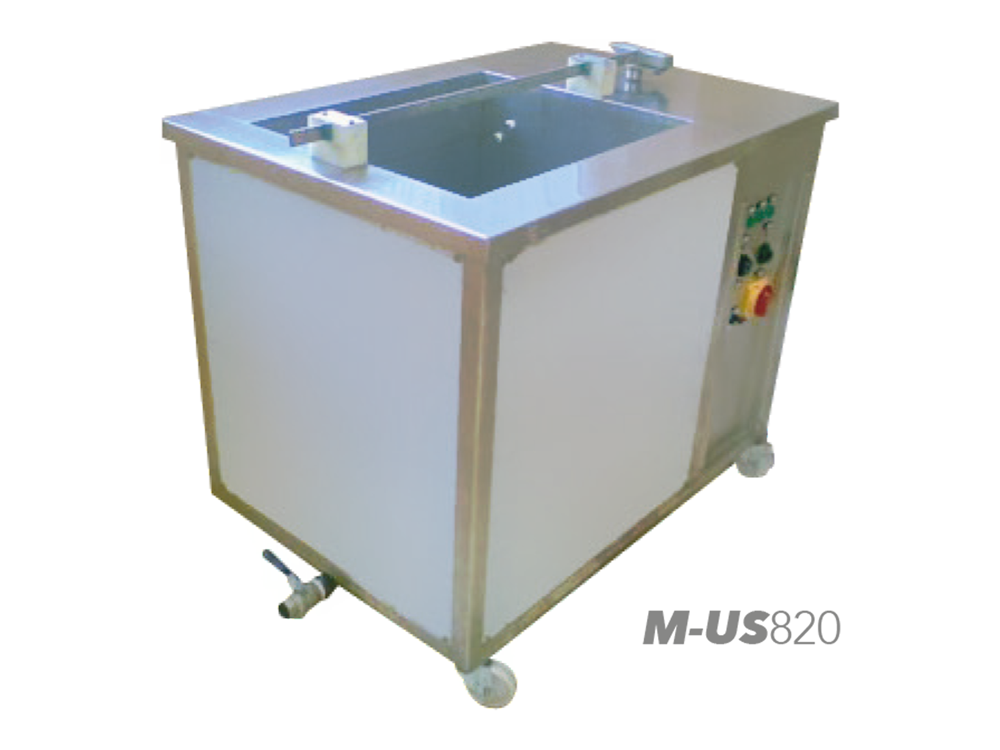
KAYAKOCVIB USW ultrasonic cleaners are used in conjunction with vibratory finishing lines where part geometry or surface quality requirements exceed the capability of pressure washing alone. The selection between PRS-W pressure washing and USW ultrasonic cleaning — or a sequential combination of both — depends on the specific application and must be evaluated based on part complexity, material sensitivity, and required cleanliness level.
Rinse, Passivation, and Drying Stages
After the primary cleaning stage, a clean water rinse is required to remove detergent residue and any remaining suspended particles. For stainless steel parts that have been through a wet vibratory process with acidic or mildly acidic compounds, a passivation rinse — typically using dilute nitric acid or citric acid solution — may be required to restore the passive oxide layer on the surface. The need for passivation depends on the alloy grade, part function, and applicable industry requirements.
Drying is the final stage in the post-finishing cleaning sequence. Parts that leave the cleaning station wet are at risk of water staining, flash rusting on carbon steel, or re-contamination if handled or stored before drying. Hot air drying, centrifugal drying, or vacuum drying may be used depending on part material and geometry. For carbon steel or low-alloy steel parts, a corrosion inhibitor rinse before drying is common practice when the parts will not be immediately coated or processed.
Process Parameters That Affect Cleaning Effectiveness
Several process variables directly control the quality of cleaning after vibratory finishing. These parameters must be defined and monitored as part of the overall process specification, not treated as secondary concerns.
- Water temperature: Higher temperatures reduce surface tension and improve compound film dissolution, but must be controlled for material sensitivity.
- Detergent type and concentration: Alkaline detergents are effective for oils and organic compound residues. Concentration must be maintained within the supplier-specified range to avoid surface attack or insufficient cleaning.
- Jet pressure and nozzle angle: In pressure washing, the mechanical impact energy must be matched to part geometry. Delicate parts or thin-walled components may require reduced pressure.
- Ultrasonic frequency and power density: Lower frequencies generate larger cavitation bubbles with more impact energy, suitable for bulk residue removal. Higher frequencies generate finer cavitation, better for delicate surfaces and precision features.
- Cycle time: Both pressure washing and ultrasonic cleaning have effective time windows. Over-extended cycles are not necessarily more effective and may increase energy consumption or cause surface effects on sensitive materials.
- Water quality: High mineral content can leave deposits on surfaces after rinsing. Deionized or softened water is recommended for final rinse stages, particularly for parts with high surface finish requirements.
- Filtration and bath maintenance: Contaminated wash water redeposits fines onto parts. Regular filtration, bath analysis, and bath change intervals must be part of the process control plan.
Material Considerations in Post-Finishing Cleaning
The base material of the part determines which cleaning chemistry and temperatures are safe to use. Steel and stainless steel parts generally tolerate a wide range of alkaline detergents and moderate water temperatures. Stainless steel requires careful management of chloride content in the cleaning solution to avoid pitting or surface damage.
Aluminum and zinc alloy (zamak) parts are sensitive to high-pH detergents, which can cause surface etching, frosting, or discoloration. Neutral or mildly alkaline detergents and lower water temperatures are appropriate for these materials. Mixed-metal batches — for example, aluminum and steel parts cleaned together — require a compromise cleaning chemistry that may not be fully optimal for either material. Where surface quality is critical, separate cleaning by material type is the better engineering approach.
Copper, brass, and bronze parts are sensitive to both strongly alkaline and strongly acidic cleaning agents. Mild neutral detergents and gentle rinsing are generally appropriate for yellow metals after finishing.
Integration of Cleaning Into the Finishing Line
In high-volume production environments, cleaning after vibratory finishing should be integrated directly into the finishing line rather than performed as a separate manual operation. Inline integration eliminates manual handling between stages, reduces the risk of contamination, and maintains consistent process timing. A typical automated line sequence runs: vibratory machine — separator — washing station — rinse — drying — outfeed conveyor.
Automation also enables process data collection at each stage, supporting quality traceability requirements in regulated industries such as automotive, aerospace, and medical device manufacturing. Flow meters, temperature sensors, conductivity monitors for bath concentration, and drying temperature controls can all be instrumented and logged in a modern automated finishing line.
Wastewater from the washing stage must be managed in compliance with local discharge regulations. The wash water carries compound residues, metal fines, and detergent. A wastewater treatment or recycling system reduces discharge volume and chemical consumption over time. In high-volume plants, wastewater recycling systems can significantly reduce operating cost compared to single-pass water discharge.
Frequently Asked Questions
Why can parts not simply be rinsed with water after vibratory finishing?
Plain water rinsing has limited ability to remove compound film and oily residues from part surfaces. Compound films have adhesive properties that require either mechanical energy, elevated temperature, detergent chemistry, or cavitation energy to break down. A water-only rinse may remove loose particles but typically leaves a thin film that can cause coating adhesion failures or discoloration in downstream operations.
When should ultrasonic cleaning be used instead of pressure washing?
Ultrasonic cleaning is preferred when parts have complex internal geometries, blind threaded holes, fine channels, or surface features that pressure washing cannot reach effectively. It is also preferred for precision parts in medical, aerospace, and hydraulic applications where residual particle levels must meet strict cleanliness requirements. For simple open-geometry parts at high throughput, pressure washing is generally sufficient and more economical.
Does the choice of finishing compound affect how difficult the cleaning step is?
Yes. Finishing compounds vary in viscosity, chemistry, and film-forming behavior. Some compounds leave heavier films on surfaces and require more aggressive cleaning conditions. Using a compound matched to the part material and finishing objective, at the correct concentration, reduces cleaning load and improves overall process efficiency. Overconcentrated compound solutions consistently produce harder-to-remove surface films.
Is a separate passivation step always required for stainless steel after vibratory finishing?
Not always. Whether passivation is required depends on the stainless steel alloy grade, the finishing process chemistry, and the functional or regulatory requirements of the part. Vibratory finishing with appropriate compounds and clean rinse water often leaves the passive layer intact. However, for parts used in corrosion-critical, medical, or food-contact applications, passivation verification and a dedicated passivation treatment step may be required as part of the process specification.
Related Process Equipment
Related Video Demonstration
Conclusion
Cleaning after vibratory finishing is an engineering process stage with defined variables, material constraints, and direct consequences for surface quality in downstream operations. The selection between pressure washing and ultrasonic cleaning — or a combination of both — must be based on part geometry, base material, contamination type, and the surface quality standard required. Process parameters including water temperature, detergent chemistry, jet pressure, ultrasonic frequency, cycle time, and water quality all require specification and control. Integration of the cleaning stage into an automated finishing line improves consistency and supports traceability. For applications in automotive, aerospace, medical, and precision CNC manufacturing, treating post-finishing cleaning as a defined process step rather than an afterthought is what separates reliable surface quality outcomes from inconsistent results.
Sorry, the comment form is closed at this time.