




26 Jul Circular vs Trough Vibratory Dryers
Choosing between a circular vs trough vibratory dryer is one of the more practical decisions in configuring a mass finishing line. The drying stage is often treated as secondary, but the wrong machine selection leads to incomplete drying, part damage, or poor throughput integration. The two machine types share the same vibration-driven drying principle but differ significantly in how they handle part geometry, batch flow, and line configuration.
In This Article
Why the Drying Stage Matters in Mass Finishing
After wet vibratory finishing, parts carry residual moisture from compound solution, rinse water, and sometimes light surface films. If parts are not dried adequately before packaging, inspection, or coating, rust formation on steel parts, water staining on aluminum, and contamination of downstream processes can occur. In production lines running multiple shifts, incomplete drying also creates rework.
Vibratory dryers use a combination of mechanical vibration, heat, and drying media such as corncob granules or walnut shell granules to absorb moisture from part surfaces. The tumbling action created by vibration brings each part surface into repeated contact with dry absorbent media, removing moisture efficiently. The selection between circular and trough geometry determines how well this motion suits the specific part being processed.
Main Selection Criteria
Before comparing machine types, the selection should begin with the part itself. The following factors drive the decision between circular and trough vibratory dryer configurations:
- Part length and aspect ratio
- Part fragility and surface sensitivity
- Part weight and risk of impact damage
- Batch size and production volume per shift
- Whether the dryer feeds directly from a finishing machine or separator
- Available floor space and line layout direction
- Whether the process requires continuous flow or batch operation
No single factor is decisive in isolation. A short, robust part may work in either machine type, while a long shaft or a delicate thin-walled component may only be suitable for one configuration. The analysis must consider the combination of these variables together.
Circular Vibratory Dryers: Working Principle and Suitability
A circular vibratory dryer operates with a ring-shaped processing bowl. Vibration is generated by an eccentric weight motor mounted below or on the bowl, producing a toroidal tumbling motion. Parts and drying media rotate continuously around the bowl and also move in a helical pattern from bottom to top of the bowl walls. This continuous circulation ensures even exposure of part surfaces to dry media.
Circular dryers are well suited for small to medium parts with compact geometry. Fasteners, CNC-machined components, stamped parts, die cast housings, and similar part families typically process well in a circular dryer. The tumbling motion is effective at reaching most surfaces of three-dimensional parts without requiring manual handling between cycles.
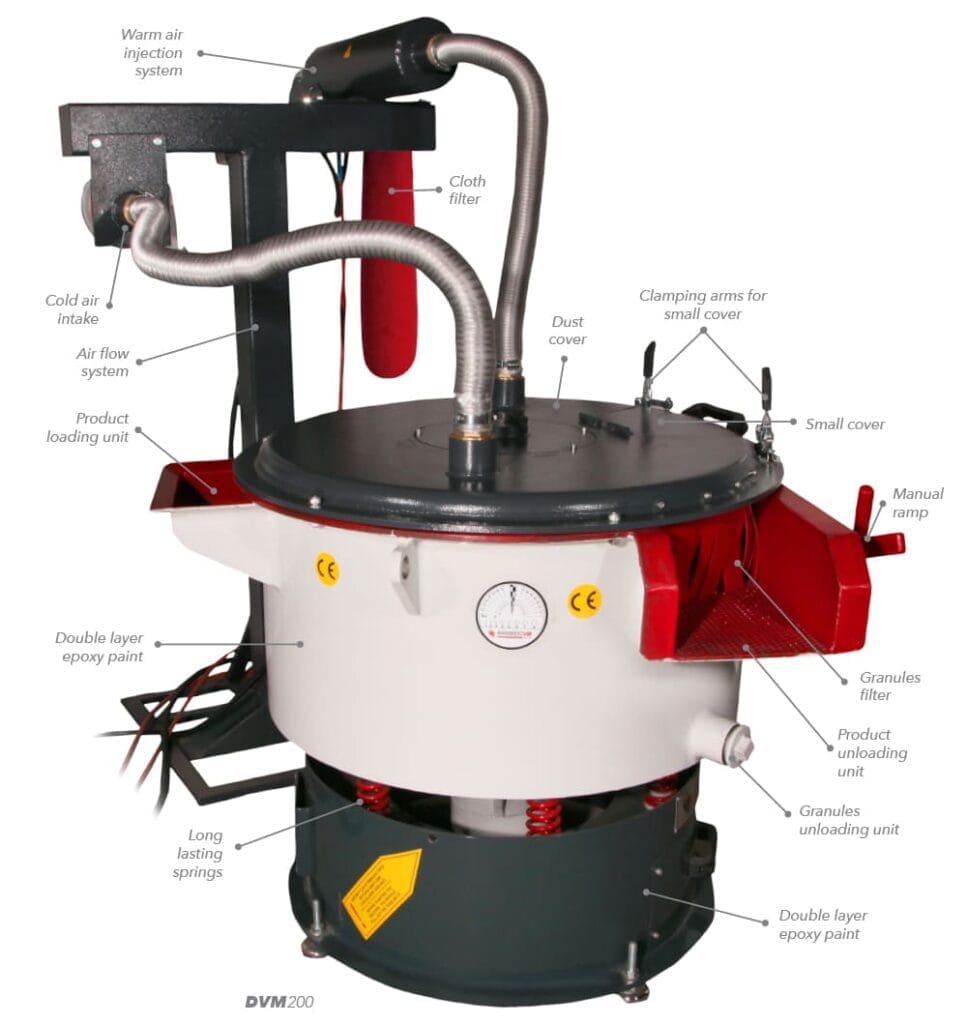
The KAYAKOCVIB DVM series circular vibratory dryer follows this operating principle and is designed to integrate directly with vibratory finishing lines or as a standalone drying station. Typical applications include steel fasteners after wet deburring, aluminum housings after polishing, and mixed small component batches.
One engineering consideration with circular dryers is that very long parts may not tumble correctly. A shaft, bar, or elongated profile in a circular bowl can bridge across the bowl geometry, reducing effective surface contact with drying media and creating uneven drying or part-on-part impact risk.
Trough Vibratory Dryers: Working Principle and Suitability
A trough vibratory dryer uses an elongated rectangular or U-shaped processing channel. Vibration drives parts and drying media in a spiral or linear conveying motion from one end of the trough toward the other. This controlled directional flow is the main functional difference from the circular design.
Trough dryers are particularly suitable for long, slender, or asymmetric parts that cannot tumble freely in a circular bowl. Shafts, profiles, connecting rods, tubes, machined bars, and other elongated components move more predictably through a trough geometry. The linear conveying motion also reduces the risk of tangling or interlocking between parts of similar elongated shape.
For production lines where parts are fed continuously from an upstream separator or finishing machine, the trough configuration offers a natural flow-through path. Parts enter at one end, travel through the drying media bed, and exit at the opposite end or through a discharge gate. This makes trough dryers easier to integrate into continuous or semi-continuous production configurations.
The KAYAKOCVIB D-TVM series trough vibratory dryer applies this working principle and is used in applications involving long automotive components, machined profiles, and other parts where controlled linear flow through the drying media is required.
Circular vs Trough Vibratory Dryer: Selection Matrix
The table below compares both machine types across the most common selection criteria for industrial drying applications.
| Selection Criterion | Circular Vibratory Dryer | Trough Vibratory Dryer |
|---|---|---|
| Best part geometry | Compact, three-dimensional, short parts | Long, slender, profiled, or asymmetric parts |
| Part flow type | Batch tumbling | Directional linear or spiral conveying |
| Part-on-part impact risk | Higher for fragile or thin-walled parts | Lower due to controlled conveying motion |
| Continuous line integration | Possible, typically end-discharge | Well suited for through-feed configurations |
| Floor footprint | Compact circular footprint | Larger linear footprint |
| Typical industries | Fasteners, CNC machining, die casting, stamping | Automotive shafts, profiles, long machined parts |
| Media type | Corncob or walnut shell granules | Corncob or walnut shell granules |
Drying Media and Process Variables
Both machine types use absorbent natural drying media. Corncob granulate is the most commonly used drying media in vibratory dryers because of its high absorbency, low abrasiveness, and ability to handle repeated drying cycles before replacement. Walnut shell granulate offers slightly higher surface polish contribution alongside drying action, making it relevant when a final surface sheen is desired after the finishing stage.
Process variables that affect drying effectiveness in both circular and trough configurations include media-to-part volume ratio, media moisture content at the start of the cycle, bowl or trough temperature when heated air assist is used, vibration amplitude, and cycle duration. Media that has absorbed too much moisture over repeated cycles loses drying efficiency and should be replaced or periodically dried in a separate drying oven.
Heat-assisted drying, where warm air is circulated through the machine or the bowl is heated, shortens cycle times and is particularly useful for parts with deep recesses, threaded holes, or blind bores where moisture can accumulate. Both machine geometries can support heat-assisted drying, but the design details vary by manufacturer and model specification.
Common Wrong Choices and How to Avoid Them
Using a circular dryer for long shaft-type parts is one of the more common configuration errors. The parts do not tumble correctly, media contact is uneven, and the risk of part-on-part scoring increases. In these cases, a trough configuration should be evaluated regardless of the lower initial cost of a smaller circular machine.
Conversely, selecting a large trough dryer for a high-volume fastener application adds unnecessary floor space and capital cost. Circular dryers handle high-volume compact part batches more efficiently, with better media-to-part contact uniformity due to the toroidal tumbling path.
Another avoidable error is under-sizing the dryer relative to the upstream finishing machine output. If the upstream vibratory finisher discharges a large batch faster than the dryer can process it, wet parts accumulate and may begin to oxidize before entering the dryer. The dryer capacity should be matched to the upstream machine discharge rate, not selected based on a smaller standalone batch size.
Production Line Integration Considerations
In automated finishing lines, both circular and trough dryers can be integrated downstream of a separator. The separator discharges cleaned and separated parts directly into the dryer inlet. In circular configurations, this typically uses a chute feed into the bowl. In trough configurations, the inlet end receives parts from the separator discharge, and the outlet end connects to a part collection bin or conveyor.
For lines processing mixed part families, a circular dryer is generally easier to use in batch-switching mode because the bowl can be fully emptied and media topped up between batches. Trough dryers in continuous mode require more attention to batch changeover procedures to avoid mixing different part types in the media bed.
Where floor space is constrained, the circular footprint offers a practical advantage. Where the production line runs in a linear direction from deburring through washing to drying, a trough dryer maintains the directional flow without requiring a 90-degree transfer.
Validation Before Production Release
Regardless of which configuration is selected, drying effectiveness should be validated before releasing the machine into full production. Validation should confirm that all surfaces, including recesses, threads, and undercuts, are dry after the specified cycle time. Parts should be inspected for residual moisture, water staining, media contamination on surface features, and any evidence of part-on-part contact damage.
If residual moisture is found in specific areas, the corrective approach depends on root cause. Insufficient cycle time, saturated media, incorrect media-to-part ratio, or absence of heat assist are the most common causes. These variables can be adjusted without changing the machine type in most cases.
Frequently Asked Questions
Can the same drying media be used in both circular and trough vibratory dryers?
Yes. Corncob and walnut shell granulates are suitable for both machine types. Media selection depends on the required surface condition and absorbency requirement, not on machine geometry.
How do I know when drying media needs to be replaced?
When drying efficiency decreases noticeably, parts exit the machine with residual moisture despite normal cycle times, or media has a visibly high moisture content at the start of a cycle, it is time to replace or thermally regenerate the media. Regular media condition checks should be part of the maintenance routine.
Is a trough vibratory dryer always better for long parts?
For parts significantly longer than the practical tumbling diameter of a circular bowl, a trough configuration is typically the more reliable choice. For borderline cases, sample testing with both configurations is recommended before committing to a machine purchase.
Can vibratory dryers be used without a preceding wash stage?
Vibratory dryers remove moisture from part surfaces. If parts carry compound residue, oil, or contamination from the finishing stage, a wash cycle before drying is generally recommended to avoid depositing residue onto parts during the drying stage. Whether washing is required depends on the compound used and the cleanliness requirement of the final part.
Related Process Equipment
Related Video Demonstration
Conclusion
The decision between a circular vs trough vibratory dryer should be driven by part geometry and production flow requirements rather than machine cost alone. Circular dryers offer compact, efficient batch drying for small to medium three-dimensional parts, while trough dryers provide controlled directional flow better suited to long, slender, or profiled components. Both types use the same drying media and vibration principle, but their motion characteristics determine how well each suits a given part family. Correct machine selection, proper media management, and dryer capacity matched to upstream output are the three variables most likely to determine whether the drying stage performs reliably as part of the wider finishing line.
Sorry, the comment form is closed at this time.