



11 Aug Centrifugal Finishing Aerospace
Centrifugal finishing aerospace applications represent one of the more demanding segments of industrial mass finishing. Aerospace precision parts carry strict surface quality requirements, tight geometric tolerances, and material sensitivities that rule out many conventional deburring methods. Centrifugal disc finishing has become a preferred process route for these components because it delivers high surface energy with controllable intensity, short cycle times, and consistent results across production batches.
In This Article
Aerospace Surface Finishing Requirements
Aerospace components are expected to meet surface finish specifications that directly affect functional performance. Edge condition, surface roughness, residual stress, and cleanliness after finishing all carry engineering significance in this industry. A burr left on a turbine bracket, hydraulic fitting, or structural connector is not a cosmetic issue. It is a potential failure point under vibration, pressure cycling, or thermal load.
The materials most frequently encountered in aerospace precision finishing are aluminum alloys and titanium alloys. Aluminum is common in structural brackets, housings, and CNC-machined frames. Titanium appears in fasteners, implant-adjacent hardware, engine components, and structural attachments where strength-to-weight ratio is controlled. Both materials respond differently to finishing media and process intensity, which makes media and compound selection a technically significant decision.
Typical finishing objectives for aerospace parts include controlled edge rounding without geometric distortion, surface roughness reduction to specified Ra ranges, removal of machining burrs from drilled or milled features, and surface preparation before coating, anodizing, or passivation. The finishing process must achieve these objectives without dimensional deviation, surface smearing, or contamination from process chemicals.
Why Centrifugal Disc Finishing Suits Precision Aerospace Parts
Centrifugal finishing generates process forces significantly higher than standard vibratory finishing. In a centrifugal disc machine, a rotating disc at the base of a stationary bowl creates a toroidal flow of media and parts. The centrifugal acceleration produces finishing forces that are typically five to fifteen times higher than those in a vibratory bowl of equivalent volume, depending on machine design and disc speed. This means that cycle times are substantially shorter for the same finishing result.
For aerospace precision parts, short cycle times translate to reduced part-on-part contact time and lower risk of part damage. The high energy environment also allows more precise control of edge rounding and surface smoothing because the process reaches a defined end point quickly. Vibratory finishing on the same parts might require extended cycles that increase dimensional uncertainty.
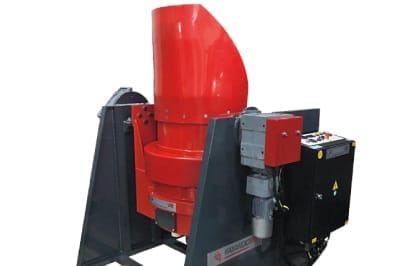
Centrifugal disc machines are well-suited to small and medium precision parts. They handle complex geometries, tight internal features, and mixed-batch production where part orientation relative to media flow matters. The KAYAKOCVIB KSM series centrifugal disc finishing machines are designed for this segment, offering adjustable disc speed and process bowl configurations suitable for aerospace component batches.
Typical Aerospace Parts Processed by Centrifugal Finishing
The range of aerospace parts entering centrifugal finishing covers a broad spectrum of machined and formed components. Common examples include CNC-machined aluminum housings, titanium fasteners, hydraulic manifold bodies, precision brackets, actuator components, and sensor housings. These parts typically arrive from milling, turning, or drilling operations with machining burrs, tool marks, and surface roughness values that exceed the specification for downstream operations.
Parts with complex bore patterns or cross-drilled holes require careful media size selection to avoid media lodging inside the part. This is one of the critical process validation steps before a centrifugal finishing process is released for production. If the media size is too close to the bore diameter, media can pack into the hole and become difficult to extract without damaging the part or introducing process delays.
Media Selection for Aluminum and Titanium Aerospace Parts
Media selection is one of the most consequential decisions in setting up a centrifugal finishing process for aerospace precision parts. Aluminum alloys are softer than steel and can be scratched or plastically deformed by aggressive ceramic media if the media grade is not matched to the application. For aluminum aerospace parts, plastic media with appropriate abrasive content is generally recommended. Plastic media applies lower surface pressure than ceramic media, reducing the risk of surface smearing or micro-scratch introduction on soft alloy surfaces.
Titanium alloys require a different approach. Titanium is harder and more chemically active than aluminum, and it can react with certain compounds. For titanium aerospace parts, ceramic media is more commonly used because the material requires stronger cutting action to address machining burrs. However, compound selection must be validated to avoid surface staining, oxidation promotion, or chemical incompatibility with the alloy grade.
Media geometry also matters for aerospace parts. Triangular or cylindrical media reaches flat surfaces effectively but may not penetrate small recessed features. Smaller media sizes improve access to tight geometries but require longer separation times and more careful attention to lodging risk. The correct media size must be confirmed through sample testing on actual production parts before process release.
| Material | Recommended Media Type | Process Compound | Primary Risk |
|---|---|---|---|
| Aluminum alloy | Plastic media | 085 deburring and polishing liquid | Surface smearing with ceramic media |
| Titanium alloy | Ceramic media | Validated neutral compound | Chemical staining, compound incompatibility |
| Aerospace aluminum (anodizing prep) | Plastic polishing media | 085 polishing liquid + 028-S degreaser | Surface roughness not meeting anodizing spec |
Process Parameters That Control Surface Quality
In centrifugal finishing for aerospace applications, several process parameters directly determine whether the finished part meets specification. Disc rotational speed controls the finishing energy. Higher disc speed increases media pressure against the part surface and accelerates burr removal, but it also increases the risk of part damage for thin or delicate geometries. Speed must be set based on part wall thickness, material hardness, and required finishing intensity.
Cycle time is the second primary variable. For precision aerospace parts, very short cycles may leave residual burrs while very long cycles may begin to affect dimensional tolerances on fine features. Typical cycle times on centrifugal disc machines are shorter than vibratory processes, but the correct endpoint still requires validation through measurement of Ra values and edge radius against specification.
Water flow rate and compound concentration affect both the cutting action of the media and the lubrication of the part-media interface. Insufficient compound concentration can cause dry finishing conditions inside the bowl, leading to surface scratching. Excess compound reduces the cutting efficiency of abrasive media. Both conditions produce inconsistent results across batches. Compound must be dosed continuously and maintained at the validated concentration range throughout the cycle.
Media-to-part ratio is a less obvious but equally important parameter. If too few parts are loaded relative to media volume, parts may contact each other during processing. If too many parts are loaded, the media cannot reach all part surfaces uniformly. The loading ratio must be established during process development and maintained consistently in production.
Process Route for Aerospace Precision Components
A validated centrifugal finishing process for aerospace precision parts typically follows a defined sequence. The steps below represent a general production route that must be adapted and validated for each specific part and specification.
- Pre-inspection: incoming parts are checked for burr condition, surface cleanliness, and dimensional conformance before finishing. Parts with heavy machining damage, gate stubs, or excessive flash may require preliminary operations before centrifugal finishing.
- Batch loading: parts are loaded into the centrifugal disc machine at the validated media-to-part ratio. Part type, size, and fragility determine whether parts are loaded individually or in groups.
- Centrifugal finishing cycle: the disc speed, compound concentration, water flow, and cycle time are set to the validated parameters. The process runs for the specified cycle duration.
- Part-media separation: after the finishing cycle, parts and media are separated using an integrated separator or a stand-alone separation unit. Proper separation prevents media fragments from remaining in part bores or recesses.
- Washing: aerospace parts typically require thorough washing after wet finishing to remove compound residues, media fines, and surface contamination. Pressure washing or ultrasonic cleaning may be required depending on part geometry and downstream process requirements such as anodizing or coating adhesion.
- Drying: parts must be dried uniformly to prevent water staining, especially on aluminum alloys. Corrosion-sensitive alloys may require hot air drying or centrifugal spin drying within a controlled time window after washing.
- Post-process inspection: surface roughness, edge condition, dimensional conformance, and cleanliness are verified against specification. For aerospace applications, this inspection step must be formally documented.
Integration with Aerospace Production Lines
Centrifugal finishing for aerospace precision parts can be integrated into semi-automated or fully automated production lines depending on production volume, part family, and quality system requirements. For low-volume, high-mix aerospace production, batch processing with manual loading and inspection is common. For higher volumes, automated part loading, cycle control, separation, washing, drying, and inspection can be linked into a continuous finishing cell.
Automated lines reduce operator variability and improve batch-to-batch consistency, which is particularly relevant for aerospace components operating under quality management systems. Cycle parameters can be recorded and logged for traceability purposes. Media consumption, compound dosing, and water usage can be monitored and controlled to maintain process stability over extended production runs.
Wastewater management is a relevant operational consideration. Centrifugal finishing with water-soluble compounds generates process water that must be treated before disposal. In production lines handling aluminum or titanium parts, the wastewater may contain suspended solids, abrasive fines, and compound residues. A wastewater treatment system integrated into the finishing line ensures regulatory compliance and allows treated water to be recycled into the process.
Comparison with Drag Finishing for High-End Aerospace Parts
For some aerospace applications, particularly cutting tools, precision molds, and high-surface-quality components requiring Ra values in the low single-digit microinch range, drag finishing may be considered alongside centrifugal disc finishing. Drag finishing moves individual parts through a media bed in a controlled programmed path, giving very high surface pressure at specific contact points. This allows extremely controlled polishing on individual high-value parts.
Centrifugal finishing handles batch quantities more efficiently and is better suited to production volumes of multiple parts per cycle. Drag finishing is typically reserved for parts where individual part control, very fine surface finish, and precise edge radius control justify the lower throughput and higher per-part processing cost. The choice between centrifugal and drag finishing depends on part value, required surface quality, production volume, and process validation outcomes. The KAYAKOCVIB DRG drag finishing machine is used in applications where this level of individual part control is specified.
Quality Control and Validation Requirements
Releasing a centrifugal finishing process for aerospace production requires documented process validation. This is not optional in regulated manufacturing environments. Validation typically involves sample processing of production-representative parts at the intended parameters, followed by measurement of Ra, edge radius, dimensional conformance, and surface cleanliness. The process window must demonstrate that results are consistent across multiple batches and across the full loading range.
Changes to media type, media supplier, compound formulation, disc speed, or cycle time after initial validation may require revalidation depending on the quality system requirements. Process parameters should be locked at the validated values and protected from uncontrolled adjustment during production. Any non-conformance identified at post-process inspection must trigger root cause analysis before production continues.
Frequently Asked Questions
What is centrifugal disc finishing and how does it differ from vibratory finishing?
Centrifugal disc finishing uses a rotating disc at the base of a stationary finishing bowl to generate high-energy media flow. It produces finishing forces typically five to fifteen times higher than vibratory finishing, resulting in shorter cycle times and more controlled surface results for precision parts.
Can centrifugal finishing be used on both aluminum and titanium aerospace parts?
Yes, but media and compound selection must be matched to each material. Aluminum alloys generally require plastic media to avoid surface damage. Titanium alloys require ceramic media for adequate cutting action, and compound compatibility must be validated for the specific alloy grade.
How is media lodging prevented in aerospace parts with internal bores?
Media size must be selected so that no individual media piece can enter and become trapped inside the smallest bore or recess on the part. This must be confirmed through sample testing before process release. Media geometry and size are selected with part bore dimensions as a primary constraint.
What washing method is recommended after centrifugal finishing of aerospace parts?
Pressure washing or ultrasonic cleaning is typically used to remove compound residues and media fines from aerospace parts after centrifugal finishing. The choice depends on part geometry complexity, cleanliness specification, and downstream requirements such as anodizing or adhesive bonding.
Related Process Equipment
Related Video Demonstration
Conclusion
Centrifugal finishing aerospace applications demand precise process control, validated media and compound selection, and documented quality systems that match the standards of the industry. The high process energy and short cycle times of centrifugal disc machines make them well-suited to aluminum and titanium precision components where conventional vibratory finishing cannot meet cycle time or surface quality targets. Process parameters including disc speed, cycle time, media type, compound concentration, and media-to-part ratio must all be validated on production-representative parts before release. For aerospace manufacturers building repeatable finishing processes, the engineering investment in process development and validation is the foundation on which consistent surface quality is achieved across every production batch.
Sorry, the comment form is closed at this time.