


11 Aug Cleaning Aerospace Parts After Surface Finishing
Cleaning aerospace parts after surface finishing is a technically demanding stage that directly affects final surface quality, coating adhesion, and compliance with aerospace contamination requirements. Whether parts have been deburred, polished, or processed through centrifugal disc finishing, residual compounds, media fragments, machining oils, and metallic fines remain on part surfaces and must be completely removed before any downstream process such as anodizing, coating, inspection, or assembly.
In This Article
Why the Cleaning Stage Matters in Aerospace Finishing
Aerospace components made from aluminum alloys, titanium, and specialty aerospace aluminum are processed through surface finishing operations to remove burrs, improve edge geometry, reduce roughness, and prepare surfaces for protective treatments. These processes use water-based compounds and abrasive media that leave behind residues which, if not removed, can cause coating adhesion failures, corrosion initiation points, or inspection failures under aerospace quality standards.
Unlike general manufacturing, the aerospace sector requires surface cleanliness that goes beyond visual inspection. Compound residue in blind holes, recesses, or threaded features can trap moisture and accelerate galvanic corrosion on aluminum and titanium. Metallic fines embedded in surface texture can compromise anodizing quality or create electrical conductivity issues in sensitive assemblies. For these reasons, the cleaning stage is not optional or secondary — it is a process-critical step with its own engineering requirements.
Typical Parts, Materials, and Residue Types
Aerospace finishing lines commonly process structural brackets, housings, actuator bodies, valve components, hydraulic manifolds, CNC-machined panels, and precision fasteners. These parts are typically produced from aluminum alloys such as 6061, 7075, and 2024, as well as titanium grades including Ti-6Al-4V. Both material groups present specific cleaning challenges.
Aluminum is reactive to aggressive alkaline chemistries and can be etched or stained if the wrong cleaning agent is used. Titanium is chemically stable but requires thorough mechanical agitation to dislodge residues from complex surface geometries. Common residue types after surface finishing include water-based finishing compound films, abrasive media dust and fines, machining oil or coolant carryover, metallic debris from deburring, and oxide layers developed during processing. The combination of residue types determines which cleaning method and chemistry should be selected.
Recommended Cleaning Process Route for Aerospace Parts
The cleaning sequence after surface finishing typically follows a structured route. Each stage is designed to address a specific contamination category, and skipping stages increases the risk of downstream process failures.
- Pre-rinse with pressurized water to remove bulk compound residue and loose media fines immediately after the finishing cycle.
- Ultrasonic or pressure washing with a compatible aqueous cleaning solution to dissolve compound films, remove oils, and dislodge residues from recesses and threaded features.
- Clean water rinse to remove detergent residue and prevent surface staining from cleaning chemical carryover.
- Hot air drying or dryer machine drying to remove moisture and prevent oxidation, water spotting, or hydrogen absorption on titanium surfaces.
- Visual and technical inspection to confirm surface cleanliness before routing parts to coating, anodizing, or assembly.
The total cleaning cycle time depends on part geometry complexity, surface area, the number of recesses or blind holes, and the type of finishing compound used. Parts with simple geometry and open surfaces typically require shorter cycles than complex multi-cavity housings.
Machine Selection for Cleaning Aerospace Parts
Two primary machine types are used for cleaning aerospace parts after surface finishing: ultrasonic cleaning systems and pressure washing systems. Each has a distinct working principle and is suited to different part geometries and contamination levels.
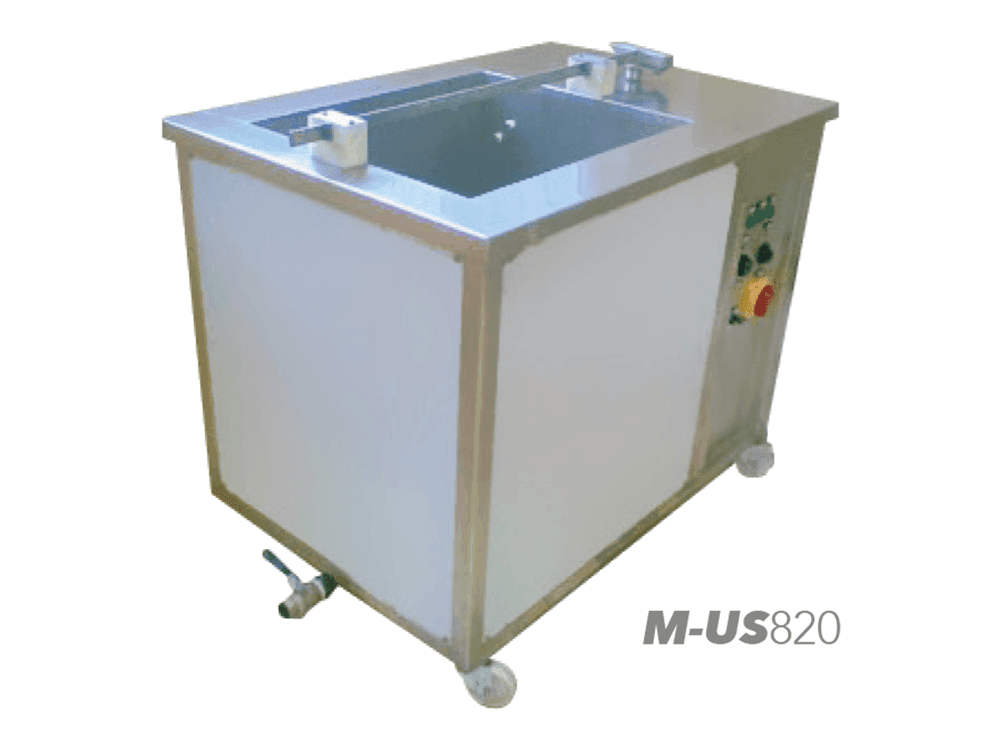
Ultrasonic cleaning systems generate high-frequency sound waves in a liquid cleaning bath, creating microscopic cavitation bubbles that collapse on the part surface. This implosion action dislodges residues from micro-scale surface features, threaded holes, blind bores, and recessed areas that pressure washing cannot reach directly. Ultrasonic cleaning is particularly effective for small precision aerospace parts, instrumentation housings, and components with tight internal channels where direct mechanical spray access is limited. The KAYAKOCVIB USW ultrasonic cleaner is designed for industrial aerospace and precision parts applications, providing controlled frequency and temperature management to match aluminum and titanium cleaning requirements.
Pressure washing systems use high-pressure water jets to mechanically remove residue from part surfaces through direct kinetic energy. These systems are effective for medium to large aerospace structural parts, housings, and brackets where compound residue is primarily surface-level and accessible. The KAYAKOCVIB PRS-W pressure washing machine provides adjustable pressure settings and rotating spray nozzle configurations suitable for structural aerospace parts. Pressure washing is faster per cycle than ultrasonic cleaning for open-geometry parts, but it cannot replicate the sub-surface cleaning action of ultrasonic cavitation for complex internal geometries.
| Cleaning Method | Working Principle | Best Suited For | Limitation |
|---|---|---|---|
| Ultrasonic Cleaning | Cavitation in liquid bath | Small precision parts, blind holes, internal channels | Slower throughput for large parts |
| Pressure Washing | High-pressure water jet | Medium to large structural parts, open geometry | Cannot reach deep blind holes effectively |
| Combined Ultrasonic + Pressure | Sequential cavitation and spray | Complex housings with mixed geometry | Longer cycle, higher equipment cost |
Cleaning Chemistry Selection for Aluminum and Titanium
Chemistry selection is one of the most technically important decisions in cleaning aerospace parts. An incompatible cleaning agent can stain, etch, or passivate aluminum surfaces in ways that compromise anodizing adhesion or create visual defects that fail inspection.
For aluminum aerospace parts, mildly alkaline or near-neutral aqueous cleaning solutions are generally preferred. Strongly alkaline solutions cause surface etching on aluminum and must be avoided unless a controlled etch is intentionally specified. The cleaning solution must also be compatible with any anodizing or conversion coating process that follows. A typical degreasing compound such as 028-S aqueous degreasing liquid is widely used in aerospace finishing lines for aluminum because it removes oils and compound residues without aggressive surface attack at standard process concentrations.
For titanium parts, aqueous neutral or mildly alkaline solutions are suitable in most cases. Titanium is generally resistant to many aqueous cleaning agents, but hydrogen embrittlement risk from acidic chemistries must be considered for high-strength titanium alloys. Process engineers should specify cleaning chemistry based on the exact alloy and downstream process requirements, not based on general assumptions.
Compound concentration, bath temperature, and dwell time all affect cleaning effectiveness. Typical ultrasonic cleaning bath temperatures for aerospace parts range from approximately 40°C to 65°C depending on the chemistry and material. Actual temperature settings must be validated by process testing for each part family and cleaning chemistry combination.
Process Parameters That Affect Cleaning Quality
Several process variables control the final cleanliness level achieved after cleaning aerospace parts. Engineers responsible for process qualification should monitor and control the following parameters:
- Cleaning solution concentration and pH, which degrade over time with accumulated contamination and must be maintained within the specified range.
- Bath temperature, which affects chemical reaction rate and cavitation intensity in ultrasonic systems.
- Ultrasonic frequency and power density, which must match the part size and material to avoid surface damage on thin-walled or delicate aerospace structures.
- Exposure time, which must be sufficient to remove all residues from deep features without overexposing parts to chemical action.
- Rinse water quality, since high mineral content in rinse water can leave calcium or magnesium deposits on aluminum surfaces, particularly after hot drying.
- Drying temperature and airflow, which affect moisture removal speed and the risk of water spotting or oxidation after cleaning.
Bath contamination monitoring is also important in high-volume aerospace cleaning operations. As oils, metallic fines, and compound residues accumulate in the cleaning bath, cleaning effectiveness decreases. Regular bath analysis and controlled fluid change intervals are standard practice in aerospace finishing environments.
Integration with the Surface Finishing Line
In production aerospace finishing lines, cleaning is not performed as a standalone manual operation. It is integrated directly into the surface finishing sequence and should be timed to follow the finishing cycle without allowing parts to sit wet or with compound residue for extended periods. Compound films that dry on aluminum or titanium surfaces can be significantly more difficult to remove than fresh wet residue.
Automated finishing lines for aerospace parts typically include a vibratory or centrifugal finishing machine, a separator to divide parts from finishing media, an integrated washing or ultrasonic cleaning unit, and a dryer, all connected by parts handling systems. For small high-precision aerospace components such as actuator pins, valve seats, or precision housings, centrifugal disc finishing followed by ultrasonic cleaning provides a controlled finishing and cleaning sequence. For larger structural aerospace parts, a trough vibratory machine followed by pressure washing and hot air drying is a common process configuration.
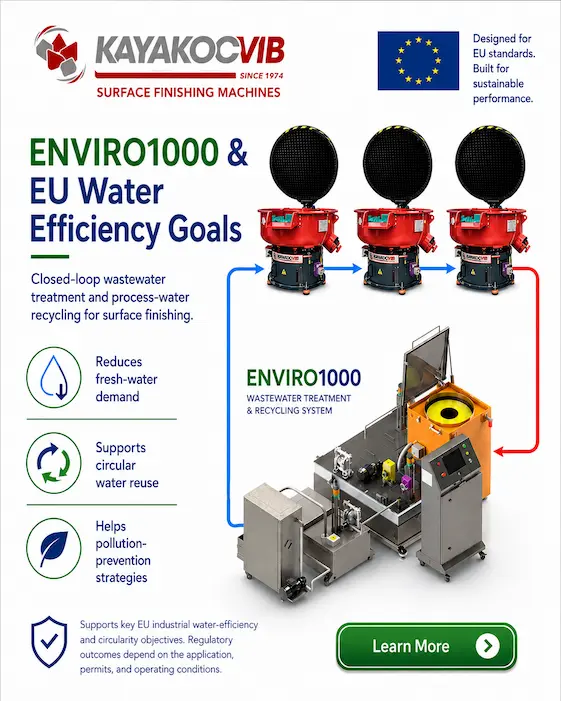
Wastewater from aerospace cleaning operations contains finishing compound residues, oils, metallic fines, and cleaning chemistry that must be treated before disposal. Industrial wastewater treatment systems using sedimentation, filtration, and pH adjustment are typically required to meet environmental discharge requirements. In some high-volume facilities, partial water recycling is implemented to reduce water consumption and disposal costs, though water quality must be monitored to prevent recontamination of parts.
Quality Control and Inspection After Cleaning
The cleaning stage must be followed by a defined inspection procedure before parts proceed to anodizing, coating, or assembly. Inspection for aerospace parts typically includes visual examination under controlled lighting, water break testing to confirm oil-free surfaces, and white glove or lint-free wipe testing to confirm no particulate contamination remains on the surface.
For high-specification aerospace components, contamination levels may be measured using gravimetric analysis or solvent extraction methods per process specifications. Parts that fail cleanliness inspection must be re-cleaned and re-inspected before release. The cleaning process parameters responsible for the failure must be identified and corrected before the next production batch.
Surface roughness measured after finishing should not change significantly after cleaning if the cleaning process is correctly specified. If ultrasonic cleaning frequency or pressure washing intensity is excessive, surface texture modification is possible on soft aluminum alloys. Process validation should confirm that cleaning does not alter the finished surface Ra value beyond acceptable tolerance for the application.
Frequently Asked Questions
What is the best cleaning method for aerospace aluminum parts after vibratory finishing?
For most aerospace aluminum parts, aqueous pressure washing or ultrasonic cleaning with a mildly alkaline or neutral detergent is appropriate. Ultrasonic cleaning is preferred for parts with blind holes or internal channels. Pressure washing is more efficient for large open-geometry parts. The specific method should be selected based on part geometry and contamination level, and validated through process testing before production release.
Can the same cleaning chemistry be used for aluminum and titanium aerospace parts?
Near-neutral aqueous cleaning solutions are generally compatible with both aluminum and titanium in most aerospace finishing applications. However, strongly alkaline solutions that etch aluminum may be acceptable for titanium but not for aluminum. Chemistry selection must be confirmed for each material and downstream process combination. Always verify with the finishing compound supplier and anodizing or coating process specifications.
How often should the ultrasonic cleaning bath be replaced in aerospace production?
Bath change frequency depends on production volume, part contamination load, and the cleaning chemistry specification. In practice, bath pH and concentration should be monitored at defined intervals, typically each shift or daily in high-volume operations. When pH or concentration falls outside the specified range, bath correction or replacement is required. Accumulated metallic fines and oils that are not removed through filtration also reduce cleaning effectiveness over time.
Does cleaning after surface finishing affect surface roughness on aerospace parts?
Correctly specified cleaning does not significantly affect surface roughness on finished aerospace parts. However, excessive ultrasonic power, incorrect frequency selection for thin-walled parts, or aggressive alkaline chemistry can modify the surface texture of soft aluminum alloys. Process validation testing should confirm that the cleaning cycle produces no measurable Ra change outside the acceptable tolerance for the application.
Related Process Equipment
Related Video Demonstration
Conclusion
Cleaning aerospace parts after surface finishing is a process stage that must be engineered with the same technical rigor as the finishing operation itself. Residue type, part geometry, base material, and downstream process requirements all determine the correct cleaning method, chemistry, parameters, and quality control approach. Ultrasonic cleaning provides superior access to complex internal geometries, while pressure washing is efficient for open structural parts. Chemistry selection must be validated for aluminum and titanium compatibility, and bath condition must be monitored continuously in production environments. When integrated correctly into the finishing line, a well-designed cleaning process ensures that aerospace parts leave the finishing stage with the surface cleanliness level required for reliable coating, anodizing, inspection, and assembly.
Sorry, the comment form is closed at this time.