


09 Aug Automotive Fastener Finishing
Automotive fastener finishing is a precision-critical process that directly affects the functional reliability, coating adhesion, and assembly performance of threaded and non-threaded fasteners used throughout vehicle manufacturing. Bolts, screws, nuts, washers, studs, clips, and specialty fasteners all require controlled surface treatment after machining, cold forming, or stamping to remove burrs, sharp edges, tool marks, and surface contamination before downstream processes such as plating, coating, heat treatment, or direct assembly. Vibratory finishing is one of the most widely used mass finishing methods for this application due to its process efficiency, consistent results across large batch volumes, and compatibility with a broad range of fastener materials and geometries.
In This Article
Surface Finishing Requirements for Automotive Fasteners
Automotive fasteners are produced from steel, stainless steel, aluminum, and occasionally titanium or specialty alloys. Each material arrives from forming or machining with specific surface defects that must be addressed before the fastener is ready for its next production stage. Cold-formed steel bolts commonly carry thread flash, head-to-shank transition burrs, and tool contact marks. Machined stainless steel fasteners may have sharp thread crests, edge irregularities at cross-holes, and residual cutting fluid contamination. Aluminum fasteners are sensitive to surface damage and require controlled finishing that removes light burrs without causing dimensional change or surface smearing.
The primary finishing objectives for automotive fasteners typically include edge deburring and rounding, surface smoothing to improve coating adhesion, removal of residual oils and machining chips, and in some cases light polishing to achieve a defined surface roughness. These objectives must be achieved consistently across production batches that can range from a few thousand to several million pieces per shift, which makes process repeatability a central engineering requirement.
How Vibratory Finishing Works for Fastener Applications
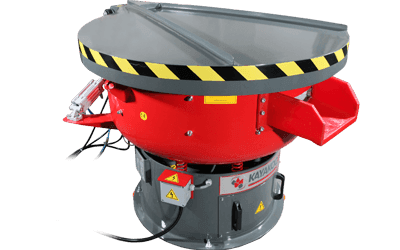
In a circular vibratory finishing machine, the tub and its contents are driven by an eccentric vibration motor mounted on the base of the machine. The vibrating motion causes the combined mass of parts and finishing media to move in a toroidal, circulating pattern through the processing bowl. This continuous relative motion between the media and the fastener surfaces generates controlled abrasion, edge rounding, and surface smoothing without the impact forces associated with barrel tumbling. Parts flow continuously through the media bed while the machine runs, which distributes the finishing action uniformly across all part surfaces including thread flanks, head undersides, and cross-hole edges.
The finishing action is governed primarily by media type, media size, compound concentration, water flow rate, vibration amplitude, and process time. For automotive fasteners, which are generally small, high-volume, and geometrically repetitive, circular vibratory machines are well matched because they handle large batch weights efficiently, allow continuous media-to-part contact on all surfaces, and can be configured for automated loading, separation, washing, and drying downstream.
Media and Compound Selection for Automotive Fasteners
Media selection is determined by the fastener base material, the type and severity of the surface defects, and the required final surface condition. For steel and stainless steel fasteners, ceramic media is the standard choice because the harder abrasive structure provides efficient cutting and deburring action on harder metals. Ceramic media is available in various shapes including triangles, cylinders, cones, and stars. Shape selection depends on fastener geometry: smaller media shapes reach thread roots and cross-hole entries more effectively, while larger shapes provide faster stock removal on heavy burrs or scale.
For aluminum fasteners, plastic media is generally preferred because aluminum is a softer, more ductile material that can be scratched or smeared by aggressive ceramic cutting. Plastic media offers gentler abrasive action, controlled surface smoothing, and lower dimensional risk on precision aluminum parts.
Compound selection follows a similar material-based logic. For steel and stainless steel fasteners, a deburring and polishing liquid such as KAYAKOCVIB 943 is commonly used to support cutting action, inhibit rust formation during wet processing, and maintain a clean media surface. A degreasing liquid such as 028-S is added when parts carry significant machining oil or coolant residue. For aluminum fasteners, 085 deburring and polishing liquid is typically used in combination with 028-S when oil removal is required. Compound concentration, water flow rate, and pH management all affect finishing performance and must be controlled within validated ranges throughout the production run.
Process Route for High-Volume Fastener Finishing
A typical production process route for automotive fasteners in a vibratory finishing line follows a defined sequence from loading to final output.
- Parts are loaded into the vibratory machine tub, either manually or via automated conveyor, at a validated charge ratio of parts to media by volume. For most fastener applications, the media-to-part ratio by volume ranges typically between 3:1 and 6:1, depending on part geometry and finishing intensity required.
- The machine runs with continuous water and compound flow at set amplitude and frequency. Process time depends on burr severity, material, and required surface condition and must be established through sample testing and process validation.
- At the end of the cycle, the separation gate opens and parts and media pass over a separator screen. Media is retained and returned to the tub. Parts discharge to the next stage.
- Parts pass through a rinsing stage to remove compound residue, loose abrasive particles, and surface contamination. In automated lines, an inline washing unit handles this step.
- Parts move to a drying stage. A vibratory dryer such as a KAYAKOCVIB DVM circular dryer uses heated airflow and drying chips to remove surface moisture without causing corrosion or water marks on finished parts. Drying is particularly important before plating, coating, or direct packaging.
- Finished parts are transferred to quality inspection, coating, heat treatment, or packaging depending on the downstream production requirement.
Machine Selection for Automotive Fastener Applications
Circular vibratory finishing machines are the dominant equipment choice for automotive fastener finishing because fasteners are typically small to medium sized, produced in large volumes, and geometrically compatible with the tub-and-media configuration. The KAYAKOCVIB KVM series of circular vibratory finishing machines covers a range of tub capacities suited to different production volumes, from development-scale batches to high-throughput production lines.
Machine selection parameters for fastener applications include tub volume relative to batch weight, vibration motor configuration for the target material and media type, separation system design, and the availability of automated loading and unloading integration. For fasteners with complex geometries such as flanged bolts, socket head caps, or parts with blind holes, the media shape and size selection plays a larger role than machine model alone in determining coverage of all part surfaces.
Trough-type vibratory machines are not generally required for standard automotive fasteners, which are typically short and compact. However, for very long threaded rods or specialty structural fasteners, a trough machine may be considered if part length creates handling or separation difficulties in a circular tub design.
Process Parameters That Control Surface Quality
Surface quality in automotive fastener finishing is controlled by a set of interdependent process variables. Understanding which variable to adjust in response to a specific quality deviation is essential for process engineers managing production consistency.
| Process Variable | Effect on Finishing Result | Typical Adjustment Direction |
|---|---|---|
| Media size | Smaller media improves thread root and recess coverage; larger media increases cutting rate | Match to part geometry and burr location |
| Media type | Ceramic for steel; plastic for aluminum | Based on base material hardness |
| Vibration amplitude | Higher amplitude increases cutting intensity and stock removal rate | Increase for heavy burrs; reduce for delicate parts |
| Process time | Longer cycle time increases edge rounding and surface smoothing | Validate by sample testing; avoid over-processing |
| Compound concentration | Higher concentration improves cutting inhibition and part cleanliness | Follow validated dosing rate; adjust for water hardness |
| Water flow rate | Controls media and compound saturation; affects cutting and cleaning balance | Maintain steady flow; adjust for compound foam level |
| Parts-to-media ratio | Insufficient media reduces finishing uniformity; excess media reduces throughput | Validate ratio through sample runs |
Actual surface roughness values, edge radius outcomes, and cycle times all depend on specific part geometry, burr severity, material condition, and media wear state. Final process parameters must always be established and validated through sample testing before production release. No process parameter set can be transferred directly from one fastener type to another without revalidation.
Production Line Integration and Automation
Automotive manufacturing environments require finishing systems that integrate cleanly into automated production flows. For high-volume automotive fastener finishing, vibratory machines are commonly integrated with automated loading systems, inline separators, rinsing stations, dryers, and conveyor transfer units to eliminate manual handling between process stages.
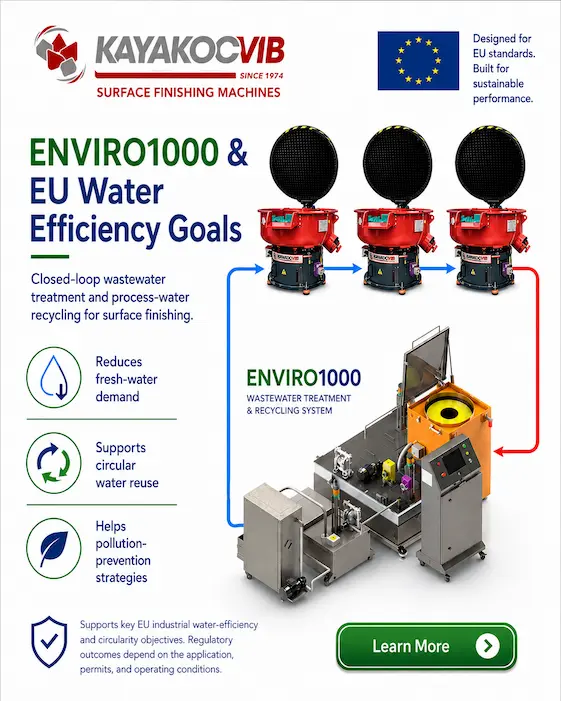
Automated loading reduces operator dependency and maintains consistent machine charge weights across shifts, which directly improves batch-to-batch surface quality consistency. Inline separation and drying allow continuous production without batch accumulation between stages. In fully automated configurations, wastewater from the rinsing and compound stages is collected and treated through a dedicated wastewater treatment or recycling system before discharge, which is a regulatory and environmental management requirement in most automotive supply chain facilities.
KAYAKOCVIB provides complete automated finishing lines that combine KVM circular vibratory machines, SM separator units, DVM dryers, and wastewater treatment systems as integrated solutions for automotive fastener production environments. The level of automation chosen depends on production volume, labor cost structure, part flow requirements, and quality control obligations in the specific facility.
Quality Control and Inspection Points
Surface quality control for automotive fasteners after vibratory finishing typically includes visual inspection for burr removal completeness, tactile or optical edge radius measurement where functional edge rounding is specified, surface roughness measurement on critical bearing surfaces, and cleanliness verification before coating or plating.
Common quality issues encountered in automotive fastener finishing include incomplete deburring in thread root areas caused by oversized media, surface smearing on aluminum parts caused by incorrect media type or excessive process intensity, part-on-part damage caused by an insufficient media-to-part ratio, and water marks or flash rust on steel fasteners caused by inadequate drying or compound control. Each of these issues has a specific process root cause that must be addressed through parameter adjustment rather than by simply extending the cycle time.
Media condition affects finishing performance continuously over time. As ceramic or plastic media wears, its cutting ability changes, which gradually shifts the finishing result. Regular media top-up or replacement according to a validated schedule is necessary to maintain process consistency across production campaigns.
Frequently Asked Questions
Can steel and aluminum fasteners be finished together in the same vibratory machine batch?
Mixing steel and aluminum fasteners in the same batch is generally not recommended. The two materials require different media types and compound chemistries. Steel parts can also cause surface damage to softer aluminum parts through direct contact during processing. Separate batches with appropriate media and compound selection are required for each material group.
What media shape is most suitable for threaded fasteners with cross-holes or recesses?
Smaller media shapes such as small triangles, cylinders, or angle-cut shapes are typically better suited for reaching thread roots, cross-hole entries, and recesses. Very large media cannot enter these geometric features and will leave burrs in confined areas. Media size must always be selected so that media cannot lodge inside the part geometry, which requires verification during process development.
How is over-processing prevented in automotive fastener finishing?
Over-processing risk is controlled by establishing and validating the minimum cycle time that achieves the required surface condition, then running to that time consistently. Regularly monitoring media condition, compound concentration, and water flow rate ensures that the process does not accelerate unintentionally as media becomes sharper after conditioning. Sample inspection at defined intervals during production provides additional control.
Is vibratory finishing suitable for fasteners before thread rolling or after?
For cold-formed fasteners, vibratory finishing is commonly applied after forming and before surface treatment such as plating or coating. Finishing before thread rolling is uncommon for functional threads because the rolling operation itself improves surface finish and fatigue resistance on thread flanks. Process sequence depends on the specific manufacturing route and must be defined by the process engineer based on the part requirements.
Related Machine and Process Resources
Related Video Demonstration
Conclusion
Automotive fastener finishing by vibratory process is a well-established, scalable, and controllable mass finishing method that reliably addresses the deburring, edge rounding, and surface smoothing requirements of high-volume fastener production. The engineering performance of the process depends on correct media selection for the base material, validated compound dosing, controlled vibration parameters, and integration with appropriate separation, washing, and drying stages. For steel and stainless steel fasteners, ceramic media with suitable deburring compounds provides efficient cutting and rust inhibition. For aluminum fasteners, plastic media and lower-intensity compounds prevent surface damage. Process parameters must always be established through sample testing for each specific fastener type, and production consistency requires regular monitoring of media condition and compound chemistry. In automated automotive production environments, vibratory finishing lines with integrated separation, drying, and wastewater management provide the throughput, repeatability, and quality control necessary for automotive supply chain requirements.
Sorry, the comment form is closed at this time.