


08 Aug Reduce Manual Deburring Automotive
The decision to reduce manual deburring in automotive supply chains is driven by three converging pressures: labor cost escalation, surface quality consistency requirements, and throughput demands that manual operations simply cannot meet at scale. Across automotive tier suppliers, manual deburring of steel, stainless steel, and aluminum components accounts for a disproportionate share of finishing labor hours, with results that vary by operator, shift, and fatigue level. Automating this step through mass finishing processes such as vibratory finishing or centrifugal disc finishing replaces subjective hand operations with repeatable, parameter-controlled cycles that can be validated and sustained across production runs.
In This Article
Typical Parts, Materials, and Burr Conditions in Automotive Finishing
Automotive supply chains produce a wide range of machined, stamped, and die-cast components that require deburring and edge rounding before assembly or coating. Common part families include transmission housings, valve bodies, bracket assemblies, gear blanks, hydraulic manifolds, suspension arms, and fastener families. These parts are produced in steel, stainless steel, and aluminum alloys, each presenting different burr characteristics and surface sensitivity requirements.
Steel and stainless steel components from CNC turning, milling, or stamping typically carry sharp wire-edge burrs at cross-holes, edges, and drilled features. Aluminum die castings may have thin parting-line flash and softer burrs but require more careful process control to avoid over-rounding or surface damage. Mixed-metal batches should generally be avoided in automated finishing because media selection must be optimized for the base material, and mixing aluminum with steel parts can cause surface contamination or inconsistent results.
Manual deburring in these contexts means an operator uses hand tools, rotary files, abrasive belts, or bench grinders to remove burrs feature by feature. For high-mix, medium-volume production lines typical in tier-two and tier-three automotive suppliers, this creates a bottleneck that scales poorly with part complexity.
Why Manual Deburring Costs Accumulate in Automotive Production
Manual deburring costs in automotive environments are rarely limited to direct labor wages. The full cost structure typically includes operator training and certification time, rework from inconsistent edge condition, quality escapes at customer inspection, ergonomic injury risk and associated compensation, and the productivity loss from high operator turnover in finishing departments. For a supplier producing several thousand machined steel or aluminum components per shift, manual deburring can require multiple dedicated operators per line, with no guarantee of part-to-part consistency.
When automotive customers specify edge-break radii, Ra surface finish targets, or burr-free assembly requirements, manual operations introduce audit risk. Automated finishing processes are repeatable by design: once a process recipe is validated through sample testing, the same media charge, compound dosing, cycle time, and machine motion produces consistent results across batches. This repeatability is the core engineering argument for automation, beyond cost reduction alone.
Recommended Process Route for Automotive Deburring Automation
For most automotive steel and aluminum components in the small-to-medium size range, wet vibratory finishing in a circular or trough vibratory machine provides a practical and cost-effective deburring route. The general process route for automated deburring follows a logical sequence from pre-inspection through finished part output.
- Pre-process inspection: confirm incoming burr condition, edge geometry, and surface requirements. Parts with heavy flash or gate stubs may require trimming before vibratory processing.
- Batch loading: parts and media are loaded into the vibratory machine at the correct load ratio, typically between 40 and 60 percent media by volume depending on part geometry and fragility.
- Wet processing cycle: the machine runs with continuous compound and water dosing. Compound type and concentration are selected based on the base material and surface condition target.
- Part-media separation: at cycle end, parts and media are separated using a vibratory separator or inline separation system. Parts must be cleanly separated without part-on-part contact to prevent surface damage.
- Post-process washing: wet finishing residue, compound film, and fine swarf are removed using a pressure washing or rinsing stage before drying or further processing.
- Drying: parts are dried in a vibratory dryer using dry corn cob or walnut shell media to absorb moisture and prevent flash rust on steel components.
- Post-process inspection: sample inspection confirms edge condition, surface finish, and part cleanliness before release to the next production stage.
Machine and Media Selection for Automotive Applications
Machine selection for automotive deburring depends on part size, geometry, fragility, and production volume. For small-to-medium steel and aluminum components such as machined valve bodies, brackets, or fastener families, circular vibratory finishing machines offer high throughput with relatively compact footprint. A machine such as the KAYAKOCVIB KVM series operates on the principle of tub-mounted eccentric mass vibration, creating a toroidal flow pattern that continuously tumbles parts and media against each other. This controlled relative motion generates the abrasive cutting action that removes burrs and rounds edges without fixturing individual parts.
For longer components such as shafts, rails, or suspension links that do not fit well in circular machines, trough-type vibratory machines are preferred because they allow linear part orientation and gentler processing of elongated geometries. The machine selection decision should always begin with part geometry and fragility, not machine availability.
Media selection follows base material logic. For steel and stainless steel automotive parts, ceramic media is the standard choice because the harder abrasive composition provides the cutting force needed to remove wire-edge burrs efficiently. Ceramic triangle or cylinder shapes are commonly used for general deburring of machined steel parts. For aluminum die castings or aluminum machined components, plastic media is generally preferred because it is softer and less aggressive, reducing the risk of surface damage on softer base materials.
Compound selection supports the media function. For steel and stainless steel parts, a 943-type deburring and polishing liquid combined with a 028-S degreasing compound is a typical process chemistry combination. For aluminum parts, an 085-type compound designed for non-ferrous metals is more suitable, paired with 028-S for degreasing where oil contamination from machining is present.
Process Parameters That Control Deburring Result Quality
In automated vibratory finishing for automotive parts, the key process parameters that determine edge condition and surface finish output are machine amplitude and frequency, media type and size, compound concentration and dosing rate, water flow rate, and cycle time. These parameters interact: increasing amplitude accelerates material removal but may increase part-on-part impact risk for thin-walled parts. Extending cycle time improves edge rounding but eventually begins removing base material beyond the target edge break.
| Parameter | Steel Parts | Aluminum Parts |
|---|---|---|
| Media type | Ceramic | Plastic |
| Media shape | Triangle or cylinder | Cylinder or cone |
| Compound | 943 + 028-S | 085 + 028-S |
| Typical cycle time | 20 to 60 minutes depending on burr size | 15 to 45 minutes depending on geometry |
| Water flow | Continuous with compound dosing | Continuous with compound dosing |
| Post-process drying | Required to prevent flash rust | Recommended for cleanliness |
Actual cycle times and parameter settings must be validated through sample testing for each part geometry and material. Published ranges are typical industrial starting points, not guaranteed process targets. Process validation should include edge condition measurement, surface roughness sampling, and cleanliness inspection before full production release.
Production Line Integration and Automation Possibilities
The operational benefit of reducing manual deburring in automotive supply chains is only fully realized when the finishing process is integrated into the production line rather than operated as an isolated batch station. In automated finishing lines, part loading, cycle control, separation, washing, drying, and unloading can be sequenced with minimal operator intervention. Automation systems can manage compound dosing, water flow, cycle timing, and separation scheduling through programmable controllers, reducing process variability further.
For high-volume automotive component production, inline separation using a vibratory separator allows continuous output from the finishing machine without stopping the cycle to manually sort parts. Parts exit the separator onto a conveyor or collection bin while media returns to the machine. Washing and drying units can be positioned downstream to complete the process route before parts move to inspection or assembly.
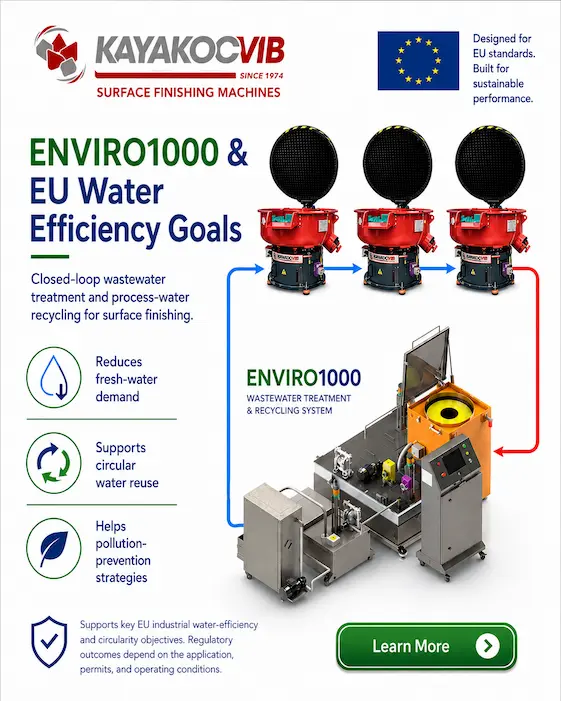
Wastewater from wet finishing operations must be managed. Compound residue, metallic fines, and process water require treatment before discharge. Wastewater treatment and recycling systems allow process water to be reused across production cycles, reducing water consumption and chemical disposal cost. This is increasingly relevant in automotive supply chains where facility environmental compliance is audited alongside product quality.
ROI Calculation Framework for Deburring Automation
Calculating the return on investment for automated deburring requires comparing the total cost of the manual operation against the annualized cost of operating an automated finishing system. The manual cost baseline should include direct labor wages and benefits, rework and scrap cost from inconsistent edge condition, quality escape costs from customer returns, ergonomic and safety compliance cost, and supervisor time allocated to finishing oversight.
The automated system cost includes machine capital cost, media and compound consumption, energy, water, maintenance, and the labor cost of operating the automated line at reduced headcount. In many automotive tier supplier environments, a single automated vibratory finishing line can replace two to four manual deburring operators per shift. Depending on labor rates, part mix, and production volume, payback periods for automated finishing equipment can range from one to three years in typical industrial applications. However, actual payback depends heavily on part complexity, volume, labor cost structure, and quality reject rate reduction. These figures require site-specific calculation and cannot be generalized across all applications.
The non-financial ROI factors are also relevant for automotive supply chain qualification: consistent edge condition improves downstream coating adhesion, reduces assembly rejections, and supports customer quality audits. These factors are difficult to quantify precisely but are consistently cited by production engineers as secondary justifications for automation investment.
Quality Control and Inspection Points
Automated finishing does not eliminate the need for process control. In automotive applications, inspection checkpoints should be established at the post-separation stage and after drying. Visual edge inspection under defined lighting conditions, tactile edge break measurement using radius gauges, and surface roughness sampling using profilometry are the standard validation methods for deburring processes.
For parts with internal cross-holes or blind features, media lodging risk must be assessed during the sample validation phase. If small ceramic media enters internal channels and cannot exit during separation, the part family may require a different media size, shape, or machine type before full production release. This is a common oversight when transferring manual deburring operations to automated processes without thorough sample validation.
Frequently Asked Questions
What types of automotive parts are best suited for automated vibratory deburring?
Small to medium machined steel or aluminum parts such as valve bodies, brackets, gear blanks, and hydraulic manifolds are well suited for vibratory finishing. Parts with simple or moderate geometry, accessible edges, and consistent burr size respond most predictably to automated deburring. Very thin-walled or fragile parts require careful process validation before production release.
How do I choose between ceramic and plastic media for automotive parts?
Use ceramic media for steel and stainless steel parts where strong cutting action is needed to remove wire-edge burrs. Use plastic media for aluminum and softer alloys where aggressive cutting could damage base material surfaces. Media selection must always reflect the base material hardness and the required surface finish output.
Can vibratory finishing replace manual deburring completely for all automotive parts?
For most small-to-medium volume automotive components, vibratory finishing can replace manual deburring for general edge rounding and burr removal. However, parts with very deep internal recesses, complex internal geometry, or very heavy burrs may require pre-trimming or supplementary operations. Process capability must be confirmed through sample testing for each part family.
What is a realistic payback period for automated deburring equipment in automotive production?
In many automotive tier supplier applications, payback periods of one to three years are reported when automated systems replace multiple manual operators. Actual payback depends on labor costs, production volume, reject rate reduction, and equipment utilization. Site-specific financial modeling is required for accurate ROI projection.
Related Process Equipment
Related Video Demonstration
Conclusion
The engineering case to reduce manual deburring in automotive supply chains is built on three measurable foundations: labor cost reduction through operator headcount rationalization, surface quality consistency through repeatable process control, and production throughput improvement through continuous automated cycling. Vibratory finishing with correctly selected media and compound for the base material — ceramic for steel, plastic for aluminum — delivers reliable edge rounding and burr removal at production scale when process parameters are validated through proper sample testing. Integration of washing, separation, drying, and wastewater management into a complete finishing line closes the gap between isolated batch operations and controlled production processes. For automotive tier suppliers facing escalating labor costs and tightening quality requirements, automated deburring is an engineering investment that addresses both simultaneously, provided the process is selected, validated, and maintained with the same rigor applied to any other production-critical manufacturing step.
Sorry, the comment form is closed at this time.