



04 Aug Deburring CNC Aluminum Parts
Deburring CNC aluminum parts with vibratory finishing is one of the most practical and scalable approaches available to production engineers working with aluminum components. CNC machined aluminum consistently produces sharp edge burrs, tool marks, and micro-roughness that must be addressed before parts move to coating, anodizing, assembly, or inspection. Vibratory finishing handles these requirements in batch production without the inconsistency of manual deburring or the part-specific fixturing demands of robotic brushing systems.
In This Article
Typical Defects on CNC Machined Aluminum Parts
CNC machining leaves predictable surface conditions that finishing engineers must plan around. Milling operations generate burrs on top edges and step transitions. Drilling produces exit burrs on through-holes and countersink lips. Tapping and threading can leave small metal folds at thread entries. Profile cutting and slotting operations often create fine feather burrs that are invisible under normal inspection but cause adhesion failures under anodizing or powder coating.
Beyond burrs, CNC aluminum surfaces carry machining marks, tool path lines, and sometimes light oxidation from coolant exposure. Depending on the alloy and coolant chemistry, light smearing of aluminum can also occur along cutting edges. A vibratory finishing process addresses the majority of these conditions simultaneously, which is one reason it is widely used in CNC job shops, automotive component suppliers, and aerospace subcontract machining facilities.
Machine Selection for CNC Aluminum Applications
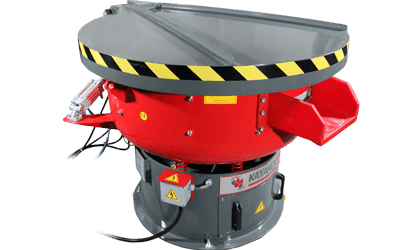
Machine selection depends on part geometry, part size, batch volume, and the degree of edge rounding required. For most CNC aluminum parts in the small to medium size range, a circular vibratory finishing machine is the practical standard choice. Circular machines create a toroidal media flow that carries parts evenly through the working mass, producing consistent contact between media and part surfaces on all accessible faces.
A circular vibratory machine such as the KAYAKOCVIB KVM series is well suited for CNC aluminum applications involving prismatic blocks, housings, brackets, end caps, flanges, and similar geometries. The continuous media circulation in a circular bowl provides uniform deburring across large batches without requiring individual part handling.
For longer aluminum parts such as extrusion profiles, rails, or elongated structural components that would be damaged or poorly finished in a circular bowl, a trough vibratory machine offers a gentler and more controlled finishing environment. The KAYAKOCVIB TVM series trough machines allow long parts to be processed without the end-on-end collision risk that circular bowls present for components with high length-to-width ratios.
Media Selection for Aluminum Parts
Media selection is the most important single decision in the process setup for deburring CNC aluminum parts. Aluminum is a relatively soft, ductile metal. Using ceramic media, which is appropriate for steel or cast iron, typically results in aggressive surface cutting, part damage on thin sections, and inconsistent edge geometry. Plastic media is the standard recommendation for aluminum finishing.
Plastic media is available in a range of shapes including triangles, cylinders, cones, satellites, and angle-cut cylinders. Shape selection depends on part geometry. Triangular and cylindrical shapes provide good general surface contact on flat and curved surfaces. Satellite shapes improve penetration into recesses, bores, and pockets but must be matched to minimum feature dimensions to avoid lodging. Angle-cut cylinders work well on parts with angled surfaces and complex edge profiles.
Media cut size must also match part scale. Using oversized media on small CNC aluminum parts reduces contact quality and slows the process. Using media that is too small increases lodging risk in holes and slots. A common approach for general CNC aluminum parts in the 50 mm to 200 mm range is to use plastic media with a cut size between 8 mm and 20 mm depending on the smallest feature dimension on the part.
Compound Selection and Water Chemistry
Vibratory finishing for aluminum uses wet processing with a liquid compound and water supplied continuously to the machine. For aluminum parts, a mild alkaline deburring and polishing compound is the standard choice. Compounds such as KAYAKOCVIB 085 are formulated for aluminum and non-ferrous metals, providing lubrication to prevent media-to-part scratching while supporting controlled surface cutting and a clean part surface after the cycle.
If parts carry machining oil, coolant residue, or contamination from handling, a degreasing compound such as 028-S is used either as a pre-wash step or combined into the deburring cycle. This is important for aluminum parts that will be anodized after finishing, because residual oil and coolant chemistry under an anodizing bath causes coating adhesion failures and cosmetic defects.
Compound dosing rate, water flow rate, and water temperature all influence surface quality and process consistency. Insufficient compound concentration reduces lubrication and increases scratching risk. Excessive compound creates foam and reduces cutting efficiency. Water flow rate must be matched to compound concentration recommendations for the specific product in use.
Process Parameters for Deburring CNC Aluminum
The table below summarizes typical process parameter ranges for vibratory deburring of CNC aluminum parts. These ranges are indicative and depend on part geometry, burr size, alloy type, media condition, and required surface finish. All process parameters should be validated through sample testing before production release.
| Parameter | Typical Range | Notes |
|---|---|---|
| Media type | Plastic | Preferred for aluminum and soft alloys |
| Media shape | Triangle, cylinder, satellite | Select based on part geometry and feature access |
| Cycle time | 20 to 90 minutes | Depends on burr size and required edge radius |
| Compound | 085 type (aluminum-compatible) | Mild alkaline, anti-scratch formulation |
| Water flow | Continuous low flow | Rate depends on machine size and compound dosing |
| Machine amplitude | 2 to 4 mm typical | Higher amplitude increases cutting intensity |
| Media-to-part ratio | 3:1 to 6:1 by volume | Higher ratio improves part protection |
Process Steps for a Vibratory Deburring Line
A complete vibratory deburring process for CNC aluminum parts typically follows this sequence.
- Pre-cleaning: Parts arriving from machining with heavy coolant or oil contamination should be pre-rinsed or pre-degreased to avoid contaminating the finishing compound bath and to prevent compound breakdown from oil overloading.
- Loading: Parts are loaded into the vibratory machine bowl with the correct media volume. The media-to-part ratio must be maintained to prevent part-on-part contact, which causes denting on soft aluminum.
- Deburring cycle: The machine runs with continuous compound and water supply. Cycle time is set based on burr size and edge rounding requirement. The vibratory motion causes constant media-to-part contact, removing burrs and smoothing edges progressively.
- Separation: After the cycle completes, parts are separated from media using a separator screen or integrated discharge and separation system. Part and media sizes must be sufficiently different to allow reliable separation.
- Rinsing: Parts are rinsed thoroughly with clean water to remove compound and fine debris from surfaces and blind holes.
- Drying: Wet aluminum parts must be dried promptly to prevent water staining and surface oxidation. Vibratory dryers with corn cob or walnut shell drying media are commonly used for this step.
- Inspection: Parts are inspected for edge condition, surface quality, and completeness of deburring on all required surfaces before release to the next production stage.
Edge Rounding Control and Surface Quality Factors
One of the important considerations when deburring CNC aluminum parts is controlling how much material is removed beyond the burr. Vibratory finishing does not stop at the burr tip. If the cycle runs longer than required, edge rounding continues and dimensional tolerances on chamfers, threads, and near-edge features can be affected. This is especially relevant for precision CNC aluminum parts in aerospace and medical applications.
The main variables controlling edge rounding intensity are cycle time, media cut and shape, compound aggressiveness, machine amplitude, and media-to-part ratio. For light deburring and minimal edge break, shorter cycles with fine plastic media and low amplitude settings are used. For heavier burr removal and controlled edge rounding, longer cycles with more aggressive plastic media shapes and higher amplitude settings are applied.
Blind holes and internal channels present a specific challenge. Vibratory media cannot enter features that are smaller than the media cut size, meaning burrs inside very small holes or narrow slots will not be reached by the process. In these cases, manual deburring of inaccessible features may still be required before or after the vibratory step. Process planners should map all features on a part and identify which areas are accessible to the chosen media before committing to vibratory finishing as the sole deburring method.
Integration into CNC Production Lines
Deburring CNC aluminum parts with vibratory finishing integrates naturally into CNC production environments because the process handles batches rather than individual parts. Parts are accumulated after machining and processed in groups, which matches the output rhythm of CNC cells operating at medium to high volumes.
For high-volume production, vibratory machines can be integrated into automated finishing lines with conveyor loading, automated compound dosing, continuous separation, drying, and downstream inspection or packaging stages. Wastewater from the vibratory finishing process contains aluminum fines, compound chemistry, and machining residue. Depending on local discharge regulations, a wastewater treatment or recycling system may be required before process water is disposed of or reused.
For lower-volume job shops, standalone batch vibratory machines with manual loading and a separate rinse and drying step are a cost-effective setup that still provides consistent and repeatable results compared to manual deburring methods.
Limitations to Consider Before Process Validation
Vibratory finishing is highly effective for deburring CNC aluminum parts with accessible geometry and moderate burr sizes. It is less suitable for parts with very deep blind holes that would create media lodging risk, for parts with thread forms that are too small to be protected from media contact, or for parts where tight dimensional tolerances on edge geometry make cycle time control critical.
Very thin-walled aluminum parts can be at risk of deformation from media impact at high amplitude settings. In these cases, lower amplitude, finer media, and shorter cycles reduce the risk. Parts with dissimilar inserts, pressed pins, or adhesive-bonded features should be evaluated carefully before vibratory processing, as compound chemistry and mechanical action may affect insert integrity.
All of these limitations can be evaluated through controlled sample testing before the process is approved for production. Sample testing is the standard industrial practice for validating vibratory finishing processes and should always precede full production release.
Frequently Asked Questions
Can ceramic media be used for deburring aluminum CNC parts?
Ceramic media is generally not recommended for aluminum in standard deburring applications. Aluminum is softer than steel and is prone to surface scratching and material damage from the harder cutting action of ceramic media. Plastic media provides adequate deburring for most aluminum CNC part applications while protecting surface quality. Ceramic media may only be considered for aluminum in specific cases where very heavy burrs require aggressive initial removal, and this should be validated through sample testing.
How long does a typical vibratory deburring cycle take for CNC aluminum parts?
Cycle times for deburring CNC aluminum parts in vibratory machines typically range from 20 to 90 minutes depending on burr size, required edge rounding, media type, machine amplitude, and part geometry. Light finishing cycles for fine CNC burrs may complete in 20 to 30 minutes. Heavier burr removal or stronger edge rounding requirements may need 60 to 90 minutes. Actual cycle time must be confirmed through sample testing for each specific part and process configuration.
What causes part-on-part denting during vibratory finishing of aluminum?
Part-on-part denting occurs when the media-to-part ratio is too low, causing aluminum parts to contact each other directly during media circulation. Aluminum is soft enough that direct part collision leaves visible dent marks. Maintaining a media-to-part ratio of at least 3:1 by volume, and in some cases higher, prevents direct part contact and protects surface quality throughout the cycle.
Is rinsing and drying required after vibratory finishing of aluminum parts?
Yes. Thorough rinsing is required to remove compound residue, aluminum fines, and machining debris from all surfaces including blind holes and recesses. Prompt drying is important because standing water on aluminum causes water staining and surface oxidation that can affect anodizing adhesion and cosmetic appearance. Vibratory drying with corn cob or walnut shell media is a common and effective drying method for batch aluminum parts.
Related Machine and Process Resources
Related Video Demonstration
Conclusion
Vibratory finishing provides a consistent, scalable, and process-controlled method for deburring CNC aluminum parts across a wide range of part geometries and production volumes. The key engineering decisions are media type and shape selection, compound chemistry matched to aluminum, cycle time control to manage edge rounding, and machine type selection based on part size and geometry. For most CNC aluminum applications, plastic media with an aluminum-compatible compound in a circular vibratory machine delivers reliable results. Parts with complex geometry, tight tolerances, or specific downstream coating requirements should always be validated through controlled sample testing before the process is approved for production release.
Sorry, the comment form is closed at this time.