


03 Aug Automatic Separation Vibratory Finishing
Automatic separation vibratory finishing is a production method in which finished parts and finishing media are separated mechanically at the end of a vibratory cycle, without manual intervention. In high-volume manufacturing environments, the separation stage is not a secondary consideration. It is a process-critical step that directly affects throughput, part quality, and the ability to integrate vibratory finishing into a continuous automated line. Understanding how separation works, what influences its reliability, and how it connects to upstream and downstream finishing stages is essential for any engineer designing or optimizing a finishing process route.
In This Article
Why Separation Matters in a Finishing Line
In batch vibratory finishing, parts and media move together inside the machine bowl throughout the entire cycle. At cycle end, both elements must be cleanly separated before parts proceed to washing, drying, inspection, or packaging. If separation is incomplete, media pieces can travel downstream and cause damage to clean parts, contaminate washing systems, or trigger false readings during automated inspection.
Manual separation using hand screens or static sieves is practical for low-volume applications, but it introduces variability, slows cycle throughput, and creates ergonomic challenges for operators handling heavy, wet, or chemically active media. Automatic separation eliminates these constraints and enables the finishing machine to operate as part of a continuous production line rather than a standalone batch station.
How Automatic Separation Works
In a typical circular vibratory finishing machine, the bowl is fitted with a discharge gate or outlet port that opens at the end of the programmed cycle. The vibratory motion drives the mixture of parts and media toward the discharge opening. A separation screen or sieve deck is positioned at or near the outlet. Media falls through the screen apertures and is collected in a return channel or hopper below, while finished parts travel across the screen surface and discharge into a downstream conveyor, elevator, or collection container.
The screen aperture size is matched to the geometry of the media being used. Typical media profiles include triangular, cylindrical, spherical, and star shapes in sizes commonly ranging from a few millimeters to over 25 mm depending on the application. The screen opening must be large enough to pass the media freely but small enough to retain all parts. For applications where parts and media have similar cross-sectional dimensions, separation becomes more demanding and may require customized screen designs or a combination of screen and vibratory amplitude settings.
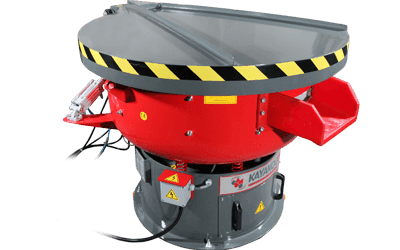
Separation efficiency is also influenced by the vibratory amplitude and frequency of the separator unit. A dedicated separator machine, such as the KAYAKOCVIB SM series, provides controlled vibratory action specifically tuned for separation tasks rather than relying on the finishing machine bowl to perform both finishing and separation simultaneously. This distinction is important in production lines where separation speed, gentleness, or media recovery accuracy is a priority.
Media Selection and Its Effect on Separation
Media geometry directly determines how reliably separation can be achieved. Irregular or angular ceramic shapes used for aggressive deburring of steel parts tend to pass through screens efficiently when properly sized. Spherical or cylindrical plastic media used for aluminum or zinc alloy parts may require different screen profiles due to lower density and tendency to float or roll differently under vibratory motion.
For steel and iron parts, ceramic media is the standard choice, offering strong cutting action for burr removal and edge conditioning. For aluminum, zamak, and other softer non-ferrous parts, plastic media is generally preferred because it reduces the risk of surface damage and provides controlled cutting rates. The density difference between plastic and ceramic media also affects how the mixture flows toward the discharge gate and through the separator, which should be considered during line commissioning.
Compound selection affects separation indirectly. Residual foam, high compound viscosity, or excessive water flow can cause media to clump or slow drainage through the screen. Compounds such as 085 deburring and polishing liquid for plastic media applications and 943 for ceramic media applications are formulated to maintain adequate fluidity and rinsing action that supports clean separation and media drainage.
Integration into an Automated Finishing Line
The full value of automatic separation vibratory finishing is realized when the separator is connected as a functional stage within a complete finishing line rather than operated as a standalone unit. A typical automated line for CNC machined steel parts might follow this sequence: parts load into the circular vibratory machine, a timed cycle runs with controlled compound dosing, the machine discharges at cycle end, the part-media mixture passes through the separator, clean parts move to a washing station for chip and compound removal, and parts then enter a drying system before transfer to final inspection or packaging.
In this configuration, the separator operates continuously in coordination with machine discharge timing and downstream conveyor or elevator speed. Process control systems can monitor separation completion, trigger compound dosing resets, and initiate the next loading cycle automatically. The result is a finishing line capable of running with minimal manual intervention across extended production shifts.
For high-volume applications in automotive fastener production, CNC turned parts, or stamped metal components, this level of integration translates directly into reduced labor cost per part, consistent cycle timing, and lower risk of part damage caused by manual handling at the separation stage. For aerospace or medical component production where surface integrity requirements are strict, automated separation also reduces the risk of part-to-part contact and mechanical damage during the transition from finishing to washing.
Process Parameters That Control Separation Quality
Several parameters influence how reliably automatic separation vibratory finishing performs in production conditions. These should be understood and validated during initial process setup rather than adjusted reactively during production.
| Parameter | Effect on Separation | Practical Note |
|---|---|---|
| Screen aperture size | Determines media pass-through and part retention | Must be matched to media geometry and smallest part dimension |
| Separator vibratory amplitude | Controls flow rate and separation speed | Higher amplitude speeds separation but may increase part-to-part contact |
| Discharge gate timing | Controls when the mixture enters the separator | Premature discharge can overload the separator screen |
| Compound flow at separation | Affects drainage and screen blinding | Reduce or stop compound dosing near end of cycle |
| Media fill level in finishing machine | Affects mixture density and flow behavior | Maintain recommended fill ratio for consistent discharge volume |
| Part geometry | Parts with cavities, threads, or recesses may trap media | Screen design and vibratory action must account for lodging risk |
Parts with deep blind holes, internal threads, or complex recesses carry a risk of media lodging during finishing. This lodged media can pass through the separation stage undetected and cause downstream problems. Where lodging risk is identified, vibratory amplitude, media size, and media shape should be adjusted during process development to minimize retention inside part features before separation begins.
Application-Specific Considerations by Industry
The technical requirements for automatic separation vary significantly across industries. In fastener manufacturing, parts are typically small, high-volume, and geometrically simple. Separation is generally reliable with standard screen configurations, and the priority is high throughput with minimal downtime between cycles. In CNC machined part finishing for automotive or general engineering, part geometry is more varied, and media selection must be confirmed to avoid lodging before an automated separation line is commissioned.
In aerospace component finishing, the emphasis shifts toward part protection during separation. Low amplitude settings, gentler screen motion, and careful part density management during discharge are important to prevent surface scratches or edge damage on precision components. Medical device finishing shares similar concerns, with the added requirement that all media contact surfaces and separation equipment meet cleanroom or contamination control standards in many applications.
General manufacturing and mixed-production environments often benefit most from flexible separator designs that can accommodate different media sizes and part families by changing screen decks. The KAYAKOCVIB SM series separators are designed for this type of flexibility, supporting integration with KVM circular vibratory machines in automated line configurations for varied part families.
Common Mistakes in Separation Line Setup
Several setup errors commonly reduce separation performance in production environments. Oversized screen apertures chosen for faster media drainage can allow small or thin parts to fall through with the media stream. Undersized apertures blind quickly with wet compound residue, slowing throughput and causing media to back up into the finishing machine outlet.
Running the finishing machine at maximum amplitude until discharge without reducing amplitude near the end of the cycle can cause the mixture to discharge too rapidly and overload the separator. This creates incomplete separation and part accumulation on the screen. Programming a brief amplitude reduction before discharge gives the mixture time to stratify and improves separation quality.
Neglecting media top-up schedules is another common source of separation inconsistency. As media wears over time, the average piece size decreases. If screen apertures are not reviewed when media is partially worn, separation performance degrades before operators identify the cause. Establishing a media inspection and top-up interval based on actual wear rate for the specific material and compound combination in use is a practical preventive measure.
Frequently Asked Questions
What is the difference between separation in the finishing machine and a dedicated separator?
Some circular vibratory machines are designed with a built-in discharge and basic screen to perform separation directly at the bowl outlet. A dedicated separator machine provides independent vibratory control, more precise screen matching, and higher separation throughput. For continuous or high-volume lines, a dedicated unit typically produces more consistent results and is easier to integrate with downstream washing and drying stages.
Can automatic separation handle parts with complex geometry?
Yes, but part complexity increases the risk of media lodging inside cavities, threads, or recesses. Before automating separation for complex geometries, a lodging risk assessment should be performed during process development. Adjusting media size, shape, and vibratory conditions to eliminate lodging is a prerequisite for reliable automated separation.
How is screen aperture size selected?
Screen aperture size is selected based on the smallest cross-sectional dimension of the parts and the largest dimension of the media pieces. The aperture must allow all media to pass freely while retaining all parts. When parts and media have similar dimensions, custom or graduated screen designs may be required. Sample testing during commissioning is the reliable method for confirming aperture selection.
Does compound choice affect separation performance?
Yes. Compounds with high foaming tendency or high viscosity can cause screen blinding and reduce drainage rate through the separator. It is good practice to reduce compound dosing rate toward the end of the finishing cycle so that the mixture entering the separator has adequate fluidity for clean drainage and screen passage.
Related Process Equipment
Related Video Demonstration
Conclusion
Automatic separation vibratory finishing is a well-established production technique that transforms a batch finishing operation into a continuous, controlled process. The engineering decisions that determine separation quality include screen aperture selection, separator vibratory parameters, media geometry and wear state, compound behavior at end of cycle, and part geometry risk assessment. When these factors are properly matched and validated, automatic separation enables high-throughput finishing lines with consistent surface quality, reduced manual handling, and predictable cycle timing across steel, stainless steel, aluminum, and mixed metal part families. Final process capability should always be confirmed through sample testing and line commissioning before full production release.
Sorry, the comment form is closed at this time.