


28 Jul Reduce Water Chemical Consumption Washing
Efforts to reduce water and chemical consumption in washing lines have become a core engineering priority across automotive, aerospace, medical device, and general metal processing facilities. Rising water costs, tightening wastewater discharge regulations, and environmental compliance requirements make efficient washing line design a genuine operational necessity rather than an optional improvement. This article explains the engineering logic behind water and chemical reduction in industrial washing lines, covering process stage design, compound dosing, filtration, and wastewater recycling from a practical factory perspective.
In This Article
Why Washing Line Efficiency Matters in Surface Finishing
Industrial washing lines consume significant volumes of water and chemical compounds across degreasing, rinsing, passivation, and drying stages. In high-volume production environments, poorly optimized lines may run continuous fresh water feeds, overdose liquid compounds, and discharge contaminated rinse water without recovery. The cumulative cost across these inefficiencies is substantial when assessed over annual operating periods.
Beyond cost, wastewater discharge limits for suspended solids, oils, heavy metals, and pH require treatment before discharge. Plants that reduce consumption at the source reduce both the volume and contamination load entering the treatment system, lowering treatment chemical costs and sludge disposal volumes simultaneously.
Washing Line Stage Architecture and Consumption Sources
A standard industrial washing line for metal parts after deburring or finishing typically includes pre-wash or degreasing, main wash, one or more rinse stages, optional passivation, and hot air or centrifugal drying. Each stage has its own consumption profile.
The degreasing stage consumes the highest chemical concentration, typically using an alkaline degreasing compound such as KAYAKOCVIB 028-S at dilutions commonly between 2% and 5% by volume depending on contamination type and part material. The main wash stage uses lower concentrations. Rinse stages consume the highest water volumes because they must reduce surface chemical concentration to acceptable levels before the next stage.
The drying stage does not directly consume water or chemicals but affects how much carry-over liquid moves into the environment, which indirectly affects chemical losses and surface staining risk if the stage is poorly designed.
Cascade Rinsing to Reduce Water Consumption
Counter-current cascade rinsing is the most effective structural change available for reducing water consumption in washing lines. In a single-stage rinse, fresh water enters continuously and contaminated water exits continuously. In a two-stage or three-stage counter-current cascade, fresh water enters only at the final rinse stage, flows backward through the sequence, and exits at the first rinse stage. Parts move forward through progressively cleaner water.
This arrangement allows the same rinsing quality to be achieved with substantially lower fresh water volume. A two-stage cascade typically reduces rinsing water consumption by 60% to 80% compared to a single-stage continuous rinse at equivalent rinse quality, depending on part geometry, drag-out volume, and target surface conductivity or chemical residue level. Actual reduction depends on application conditions and requires validation through process testing.
Three-stage cascades are used when parts carry significant liquid drag-out, when the process requires very low residual chemical on the surface, or when discharge limits are tight and minimizing contaminant concentration in the exit stream is important.
Compound Dosing Control and Chemical Reduction
Manual compound dosing is one of the most common sources of chemical overconsumption in industrial washing systems. Operators tend to add more compound than needed to ensure cleaning performance, particularly when the process has no feedback mechanism. The result is excess foam, elevated chemical concentration, and higher discharge treatment requirements.
Automated dosing systems use conductivity sensors, concentration analyzers, or volumetric dosing pumps with time-controlled injection to maintain compound concentration within a defined operating band. Conductivity-based dosing is practical for alkaline degreasing compounds because dissolved compound concentration correlates reliably with electrical conductivity in the wash bath. When conductivity falls below the setpoint, dosing activates; when it reaches the upper limit, dosing stops.
Typical operating concentration ranges for alkaline degreasing in industrial metal washing are narrow, commonly between 1.5% and 4% depending on the compound formulation and contamination load. Automated dosing commonly reduces chemical consumption by 20% to 40% compared to manual dosing in comparable applications. Results depend on the specific compound, part contamination level, and process configuration.
Filtration and Bath Life Extension
Wash bath contamination from oils, metallic fines, abrasive media residue, and oxidation products degrades cleaning performance and forces early bath replacement. Continuous or periodic filtration extends bath life significantly and reduces total chemical consumption per unit of production.
Bag filters, cartridge filters, or oil skimmers remove floating oils and suspended particles from the wash bath. Bag and cartridge filters are suitable for removing solid fines from the degreasing bath. Oil skimmers or coalescing oil separators are appropriate for removing tramp oil that accumulates from cutting fluids or lubricants carried in on parts.
In automated washing lines, filtration runs continuously or on timed cycles without operator intervention. Extending wash bath life from one week to four weeks through filtration, for example, reduces chemical replenishment frequency and reduces the wastewater volume requiring treatment when the bath is eventually replaced. Actual bath life depends on contamination load, part volume, and compound type.
Ultrasonic and Pressure Washing: Consumption Comparison
Selecting the appropriate washing technology for the part type and contamination level affects both cleaning performance and resource consumption. Ultrasonic cleaning and pressure washing represent different approaches with different consumption profiles.
| Parameter | Ultrasonic Cleaning | Pressure Washing |
|---|---|---|
| Cleaning mechanism | Cavitation in liquid bath | High-pressure liquid jet |
| Water volume per cycle | Fixed tank volume, low per-part use | Higher flow, depends on nozzle and time |
| Chemical concentration | Low to medium, bath reused | Low, typically dilute spray |
| Suitable for blind holes | Yes, cavitation penetrates | Limited, jet access dependent |
| Suitable for delicate parts | Yes, with frequency selection | Risk of deformation at high pressure |
| Energy consumption | Medium, ultrasonic generator plus heater | Medium to high, pump-driven |
| Typical applications | Precision parts, medical, aerospace | Larger parts, heavy contamination |
KAYAKOCVIB USW ultrasonic cleaners use bath-based cavitation cleaning, which is well suited to parts with complex geometry, blind holes, or tight tolerances where jet cleaning cannot reliably reach all surfaces. Because the bath volume is fixed and the liquid is filtered and reused across multiple cleaning cycles, per-part water and chemical consumption is typically lower than equivalent pressure washing for the same part volume.
KAYAKOCVIB PRS-W pressure washing machines are more appropriate for larger parts, heavy oil or chip contamination, or when parts require a high-flow rinse after bulk finishing. Pressure washing systems benefit from closed-loop water recirculation, inline filtration, and oil separation to reduce consumption and extend water reuse cycles.
Wastewater Recycling and Closed-Loop Water Management
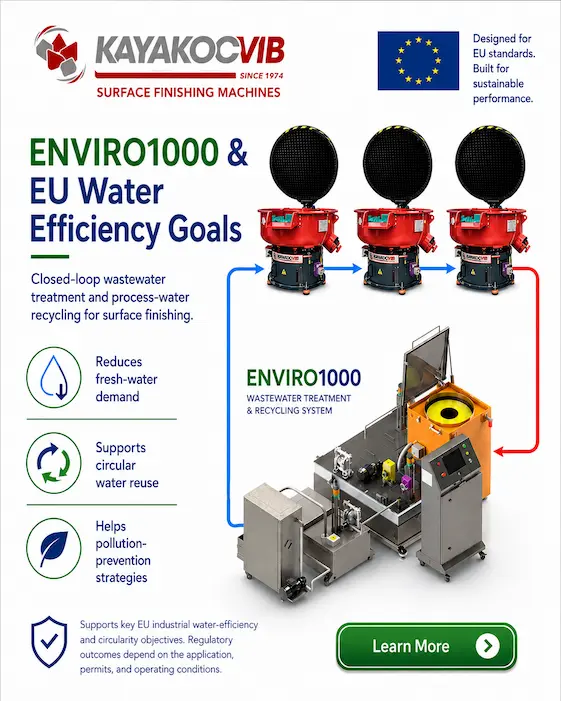
Wastewater treatment and recycling systems allow rinse water to be cleaned and returned to the washing line instead of discharged. This is the most impactful single measure available for reducing total water consumption in high-volume washing operations.
A closed-loop system typically includes an oil-water separator to remove floating oils, a filtration stage to remove suspended solids, a pH adjustment stage to bring water within acceptable range for reuse or discharge, and a clear water storage tank that feeds back into the rinse stages. In some applications, a reverse osmosis or ultrafiltration module may be added to produce demineralized water for final rinsing or passivation stages where mineral deposits or staining must be avoided.
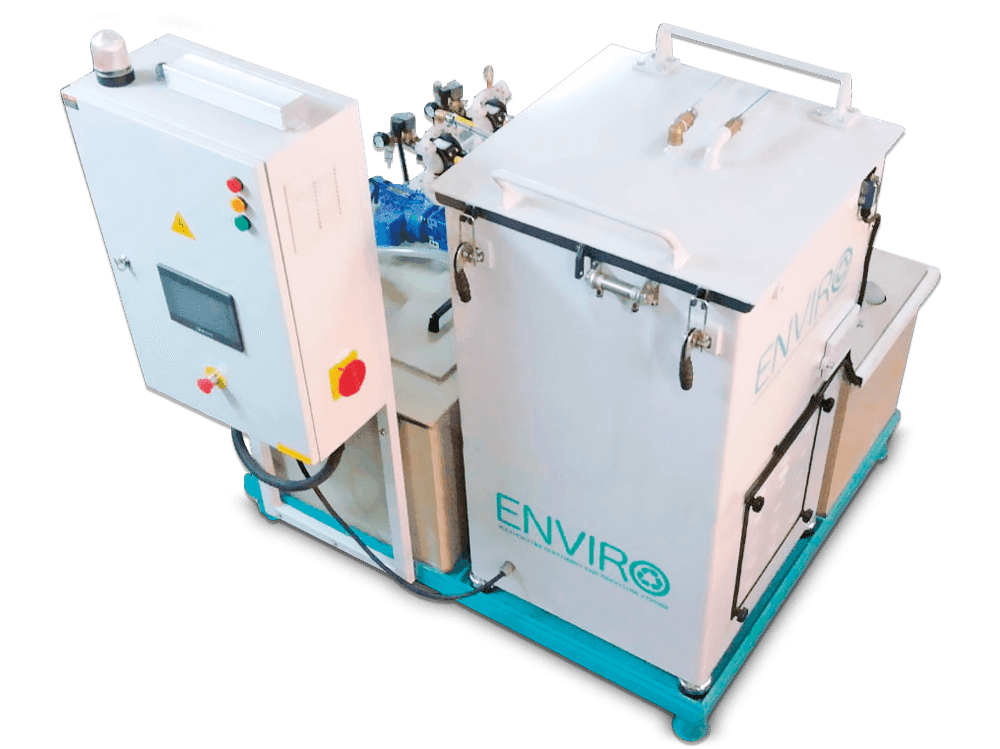
The KAYAKOCVIB ENVIRO1000 wastewater treatment system is designed for integration with industrial finishing and washing lines to enable water recycling and controlled chemical management. Systems of this type reduce fresh water intake significantly, lower chemical discharge volumes, and reduce the frequency and cost of wastewater disposal. Actual water recovery rates depend on contamination load, part material, and process design.
For plants processing steel and stainless steel parts through wet vibratory finishing followed by washing, integrating the finishing machine effluent with the washing line wastewater treatment system allows centralized management of all liquid waste streams, reducing the number of separate discharge points and simplifying regulatory compliance.
Process Parameters That Control Resource Consumption
Several process variables directly affect how much water and chemical a washing line consumes during normal production. Engineering these parameters correctly during line commissioning reduces ongoing operating costs.
- Wash bath temperature: Higher temperatures improve degreasing efficiency and may allow lower chemical concentrations. Typical alkaline degreasing operates between 50°C and 70°C. Underpowered heating leads to operators compensating with excess chemical.
- Part drag-out volume: The amount of liquid carried from one stage to the next depends on part geometry, drainage design, and conveyor speed. Drip zones between stages reduce drag-out and lower the contamination load entering rinse stages.
- Rinse water flow rate: Continuous overflow rinsing consumes more water than controlled-fill-and-dump or recirculating rinse systems. Spray rinse nozzle sizing and pressure affect both coverage and water volume.
- Bath replacement frequency: Replacing the bath too early wastes chemical. Replacing it too late degrades cleaning quality. Conductivity monitoring, oil concentration measurement, or turbidity tracking provides objective replacement criteria.
- Compound selection: Compounds formulated for low foaming, rapid biodegradability, and broad material compatibility reduce treatment complexity and may allow higher reuse cycles before bath replacement.
Material-Specific Washing Considerations
Material choice affects both compound selection and water management. Aluminum parts require pH-neutral or mildly alkaline compounds because strongly alkaline solutions attack aluminum surfaces, increasing chemical consumption as the bath is contaminated by dissolved aluminum. Steel and stainless steel tolerate higher pH alkaline degreasing. Mixed-metal production batches require careful compound selection to avoid surface attack on sensitive materials.
For stainless steel parts requiring passivation after finishing, the passivation stage uses nitric or citric acid solutions. These stages require dedicated rinse sequences to prevent acid carry-over into the main wash circuit. Separate treatment of passivation rinse water is typically required because of its different pH and chemistry.
Aluminum finishing lines that use 028-S degreasing liquid should verify compound compatibility with the specific alloy and surface condition. Where anodizing or coating follows washing, rinse water conductivity control is particularly important because mineral contamination from hard tap water can cause adhesion defects or surface staining.
Automation and Monitoring for Sustained Reduction
Reducing water and chemical consumption is not a one-time calibration exercise. Without continuous monitoring and automation, consumption tends to drift upward as operators compensate for perceived cleaning quality variations by adding more compound or increasing water flow. Automation sustains the reduction by removing manual decision points.
Key automation elements for washing line resource management include conductivity-controlled compound dosing, flow meters on fresh water supply lines with setpoint alarms, automated bath dump timers linked to contamination monitoring, oil skimmer activation on timed or sensor-triggered cycles, and data logging for trend analysis and maintenance scheduling. These elements are available as modular additions to existing washing lines or as integrated features in purpose-built automated washing and treatment systems.
Frequently Asked Questions
What is the most effective way to reduce water consumption in a washing line?
Counter-current cascade rinsing is typically the most effective structural measure. Combining cascade rinsing with closed-loop wastewater recycling delivers the greatest overall reduction in fresh water intake.
How much can automated chemical dosing reduce compound consumption?
In comparable industrial applications, automated conductivity-controlled dosing commonly reduces chemical consumption by 20% to 40% versus manual dosing. Actual results depend on compound type, contamination load, and process configuration, and require validation for each specific application.
Can a single wastewater treatment system serve both the finishing machine and the washing line?
Yes. In integrated finishing lines, effluent from vibratory finishing machines and washing line rinse stages can be routed to a shared wastewater treatment system. This simplifies discharge management and reduces infrastructure cost, but requires correct flow balancing and treatment capacity sizing for the combined volume.
What is the minimum rinse stage configuration recommended for a metal washing line?
For most metal finishing applications, a two-stage counter-current rinse is the practical minimum. Single-stage rinsing is only adequate for low-contamination applications or where very high fresh water flow rates are acceptable. Three-stage cascades are appropriate for parts with complex geometry, heavy drag-out, or tight surface cleanliness requirements.
Related Process Equipment
Related Video Demonstration
Conclusion
The engineering approach to reduce water and chemical consumption in washing lines combines stage architecture design, dosing automation, filtration, material-appropriate compound selection, and wastewater recycling into a coherent system rather than treating each element in isolation. Counter-current cascade rinsing, conductivity-controlled compound dosing, continuous bath filtration, and closed-loop water recycling each deliver measurable consumption reductions that compound when implemented together. The correct configuration depends on part material, contamination type, production volume, and regulatory requirements. Process validation through water balance analysis, conductivity monitoring, and cleanliness testing is necessary before establishing final operating parameters. When designed correctly, an optimized industrial washing line delivers consistent surface cleanliness at lower operating cost and reduced environmental impact over its production lifetime.
Sorry, the comment form is closed at this time.