



22 Jul Finishing Media Shapes
Finishing media shapes are one of the most important variables in mass finishing process design. The geometry of the media piece directly determines how contact is made with part surfaces, how effectively burrs are removed, whether media reaches recessed areas, and how the final surface texture develops. Selecting the wrong shape for a given part geometry or process goal leads to inconsistent results, incomplete coverage, or media lodging, regardless of machine type or compound quality.
In This Article
Why Media Shape Matters in Mass Finishing
In vibratory and centrifugal finishing systems, media acts as the cutting or polishing tool. Unlike fixed tooling, media pieces move freely through the part load and contact surfaces at random angles. The shape of each media piece controls the contact geometry, the accessibility to part features, and the relative aggressiveness of cutting action.
A flat-sided shape makes planar contact with flat surfaces and generates broader cutting zones. A pointed or angular shape concentrates force at edges and corners. A cylindrical shape rolls against surfaces and creates consistent line contact. Each behavior produces different surface results on the same part material with the same compound.
Process engineers must match media shape to the specific part geometry, feature accessibility, and required surface outcome before adjusting other parameters such as cycle time, compound concentration, or machine amplitude.
The Four Primary Finishing Media Shapes
Cone Media
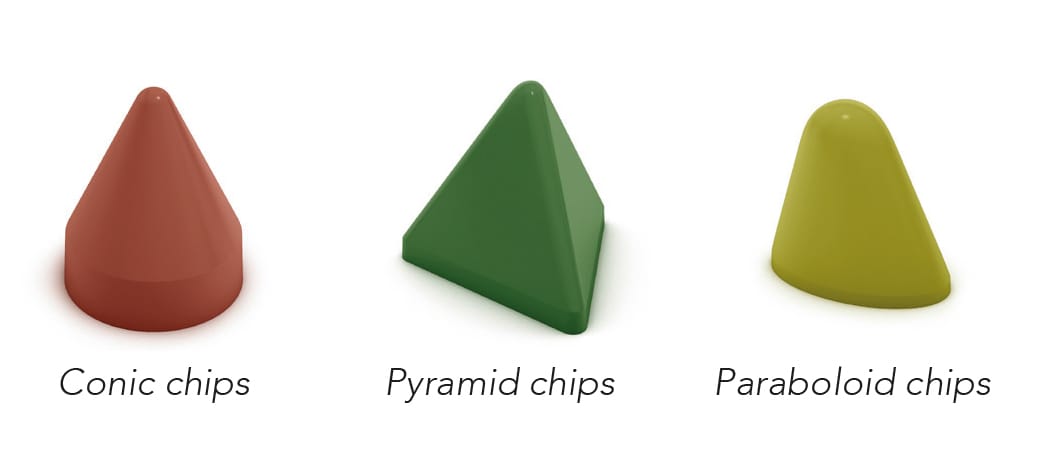
Cone-shaped media has a circular base tapering to a point. This geometry allows the media to access recessed holes, internal radii, thread roots, and undercut features that flat-sided shapes cannot reach. The pointed tip concentrates abrasive contact at the apex, making cone media effective for deburring small bores and narrow slots.
Cone media is widely used in fastener finishing, precision CNC machined parts with drilled holes, and hydraulic valve bodies where internal features must be deburred without affecting external surfaces. The tapered geometry also reduces the risk of bridging across cavities, which is a common problem with cylindrical or block-type media in parts with closely spaced features.
One limitation of cone media is that the point contact at the apex can produce localized material removal that is not uniform across flat surfaces. For parts requiring consistent flat-surface finishing, cone media is often mixed with other shapes rather than used alone.
Triangle Media
Triangle media, also called tristar or tri-angle media, has three flat faces and three edges. The flat faces provide broad surface contact for efficient cutting and polishing on flat or slightly curved surfaces. The edges and corners of the triangular cross-section allow access to internal angles, corner radii, and narrow grooves.
Triangle media is one of the most versatile finishing media shapes in industrial use. It performs well across a wide range of part geometries because it combines flat-face cutting efficiency with edge-access capability. It is commonly selected for stamped metal parts, die castings, small structural components, and general deburring applications where part geometry varies within the same production batch.
The three-edge geometry also helps prevent lodging in most standard part features, because the edges act as natural extraction points that push the media out of cavities during machine motion. However, triangle media can lodge in very narrow slots or blind holes where the edge dimension exceeds the slot width, and this risk must be evaluated during media selection.
Cylinder Media
Cylindrical media has a circular cross-section and a defined length-to-diameter ratio. It rolls freely through the part load and generates consistent line contact along the cylindrical surface. This rolling behavior produces a controlled burnishing or cutting action that is distributed evenly along the contact zone.
Cylinder media is frequently used for polishing flat surfaces, producing consistent surface roughness on round or prismatic parts, and for burnishing applications where the objective is to compress and smooth the surface rather than remove significant material. It is well suited for shaft-type parts, bearing components, and small turned parts where surface texture uniformity is important.
The main limitation of cylinder media is poor accessibility to recessed features. A cylinder cannot enter blind holes, narrow slots, or internal angles effectively. For parts with complex geometries, cylinders are typically mixed with cone or triangle media to ensure complete coverage.
Pyramid Media
Pyramid media has a square or rectangular base with four sloping faces converging to an apex or a truncated top. The angled faces allow contact at multiple orientations as the media tumbles through the part load, while the base edges provide cutting action on flat surfaces and the apex or edges address corners and radii.
Pyramid media is used in applications requiring aggressive material removal combined with good surface coverage. It is effective for deburring heavily burred steel parts, removing casting flash, and finishing complex geometries with both flat and curved features. The multi-face geometry means the media contacts the part differently at each tumbling position, which can improve consistency across irregular surfaces.
Like cone media, pyramid shapes carry a risk of point or edge wear that changes the effective cutting geometry over time. Regular media inspection and replacement of worn pieces is necessary to maintain consistent process results.
Media Shape Selection Logic
Selecting the correct finishing media shape requires analysis of part geometry, feature accessibility, material hardness, burr characteristics, and the required surface outcome. The table below summarizes the primary selection criteria for each shape.
| Media Shape | Best For | Accessibility | Typical Application |
|---|---|---|---|
| Cone | Internal holes, narrow slots, thread roots | High for recessed features | Fasteners, hydraulic components, CNC parts with bores |
| Triangle | General deburring, mixed geometries | Good for edges and corners | Stamped parts, die castings, general machined components |
| Cylinder | Flat surfaces, burnishing, polishing | Low for recessed features | Shaft parts, bearings, turned components |
| Pyramid | Heavy deburring, complex surfaces | Medium, multi-face contact | Casting flash removal, heavily burred steel parts |
In practice, many production processes use a mixed media charge combining two or more shapes. A common combination for machined aluminum parts is cone media for hole access and triangle media for flat surface finishing, run together in the same machine cycle with an appropriate plastic media formulation. For steel components with heavy burrs and deep holes, pyramid media and cone media are sometimes combined to address both aggressive deburring and internal feature access.
Process Walkthrough: Selecting and Running a Shape-Optimized Media Charge
The following steps describe the engineering workflow for selecting and validating finishing media shapes for a new part introduction.
- Analyze the part drawing and physical sample. Identify all burr locations, surface conditions, internal features, hole diameters, slot widths, and corner radii. Note the material and hardness.
- Identify the process objective. Determine whether the goal is deburring, edge rounding, surface polishing, burnishing, or a combination. The objective determines both the media type and shape requirement.
- Select media material based on part material. For aluminum and zamak parts, plastic media is generally preferred to avoid aggressive material removal. For steel and stainless steel parts, ceramic media is typically selected for effective cutting and deburring action.
- Select media shape based on part geometry analysis. Use cone or pyramid media when internal features and recessed areas must be reached. Use triangle media for general or mixed-geometry applications. Use cylinder media when flat-surface polishing or burnishing is the primary objective.
- Determine media size relative to part features. Media must be small enough to enter recesses without lodging, but large enough to prevent entrapment in holes or cavities. A practical rule is that media should not enter any feature from which it cannot freely exit during machine motion.
- Load the machine with parts and media at the recommended charge ratio. For most vibratory applications, the media-to-part ratio by volume is typically in the range of 3:1 to 5:1, but this depends on part geometry and machine type.
- Set compound concentration and water flow. For plastic media on aluminum parts, a deburring and polishing liquid such as KAYAKOCVIB 085 compound is commonly used together with 028-S for degreasing. For ceramic media on steel parts, 943 deburring and polishing liquid and 028-S are typical process chemicals.
- Run an initial trial cycle and inspect parts at intermediate intervals. Check for complete burr removal, surface uniformity, and absence of media lodging. Adjust cycle time, compound, or media charge if results are incomplete.
- After successful trial, document the confirmed media shape, size, charge ratio, compound, water flow, and cycle time as the validated process parameters.
Media Shape and Machine Interaction
The geometry of finishing media shapes interacts directly with the motion pattern of the machine. In circular vibratory machines, media and parts follow a toroidal circulation path. Cone and triangle media tumble actively through this path and contact part surfaces from multiple angles. Cylinder media rolls along the machine bowl surface and may produce more directional contact on flat parts.
In centrifugal disc finishing machines, the high processing intensity amplifies the cutting action of angular media shapes such as pyramid and triangle. These machines are well suited for short-cycle precision work where aggressive shape geometry can be used at controlled intensity. Cone media in centrifugal disc machines is effective for precision parts with fine internal features.
For trough-type vibratory machines handling long or large parts, media shape selection must also consider the linear motion pattern of the machine. Triangle and cylinder media are generally stable in trough systems. Cone and pyramid media can be used in trough machines, but the trough motion may produce less isotropic contact than circular systems, which can affect surface uniformity on complex parts.
Media Lodging Risk by Shape
Media lodging occurs when a media piece enters a part feature and cannot exit freely during machine motion. Lodged media can damage parts during unloading, generate secondary defects, or create dimensional interference in subsequent assembly operations. Shape selection is the primary tool for controlling lodging risk.
Cone media carries higher lodging risk in through-holes near the cone base diameter. If the base diameter approaches the hole diameter, the cone can seat and wedge. This is prevented by selecting a cone size whose base diameter is either clearly smaller or clearly larger than the hole diameter, avoiding transitional fits.
Triangle media can lodge in narrow slots when the edge-to-edge dimension matches the slot width. The slot width should either allow the full triangle to pass through or be clearly too narrow for any orientation of the triangle to enter.
Cylinder media rarely lodges in holes unless the cylinder diameter is close to the hole diameter and the length allows the cylinder to stand vertically inside the hole. Size selection away from the transitional range controls this risk.
Pyramid media has multiple faces and edges that can wedge in recesses under high processing intensity. When using pyramid media on parts with narrow features, processing intensity should be validated carefully during trial runs.
Surface Quality Factors Related to Media Shape
The surface texture produced by finishing media shapes depends on the contact geometry, abrasive grain distribution in the media, processing intensity, and compound action. Angular shapes such as triangle and pyramid tend to produce more active cutting and can achieve lower Ra values in shorter cycle times on hard materials, but may leave a more directional texture on soft metals. Rounded shapes such as cylinders produce more consistent burnishing-type surface textures with less directionality.
For applications requiring tight surface roughness targets, shape selection should be validated through sample testing rather than assumed from general guidelines. Actual Ra outcomes depend on compound concentration, media age, processing intensity, cycle time, and part material hardness, and require confirmation through measurement on production representative parts.
Frequently Asked Questions
Can different finishing media shapes be mixed in the same machine load?
Yes, mixing two or more media shapes in the same load is common practice. Combining cone media for internal feature access with triangle media for flat surface coverage is a typical approach for complex parts. The mix ratio should be determined by the proportion of internal versus external features on the part.
How does media size relate to media shape selection?
Size and shape must be selected together. The shape determines accessibility and contact geometry, while the size determines whether the media can physically enter or exit a given feature. Both parameters must be matched to the part drawing before running production trials.
What happens to finishing media shapes as media wears during use?
Media wears continuously during use. Angular shapes gradually lose their edges and points, which reduces cutting aggression and changes the contact geometry. Cone and pyramid media become more rounded over time. Regular media inspection and controlled replenishment maintain consistent process performance. A media management schedule based on measured media volume and visual inspection is recommended for production lines.
Is plastic media available in cone and pyramid shapes?
Yes, plastic media is available in cone, triangle, cylinder, and pyramid shapes. Shape selection logic for plastic media follows the same part geometry analysis as ceramic media. The difference is that plastic media is softer and less abrasive, making it suitable for aluminum, zamak, copper, and other soft metal parts where ceramic media would be too aggressive.
Related Process Equipment
Conclusion
Finishing media shapes are a foundational engineering variable in any mass finishing process, and selecting the correct shape for a given part geometry is as important as machine selection or compound choice. Cone media addresses internal features and recesses. Triangle media provides versatile general-purpose coverage for mixed geometries. Cylinder media delivers consistent surface contact for polishing and burnishing. Pyramid media handles aggressive deburring on complex parts with heavy burr conditions. In most industrial applications, a validated media shape selection starts with detailed part geometry analysis, continues through controlled trial runs, and is confirmed through surface quality measurement before production release. Matching finishing media shapes to part requirements reduces cycle time variability, prevents lodging, and ensures consistent surface results across production volumes.
Sorry, the comment form is closed at this time.