


10 Jul Washing and Drying Laser Cut Parts
Washing and drying laser cut parts after surface finishing is a process stage that directly affects final part quality, coating adhesion, corrosion resistance, and downstream production reliability. After deburring, edge rounding, or polishing operations, laser cut components typically carry residual finishing compounds, metallic fines, oxide particles, and abrasive media dust that must be removed before any subsequent process such as coating, plating, welding, or assembly. Selecting the correct washing and drying method is not a cosmetic decision — it is an engineering requirement with measurable consequences for surface cleanliness, dimensional stability, and process repeatability.
In This Article
Why Laser Cut Parts Require Careful Cleaning After Finishing
Laser cutting produces a distinctive surface condition that influences the entire finishing and cleaning sequence. The thermal energy of the cutting process creates a heat-affected zone along the cut edge, often leaving oxide layers, slag residue, and scale deposits on the part surface. When these parts are processed through a vibratory or centrifugal finishing machine with wet compounds, the surface accumulates finishing compound residue, abrasive dust, and metallic particles from the media-part interaction.
Steel and stainless steel laser cut parts are particularly prone to oxide contamination after cutting. Aluminum laser cut parts may carry intermetallic oxide layers as well as polishing paste residue from the finishing stage. In both cases, if these residues are not removed before painting, powder coating, or anodizing, the coating will have poor adhesion and the surface will fail prematurely under service conditions.
Additionally, laser cut parts often have complex geometries with internal pockets, slots, and narrow features. These areas tend to trap finishing media fragments, compound residue, and metallic fines more aggressively than simple prismatic parts. The cleaning system must be capable of reaching these areas effectively, which is a key machine selection criterion.
Washing Methods Used After Laser Cut Part Finishing
Two primary washing technologies are applied industrially for cleaning laser cut parts after surface finishing: pressure washing and ultrasonic cleaning. Each method has a different working principle, and each suits different part geometries, contamination types, and production volumes.
Pressure Washing
Pressure washing uses directed high-pressure water jets, typically combined with a cleaning agent, to mechanically dislodge surface contamination. The cleaning action depends on hydraulic impact force, chemical activity of the detergent, water temperature, and exposure time. Pressure washing machines in industrial use are typically enclosed cabinet-type or tunnel-type systems that rotate or convey parts through the spray zone.
For laser cut steel and stainless steel parts with moderate surface contamination — such as residual vibratory finishing compound and light metallic dust — pressure washing delivers reliable cleaning results. Systems such as the KAYAKOCVIB PRS-W pressure washing machine are designed for integration into production finishing lines, allowing parts to move directly from the finishing stage through washing and into drying without manual handling.
Pressure washing is well suited for flat or moderately complex parts. For parts with deep internal channels or blind holes, pressure washing alone may leave residue in areas that the water jets cannot reach effectively.
Ultrasonic Cleaning
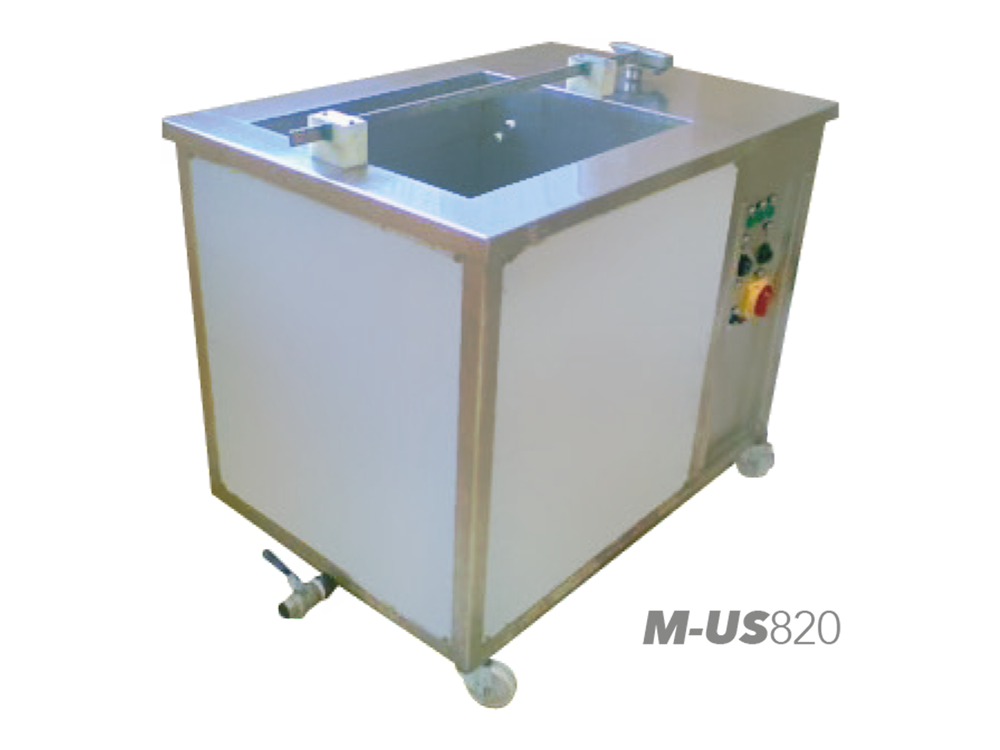
Ultrasonic cleaning uses high-frequency sound waves transmitted through a liquid medium to generate cavitation — the rapid formation and implosion of microscopic bubbles at the part surface. This cavitation energy dislodges contamination from the surface and from internal geometries, including slots, holes, and undercuts that are inaccessible to pressure washing jets.
For precision laser cut parts, complex geometries, or applications where coating adhesion requirements are stringent, ultrasonic cleaning provides more thorough contamination removal than pressure washing alone. The KAYAKOCVIB USW ultrasonic cleaner is designed for industrial use cases where surface cleanliness must meet downstream process specifications, including pre-treatment before coating or plating.
Ultrasonic cleaning is particularly effective for removing polishing compound residues, fine metallic particles, and oxide layers from stainless steel and aluminum laser cut parts. The choice of cleaning fluid and temperature will influence cleaning effectiveness significantly, and both must be validated for the specific material and contamination type.
Washing Process Variables That Control Cleaning Quality
Effective washing of laser cut parts after finishing depends on several interacting process variables. Understanding these variables allows the process engineer to optimize the cleaning stage for the specific part, material, and contamination condition.
| Variable | Effect on Cleaning Quality | Typical Consideration |
|---|---|---|
| Water temperature | Higher temperature improves chemical activity and contamination solubility | Commonly 40–70°C depending on chemistry and material |
| Cleaning agent concentration | Affects degreasing, oxide removal, and residue dissolution | Requires validation per compound and material type |
| Pressure (for pressure washing) | Higher pressure increases mechanical removal force | Must be controlled to avoid part deformation on thin sections |
| Ultrasonic frequency | Lower frequency increases cavitation energy; higher frequency is gentler | 25–40 kHz common for metal parts; higher for delicate surfaces |
| Exposure time | Longer exposure improves cleaning but reduces throughput | Must be balanced with production cycle requirements |
| Rinsing stage | Removes chemical residue after washing | Clean water rinse or demineralized water rinse depending on application |
For steel and stainless steel laser cut parts, alkaline cleaning agents with moderate to high pH are generally effective for removing compound residue and metallic fines. For aluminum parts, pH-neutral or mildly alkaline cleaning agents should be used to avoid chemical etching of the surface. The compound selection used during the preceding finishing stage also affects cleaning requirements — heavy oil-based compounds typically require stronger degreasing chemistry than water-based compounds.
Drying Methods and Engineering Considerations
After washing, laser cut parts must be dried efficiently and completely before any downstream process. Residual moisture on steel parts will cause flash rusting within minutes, particularly if the water used in washing is not demineralized or if no rust inhibitor is applied. Aluminum parts are less sensitive to flash rusting but may develop water spots or staining that affect the visual quality of the finished surface.
Industrial drying of laser cut metal parts is typically achieved through one of three methods: hot air drying, centrifugal drying, or drying within a vibratory dryer using dry corn cob or walnut shell media.
Hot Air Drying
Hot air drying uses heated airflow to evaporate moisture from the part surface. It is commonly integrated into washing machine lines as a final stage, where parts pass through a heated drying zone after the rinse stage. For flat or simple laser cut parts, hot air drying is efficient and suitable for high-volume production.
For parts with internal pockets, threaded holes, or overlapping features, hot air drying may not reach trapped water completely. In these cases, supplementary drying methods or extended drying time may be required.
Vibratory Drying
Vibratory drying uses dry organic media — typically dry corn cob granules — in a vibratory machine to absorb moisture from wet parts through contact and friction. The media carries moisture away from the part surface as the mass moves in the vibratory bowl. This method is particularly effective for complex parts with internal features, as the media can reach into slots and pockets where air drying is less effective.
Vibratory drying is also beneficial for parts that have received a rust inhibitor after washing, as the corn cob media distributes the inhibitor uniformly across the surface while drying. KAYAKOCVIB DVM series circular vibratory dryers are designed for this application, and can be integrated into a continuous finishing and washing line to minimize manual handling between stages.
Centrifugal Drying
Centrifugal drying uses high-speed rotation to fling surface water off parts by centrifugal force. It is fast and effective for small to medium parts without deep internal features. For parts with complex geometries, centrifugal drying alone may leave moisture trapped in cavities and should be combined with hot air drying or vibratory drying.
Material-Specific Considerations for Steel, Stainless Steel, and Aluminum
The material of the laser cut part determines the selection of cleaning chemistry, drying method, and post-wash protection strategy. These decisions cannot be standardized across all metals without risk of surface damage or inadequate cleanliness.
For carbon steel laser cut parts, flash rusting after washing is a primary process risk. The time between washing and drying must be minimized. A rust inhibitor should be applied during or immediately after the final rinse stage, and drying must be completed before the inhibitor film breaks down. Vibratory drying with corn cob media is particularly effective for steel parts when rust inhibitor distribution is also required.
For stainless steel laser cut parts, the primary concern after washing is ensuring that no chloride-containing water residue remains on the surface. Chloride contamination on stainless steel can initiate pitting corrosion, particularly for grades 304 and 316 in contact with aggressive environments. Demineralized or deionized water should be used for the final rinse stage on stainless steel parts where corrosion resistance is critical.
For aluminum laser cut parts, the cleaning chemistry must be selected carefully. Strongly alkaline cleaners will etch aluminum surfaces, which may be acceptable as a deliberate pre-treatment step but must not occur uncontrolled. Neutral or mildly alkaline cleaners with inhibitors suitable for aluminum are preferred. Drying can be performed with hot air or vibratory methods without significant risk of surface damage.
Integration of Washing and Drying into a Complete Finishing Line
In production environments processing laser cut parts at volume, washing and drying should be integrated into the finishing line rather than executed as separate manual steps. A typical automated finishing line for laser cut parts may follow this sequence:
- Parts loaded into a vibratory finishing machine for deburring and edge rounding using wet compound and appropriate media.
- Parts separated from media using a separator machine after the finishing cycle.
- Parts transferred to a pressure washing or ultrasonic cleaning machine for compound removal and surface cleaning.
- Parts rinsed with clean water, with optional rust inhibitor addition for steel parts.
- Parts transferred to a vibratory dryer or hot air dryer for complete moisture removal.
- Parts unloaded for inspection, coating, or further processing.
Automation between these stages reduces handling time, minimizes the risk of flash rusting on steel parts, and ensures consistent surface cleanliness across high production volumes. Conveyor systems, buffer hoppers, and timed process controllers can be used to synchronize the finishing, washing, and drying stages without manual intervention.
For facilities processing both steel and aluminum laser cut parts, it is important to use separate washing chemistry setups for each material group, or to use a chemistry validated as safe for mixed-metal batches. Mixing steel and aluminum parts in the same washing or finishing batch can cause galvanic contamination or cross-material staining.
Quality Control and Validation After Washing and Drying
Surface cleanliness after washing and drying laser cut parts should be validated before parts proceed to downstream processes. Validation methods depend on the application and required cleanliness level.
For general manufacturing applications, a visual inspection under good lighting conditions is the minimum acceptable check. The surface should be free of visible residue, staining, water spots, flash rust, and compound deposits. For parts destined for powder coating or liquid painting, a water-break test — where clean water is applied to the surface and its spreading behavior indicates the degree of surface cleanliness — provides a simple but effective indicator of contamination presence.
For precision applications, gravimetric cleanliness testing or particle count analysis may be required. These methods quantify the residual contamination level and allow the process engineer to validate that washing parameters are consistently achieving the required cleanliness specification. Actual cleanliness levels depend on part geometry, contamination load, washing machine type, water quality, cleaning agent selection, and drying method, and must be confirmed through process testing under production conditions.
Frequently Asked Questions
Why do laser cut parts need washing after vibratory finishing?
After vibratory or centrifugal finishing, laser cut parts carry residual finishing compound, abrasive media dust, and metallic fines. If these residues are not removed, they interfere with coating adhesion, cause corrosion initiation points, and contaminate downstream processes such as plating or assembly.
What is the difference between pressure washing and ultrasonic cleaning for laser cut parts?
Pressure washing uses directed hydraulic force to remove surface contamination and is effective for moderate contamination on accessible surfaces. Ultrasonic cleaning uses cavitation energy to reach into slots, holes, and complex features where pressure jets cannot penetrate. For parts with internal geometries or high cleanliness requirements, ultrasonic cleaning typically provides more thorough results.
How should steel laser cut parts be dried to prevent rust?
Steel laser cut parts should be dried immediately after washing to prevent flash rusting. A rust inhibitor applied during the final rinse stage provides additional protection. Vibratory drying with dry corn cob media is effective because it absorbs moisture from complex surface features while also distributing the rust inhibitor film uniformly across the part surface.
Can aluminum and steel laser cut parts be washed in the same batch?
Washing aluminum and steel parts together in the same batch carries a risk of cross-contamination through galvanic or chemical interaction, and cleaning chemistry optimized for one material may not be suitable for the other. In production, separating aluminum and steel parts into dedicated washing batches or using validated mixed-metal chemistry is strongly recommended.
Related Process Equipment
Related Video Demonstration
Conclusion
Washing and drying laser cut parts after surface finishing is an engineering-defined process stage with direct consequences for downstream coating performance, corrosion resistance, and part quality. The choice between pressure washing and ultrasonic cleaning depends on part geometry, contamination type, material, and required cleanliness level. Drying method selection must account for part geometry, material sensitivity to flash rust or water staining, and production throughput requirements. For steel parts, rust protection during the drying stage is a process requirement, not an optional step. Integrating washing and drying laser cut parts into a continuous automated finishing line reduces handling time, improves consistency, and supports repeatable surface quality across production volumes. All process parameters and cleanliness targets should be validated through sample testing under actual production conditions before full-scale release.
Sorry, the comment form is closed at this time.