


31 May Vibratory Finishing Zamak
Vibratory finishing zamak parts is widely used in die casting, automotive, and general manufacturing industries to remove burrs, smooth parting lines, and prepare surfaces for subsequent coating or plating operations. Zamak, a zinc-based alloy family with additions of aluminum, magnesium, and copper, is a common die casting material valued for its dimensional precision and castability, but die cast parts typically arrive from the mold with flash, parting line remnants, gate stubs, and minor surface irregularities that require finishing before final use. Vibratory finishing provides a controlled, repeatable, and scalable method for processing zamak components in industrial volumes.
Material Characteristics of Zamak Relevant to Finishing
Zamak alloys, commonly designated as Zamak 3, Zamak 5, and Zamak 7, have a relatively low hardness compared to aluminum alloys or steel. The Brinell hardness of typical Zamak 3 is in the range of 82 HB, which means the material responds quickly to abrasive finishing action. This low hardness allows shorter cycle times compared to ferrous materials, but it also creates a risk of over-finishing, surface waviness, or unwanted dimensional material removal if process parameters are not properly controlled.
The density of zinc alloys is higher than aluminum, which affects how parts move inside the vibratory machine bowl. Heavier parts settle differently in the media mass and may require careful media-to-part ratio selection to ensure uniform contact and avoid part-on-part collisions, which can cause denting or deformation, particularly on thin-walled or decorative surfaces.
How Vibratory Finishing Works on Die Cast Parts
In a circular vibratory finishing machine, an unbalanced motor generates controlled vibration that causes the entire mass of media and parts to circulate in a toroidal flow pattern inside the bowl. Parts move continuously through the media, which acts as a cutting or polishing tool depending on its grade and composition. The relative motion between media surfaces and part surfaces generates the abrasive action that removes flash, smooths edges, and improves surface condition.
For zamak die castings, the key mechanical interactions are edge rounding at parting lines and gate areas, flash removal where the flash is thin enough for vibratory action, and surface micro-smoothing on flat or convex surfaces. It is important to note that heavy gate stubs or thick casting flash exceeding approximately 0.5 mm may require manual trimming or press-cutting before vibratory finishing, as vibratory action alone is generally not efficient for removing heavy material.
The vibratory motion parameters, primarily vibration amplitude and frequency, determine the aggressiveness of the process. Higher amplitude settings accelerate material removal but increase the risk of part damage on delicate or thin-walled zamak castings. Amplitude and frequency settings should be established through sample testing for each specific part geometry.
Machine Selection for Zamak Components
Circular vibratory finishing machines are the standard platform for most zamak die casting applications. A circular machine such as the KAYAKOCVIB KVM series accommodates a wide range of part sizes and batch volumes, provides consistent media flow, and allows wet processing with compound injection. The circular bowl geometry promotes uniform part circulation when media-to-part ratio and loading weight are correctly set.
For very small zamak parts such as miniature hardware, decorative findings, or small automotive clips, the machine volume and media size must be matched carefully to prevent parts from becoming lodged in media gaps. For larger structural zamak die castings, the machine bowl volume and motor power must be sufficient to keep the full load in active circulation without dead zones forming at the bowl perimeter.
Trough-type vibratory machines may be preferred for elongated zamak parts, such as handles or brackets, where the part length exceeds what can be processed effectively in a circular bowl without risk of tangling or clustering. However, the majority of zamak die cast components, being compact and near-net-shape, are well-suited to circular vibratory finishing.
Media Selection for Zinc Alloy Parts
Media selection is one of the most important process variables in vibratory finishing zamak components. The wrong media type can cause excessive material removal, surface scratching, or inadequate finishing results. The following table summarizes the main media types relevant to zamak finishing and their typical applications.
| Media Type | Typical Use for Zamak | Abrasiveness | Notes |
|---|---|---|---|
| Plastic bonded abrasive | Deburring, edge rounding, light flash removal | Low to medium | Preferred for delicate or decorative parts |
| Ceramic bonded abrasive | Heavy deburring, rough surface smoothing | Medium to high | Risk of over-cutting on soft zamak if grade not matched |
| Porcelain or steel burnishing media | Brightening, pre-plating surface preparation | None to very low | Used after abrasive stage for surface refinement |
| Dry corn cob or walnut shell | Drying and light polishing after wet stages | Very low | Not suitable for deburring; used in final dry finishing |
For most industrial zamak deburring applications, plastic media in a fine to medium grade is the standard starting point. Ceramic media can be used for more aggressive deburring but the grade selection must be validated on sample parts to avoid excessive material removal on thin walls or sharp edges that must remain dimensionally controlled.
Media shape also influences accessibility. Star-shaped or cone-shaped media access complex internal geometry better than cylindrical shapes. Tetrahedron or angle-cut cylinder shapes are commonly used for general zamak die casting deburring. Media size must be selected to prevent lodging in holes, slots, or recesses present on the part.
Compound and Water Control
In wet vibratory finishing, a water-soluble compound is continuously dosed into the process at a controlled flow rate. For zamak, the compound serves multiple functions: it lubricates the media-part interface to control cutting rate, prevents re-deposition of removed material onto the part surface, inhibits corrosion on the zinc alloy surface during the wet process, and supports the surface condition required before plating or painting.
Zamak is sensitive to aggressive chemical attack. Highly alkaline or acidic compounds can cause surface etching, discoloration, or hydrogen embrittlement risk if the part will be subsequently electroplated. Compounds formulated for zinc alloy or general non-ferrous mass finishing should be used, with pH values maintained within a range that protects the base material. Compound concentration and flow rate should be set conservatively and adjusted based on visual inspection of part condition after trial runs.
Water hardness also affects compound performance. In areas with high mineral content water, compound consumption may increase and residue formation on parts can become a problem. Water treatment or filtered water supply may improve process consistency in such cases.
Process Parameters That Influence Surface Quality
The following variables have the most direct influence on surface finish quality when performing vibratory finishing on zamak die castings:
- Vibration amplitude and frequency setting on the machine
- Media type, shape, size, and abrasive grade
- Media-to-part volume ratio, typically 3:1 to 5:1 by volume for most zamak parts
- Compound type, concentration, and dosing rate
- Water flow rate and pH control
- Cycle time, which must be matched to the required material removal and surface condition
- Part loading weight and batch size per cycle
- Initial part condition, including flash thickness, gate stub height, and casting surface roughness
Cycle times for zamak deburring in vibratory finishing typically range from 20 to 90 minutes depending on the part geometry, initial surface condition, media selection, and target surface quality. These are indicative ranges. Actual cycle time must be determined through sample testing and process validation, as each application presents different conditions.
Drying After Wet Vibratory Finishing
After wet vibratory finishing, zamak parts must be dried promptly to prevent water staining, oxidation, or white corrosion on the zinc alloy surface. Water staining on zamak is particularly visible and can affect adhesion in subsequent plating or painting operations. Two common drying methods are used in industrial practice.
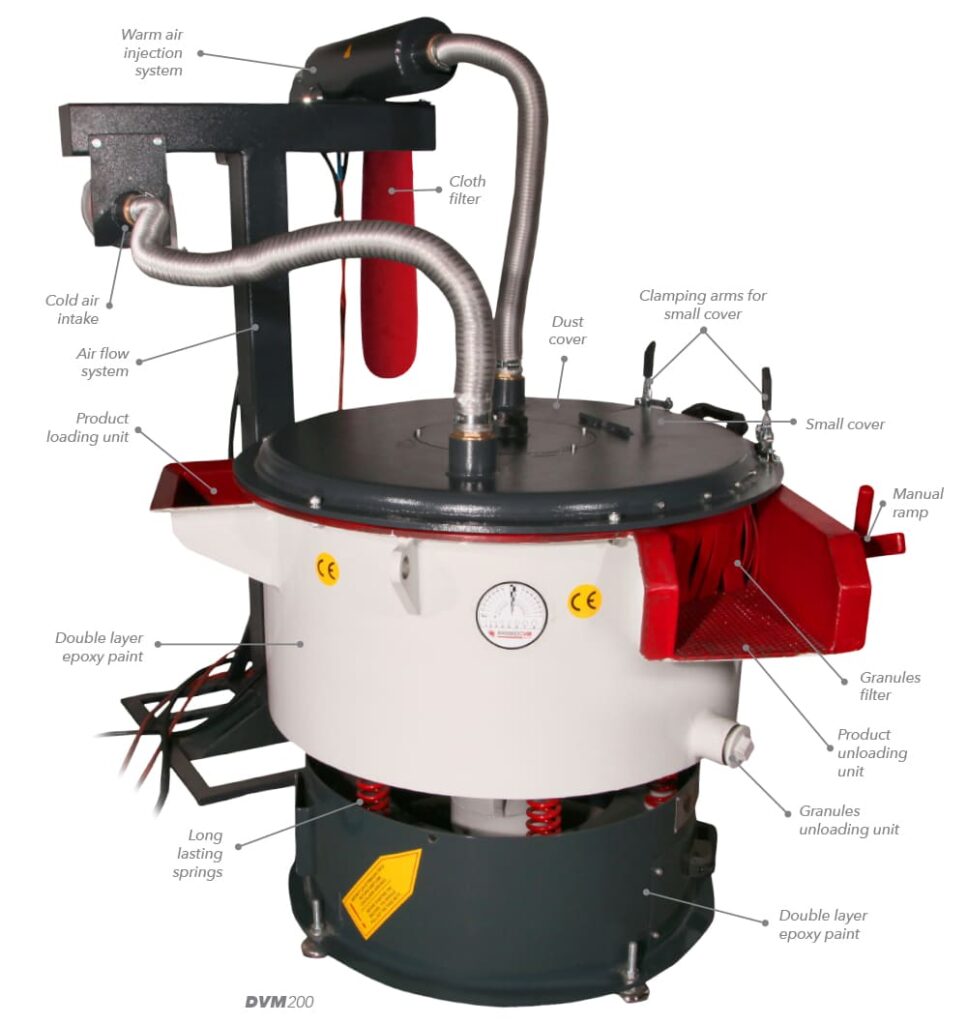
Thermal drying in a dedicated vibratory dryer using dry corn cob or walnut shell media with drying compound is the most common method for medium and high production volumes. The parts are transferred to a circular vibratory dryer such as the KAYAKOCVIB DVM series, where dry organic media absorbs residual water, and the gentle abrasive action of the organic material contributes to a light surface brightening effect. Drying time depends on part geometry and surface area, and typically ranges from 15 to 40 minutes.
Centrifugal or hot air drying systems are also used in automated finishing lines where drying must be integrated into a continuous production flow. For corrosion-sensitive zamak applications or parts destined for electroplating, drying must be completed before the surface condition degrades, and parts should move to the next operation without extended storage in a wet or damp state.
Surface Quality After Vibratory Finishing
The achievable surface condition after vibratory finishing zamak parts depends heavily on the initial casting quality, media selection, and process parameters. In typical industrial applications, vibratory finishing on zamak can produce surfaces suitable for electroplating, lacquer coating, powder coating, or decorative chromate finishing. The process removes or reduces parting line marks, flash remnants, and surface roughness from the casting skin.
For applications requiring bright decorative surfaces before plating, a two-stage process is commonly used: an abrasive deburring stage followed by a burnishing or brightening stage with porcelain media and a brightening compound. This produces a smoother, more reflective surface that improves electroplate adhesion and appearance.
It should be noted that vibratory finishing does not correct dimensional defects, deep shrinkage porosity exposed at the casting surface, or cold shut defects. Parts with these casting defects may still show surface anomalies after finishing. Visual inspection before and after finishing helps identify parts that require rework or rejection before coating operations.
Frequently Asked Questions
Can vibratory finishing remove all flash from zamak die castings?
Vibratory finishing effectively removes thin flash and parting line remnants from zamak castings. However, thick gate stubs or heavy flash sections typically require pre-trimming before vibratory processing. Attempting to remove heavy material stock purely through vibratory action results in impractically long cycle times and may cause part damage.
What is the correct media-to-part ratio for zamak finishing?
A volume ratio of approximately 3:1 to 5:1 media to parts is typical for zamak die cast components in circular vibratory machines. Lower ratios reduce buffering between parts and increase the risk of part-on-part contact, which can cause denting on soft zinc alloy surfaces. Exact ratios should be confirmed through process trials.
How should zamak parts be dried after wet vibratory finishing?
Prompt drying in a dedicated vibratory dryer with dry organic media and a drying compound is the recommended method. Zamak is susceptible to white rust and water staining, so drying should follow immediately after the wet finishing stage without extended waiting time. Thermal drying in corn cob or walnut shell media is the industrial standard for most zamak applications.
Is vibratory finishing suitable for decorative zamak parts before electroplating?
Yes. A two-stage vibratory process combining an abrasive deburring stage with a subsequent burnishing stage using porcelain media can prepare zamak surfaces to a condition suitable for decorative electroplating. Compound selection and process pH must be controlled to avoid surface etching or discoloration that would affect plating adhesion.
Conclusion
Vibratory finishing zamak die cast components is a well-established industrial process that addresses the primary surface challenges introduced by the die casting operation. Selecting the correct machine type, media grade and shape, compound chemistry, and process parameters requires understanding the material sensitivity of zinc alloys and the specific surface quality requirements of the downstream operation. For production environments processing zamak parts at medium to high volumes, circular vibratory finishing machines paired with dedicated drying equipment represent a practical and scalable solution. Process validation through sample testing remains the essential step before committing to production cycle parameters, as part geometry, initial casting condition, and target surface quality vary significantly across applications.
Sorry, the comment form is closed at this time.