



01 Jul Titanium Implant Surface Finishing
Titanium implant surface finishing is one of the most demanding applications in industrial mass finishing. Titanium alloys used in orthopedic, spinal, and dental implants require controlled surface conditions that go beyond typical deburring or polishing operations. Edge geometry, surface roughness, micro-crack absence, and contamination-free surfaces are all engineering requirements that directly influence implant performance, osseointegration behavior, and regulatory acceptance. This article explains the engineering principles, machine selection logic, process variables, and quality considerations relevant to finishing titanium implant components.
In This Article
Engineering Characteristics of Titanium in Surface Finishing
Titanium and its alloys, particularly Ti-6Al-4V ELI used in medical implants, present specific challenges during surface finishing. The material has a relatively low modulus of elasticity, low thermal conductivity, and a strong tendency to work-harden under aggressive mechanical contact. These properties make titanium sensitive to excessive heat generation, abrasive contamination, and surface smearing if incorrect media or process parameters are applied.
Unlike steel, titanium does not respond well to ceramic media at high process intensities without careful process design. Aggressive ceramic cutting can produce micro-scratches, torn edges, or embedded abrasive particles that are incompatible with medical surface quality requirements. Plastic media with controlled cutting grades, combined with appropriate process chemistry, is generally the preferred starting point for titanium implant finishing, though the final media selection must always be confirmed through sample testing.
The surface condition of titanium parts arriving from CNC machining typically includes machining marks, tool step transitions, minor burrs on edges, and roughness values in the range that preclude direct use in implant applications. The finishing process must reduce these defects without introducing new surface damage or dimensional deviation.
Process Route for Titanium Implant Components
Titanium implant surface finishing typically follows a multi-stage process route rather than a single operation. The exact sequence depends on the starting surface condition, part geometry, and required final surface specification. A representative process route for CNC-machined titanium implant parts includes the following stages.
- Pre-cleaning to remove cutting oils, chips, and machining residues before introducing parts into the finishing machine.
- Deburring and edge contouring using a controlled mass finishing or drag finishing operation to remove burrs and smooth edge transitions without aggressive material removal.
- Surface smoothing to reduce roughness from machining marks and tool paths, typically using finer plastic media or pre-polishing media.
- Polishing or micro-finishing to achieve the target surface roughness, which for many implant surfaces falls in a low Ra range requiring fine media and compatible polishing compounds.
- Post-process cleaning using ultrasonic cleaning or pressure washing to remove media fines, compound residues, and loose contamination before inspection.
Each stage requires its own process validation. The output surface condition of one stage directly defines the input condition for the next. Skipping or shortening a stage without process data typically results in quality failures downstream.
Machine Selection for Titanium Implant Finishing
Machine selection for titanium implant components is driven primarily by part geometry, required surface uniformity, dimensional sensitivity, and production volume. Three machine types are relevant for this application.
Circular vibratory finishing machines, such as the KAYAKOCVIB KVM series, can process small to medium titanium parts in batch mode. They are suitable for initial deburring or early smoothing stages where part geometry allows free movement through the media mass. However, for complex implant geometries with undercuts, internal surfaces, or tight radii, vibratory machines may not deliver uniform surface treatment across all part areas.
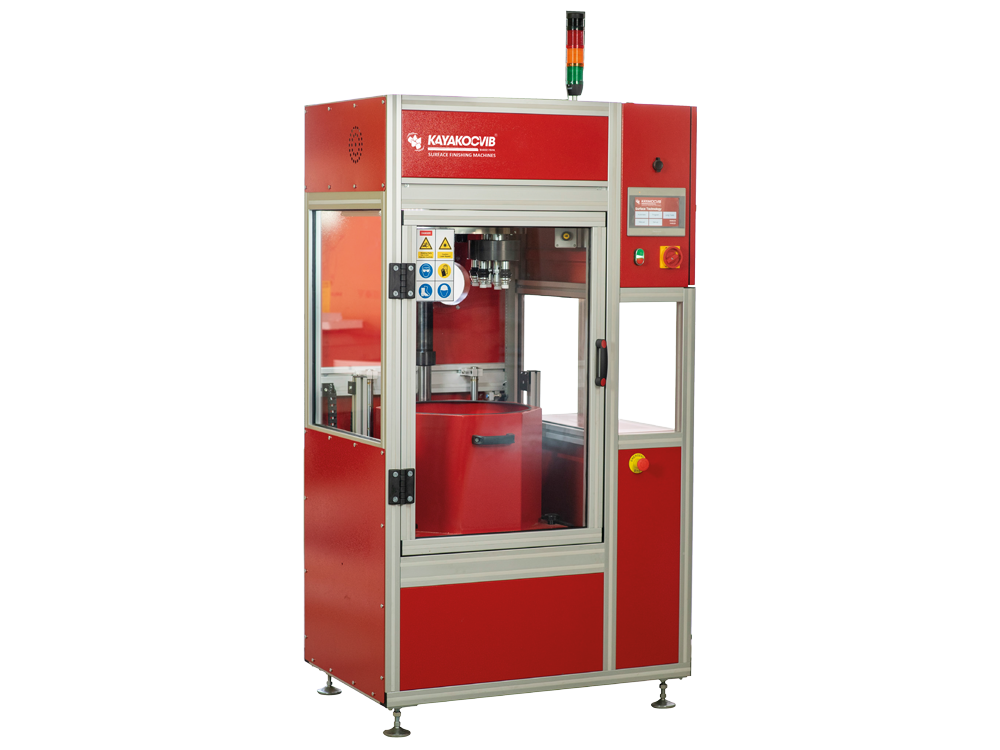
For high-precision titanium implants where surface uniformity across all functional surfaces is required, drag finishing machines offer a more controlled alternative. In drag finishing, individual parts are mounted on fixtures and dragged through a media mass in a controlled path. This method ensures that every surface area of the implant receives consistent media contact under defined force and velocity conditions. The DRG drag finishing machine platform, such as the KAYAKOCVIB DRG-XL or DRG Stream Finishing Machine, is designed for exactly this class of application. Drag finishing is particularly relevant when polishing results must be reproducible part to part, and when surface geometry complexity rules out bulk processing.
Centrifugal disc finishing machines, such as the KAYAKOCVIB KSM series, are also applicable for small implant components that can be processed in bulk without fixturing, provided part-on-part contact risk is assessed and managed through correct loading ratios and media selection.
Media and Compound Selection for Titanium
Media and compound selection for titanium implant finishing must account for the material’s sensitivity, the required material removal rate, and the absence of cross-contamination risk from media residues.
Plastic media is generally the preferred choice for titanium implant components. Plastic media offers controlled cutting action with reduced risk of aggressive surface damage. Media geometry should match the part’s surface features to ensure access to all functional areas without lodging in slots or bores. Media size selection must be validated to prevent lodging in implant holes or threads, which is a production risk that can result in contaminated parts reaching inspection or assembly.
Compound selection for titanium must consider both the process chemistry and its compatibility with medical-grade surface requirements. Neutral or mildly acidic compounds designed for light cutting and fine polishing are typically used. Heavy degreasing compounds used in steel finishing are generally not appropriate for titanium implants. Compound concentration, flow rate, and replenishment rate must be controlled to maintain consistent process chemistry throughout the cycle.
Dry polishing with ceramic burnishing media or dry corn cob media is sometimes used as a final step to achieve high-luster polishing on titanium implant surfaces where a bright surface finish is specified. This stage produces no liquid waste and does not introduce compound residue, which simplifies post-process cleaning.
Process Parameters That Control Surface Quality
In titanium implant surface finishing, the process outcome is directly controlled by a set of machine and media parameters. Understanding which parameters govern which aspect of surface quality allows process engineers to make targeted adjustments rather than trial-and-error changes.
| Process Parameter | What It Controls | Typical Adjustment Direction |
|---|---|---|
| Media cutting grade | Material removal rate and scratch depth | Finer grade for lower Ra targets |
| Media size and geometry | Surface access, lodging risk | Smaller media for complex geometry |
| Process intensity (drag speed or vibration amplitude) | Contact force and cutting energy | Lower intensity for delicate titanium parts |
| Cycle time per stage | Cumulative material removal and smoothing | Validated per stage based on incoming roughness |
| Compound concentration | Lubrication, cutting chemistry, fines removal | Adjusted to maintain stable process environment |
| Water flow rate (wet process) | Fines removal, temperature control | Continuous flow recommended for implant finishing |
| Part loading ratio | Part-on-part contact risk | Low loading ratio for delicate implants |
Actual surface roughness values achievable depend on starting condition, media selection, number of stages, and part geometry. Process capability must be confirmed through sample testing and surface measurement before production release. No finishing process guarantees a specific Ra value without application-specific validation.
Cross-Contamination and Material Compatibility Considerations
In medical implant finishing, cross-contamination between different part materials or media types is a serious quality risk. Titanium parts should not share finishing media that has been used for steel or iron parts. Iron particles embedded in a titanium surface can cause corrosion or biocompatibility issues that are not acceptable for implant applications.
Dedicated media batches for titanium, separate machine bowls or trough liners, and strict lot control procedures are standard practice in compliant medical finishing environments. Media replacement intervals must be defined based on media wear rate and contamination monitoring, not only on visual inspection.
After finishing, parts should be cleaned using ultrasonic cleaning systems with validated cleaning chemistry, followed by rinsing and controlled drying to prevent water marks or oxidation on polished titanium surfaces. Cleaning validation is a separate engineering activity that must confirm residue levels meet the implant manufacturer’s specifications.
Automation and Production Integration
For high-volume titanium implant production, automation of the finishing line reduces operator dependency and improves process repeatability. Automated drag finishing systems can include CNC-controlled spindle paths, programmable drag speed profiles, and automated part loading and unloading. These features make it possible to run defined finishing programs for each implant part number and to record process parameters for traceability purposes.
Integration of post-finishing washing, ultrasonic cleaning, and controlled drying into a single line eliminates manual transfer steps that introduce contamination risk. For facilities operating under quality management systems relevant to medical device manufacturing, automation of parameter logging and recipe management supports process documentation requirements.
Separator machines can be integrated between process stages to remove used media fines and prepare clean media for the next stage. Wastewater from wet finishing stages must be managed through a treatment system before discharge, which is a facility planning consideration that should be included in line design from the outset.
Quality Control Points After Finishing
Surface quality validation after titanium implant surface finishing typically includes the following inspection and measurement activities.
- Surface roughness measurement using contact profilometry or optical methods to verify Ra and Rz values against specification.
- Visual inspection under defined lighting conditions to detect scratches, pitting, smearing, or media lodging evidence.
- Dimensional inspection to confirm that material removal during finishing has not exceeded dimensional tolerance bands, particularly on functional contact surfaces.
- Cleanliness testing to verify absence of particle contamination, compound residue, or media debris at the specified cleanliness level.
- Periodic metallographic cross-section review in process development or validation phases to confirm absence of embedded abrasives or surface micro-damage.
These inspection points should be defined in the process validation plan before production release. Inspection frequency and sampling plans depend on the risk level of the specific implant component and the stability of the finishing process.
Frequently Asked Questions
What type of machine is most suitable for polishing titanium implants?
Drag finishing machines are generally preferred for complex titanium implant geometries where uniform surface treatment across all surfaces is required. For simpler part shapes in higher volumes, centrifugal disc or vibratory finishing machines may be used for preliminary stages.
Can ceramic media be used for titanium implant finishing?
Ceramic media is not typically recommended as the primary media for titanium implant finishing due to the risk of aggressive surface cutting and potential abrasive embedding. Plastic media with controlled cutting grades is generally the preferred starting point, confirmed through process sample testing.
How many finishing stages are typically required for a CNC-machined titanium implant?
Most CNC-machined titanium implants require a minimum of two to four finishing stages, moving from deburring through progressive smoothing to fine polishing. The exact number of stages depends on the starting roughness, target specification, and part geometry complexity.
What cleaning process is recommended after wet finishing of titanium implants?
Ultrasonic cleaning using validated cleaning chemistry is commonly used after wet finishing of titanium implants to remove compound residues, media fines, and loose contamination. Post-cleaning rinsing and controlled drying are required to prevent surface oxidation or water marks on polished surfaces.
Related Process Equipment
Related Video Demonstration
Conclusion
Titanium implant surface finishing is a multi-stage engineering process that requires careful selection of machine type, media, process chemistry, and operating parameters. The demanding surface quality requirements of implant components make it unsuitable to treat this as a standard mass finishing application. Drag finishing machines provide the highest level of surface control for complex implant geometries, while centrifugal disc and vibratory machines may contribute usefully in earlier process stages. Media and compound compatibility with titanium must be validated specifically, and cross-contamination controls must be maintained throughout production. Process capability for any implant finishing route must be confirmed through systematic sample testing and surface measurement before production release, since actual results depend on part geometry, starting condition, machine configuration, and the specific media and compound combination used.
Sorry, the comment form is closed at this time.