


22 Jun Surface Finishing Wastewater Treatment
Surface finishing wastewater treatment is the process of separating suspended solids, emulsified oils, finishing compounds, and heavy metal residues from the process water generated during vibratory deburring, polishing, and mass finishing operations. Without a structured treatment approach, this contaminated water cannot be discharged to drain systems legally, and continuous fresh water consumption increases operating costs significantly. Understanding how the treatment sequence works helps production engineers and plant managers select the right equipment configuration and manage water responsibly across a finishing line.
In This Article
Where Wastewater Originates in a Finishing Line
Every wet mass finishing process generates a continuous or batch flow of contaminated water. During vibratory or centrifugal disc finishing, water carries finishing compound, media fines, metal particles, machining oils, and surface scale away from the parts. This effluent is collected at the base of the machine and flows either directly to a drain or into a treatment system.
In a typical production line, wastewater sources include the finishing machine discharge, the part separation stage, and any downstream washing step. If parts are rinsed after finishing to remove compound residue or abrasive dust, that rinse water adds to the total effluent volume. For high-volume operations finishing steel, stainless steel, or aluminum parts, the combined effluent can carry a significant load of suspended solids, dissolved compounds, and free or emulsified oils.
The Core Treatment Sequence
Surface finishing wastewater treatment typically follows a multi-stage sequence designed to progressively reduce contamination from coarse solids down to fine dissolved substances. The exact configuration depends on part material, compound type, and whether the goal is clean discharge or closed-loop water reuse.
- Coarse Solids Screening: The first stage removes large particles such as media fines, metal chips, and abrasive fragments using a screen or filter basket. This protects downstream equipment and reduces the load entering the treatment tank.
- Sedimentation: Wastewater flows into a sedimentation tank where gravity separates heavier suspended solids from the liquid phase. A correctly sized tank provides sufficient residence time for particles to settle as sludge at the base. The KAYAKOCVIB SDM-T sedimentation tank is designed for this stage, offering structured settling zones to improve separation efficiency.
- Flocculation or Chemical Treatment: Fine particles that remain in suspension after sedimentation are too small to settle by gravity alone. A flocculant agent is dosed into the water to agglomerate fine particles into larger clusters that can settle or be filtered. The flocculant type and dosing rate must be matched to the specific compound chemistry and metal content in the effluent.
- Oil Separation: Free and emulsified oils require dedicated separation. Free oils can be skimmed from the surface of a settling zone. Emulsified oils, which are chemically bonded with water through compound surfactants, require chemical breaking before separation. pH adjustment is often used to destabilize oil emulsions and allow phase separation.
- Fine Filtration: After sedimentation and flocculation, a filtration stage removes residual fine solids from the clarified water. Filter bags, filter presses, or cartridge filters are used depending on the required effluent quality and the volume of sludge produced.
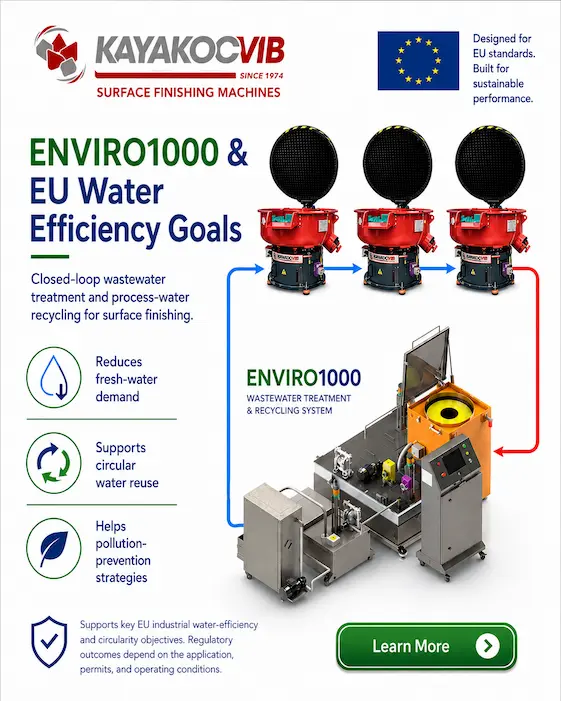
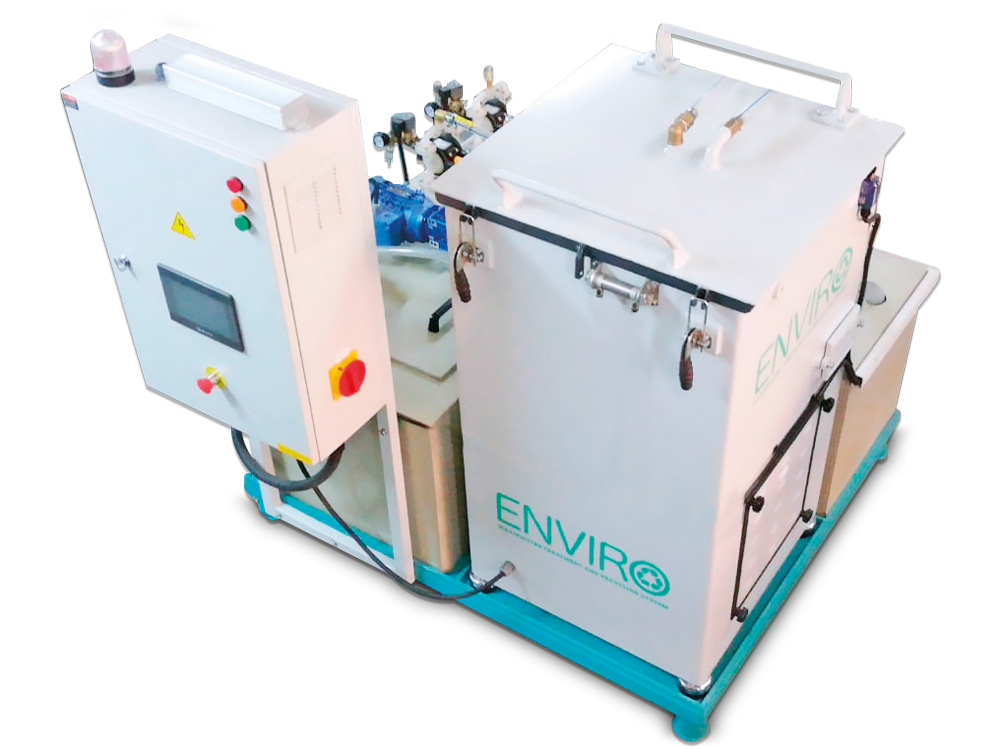
- Treated Water Collection and Reuse: Clarified water is collected in a clean water tank. In a closed-loop configuration, this water is returned to the finishing machine as process water, reducing fresh water consumption significantly. The KAYAKOCVIB ENVIRO1000 and FLOG wastewater treatment systems are designed to support closed-loop water recycling in industrial finishing environments.
- Sludge Handling: Settled and filtered solids accumulate as sludge. This sludge must be dewatered and disposed of in accordance with local waste regulations. For operations finishing steel or mixed metals, the sludge may be classified as industrial waste and requires documentation for disposal.
Machine Selection and System Configuration
The right treatment system configuration depends on production volume, compound chemistry, part material, and the regulatory discharge standard that applies to the facility. A small job shop running one vibratory machine intermittently has different treatment requirements than a high-volume automotive finishing line running multiple machines continuously.
For intermittent or lower-volume operations, a sedimentation tank combined with batch chemical treatment and filter bags is often sufficient. For continuous high-volume production, an integrated system combining sedimentation, automatic flocculant dosing, oil separation, and fine filtration is more appropriate. The KAYAKOCVIB FLOG system is designed for compact installations where space is limited but continuous water recycling is still required.
When finishing aluminum parts, the effluent chemistry differs from steel finishing. Aluminum finishing compounds are typically alkaline and may contain aluminum hydroxide precipitates. Steel finishing generates iron-rich sludge and may contain cutting oil residues. These differences affect flocculant selection, pH adjustment requirements, and sludge disposal classification.
Process Parameters That Affect Treatment Performance
Treatment performance depends on several controllable process variables. Understanding these parameters allows engineers to optimize the system and maintain consistent effluent quality over time.
| Parameter | Effect on Treatment | Typical Control Method |
|---|---|---|
| pH Level | Affects flocculation efficiency and oil emulsion stability | Acid or alkali dosing with pH probe feedback |
| Flocculant Dosage | Controls particle agglomeration rate and sludge volume | Metering pump with jar test calibration |
| Residence Time in Sedimentation Tank | Determines how much settling occurs before overflow | Tank sizing relative to flow rate |
| Temperature | Affects oil viscosity and settling behaviour | Passive in most installations |
| Suspended Solids Load | Determines filter change frequency and sludge volume | Coarse screening upstream of treatment tank |
pH control is particularly important when finishing mixed metal batches or when compound chemistry changes between production shifts. A pH that is too high or too low can reduce flocculant performance and allow fine solids to pass through to the clean water tank, reducing the effectiveness of closed-loop reuse.
Closed-Loop Water Reuse in Industrial Finishing
Closed-loop water reuse is one of the primary operational benefits of a structured surface finishing wastewater treatment system. In a closed-loop configuration, treated water is continuously returned to the finishing machine rather than discharged to drain. Fresh water is only added to compensate for evaporation and drag-out losses.
In many industrial applications, a properly operated closed-loop system can reduce fresh water consumption substantially compared to an open-drain operation. However, actual water savings depend on the treatment system efficiency, the volume of sludge produced, and the drag-out rate from the finishing machine and separation stage. These figures require validation under actual production conditions.
One operational consideration in closed-loop systems is the gradual accumulation of dissolved salts and compound residues in the recirculated water. Over time, if the water is not partially refreshed or the chemistry is not managed, finishing performance may degrade. Monitoring compound concentration, pH, and conductivity in the process water helps maintain consistent finishing results when operating in closed-loop mode.
Regulatory and Environmental Considerations
Industrial wastewater from surface finishing operations typically contains suspended solids, heavy metals, oils, and surface-active compounds that exceed the direct discharge limits set by local environmental regulations. In most jurisdictions, untreated finishing effluent cannot be discharged directly to municipal sewer systems or surface water without prior treatment and compliance documentation.
The specific discharge limits vary by country and region, but common parameters that are regulated include suspended solids concentration, chemical oxygen demand, heavy metal content such as iron, zinc, nickel, or chromium depending on part material, oil and grease content, and pH range. A treatment system must be designed to consistently meet these parameters under varying production loads.
For facilities pursuing environmental certification or sustainability reporting, a closed-loop surface finishing wastewater treatment system also provides measurable data on water consumption reduction and chemical usage, which can support environmental management system documentation.
Frequently Asked Questions
What contaminants are typically found in surface finishing wastewater?
Finishing effluent typically contains suspended abrasive particles, media fines, metal swarf, machining oils, emulsified cutting fluids, finishing compound residues, and dissolved metal ions. The exact composition depends on the part material, media type, and compound chemistry used in the process.
Can all finishing operations use closed-loop water reuse?
Most wet vibratory and centrifugal disc finishing operations can be configured for closed-loop reuse if the treatment system is correctly sized and maintained. Operations with very high oil contamination or heavy metal loads may require additional treatment stages before the water quality is suitable for reuse without affecting finishing results.
How is sludge from a finishing wastewater treatment system managed?
Sludge collected from sedimentation tanks and filter presses must be dewatered and disposed of according to local industrial waste regulations. For operations finishing steel, stainless steel, or mixed metals, the sludge is typically classified as industrial waste and must be handled by a licensed waste contractor. Aluminum sludge disposal requirements may differ depending on compound content.
What is the role of flocculants in finishing wastewater treatment?
Flocculants cause fine suspended particles that cannot settle by gravity alone to agglomerate into larger clusters. These clusters settle faster and are more easily captured by filters. The correct flocculant type and dosing rate must be determined through laboratory jar testing with a sample of the actual finishing effluent, as generic dosing rates may not be effective for all compound and metal combinations.
Related Process Equipment
Conclusion
Surface finishing wastewater treatment is not a single machine or a single chemical step. It is a structured sequence of physical separation, chemical treatment, filtration, and water management stages that must be matched to the specific effluent characteristics of each finishing operation. For manufacturers finishing steel, aluminum, stainless steel, or mixed metal parts in high production volumes, a properly configured treatment system reduces water consumption, supports regulatory compliance, and stabilises finishing process chemistry. Systems such as the KAYAKOCVIB ENVIRO1000, FLOG, and SDM-T sedimentation tank provide engineered solutions for each stage of this treatment sequence, but the actual configuration, chemical programme, and operating parameters must be validated for each specific production environment before full-scale implementation.
Sorry, the comment form is closed at this time.