


31 May Stainless Steel Laser Cut Deburring
Stainless steel laser cut deburring is a systematic process used to remove sharp edges, micro-burrs, and oxide discoloration from laser-cut stainless steel components before they proceed to assembly, coating, or end use. Laser cutting produces clean profile cuts but typically leaves a heat-affected zone, a sharp top edge, a partially melted bottom edge, and in many cases a hardened oxide layer that must be removed to meet functional and safety requirements. Without a controlled deburring step, these conditions create risks in downstream handling, coating adhesion, and component performance.
Why Sharp Edges on Laser Cut Stainless Steel Require Controlled Finishing
Laser-cut stainless steel parts present a specific set of surface conditions that differ from stamped or machined parts. The focused thermal energy of the laser creates a narrow heat-affected zone along each cut edge. This zone typically exhibits slight hardness increase, oxide scale, and in some cases microscopic micro-cracks or resolidified material deposits. The top edge of the cut often carries a true sharp burr, while the bottom edge may retain dross or slag depending on the gas type, laser power, and cutting speed used.
Sharp edges on stainless steel are not only a handling hazard for operators but also a functional problem. In many applications, sharp edges reduce fatigue resistance, create stress concentration points, and interfere with coating adhesion. For parts that will be electropolished, powder coated, or used in fluid-handling systems, edge condition is a process-critical dimension. Deburring and edge rounding are therefore not optional finishing steps but are engineering requirements defined by the application.
How Vibratory Finishing Removes Burrs and Rounds Edges
Vibratory finishing is the most widely used mass finishing method for stainless steel laser cut deburring at industrial scale. In a vibratory machine, abrasive ceramic or plastic media tumbles continuously against the parts in a wet or dry environment. The relative motion between media and part surfaces creates controlled micro-cutting and micro-abrasion across all exposed surfaces and edges simultaneously.
The working principle relies on the machine tub vibrating at a controlled frequency and amplitude, which generates a helical flow pattern. Parts and media circulate together through this flow path, with each media contact removing a small amount of material from burrs, sharp edges, and surface high points. The process is isotropic, meaning it acts on all surfaces and edges in contact with media regardless of part orientation. This characteristic makes it well suited for complex laser-cut profiles with internal cutouts, slots, and irregular contours.
Wet finishing with a chemical compound dissolved in water is standard practice for stainless steel. The compound serves multiple functions: it prevents rust staining or contamination from ferrous media particles, controls foam, keeps abrasive fines in suspension, and can provide light passivation or brightening effects depending on formulation. Water flow rate and compound concentration must be controlled throughout the cycle to maintain consistent results.
Machine Selection for Laser Cut Sheet Metal Parts
The two primary machine types used for stainless steel laser cut deburring in production environments are circular vibratory finishing machines and trough vibratory finishing machines. Selecting the correct machine type depends primarily on part size, geometry, and batch size.
Circular vibratory machines such as the KAYAKOCVIB KVM series are well suited for small to medium laser-cut parts, including brackets, plates, cover panels, flanges, and profiled sheet metal components. The circular tub generates uniform flow across the entire media bed, which produces consistent edge treatment on all parts in the batch. These machines are available in a range of bowl sizes and are compatible with automated media and part separation through integrated or attached separator units.
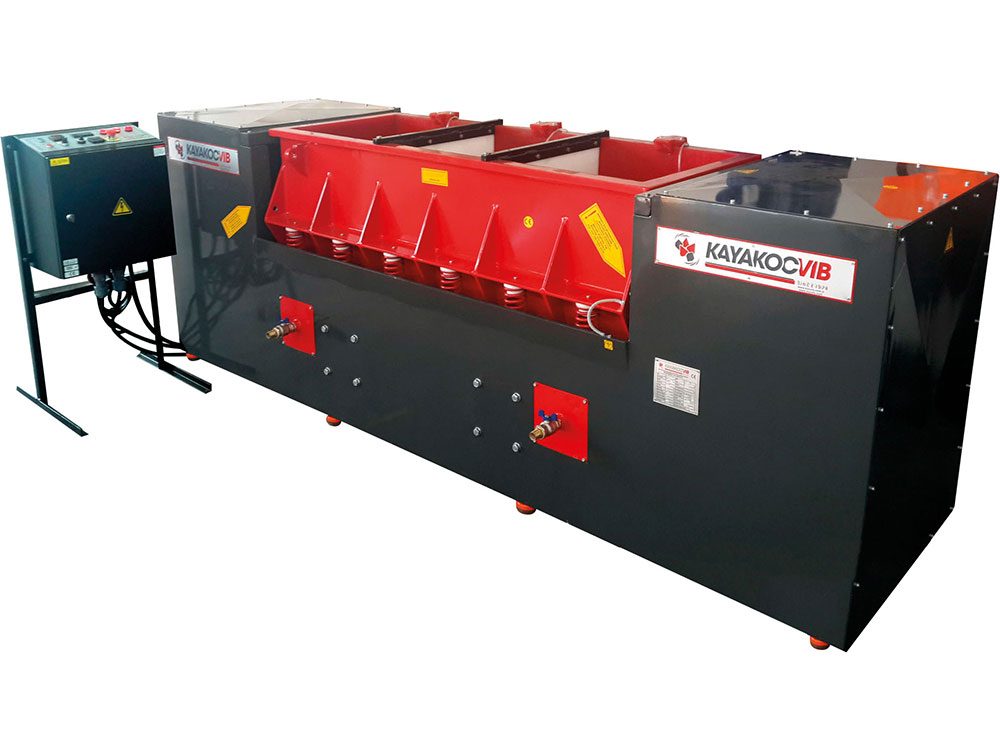
For longer laser-cut profiles, structural members, or parts that exceed the effective diameter of a circular bowl, trough-type vibratory machines such as the KAYAKOCVIB TVM series are more appropriate. The elongated trough geometry allows long parts to process without excessive contact with machine walls and reduces the risk of part-on-part damage during the cycle. Trough machines also facilitate linear part flow in automated production lines.
| Part Condition | Preferred Machine Type | Typical Application |
|---|---|---|
| Small to medium laser-cut plates and brackets | KVM Circular Vibratory | Sheet metal components, flanges, cover panels |
| Long profiles or structural laser-cut sections | TVM Trough Vibratory | Long brackets, frames, elongated sheet parts |
| Parts with heavy dross or slag requiring pre-cleaning | Either, with adjusted media and compound | High-power laser cuts with bottom-edge dross |
| Mixed batch with varied geometries | KVM Circular Vibratory | General contract finishing, varied stainless parts |
Media and Compound Selection
Media selection is one of the most important variables in any stainless steel laser cut deburring process. The wrong media type or size can result in incomplete edge rounding, surface scratching, media lodging in holes or slots, or extended cycle times.
For general edge rounding and burr removal on stainless steel laser-cut parts, medium-grade ceramic cutting media is the standard starting point. Ceramic media contains abrasive grain bonded in a ceramic matrix and provides effective micro-cutting action on stainless steel surfaces. Media shape should be selected based on part geometry: triangular or cylindrical shapes are suitable for flat plates with through-holes, while angular or star-shaped media may reach internal profiles more effectively in some cases.
Media size must be larger than the smallest hole or slot on the part to prevent lodging. This is a practical constraint that directly influences media selection. If a laser-cut part contains holes smaller than 4 mm, media selection must account for this to avoid the need for manual removal of lodged media after processing.
Plastic media or fine-grade ceramic media may be used in a second stage when a smoother surface finish is required after initial deburring. This two-stage approach is common for stainless steel parts that will be visually inspected or used in sanitary applications where surface texture must meet specific requirements.
Compound selection for stainless steel should typically be a non-ferrous or stainless-compatible formulation. Compounds designed for steel or cast iron may leave iron deposits on stainless surfaces, which cause rust staining during or after processing. Stainless-specific compounds maintain a clean processing environment, support surface brightness, and in some formulations provide mild passivation effects. Compound dosing rate and water flow must be validated during process development.
Step-by-Step Process for Stainless Steel Laser Cut Deburring
- Inspect incoming laser-cut parts for dross, slag, and edge condition to confirm they are suitable for vibratory processing. Heavy dross deposits may require pre-cleaning or mechanical dross removal before finishing.
- Load the vibratory machine with the correct media type, shape, and size for the part geometry. Confirm that media dimensions prevent lodging in all part holes and slots.
- Set the machine amplitude and frequency based on the required process intensity. Higher amplitude increases aggressiveness and is suitable for heavier burrs and edge rounding. Lower amplitude is used for lighter finishing and surface refinement.
- Add water and compound at the correct concentration. Establish a continuous water drip flow to flush abrasive fines and maintain compound concentration during the cycle.
- Run the deburring cycle. Typical cycle times for edge rounding on stainless steel laser-cut parts range from 20 to 90 minutes depending on burr condition, edge rounding requirement, media type, and machine intensity. Actual results depend on application conditions and require sample testing and process validation.
- After the cycle, separate parts from media using a separator machine or a built-in separation screen. Ensure all parts are fully discharged and no media remains lodged in part features.
- Rinse parts with clean water to remove compound residue and abrasive fines. If required, dry parts in a vibratory dryer or centrifuge to prevent water staining on stainless surfaces.
- Inspect finished parts for edge condition, surface texture, and any signs of part damage or media marks. Verify that the edge rounding meets the application requirement before releasing parts.
Process Parameters That Control Edge Rounding Results
Several process variables directly influence the outcome of stainless steel laser cut deburring. Understanding these variables allows production engineers to adjust the process for different part geometries, edge conditions, and surface requirements.
Machine amplitude controls the contact force between media and parts. Higher amplitude increases the cutting rate and is suitable for heavier burrs or more aggressive edge rounding targets. Lower amplitude reduces contact force and is used when fine surface finish or light deburring is required. Amplitude is typically adjustable on vibratory machines through eccentric weight settings.
Process time controls the total amount of material removal. Longer cycles produce greater edge rounding and surface refinement but also remove more base material from flat surfaces. For sheet metal parts, surface flatness and dimensional tolerance must be considered when setting cycle time.
Media-to-part ratio influences the frequency of media-part contact and the uniformity of finishing. A typical media-to-part ratio range is approximately 3:1 to 5:1 by volume, though this depends on part geometry and machine size. Under-loading the machine with too many parts relative to media volume reduces finishing uniformity and can cause part-on-part contact damage.
Water flow rate and compound concentration affect both cutting rate and surface condition. Insufficient compound concentration leads to increased surface roughness and potential corrosion risk during processing. Excessive compound concentration can reduce abrasive action by cushioning media contact. Compound dosing should be calibrated and monitored during production runs.
Common Surface and Edge Defects After Laser Cutting
Before designing a deburring process, engineers should understand the specific defect types present on incoming laser-cut stainless steel parts. The most common conditions are sharp top-edge burrs, bottom-edge dross or slag, oxide scale in the heat-affected zone, and surface roughness in the cut face itself.
Vibratory finishing effectively addresses sharp edges, light burrs, and surface oxide removal in most applications. Heavy dross or slag deposits on the bottom cut face may not be fully removable by vibratory finishing alone and may require pre-treatment or complementary mechanical processing. Similarly, cut-face surface roughness, which is an inherent characteristic of laser cutting, is only partially reduced by vibratory finishing and will remain dependent on the laser cutting parameters used upstream.
Engineers should evaluate the incoming part condition against the required output specification before selecting the deburring process and equipment. Vibratory finishing is not appropriate as the only process step if the incoming parts require heavy material removal or structural dross elimination.
Automation and Production Line Integration
For high-volume laser cutting operations, manual loading and unloading of vibratory finishing machines introduces labor cost, cycle time variability, and handling risk. Automated finishing lines can be configured with conveyor loading systems, automatic part-media separation, rinsing stations, and vibratory or centrifugal drying units to create a continuous processing flow.
In automated configurations, parts discharged from the laser cutter can be transferred directly to the finishing line with minimal operator handling. Separator machines discharge finished parts onto conveyors, rinsing systems clean parts in sequence, and dryers complete the process before parts reach the next production step. PLC-controlled recipe management allows different part types to run on preset programs, reducing setup time and improving process repeatability.
Wastewater generated during wet vibratory finishing contains abrasive fines, metal particles, and compound residue. In production environments with significant water consumption, closed-loop wastewater treatment and recycling systems reduce water consumption, manage chemical discharge, and support environmental compliance requirements. This is a practical consideration for high-volume stainless steel laser cut deburring operations.
Frequently Asked Questions
Can vibratory finishing remove all dross from laser-cut stainless steel?
Vibratory finishing removes light dross, sharp edges, and oxide scale effectively. Heavy dross deposits formed at the bottom of the cut during low-quality or high-power laser cutting may not be fully removable by vibratory media alone and may require mechanical pre-treatment or manual cleaning before vibratory processing.
What media type is recommended for stainless steel laser-cut parts?
Medium-grade ceramic cutting media in cylindrical or triangular shapes is the standard starting point for stainless steel laser cut deburring. Media size must be selected to prevent lodging in part holes and slots. A second-stage plastic or fine ceramic media may be used if smoother surface texture is required after initial deburring.
How long does a typical vibratory deburring cycle take for laser-cut stainless parts?
Cycle times typically range from 20 to 90 minutes depending on burr severity, edge rounding target, media type, machine amplitude, and part geometry. Actual cycle times must be determined through sample testing and process validation for each specific application.
Is a separate washing step necessary after vibratory finishing of stainless steel?
Rinsing after vibratory finishing is recommended for stainless steel parts to remove compound residue and abrasive fines. If parts will proceed to electropolishing, passivation, or coating, a dedicated washing step using pressurized or ultrasonic cleaning may be required to ensure surface cleanliness meets downstream process requirements.
Conclusion
Stainless steel laser cut deburring is an engineering process that requires careful selection of machine type, media, compound, and process parameters based on the specific part geometry, burr condition, and output surface quality requirement. Vibratory finishing is the most practical and scalable method for removing sharp edges and oxide deposits from laser-cut stainless steel parts in production volumes, but the process must be designed and validated for each application. Machine selection between circular and trough configurations should be driven by part size and geometry. Media selection must prevent lodging while delivering the required cutting action. Cycle time, amplitude, and compound concentration must be tuned through sample testing rather than assumed from generic process data. For high-volume operations, automated line integration with separation, rinsing, drying, and wastewater treatment adds process control, reduces labor dependency, and improves consistency across production runs.
Sorry, the comment form is closed at this time.