


01 Aug ENVIRO1000 Wastewater Treatment
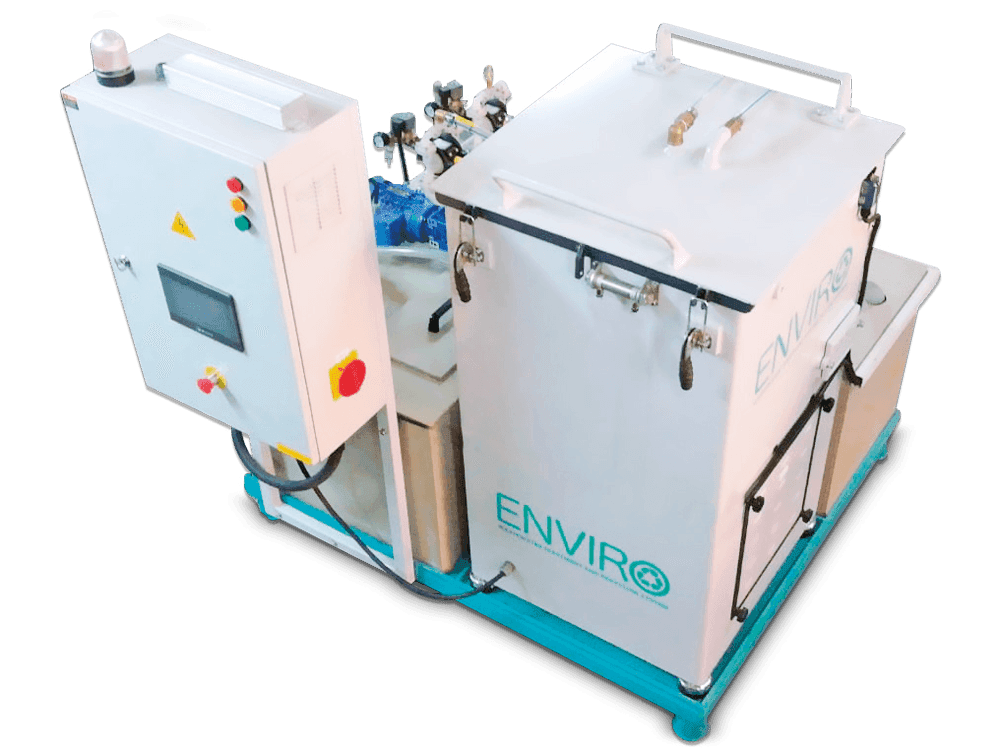
ENVIRO1000 wastewater treatment is the controlled mechanical and chemical process of separating finishing residues from process water generated during vibratory, centrifugal disc, or mass finishing operations. In industrial surface finishing, process water carries a complex mixture of metallic fines, abrasive particles, spent compound, emulsified oils, and suspended solids. Without an effective treatment stage, this mixture cannot be safely discharged, reused, or disposed of in compliance with industrial effluent regulations. The ENVIRO1000 system, developed by KAYAKOCVIB, addresses this requirement through centrifugal separation combined with chemical conditioning and solids collection.
In This Article
What ENVIRO1000 Wastewater Treatment Handles
Surface finishing operations using wet vibratory finishing, centrifugal disc machines, or drag finishing systems produce continuous effluent. This effluent contains a combination of inorganic abrasive fines from ceramic or plastic media wear, metallic particles removed from workpieces, emulsified cutting and polishing compounds, free and emulsified oils from machined parts, and suspended colloidal particles that are too fine for simple settling.
Standard gravity settlement alone is insufficient for this type of effluent. Fine metallic and abrasive particles remain suspended for extended periods, compound emulsifies oils into stable droplets, and dissolved chemicals require pH adjustment before safe handling. The ENVIRO1000 system is designed to resolve all of these conditions within a compact industrial unit that can operate continuously alongside a finishing line.
Centrifugal Separation Principle
The core separation mechanism in the ENVIRO1000 is centrifugal force. Process water from finishing machines is fed into a rotating bowl or drum assembly. The centrifugal acceleration applied to the liquid is significantly higher than gravity, typically in the range of several hundred times gravitational force depending on the system configuration. This acceleration forces denser solids to the bowl wall at a rate far greater than what gravity settlement could achieve in the same volume and time.
Separated solids accumulate as a compacted cake on the bowl wall and are periodically discharged either automatically or manually depending on the system design. The clarified water exits through an overflow weir or central outlet and is collected for reuse or further treatment. Centrifugal separation is particularly effective for fine metallic particles and dense abrasive fines that resist conventional sedimentation.
Chemical Conditioning and Flocculation Stage
Centrifugal force alone is not sufficient to capture very fine colloidal particles or to break emulsified oil droplets. The ENVIRO1000 system incorporates a chemical conditioning stage upstream of the centrifuge bowl. In this stage, a flocculant or coagulant is dosed into the incoming effluent under controlled conditions. The chemical agent neutralizes the surface charge on colloidal particles, causing them to aggregate into larger flocs that are heavy enough to be captured by centrifugal force.
For oil removal, a demulsifying agent is used to destabilize emulsified oil droplets, allowing them to coalesce and separate from the water phase. The pH of the effluent is also adjusted in this stage to a range suitable for treatment. Typical finishing effluents have alkaline pH values due to compound chemistry, and pH correction is part of the conditioning protocol before centrifugal processing.
The choice of flocculant, coagulant dosage, and pH target depends on the specific finishing process, the metals being processed, and the compounds in use. For operations finishing aluminum, the effluent chemistry differs from operations finishing steel or stainless steel, and the conditioning program should be adjusted accordingly. Process validation through jar testing or pilot trials is recommended before commissioning a continuous treatment program.
Closed-Loop Water Reuse
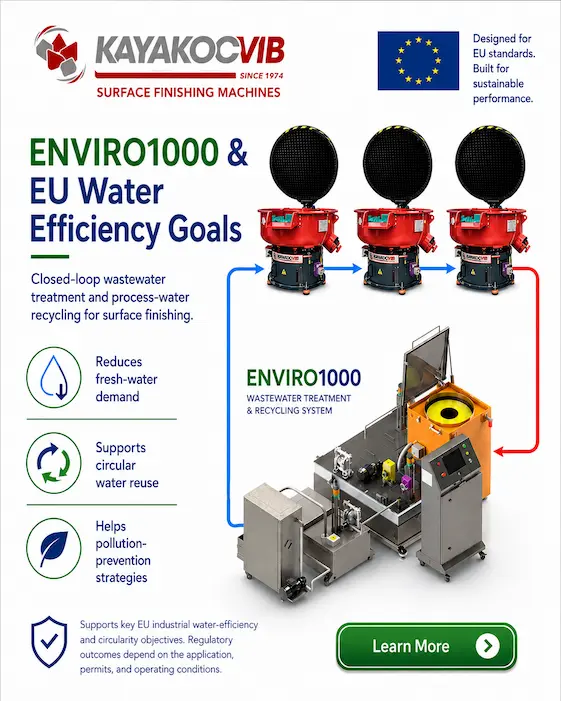
One of the primary engineering benefits of the ENVIRO1000 wastewater treatment system is the ability to implement closed-loop or partially closed-loop water reuse. After centrifugal treatment and clarification, the recovered water retains a residual concentration of active compound. In many finishing operations, this treated water can be returned directly to the finishing machine reservoir rather than being discharged.
Closed-loop reuse reduces fresh water consumption, reduces the volume of effluent requiring disposal, and reduces compound consumption because residual actives are retained in the recycled water. In high-volume finishing operations, the reduction in daily water and compound usage can be substantial, though actual savings depend on the specific machine type, process chemistry, and production volume. Water reuse feasibility must be confirmed by monitoring treated water quality against the process requirements for each application.
In operations where full recirculation is not possible due to dissolved salt buildup or contamination accumulation, a partial bleed-and-feed approach is used. A defined fraction of treated water is discharged and replaced with fresh water, maintaining the quality of the circulating process water within acceptable limits.
Solids Management and Sludge Handling
Solids separated by the ENVIRO1000 centrifuge are discharged as a moist compacted sludge. The dry solids content of this sludge is significantly higher than what is achievable with gravity settlement, which reduces the volume and weight of material that must be handled and disposed of. The sludge contains a mixture of metallic fines, abrasive particles, and dewatered compound residues.
Depending on the base metals processed, the sludge may be classified as hazardous industrial waste requiring licensed disposal, or it may be suitable for recycling through metal recovery services. Operations finishing steel and stainless steel may find that metallic sludge has scrap recovery value. Operations finishing aluminum or mixed metals should confirm the regulatory classification of the sludge before arranging disposal routes.
Sludge discharge frequency depends on the solids loading rate of the finishing operation. High-volume operations with aggressive deburring cycles generate more solids than light polishing or burnishing operations. The ENVIRO1000 system can be configured for manual sludge removal or for automatic discharge cycles depending on the required production continuity.
System Integration with Finishing Lines
The ENVIRO1000 wastewater treatment system is designed for integration alongside industrial finishing lines rather than as a standalone end-of-pipe treatment unit. Process water from one or more finishing machines is fed continuously to the treatment system. Treated water is returned to the machine reservoirs. Solids are collected in a sludge container. Chemical dosing systems maintain the conditioning program automatically based on flow rate and effluent quality monitoring.
In automated finishing lines that include vibratory finishing machines, separation equipment, washing stations, and drying units, the wastewater treatment system forms the utility backbone of the wet process section. KAYAKOCVIB designs integrated finishing lines that combine KVM series circular vibratory machines or TVM series trough machines with the ENVIRO1000 or related systems such as the FLOG flocculation unit and the SDM-T sludge dewatering module to handle the full water and solids balance of the operation.
The FLOG system is used when flocculation and gravity clarification is the primary treatment approach, typically for lower-flow or lower-solids applications. The SDM-T sludge dewatering module is used when the separated sludge requires further dewatering before disposal. These systems can be used independently or combined with the centrifugal ENVIRO1000 treatment stage depending on the effluent volume, solids loading, and site discharge requirements.
Key Process Parameters for ENVIRO1000 Operation
Effective operation of the ENVIRO1000 centrifugal wastewater treatment system depends on controlling several process variables. Flow rate must remain within the rated capacity of the centrifuge to ensure adequate residence time for solids separation. Exceeding the rated flow rate reduces separation efficiency and increases solids carryover into the treated water.
Chemical dosage must be calibrated to the effluent characteristics. Under-dosing flocculant leads to inadequate particle aggregation and poor separation. Over-dosing creates excess chemical residue in the treated water that may interfere with the finishing process chemistry. Dosing pumps should be set based on initial jar testing and adjusted periodically as the process chemistry changes.
Bowl cleaning frequency directly affects separation performance. As the sludge cake builds on the bowl wall, the effective separation volume decreases and the centrifuge efficiency drops. Discharge cycles should be set to maintain consistent cake thickness within the design limits of the machine. Automated discharge systems improve consistency compared to manual operator-dependent cleaning schedules.
| Parameter | Engineering Consideration | Impact on Performance |
|---|---|---|
| Inlet flow rate | Must not exceed rated centrifuge capacity | Overload reduces solids capture efficiency |
| Flocculant dosage | Calibrate to effluent solids and chemistry | Incorrect dosage reduces clarification quality |
| pH adjustment | Target neutral to slightly alkaline range for most applications | pH affects particle charge and floc formation |
| Sludge discharge cycle | Set based on solids loading rate | Excessive cake buildup reduces bowl capacity |
| Treated water quality monitoring | Turbidity or TSS measurement | Confirms separation performance before reuse |
Comparison with Alternative Treatment Approaches
Gravity settlement tanks are the simplest alternative to centrifugal treatment. They require no mechanical energy for separation but are limited by particle size and density. Very fine metallic particles and abrasive fines may remain suspended for hours in a gravity tank, requiring large tank volumes to achieve acceptable clarification. Gravity settlement is generally suitable only for lower-flow applications with coarser solids and is less effective for finishing effluents containing fine colloidal particles or emulsified oils.
Filter press systems can achieve high solids dryness but require significant capital investment, larger footprint, and more intensive maintenance than centrifugal systems. They are well suited to high-volume operations where maximum sludge dewatering is required. In many finishing operations, a centrifugal unit such as the ENVIRO1000 provides a practical balance of separation efficiency, footprint, and operating cost without the complexity of a full filter press installation.
Membrane filtration and ultrafiltration systems provide high treated water quality but have higher capital and maintenance costs and require careful management of membrane fouling from oils and solids. They are typically used in operations with strict treated water quality requirements or where water reuse standards are demanding. For most standard mass finishing operations, centrifugal treatment combined with chemical conditioning provides adequate water quality for recirculation without the operational complexity of membrane systems.
Practical Implementation Considerations
Before installing an ENVIRO1000 wastewater treatment system, the site water balance should be defined. This includes total process water volume, daily effluent generation rate, solids loading from the finishing process, oil input from incoming parts, and local discharge limits. These parameters determine the required treatment capacity, chemical dosing rates, and sludge handling requirements.
Operators should be trained to monitor treated water quality, check chemical inventory, and manage sludge discharge routines. Consistent operation is important because the treatment system supports the entire water supply for the finishing line. Unplanned downtime of the treatment system can interrupt finishing machine operation if treated water reserves are limited.
Process changes such as switching to a new finishing compound, changing the base metal being processed, or modifying machine cycle parameters can alter the effluent characteristics significantly. Any major process change should be followed by a reassessment of the chemical conditioning program to maintain treatment effectiveness.
Frequently Asked Questions
What types of finishing operations benefit most from the ENVIRO1000 system?
Operations with high daily water volumes, fine metallic solids, emulsified oils, and stringent discharge requirements benefit most. Wet vibratory finishing, centrifugal disc finishing, and drag finishing operations are typical applications.
Can the treated water from the ENVIRO1000 be reused directly in the finishing machine?
In many cases, yes. Treated water retains residual compound activity and can be recirculated. However, treated water quality must be monitored to confirm it meets the process requirements of the specific finishing application before full closed-loop reuse is implemented.
What is the difference between the ENVIRO1000, FLOG, and SDM-T systems?
The ENVIRO1000 is a centrifugal separation unit for continuous solids and oil removal from finishing effluent. The FLOG is a flocculation and gravity clarification system suited to lower-flow applications. The SDM-T is a sludge dewatering module that further reduces the moisture content of separated sludge before disposal. These systems can be used independently or combined depending on the application requirements.
How often does the centrifuge bowl need to be cleaned?
Cleaning frequency depends on the solids loading rate of the finishing operation. High-volume aggressive deburring operations may require more frequent discharge cycles than light polishing operations. Automatic discharge configurations reduce the operator dependency of this maintenance task.
Related Process Equipment
Conclusion
ENVIRO1000 wastewater treatment is an engineered response to the specific effluent management requirements of industrial surface finishing operations. Centrifugal separation, combined with chemical conditioning, flocculation, and pH adjustment, provides consistent solids removal, oil separation, and water clarification that gravity settlement alone cannot achieve. Closed-loop water reuse reduces operational costs and environmental impact, provided the treated water quality is validated against the finishing process requirements. For operations processing steel, stainless steel, aluminum, or mixed metals through wet finishing machines, integrating a centrifugal wastewater treatment system into the finishing line is an engineering decision that directly affects both process sustainability and site compliance. System selection between the ENVIRO1000, FLOG, and SDM-T configurations should be based on the specific effluent volume, solids loading, oil content, and local discharge or reuse requirements of each installation.
Sorry, the comment form is closed at this time.