



04 Jul Deburring Titanium Aerospace Parts
Deburring titanium aerospace parts presents a distinct set of engineering challenges that separate titanium finishing from standard CNC part deburring. Titanium alloys such as Ti-6Al-4V are widely used in aerospace structural components, engine parts, brackets, housings, and fasteners because of their high strength-to-weight ratio, corrosion resistance, and thermal stability. However, these same properties make titanium difficult to machine and difficult to finish. Burrs generated during milling, turning, drilling, or EDM are often harder and more tenacious than those found on aluminum or steel parts, and the finishing process must achieve precise edge condition and surface quality without introducing contamination, thermal damage, or dimensional deviation.
In This Article
Why Titanium Requires a Dedicated Finishing Approach
Titanium’s mechanical properties directly affect how burrs form and how they respond to finishing processes. Ti-6Al-4V has a tensile strength in the range of 900 to 1100 MPa depending on heat treatment condition, and its low thermal conductivity means heat generated during machining or finishing concentrates at the workpiece surface. This creates a risk of work hardening, smearing, or surface discoloration if the finishing process applies excessive heat or contact pressure without adequate compound cooling and lubrication.
Unlike aluminum, titanium is also susceptible to contamination from ferrous particles. Cross-contamination from iron or steel media, tools, or fixtures can lead to surface corrosion in service, which is unacceptable for flight-critical components. This means media selection, machine cleanliness, and batch segregation are engineering requirements, not just quality preferences.
Aerospace production standards also typically require documented process control, edge radius consistency, and surface roughness within defined limits. These requirements make informal manual deburring insufficient for series production of titanium aerospace components.
Typical Parts, Defect Types, and Finishing Requirements
Titanium aerospace parts that commonly require deburring and edge rounding include structural brackets and clips, hydraulic manifold bodies, turbine blade platforms, compressor disc bores, fastener blanks, and precision housings. The defect types generated during machining vary by operation. Milling and pocket milling typically leave sharp corner burrs and micro-burrs along tool exit edges. Drilling creates exit burrs and raised edge lips. Turning can leave spiral burrs or sharp radii on shoulders. EDM wire cutting produces a recast layer and fine edge sharpness that must be relieved before part assembly or coating.
The required finishing result depends on the part function. Structural parts typically require consistent edge rounding with a defined radius range, controlled surface roughness on functional faces, and complete burr removal without dimensional change to critical features. Parts that will receive thermal spray coatings or PVD coatings may also require specific surface texture to promote adhesion. In all cases, the finishing process must be repeatable and documented for aerospace quality systems.
Recommended Process Route for Titanium Aerospace Finishing
The typical process route for deburring titanium aerospace parts in series production follows a defined sequence. Pre-cleaning removes machining oil, coolant residues, and chips before the part enters the finishing machine. This prevents contamination of the process media and helps the finishing compound work effectively. The main deburring and edge rounding stage uses a mass finishing or drag finishing machine with selected media and compound. A post-finishing wash removes compound residue and loose media fines from the part surface. Inspection and measurement confirm edge condition and surface quality before the part proceeds to the next operation.
For parts with complex geometry, blind holes, or intersecting bore features, an additional cleaning stage using pressure washing or ultrasonic cleaning may be required to remove media fragments or compound from inaccessible areas. Media lodging in small holes is a known risk with certain media sizes and must be addressed in the process design phase.
Machine Selection for This Application
The choice of finishing machine for deburring titanium aerospace parts depends on part size, geometry complexity, required surface quality, production volume, and the level of process control required.
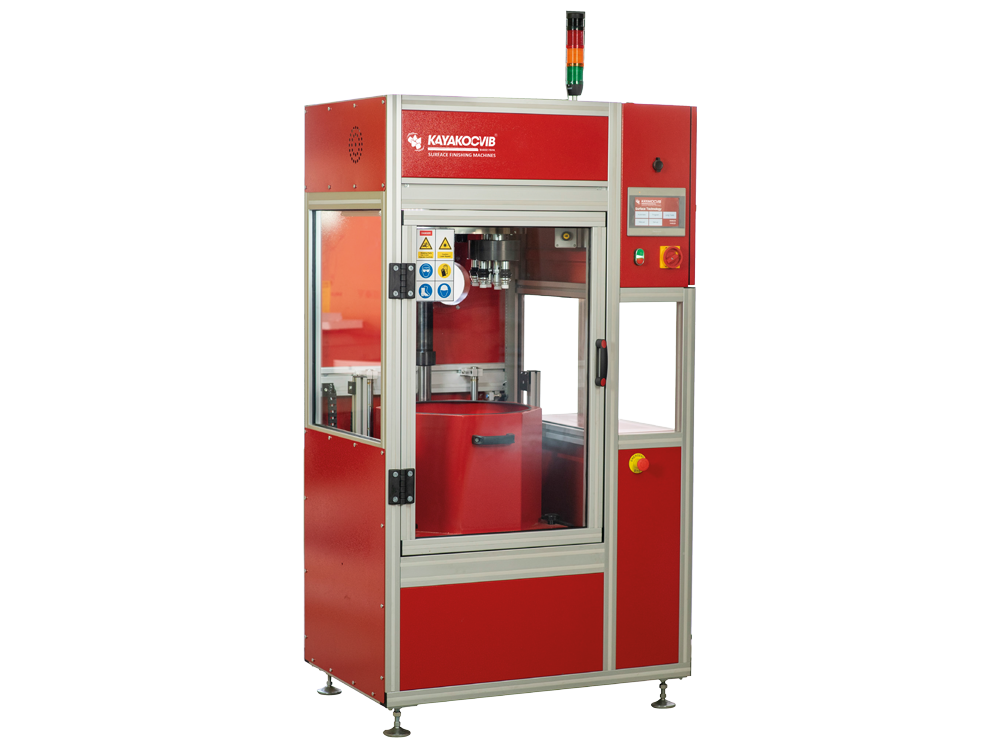
For small to medium precision titanium parts with tight dimensional tolerances and high surface quality requirements, centrifugal disc finishing machines are well suited. The centrifugal disc generates a toroidal flow pattern that produces high contact pressure between media and part, resulting in efficient burr removal and consistent edge rounding in shorter cycle times compared to conventional vibratory finishing. The KAYAKOCVIB KSM series centrifugal disc finishing machines are an example of this machine type, commonly used for aerospace precision parts where cycle time and surface consistency are both important. The high energy input of centrifugal disc machines also helps address titanium’s harder burr structure without requiring excessively abrasive media.
For larger titanium structural components, long profiles, or parts that cannot be batch-processed in a centrifugal machine, drag finishing machines provide a controlled alternative. In drag finishing, individual parts are fixtured and dragged through a media bed at controlled depth, speed, and angle. This approach allows precise control over contact geometry, which is valuable for parts where only selected surfaces or edges should be processed. The KAYAKOCVIB DRG drag finishing machine is designed for this type of application, where part orientation, immersion depth, and process parameters must be individually controlled for each component or part family.
Circular vibratory machines can be used for titanium deburring in lower-precision applications or for rough deburring stages prior to a secondary finishing operation, but they generally provide lower energy density than centrifugal disc machines and less geometric control than drag finishing. For aerospace applications with strict edge radius and surface requirements, centrifugal disc or drag finishing is typically the preferred process route.
Media and Compound Selection for Titanium
Media selection for deburring titanium aerospace parts must balance cutting ability, surface quality, contamination risk, and media durability. Titanium is harder than aluminum but softer than hardened steel, which places it in a range where medium-hardness ceramic media is generally effective for deburring. High-density ceramic media provides the contact pressure needed to address titanium’s harder burr structure while avoiding excessive surface scratching on functional faces.
Media shape must be matched to part geometry. For parts with complex pockets, angled bores, or narrow slots, pointed or cylindrical media shapes improve access to recessed areas. For open surfaces and external edge rounding, triangular or elliptical media shapes distribute contact evenly and reduce the risk of shape imprinting on soft or semi-finished surfaces.
Media size selection must also account for hole and slot dimensions on the part. Any media that could enter a bore or pocket must be larger than that feature to prevent lodging. This is a non-negotiable requirement for parts with intersecting bore networks or hydraulic passage geometry.
Compound selection for titanium finishing typically uses a neutral to mildly alkaline deburring and polishing liquid that provides lubrication, prevents media glazing, and keeps the machine clean without attacking titanium or leaving residues that complicate downstream cleaning. Acidic compounds should be avoided unless specifically validated, as they can react with titanium surfaces and affect passivation or coating adhesion. The compound concentration and flow rate must be controlled to maintain consistent cutting action and prevent media loading throughout the production run.
Process Parameters That Control Edge Quality
In centrifugal disc finishing of titanium aerospace parts, the parameters that most directly influence edge rounding and surface quality are disc rotation speed, media fill level, part load weight, cycle time, and compound flow rate. Higher disc speeds increase energy input and cutting rate, which can shorten cycle time but also increase the risk of part-to-part contact damage or media wear. The operating parameters must be established through sample testing on representative parts and confirmed by measurement before production release.
| Parameter | Effect on Process | Typical Adjustment Direction |
|---|---|---|
| Disc rotation speed | Controls energy input and cutting rate | Increase for harder burrs, reduce for delicate parts |
| Media fill level | Affects contact pressure and flow pattern | Higher fill increases coverage on complex geometry |
| Cycle time | Determines total material removal and edge radius | Extend for larger edge radius requirements |
| Compound flow rate | Controls lubrication and media cleaning | Increase if media glazing or discoloration occurs |
| Part load per batch | Affects part-to-part contact risk and media-to-part ratio | Reduce load for fragile or high-finish parts |
In drag finishing, additional parameters include immersion depth, drag path speed, and the number of passes per part. These parameters allow fine adjustment of the finishing result for each specific part geometry and edge condition. Because parts are individually fixtured, drag finishing also eliminates part-to-part contact risk, which is relevant for parts with very tight surface finish requirements or complex three-dimensional profiles.
Production Line Integration and Automation
For series production of titanium aerospace components, manual deburring is difficult to sustain from a quality consistency and production efficiency perspective. Automated finishing lines that integrate part loading, finishing, media separation, washing, and drying provide repeatable process control and reduce operator variability.
In an automated centrifugal disc finishing line, parts are loaded into the machine in defined batches, the process runs according to a stored program, and finished parts are discharged and passed to a separator that removes media before the parts proceed to a washing unit. For titanium parts that require clean surfaces for downstream coating or inspection, a pressure washing or ultrasonic cleaning unit after finishing ensures complete removal of compound residue and media fines.
Process documentation and traceability are important requirements in aerospace manufacturing. Automated finishing machines with programmable controllers allow process parameters to be stored, recalled, and logged for each part number. This supports quality management requirements and simplifies process validation activities when part designs or material lots change.
Surface Quality Control and Inspection
After finishing, titanium aerospace parts should be inspected for edge radius consistency, surface roughness on functional faces, and absence of remaining burrs on all required edges. Edge radius measurement is typically performed using optical measurement systems or contact profilometers, depending on the geometry and tolerance requirement. Surface roughness measurement uses profilometry, with Ra values checked against the drawing requirement.
Parts should also be inspected for media lodging, surface discoloration indicating heat, and any signs of corrosion or ferrous contamination. If cross-contamination from iron-containing media or fixtures is a risk, surface inspection under magnification or chemical spot testing may be required depending on the part’s application criticality.
Process validation for a new part or media change typically requires sample testing with a defined number of parts, measurement of all critical parameters, and sign-off before full production begins. This is standard practice in aerospace manufacturing and should be built into the finishing process qualification plan from the start.
Frequently Asked Questions
Can standard vibratory finishing machines be used for titanium aerospace parts?
Circular vibratory machines can perform basic deburring on titanium parts, but they typically provide lower energy density than centrifugal disc machines and less geometric control than drag finishing systems. For aerospace applications with strict edge radius, surface roughness, and contamination requirements, centrifugal disc or drag finishing is generally more suitable.
What media type should be avoided with titanium parts?
Steel shot or steel media should not be used with titanium parts due to ferrous contamination risk. Iron particles embedded in titanium surfaces can initiate corrosion in service. Only non-ferrous ceramic or plastic media that has been validated for titanium processing should be used, and media batches should be segregated to prevent cross-contamination from steel or iron part runs.
How is edge radius controlled during centrifugal disc finishing?
Edge radius is primarily controlled by cycle time, disc speed, and media selection. Longer cycle times produce larger edge radii. Process parameters must be established through sample testing and validated by measurement on production-representative parts. Actual achievable radius depends on part geometry, burr size, media type, and compound conditions.
What washing method is recommended after finishing titanium aerospace parts?
Pressure washing or ultrasonic cleaning is typically recommended after finishing titanium aerospace parts, particularly for parts with complex internal geometry, hydraulic passages, or coating preparation requirements. These methods effectively remove compound residue and media fines from recessed areas that spray rinsing alone may not reach.
Related Process Equipment
Related Video Demonstration
Conclusion
Deburring titanium aerospace parts is an engineering problem that requires matching the right machine type, media selection, and process parameters to the specific part geometry, burr condition, and surface quality requirement. Centrifugal disc finishing machines provide high energy density and consistent results for small to medium precision titanium parts, while drag finishing systems offer individual part control for complex or high-value components where contact geometry must be precisely managed. Media must be selected to avoid contamination risk, and compound chemistry must be compatible with titanium’s surface requirements for downstream operations. Production automation, process documentation, and validated inspection protocols are not optional in aerospace manufacturing but are core elements of any reliable finishing process for this application. The correct finishing solution for a specific titanium aerospace component should always be confirmed through sample testing and documented process validation before full production release.
Sorry, the comment form is closed at this time.