


27 Jun Choose Wastewater Treatment System
The decision to choose a wastewater treatment system for surface finishing machines is not simply a compliance requirement. It is an engineering decision that affects process reliability, compound performance, water reuse feasibility, and long-term operating cost. Vibratory finishing, centrifugal disc finishing, and other wet mass finishing processes generate effluent that contains suspended solids, metallic fines, spent compound, emulsified oils, and colloidal particles. Without an appropriately matched treatment system, this effluent cannot be discharged or reused, and the process becomes both environmentally and economically unsustainable.
In This Article
What Makes Finishing Wastewater Difficult to Treat
Finishing machine effluent differs from general industrial wastewater in composition and variability. The liquid discharged from a vibratory or centrifugal finishing system typically contains fine metallic particles from deburring and edge rounding, media wear particles, surfactant-based compounds, emulsified cutting fluids or oils carried in from upstream machining, and pH-adjusted process water. The particle size distribution is often broad, ranging from coarse sediment down to colloidal fines that resist gravity settling without chemical assistance.
The composition also changes depending on the workpiece material. Steel and iron finishing generates ferrous fines that are dense and settle relatively quickly. Aluminum and zinc alloy finishing produces lighter, slower-settling particles. Mixed-metal operations are the most challenging because particle behavior and chemical compatibility must be managed simultaneously. Any treatment system selection must account for this material variability from the outset.
Primary Selection Criteria
When engineers choose a wastewater treatment system, the evaluation must cover several interdependent factors. Effluent volume per shift is the starting point, but it is not the only dimension. The solids loading rate, oil contamination level, compound type, required discharge quality, and whether closed-loop water reuse is a target all influence which treatment technology is appropriate.
- Daily effluent volume generated by the finishing machines
- Suspended solids concentration and particle size range
- Oil and emulsified grease content from incoming parts
- Type and concentration of finishing compound used
- Target discharge standard or local regulatory limit
- Whether closed-loop water reuse is required
- Available floor space and maintenance resource
- Number of finishing machines connected to the system
These criteria interact. A high oil content, for example, may require a dedicated oil separation stage before flocculation can work effectively. A strict discharge limit may require a multi-stage treatment sequence rather than a single sedimentation tank. Understanding these interactions before selecting equipment prevents undersizing errors and avoids costly retrofits.
Treatment Technology Options and Their Suitability
Three primary treatment approaches are used in finishing machine applications: gravity sedimentation, chemical flocculation with sedimentation, and centrifugal or mechanical separation. Each has a defined range of suitability based on particle characteristics, required effluent quality, and system footprint.
| Technology | Particle Size Handled | Oil Removal | Water Reuse Suitability | Typical Application |
|---|---|---|---|---|
| Gravity Sedimentation | Coarse to medium | Partial surface skimming | Moderate, after settling | Low-volume, simple solids |
| Chemical Flocculation | Fine to colloidal | Good with coagulant assist | High, after clarification | Mixed metals, colloidal fines |
| Centrifugal Separation | Fine to very fine | Limited without separate stage | High throughput, compact | High-volume, space-constrained |
| Multi-Stage Combined | Full range | Best overall | Highest, near closed-loop | Automotive, high-compliance lines |
Gravity sedimentation systems such as the KAYAKOCVIB SDM-T sedimentation tank are appropriate for operations where particle size is predominantly coarse, effluent volume is moderate, and the suspended solids do not include significant colloidal fractions. These systems require minimal chemical addition and have low operating complexity, but they are not suitable when fine particles dominate or when strict discharge limits apply without downstream polishing.
Chemical flocculation systems add coagulant and flocculant reagents to the wastewater stream, causing fine and colloidal particles to aggregate into larger flocs that settle efficiently. The KAYAKOCVIB FLOG wastewater treatment system applies this principle with automated reagent dosing and controlled mixing, making it suitable for aluminum, mixed-metal, and high-compound-load operations where gravity settling alone would be ineffective. Flocculation systems require reagent management and sludge handling but can consistently achieve clarified water suitable for reuse or controlled discharge.
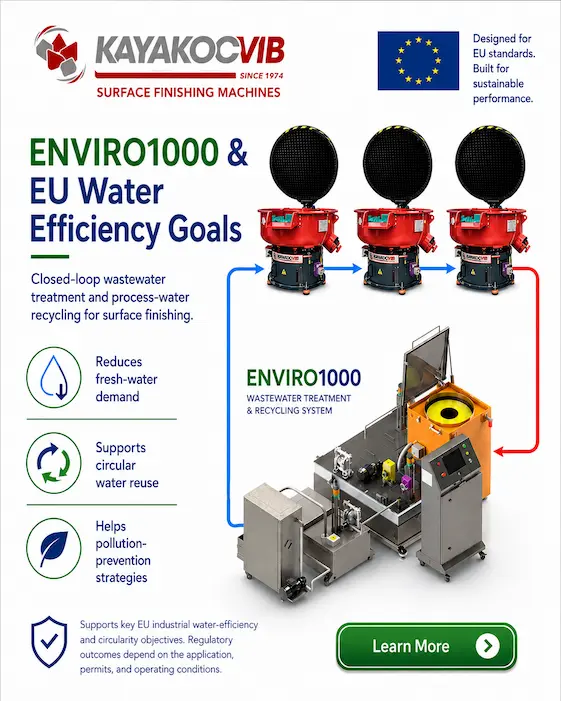
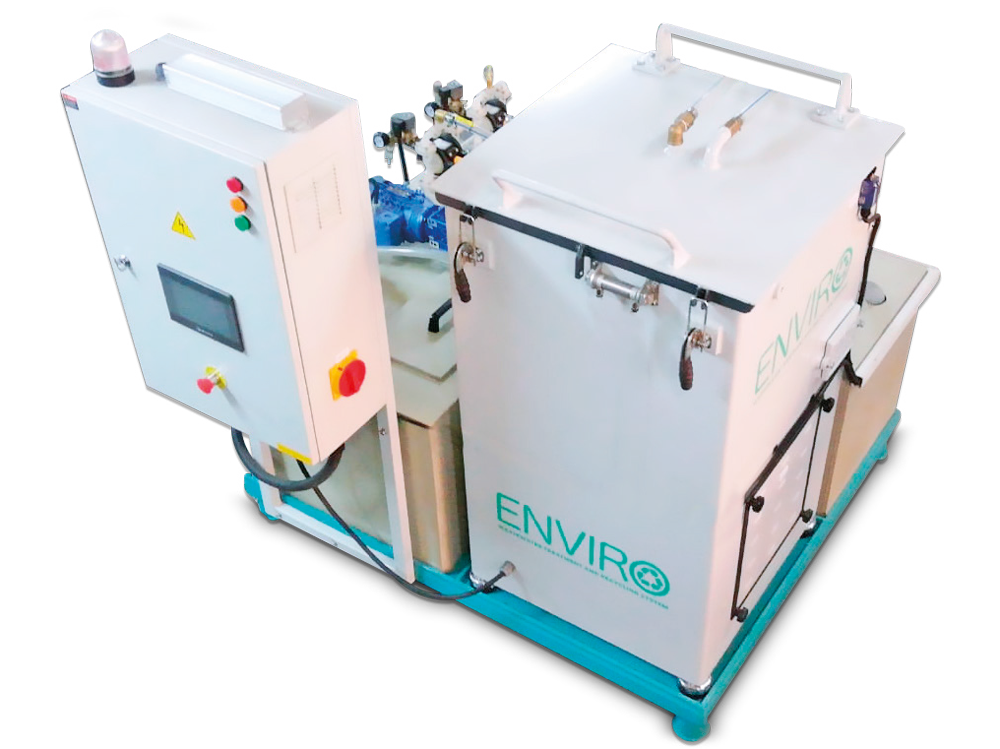
The KAYAKOCVIB ENVIRO1000 wastewater treatment system represents a higher-capacity configuration designed for closed-loop water reuse in continuous finishing operations. It combines solids separation, oil removal, and water recovery stages to return treated water back to the finishing machines, reducing freshwater consumption and compound dosing requirements. This configuration is well suited to automotive component lines, CNC machined part finishing, and any production environment where wastewater discharge is restricted or freshwater cost is a significant factor.
Matching System Capacity to Machine Output
A common engineering error is sizing the treatment system based on peak instantaneous flow rather than actual average effluent generation rate. Finishing machines do not discharge at a constant rate. Effluent is generated during the process cycle, and the treatment system must be able to process accumulated volume during the available treatment window, which may differ from the machine operating schedule.
The correct approach is to calculate total effluent volume per shift per machine, multiply by the number of connected machines, and add a design margin of at least twenty to thirty percent to account for compound flush cycles, media cleaning operations, and future machine additions. Undersized treatment capacity leads to overflow accumulation, process interruption, and degraded water quality returning to the machine.
For multi-machine installations in automotive or high-volume CNC machining environments, a centralized treatment system with buffer tank capacity is often more efficient than individual treatment units per machine. Centralized systems reduce reagent cost, simplify monitoring, and allow consistent water quality management across the entire finishing line.
Closed-Loop Water Reuse Logic
Closed-loop water reuse is achievable when the treatment system consistently delivers clarified water with suspended solids below a threshold that will not interfere with compound activity or cause abrasive wear in pump components. The exact threshold depends on the finishing process, compound type, and machine design, and must be validated through water quality monitoring during commissioning.
For vibratory finishing operations running 085-series deburring compounds on aluminum parts or 943-series compounds on steel parts, the reused water must not carry residual flocculant concentrations that would interfere with compound pH or foaming behavior. This means compound compatibility with the treatment chemistry must be confirmed before committing to a closed-loop configuration. In most cases, standard finishing compounds used within their recommended concentration ranges are compatible with properly treated recirculated water, but this must be verified on a case-by-case basis.
Oil content in recirculated water is a particular concern when parts arrive at the finishing machine with residual cutting fluid or stamping lubricant. If oil is not adequately removed, it accumulates in the process water, reduces compound effectiveness, and can cause surface staining or inconsistent finishing results. Oil separation should be included as a treatment stage whenever parts carry significant hydrocarbon contamination from upstream processes.
How to Choose a Wastewater Treatment System: Decision Checklist
The following checklist reflects the engineering decision sequence recommended for selecting an appropriate treatment configuration. It is not a rigid specification, but a structured evaluation framework that helps avoid common selection errors.
- Quantify total daily effluent volume from all connected finishing machines.
- Characterize the suspended solids: particle size, density, and metallic composition.
- Assess oil and emulsified grease content based on incoming part condition.
- Identify the applicable discharge standard or confirm that closed-loop reuse is the target.
- Determine whether the finishing compound chemistry is compatible with planned treatment reagents.
- Select the primary treatment technology based on particle characteristics and effluent quality requirement.
- Size the system with a twenty to thirty percent capacity margin over calculated peak load.
- Confirm sludge handling and disposal logistics before equipment procurement.
- Validate treated water quality through pilot testing before committing to closed-loop operation.
- Define monitoring frequency for suspended solids, pH, oil content, and compound concentration in recirculated water.
Common Selection Mistakes
Selecting a gravity sedimentation tank for an operation that produces predominantly fine or colloidal particles is one of the most frequent errors. The tank fills with unsettled fines, effluent quality remains poor, and the system fails to meet discharge requirements. This often happens when the treatment system is selected based on machine volume alone without particle characterization.
Another common mistake is ignoring oil contamination during the selection phase. If incoming parts carry significant cutting oil, and the treatment system has no oil removal stage, oil accumulates in the process loop. Over time this degrades compound performance, creates surface quality problems, and may cause foaming that disrupts the vibratory finishing process.
Underestimating sludge generation rate is also problematic. Flocculation-based systems produce sludge that must be dewatered and disposed of. If sludge handling logistics are not planned before installation, the system can become a bottleneck. For high-volume operations, a filter press or sludge dewatering unit should be evaluated as part of the overall treatment package.
Frequently Asked Questions
Can one wastewater treatment system serve multiple finishing machines?
Yes. A centralized treatment system with appropriate buffer tank capacity can serve multiple machines. This approach reduces capital and operating cost compared to individual units per machine, and simplifies water quality monitoring. The system must be sized for the combined peak effluent load from all connected machines plus a design margin.
How do I know if my finishing compound is compatible with closed-loop treated water?
Compound suppliers can advise on compatibility with common treatment reagents. In practice, most industrial finishing compounds used at standard concentrations are compatible with properly treated recirculated water. Validation through water quality analysis and trial runs during commissioning is strongly recommended before establishing permanent closed-loop operation.
What solids concentration is acceptable in recirculated water?
Acceptable suspended solids concentration in recirculated finishing water depends on the process and machine type. Most vibratory finishing operations can tolerate moderate residual solids if compound performance is not affected. However, specific thresholds must be determined during commissioning through monitoring and process observation. There is no single universal limit applicable to all finishing applications.
Is chemical flocculation necessary for aluminum finishing wastewater?
In most cases, yes. Aluminum and zinc alloy finishing generates fine, low-density particles that do not settle efficiently under gravity alone. Flocculation aggregates these particles into settleable flocs and is typically necessary to achieve water clarity suitable for reuse or compliant discharge.
Related Process Equipment
Conclusion
The process to choose a wastewater treatment system for finishing machines requires a structured engineering evaluation that goes beyond simply matching tank volume to machine size. Particle characteristics, oil content, compound compatibility, discharge requirements, and water reuse targets must all be assessed together before a technology can be selected. Gravity sedimentation works well for coarse-particle, low-complexity effluent. Flocculation-based systems are necessary when fine or colloidal particles are present. Combined multi-stage systems, such as the KAYAKOCVIB ENVIRO1000, are appropriate when closed-loop water reuse is the operational target in high-volume or environmentally constrained production environments. Matching system capacity correctly, planning sludge handling from the outset, and validating treated water quality during commissioning are the practical steps that determine whether a treatment system delivers reliable long-term performance.
Sorry, the comment form is closed at this time.